Why Pope Leo’s Visit To Turkey Is Important – Analysis
 Pope Leo XIV addresses bishops, priests, religious, pastoral workers, and laypeople at the Cathedral of the Holy Spirit in Istanbul, Turkey, on Nov. 28, 2025. | Credit: Vatican Media
November 29, 2025
Arab News
By Dr. Sinem Cengiz
Pope Leo XIV’s much-anticipated visit to Turkiye — his first official foreign trip as pontiff — has both diplomatic and religio-historic importance.
Paul VI became the first pope to visit Turkey in 1967, following the establishment of relations between the Holy See and Ankara seven years earlier. This is the fifth papal visit since that landmark trip.
Leo arrived in Turkiye on Thursday and will stay until Sunday, with a busy itinerary. Traditionally, papal visits to Turkiye have had two main stops: Ankara and Istanbul. In Ankara, meetings with officials are held, in which discussions mainly focus on regional and international humanitarian issues. While in Istanbul, meetings are held with religious figures and community members.
In this visit, Ankara was the pope’s first stop. There, he visited Anitkabir, the mausoleum of Mustafa Kemal Ataturk, the founder of modern Turkiye, and was then welcomed with an official ceremony at the Presidential Complex by President Recep Tayyip Erdogan.
Leo’s visit serves several purposes. While Turkiye is a Muslim-majority country, it is also home to the Ecumenical Patriarch Bartholomew I, who is considered the spiritual leader of the Eastern Orthodox Church. His headquarters are in Istanbul. The first purpose of the visit is to send a unification message regarding Catholic-Orthodox relations.
In addition, Turkiye is considered by the Vatican as a significant geopolitical actor that plays a key role in regional crises. Thus, the second purpose of the visit focuses on Turkiye-Vatican relations, which have seen improvement of late, particularly in the context of the Russia-Ukraine conflict and the Gaza war.
The Vatican has expressed appreciation for Turkiye’s efforts to mediate between Russia and Ukraine. Although the Holy See has also attempted to broker a ceasefire between Kyiv and Moscow, those initiatives have so far failed. In addition, the war in Gaza has intensified diplomatic traffic between the Holy See and Ankara. Erdogan and the late Pope Francis held several phone calls on the Gaza war. The Holy See has particularly drawn international attention with its stance on the plight of the Palestinians, an issue also of deep sensitivity to Turkiye.
The last papal visit to Turkiye took place in 2014, continuing the tradition of popes visiting the country in the early years of their tenures. During his 2014 visit, Francis visited the Hagia Sophia, then a museum before it was converted to a mosque in 2020, and the Sultanahmet Mosque, known as the Blue Mosque, where his prayer was widely seen as a gesture of interfaith dialogue and a symbol of strengthening Catholic-Muslim relations. Leo’s itinerary includes only the Blue Mosque. In 2014, Francis was warmly welcomed by the Turkish public and a similar atmosphere surrounds this visit. Souvenirs and posters featuring a portrait of Leo alongside the Turkish flag have been prepared.
Overseas trips are considered an important part of the Holy See’s soft power, giving the pope the opportunity to meet leaders, engage with Christian communities and draw global media attention to regional issues. During his visit to Turkiye, Leo is expected to focus on continued efforts toward Catholic-Orthodox reconciliation, strengthen dialogue between Christians and Muslims, raise concerns over regional issues, and support local Christian communities.
There have been reports that the pope is likely to raise the possible reopening of a Greek Orthodox religious seminary in Turkiye, known as Heybeliada school, which was closed in 1971 following a Constitutional Court ruling that private higher education institutions must be affiliated with state universities. The seminary, founded in 1844, is a symbol of Orthodox heritage and it trained generations of Greek Orthodox patriarchs, including Bartholomew.
Turkiye has long faced pressure from the US and EU to reopen it. Optimism grew after US President Donald Trump discussed the issue with Erdogan at the White House in September. Erdogan reportedly told Trump at their meeting that “we are ready to do whatever is incumbent upon us regarding the Heybeliada school.”
However, the central purpose of Leo’s Turkiye trip is to mark the 1,700th anniversary of the First Council of Nicaea, Christianity’s first ecumenical council, which was held in 325 A.D. in today’s Iznik, in the northwestern Turkish province of Bursa. The pope will pray with Bartholomew toward the ruins of the Basilica of St. Neophytos and sign a joint declaration as a symbolic gesture of Christian unity. According to reports, 15,000 Christians are expected to attend the ceremony in Iznik.
Data from the Catholic Church states that about 33,000 Catholics currently live in Turkiye. The meeting between Leo and Bartholomew is considered an important step for the convergence of the Catholic and Orthodox churches. The pope is also scheduled to perform a prayer service to an estimated 4,000 people at the Volkswagen Arena in Istanbul. Leo has also met the head of Turkiye’s Presidency of Religious Affairs and the country’s chief rabbi.
Within this context, the pope’s first overseas visit being to Turkiye comes as no surprise. It is both a papal tradition and a deliberate choice. Turkiye is a mosaic of faiths, home to Muslims, Christians, Jews and other religious minorities. It also hosts religious archaeological sites, making the country particularly important in the eyes of other communities. The timing of the visit is also important, as it comes when greater reconciliation is needed. Leo hopes to foster stronger Turkiye-Vatican relations, while also encouraging a united moral stance toward crises from Gaza to Ukraine.

November 29, 2025
Arab News
By Dr. Sinem Cengiz
Pope Leo XIV’s much-anticipated visit to Turkiye — his first official foreign trip as pontiff — has both diplomatic and religio-historic importance.
Paul VI became the first pope to visit Turkey in 1967, following the establishment of relations between the Holy See and Ankara seven years earlier. This is the fifth papal visit since that landmark trip.
Leo arrived in Turkiye on Thursday and will stay until Sunday, with a busy itinerary. Traditionally, papal visits to Turkiye have had two main stops: Ankara and Istanbul. In Ankara, meetings with officials are held, in which discussions mainly focus on regional and international humanitarian issues. While in Istanbul, meetings are held with religious figures and community members.
In this visit, Ankara was the pope’s first stop. There, he visited Anitkabir, the mausoleum of Mustafa Kemal Ataturk, the founder of modern Turkiye, and was then welcomed with an official ceremony at the Presidential Complex by President Recep Tayyip Erdogan.
Leo’s visit serves several purposes. While Turkiye is a Muslim-majority country, it is also home to the Ecumenical Patriarch Bartholomew I, who is considered the spiritual leader of the Eastern Orthodox Church. His headquarters are in Istanbul. The first purpose of the visit is to send a unification message regarding Catholic-Orthodox relations.
In addition, Turkiye is considered by the Vatican as a significant geopolitical actor that plays a key role in regional crises. Thus, the second purpose of the visit focuses on Turkiye-Vatican relations, which have seen improvement of late, particularly in the context of the Russia-Ukraine conflict and the Gaza war.
The Vatican has expressed appreciation for Turkiye’s efforts to mediate between Russia and Ukraine. Although the Holy See has also attempted to broker a ceasefire between Kyiv and Moscow, those initiatives have so far failed. In addition, the war in Gaza has intensified diplomatic traffic between the Holy See and Ankara. Erdogan and the late Pope Francis held several phone calls on the Gaza war. The Holy See has particularly drawn international attention with its stance on the plight of the Palestinians, an issue also of deep sensitivity to Turkiye.
The last papal visit to Turkiye took place in 2014, continuing the tradition of popes visiting the country in the early years of their tenures. During his 2014 visit, Francis visited the Hagia Sophia, then a museum before it was converted to a mosque in 2020, and the Sultanahmet Mosque, known as the Blue Mosque, where his prayer was widely seen as a gesture of interfaith dialogue and a symbol of strengthening Catholic-Muslim relations. Leo’s itinerary includes only the Blue Mosque. In 2014, Francis was warmly welcomed by the Turkish public and a similar atmosphere surrounds this visit. Souvenirs and posters featuring a portrait of Leo alongside the Turkish flag have been prepared.
Overseas trips are considered an important part of the Holy See’s soft power, giving the pope the opportunity to meet leaders, engage with Christian communities and draw global media attention to regional issues. During his visit to Turkiye, Leo is expected to focus on continued efforts toward Catholic-Orthodox reconciliation, strengthen dialogue between Christians and Muslims, raise concerns over regional issues, and support local Christian communities.
There have been reports that the pope is likely to raise the possible reopening of a Greek Orthodox religious seminary in Turkiye, known as Heybeliada school, which was closed in 1971 following a Constitutional Court ruling that private higher education institutions must be affiliated with state universities. The seminary, founded in 1844, is a symbol of Orthodox heritage and it trained generations of Greek Orthodox patriarchs, including Bartholomew.
Turkiye has long faced pressure from the US and EU to reopen it. Optimism grew after US President Donald Trump discussed the issue with Erdogan at the White House in September. Erdogan reportedly told Trump at their meeting that “we are ready to do whatever is incumbent upon us regarding the Heybeliada school.”
However, the central purpose of Leo’s Turkiye trip is to mark the 1,700th anniversary of the First Council of Nicaea, Christianity’s first ecumenical council, which was held in 325 A.D. in today’s Iznik, in the northwestern Turkish province of Bursa. The pope will pray with Bartholomew toward the ruins of the Basilica of St. Neophytos and sign a joint declaration as a symbolic gesture of Christian unity. According to reports, 15,000 Christians are expected to attend the ceremony in Iznik.
Data from the Catholic Church states that about 33,000 Catholics currently live in Turkiye. The meeting between Leo and Bartholomew is considered an important step for the convergence of the Catholic and Orthodox churches. The pope is also scheduled to perform a prayer service to an estimated 4,000 people at the Volkswagen Arena in Istanbul. Leo has also met the head of Turkiye’s Presidency of Religious Affairs and the country’s chief rabbi.
Within this context, the pope’s first overseas visit being to Turkiye comes as no surprise. It is both a papal tradition and a deliberate choice. Turkiye is a mosaic of faiths, home to Muslims, Christians, Jews and other religious minorities. It also hosts religious archaeological sites, making the country particularly important in the eyes of other communities. The timing of the visit is also important, as it comes when greater reconciliation is needed. Leo hopes to foster stronger Turkiye-Vatican relations, while also encouraging a united moral stance toward crises from Gaza to Ukraine.
Dr. Sinem Cengiz is a Turkish political analyst who specializes in Turkiye’s relations with the Middle East. X: @SinemCngz
Arab News
Arab News is Saudi Arabia's first English-language newspaper. It was founded in 1975 by Hisham and Mohammed Ali Hafiz. Today, it is one of 29 publications produced by Saudi Research & Publishing Company (SRPC), a subsidiary of Saudi Research & Marketing Group (SRMG).
Arab News
Arab News is Saudi Arabia's first English-language newspaper. It was founded in 1975 by Hisham and Mohammed Ali Hafiz. Today, it is one of 29 publications produced by Saudi Research & Publishing Company (SRPC), a subsidiary of Saudi Research & Marketing Group (SRMG).
On the second day of his visit to Turkey, Pope Leo XIV joined Orthodox patriarchs on Friday in a commemoration ceremony at the site of the origin of the Nicaean Creed, a central Christian statement of belief that was adopted 1,700 years ago.
Issued on: 28/11/2025
By: FRANCE 24
Pope Leo XIV joined Eastern and Western patriarchs and priests Friday in commemorating an important anniversary in Christian history, gathering at the site in Turkey of an unprecedented A.D. 325 meeting of bishops to pray that Christians might once again be united.
Leo, Ecumenical Patriarch Bartholomew I and other Christian leaders met on the shores of Lake Iznik, the site of the Council of Nicaea that produced a creed, or statement of faith, that is still recited by millions of Christians today.
Standing over the ruins of the site, the men recited the creed, which Leo said was “of fundamental importance in the journey that Christians are making toward full communion.”
“In this way, we are all invited to overcome the scandal of the divisions that unfortunately still exist and to nurture the desire for unity for which the Lord Jesus prayed and gave his life,” he said.
Pope Leo meets Turkey's Erdogan and Orthodox leaders on first overseas trip
The 70-year-old pontiff spent Friday morning with Catholic leaders before going to Iznik to celebrate the 1,700th anniversary of the First Council of Nicaea, a gathering of bishops who drew up a foundational statement of faith still central to Christianity today.
The prayer marked the highlight of Leo's visit to Turkey and the main reason for his trip, the first of his pontificate.
The Nicaea gathering took place at a time when the Eastern and Western churches were still united. They split in the Great Schism of 1054, a divide precipitated largely by disagreements over the primacy of the pope. But even today, Catholic, Orthodox and most historic Protestant groups accept the Nicaean Creed, making it a point of agreement and the most widely accepted creed in Christendom.
As a result, celebrating its origins at the site of its creation with the spiritual leaders of the Catholic and Orthodox churches and other Christian representatives marked a historic moment in the centuries-old quest to reunite all Christians.
“The Nicene Creed acts like a seed for the whole of our Christian existence. It is a symbol not of a bare minimum; it is a symbol of the whole,” said Bartholomew, spiritual leader of the world's Orthodox Christians.
At the start of the prayer service, he told the men they were gathering not just to remember the past.
© France 24
01:34
01:34
“We are here to bear living witness to the same faith expressed by the fathers of Nicaea. We return to this wellspring of the Christian faith in order to move forward,” he said.
Roman Emperor Constantine had convened the gathering of bishops from around the Roman Empire after he had consolidated control following years of civil war and political intrigues.
Constantine wouldn’t formally convert to Christianity until the end of his life, in 337. But by 325, he had already been showing tolerance and favor toward a Christian sect that had emerged from the last great spasm of Roman persecution.
The version of the creed that emerged from the council, and recited today by Catholics, begins: “I believe in one God, the Father almighty … ”
Catholic and Orthodox hymns
The service commemoration, which featured alternating Catholic and Orthodox hymns, took place at the lakeside archaeological excavations of the ancient Basilica of Saint Neophytos. The stone foundations of the basilica, which were recently uncovered by the lake's receding waters, are believed to be on the site of an earlier church that hosted the council 1,700 years ago.
In addition to Leo and Bartholomew, the participants of the commemorative service included priests, patriarchs and bishops from Orthodox Greek, Syrian, Coptic, Malankarese, Armenian, Protestant and Anglican churches.
In his remarks to the men, Leo said all Christians must strongly reject the use of religion to justify war, violence “or any form of fundamentalism or fanaticism.”
“Instead, the paths to follow are those of fraternal encounter, dialogue and cooperation,” he said.
Small protest
Christians are a minority in predominantly Sunni Muslim Turkey, and ahead of the prayer in Iznik, around 20 members of a small Turkish Islamic party staged a brief protest. They said the encounter posed a threat to Turkey’s sovereignty and national identity.
Under a heavy police presence, Mehmet Kaygusuz, a member of the New Welfare Party, read a statement denouncing what he said were efforts to establish a “Vatican-like Greek Orthodox state” in Turkey. The group dispersed peacefully shortly after.
Iznik resident Suleyman Bulut, 35, acknowledged his town’s deep historical and spiritual significance for Christians and said he had no issue with them coming to honor their heritage.
“Muslims (too) should go and visit places that belong to us in the rest of the world, in Europe,” he said.
But Hasan Maral, a 41-year-old shopkeeper said he felt uncomfortable with visit. “The pope coming here feels contradictory to my faith,” he said.
'Viva il Papa'
Leo began his first full day in Istanbul by encouraging Turkey’s tiny Catholic community to find strength in their small numbers. According to Vatican statistics, Catholics number around 33,000 in a nation of 85 million, most of whom are Sunni Muslims.
He received a raucous welcome at the Cathedral of the Holy Spirit, where he was greeted with shouts of “Papa Leo” and “Viva il Papa” (Long Live the pope).
“The logic of littleness is the church’s true strength,” Leo told them in English. “The significant presence of migrants and refugees in this country presents the church with the challenge of welcoming and serving some of the most vulnerable.”
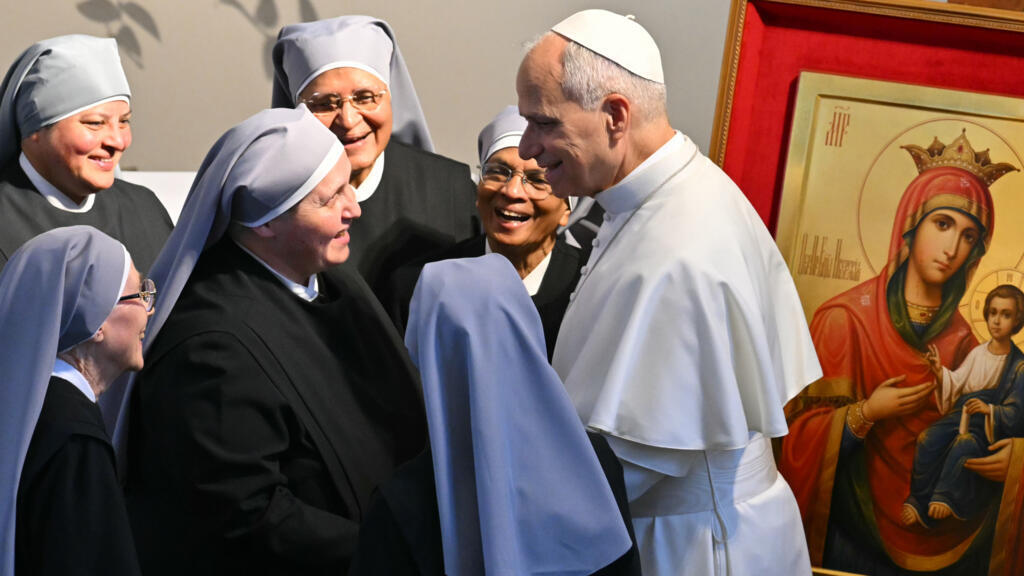
Leo later visited with a group of nuns, the Little Sisters of the Poor, who run a nursing home in Istanbul.
“He was so simple. We just felt he was at home. He felt very much at ease. Everybody got what they expected: a blessing, a kind word. It’s just enormous,” said Sister Margret of the Little Sisters of the Poor Nursing Home.
On Saturday, Leo continues with his ecumenical focus, meeting with Bartholomew and other Christian leaders. But he’ll also visit the Sultan Ahmed Mosque, commonly known as the Blue Mosque, and will celebrate a late afternoon Mass in Istanbul’s Volkswagen Arena.
Leo heads to Lebanon on Sunday for the second and final leg of his trip.
(FRANCE 24 with AP)
Pope to visit Istanbul's Blue Mosque
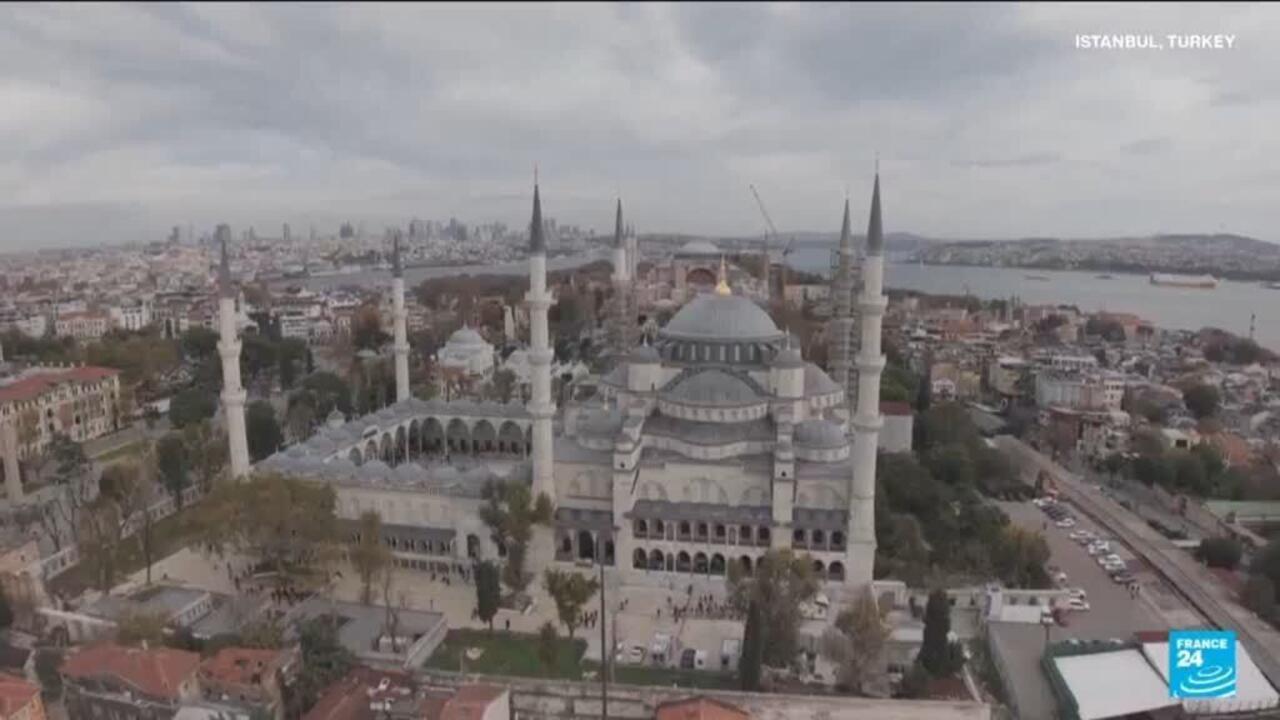
Istanbul (AFP) – Pope Leo XIV will visit Istanbul's famed Blue Mosque early on Saturday on the third day of his trip to Turkey.
Issued on: 29/11/2025 - RFI
Istanbul (AFP) – Pope Leo XIV will visit Istanbul's famed Blue Mosque early on Saturday on the third day of his trip to Turkey.
Issued on: 29/11/2025 - RFI
Pope Leo XIV is on a four-day visit to Turkey, the first overseas trip since he was elected as head of the world's 1.4 billion Catholics © Andreas SOLARO / AFP
It will be the first time the American pope, who was elected in May as leader of the world's 1.4 billion Catholics, visits a Muslim place of worship since taking over from his late predecessor Francis, who championed dialogue with Islam.
With such a highly symbolic gesture, Leo follows in the footsteps of Pope Benedict XVI, who visited the site in 2006, and Francis who did the same in 2014 accompanied by the Grand Mufti of Istanbul.
But unlike them, he will not be visiting the nearby Hagia Sophia, the legendary sixth-century basilica, which was built during the Byzantine Empire and converted into a mosque following the conquest of Constantinople in 1453.
In a key reform by post-Ottoman Turkish authorities led by Mustafa Kemal Ataturk, the Hagia Sophia became a museum in 1935. And 50 years later, it was declared a UNESCO World Heritage site.
But in 2020, it was converted back into a mosque in a move that drew international condemnation, including from the late Pope Francis who said he was "very saddened" by the decision of President Recep Tayyip Erdogan.
Critics have accused Erdogan and his Islamist-rooted AKP party of chipping away at the Muslim-majority country's secular pillars.
The Blue Mosque -- which gets its name from the vibrant blue Iznik tiles that line its interior -- is one of Istanbul's main tourist attractions.
With its six towering minarets, the mosque was built in the early 17th century during the reign of Sultan Ahmed I, on part of the former Hippodrome, a huge chariot-racing stadium that was a central feature of Constantinople when it was the Byzantine capital.
On Saturday afternoon, Leo will meet local church leaders and attend a brief service at the Patriarchal Church of St. George before joining Ecumenical Patriarch Bartholomew I at his palace on the banks of the Golden Horn estuary.
There, the two spiritual leaders will sign a joint declaration, the content of which has not yet been made public.
Later that same day, Leo will hold a mass at the city's Volkswagen Arena, where some 4,000 worshippers are expected to join him.
The pontiff flew to Iznik on Friday for an ecumenical prayer service to mark 1,700 years since one of the early Church's most important gatherings.
On Sunday morning, after a prayer service at the Armenian cathedral and leading a divine liturgy, the Orthodox equivalent of a mass, at St George's, he will head to Lebanon for the second leg of his trip -- his first overseas tour since being elected to the position.
© 2025 AFP
It will be the first time the American pope, who was elected in May as leader of the world's 1.4 billion Catholics, visits a Muslim place of worship since taking over from his late predecessor Francis, who championed dialogue with Islam.
With such a highly symbolic gesture, Leo follows in the footsteps of Pope Benedict XVI, who visited the site in 2006, and Francis who did the same in 2014 accompanied by the Grand Mufti of Istanbul.
But unlike them, he will not be visiting the nearby Hagia Sophia, the legendary sixth-century basilica, which was built during the Byzantine Empire and converted into a mosque following the conquest of Constantinople in 1453.
In a key reform by post-Ottoman Turkish authorities led by Mustafa Kemal Ataturk, the Hagia Sophia became a museum in 1935. And 50 years later, it was declared a UNESCO World Heritage site.
But in 2020, it was converted back into a mosque in a move that drew international condemnation, including from the late Pope Francis who said he was "very saddened" by the decision of President Recep Tayyip Erdogan.
Critics have accused Erdogan and his Islamist-rooted AKP party of chipping away at the Muslim-majority country's secular pillars.
The Blue Mosque -- which gets its name from the vibrant blue Iznik tiles that line its interior -- is one of Istanbul's main tourist attractions.
With its six towering minarets, the mosque was built in the early 17th century during the reign of Sultan Ahmed I, on part of the former Hippodrome, a huge chariot-racing stadium that was a central feature of Constantinople when it was the Byzantine capital.
On Saturday afternoon, Leo will meet local church leaders and attend a brief service at the Patriarchal Church of St. George before joining Ecumenical Patriarch Bartholomew I at his palace on the banks of the Golden Horn estuary.
There, the two spiritual leaders will sign a joint declaration, the content of which has not yet been made public.
Later that same day, Leo will hold a mass at the city's Volkswagen Arena, where some 4,000 worshippers are expected to join him.
The pontiff flew to Iznik on Friday for an ecumenical prayer service to mark 1,700 years since one of the early Church's most important gatherings.
On Sunday morning, after a prayer service at the Armenian cathedral and leading a divine liturgy, the Orthodox equivalent of a mass, at St George's, he will head to Lebanon for the second leg of his trip -- his first overseas tour since being elected to the position.
© 2025 AFP

No comments:
Post a Comment