Taiwan to manufacture 100,000 drones monthly by 2030
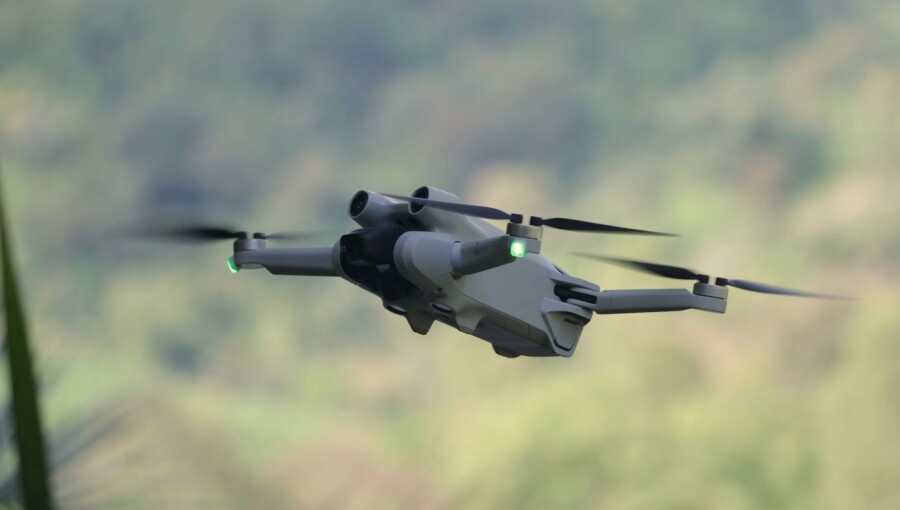
Taiwan projects its drone industry will expand massively to manufacture 100,000 units per month by 2030 and export half of them, the Ministry of Economic Affairs announced on May 21, Taipei Times reports.
The move highlights Taiwan's push to build a reliable, democratic hardware supply chain in Asia. This rapid capacity scaling aims to offer global buyers a secure alternative to Chinese tech amidst rising regional tensions.
Current assembly capabilities stand at 15,000 units monthly, but local factories can scale up quickly as market demand rises, Industrial Development Administration Director-General Chiou Chyou-huey told a press conference in Taipei on May 21.
Taiwanese drone output surged 2.5-fold last year to TWD12.9bn ($408.3mn) under a government investment programme for uncrewed vehicles, Chiou said.
The Executive Yuan approved a TWD44.2bn ($1.40bn) funding blueprint over six years to develop domestic uncrewed aerial hardware, targeting an output value above TWD40bn ($1.27bn) by 2030. If production value doubles to TWD26bn ($822.8mn) this year, the 2030 target could be revised upward, Chiou noted.
The domestic drone ecosystem currently relies on local purchase orders, with commercial-grade military hardware driving the bulk of manufacturing.
Outbound shipments account for just over 20% of total sales, led by the US, Poland and the Czech Republic.
International sales reached $147mn in the first four months of this year. Outbound shipments totalled $93mn last year, Chiou told a Cabinet press briefing on April 30.
Chinese consumer quadcopters hold a dominant price advantage due to massive manufacturing scale. However, the price gap narrows significantly for military-grade commercial systems where reliability, autonomous flight and anti-jamming features matter most, making Taiwan highly competitive, Chiou added.
According to Taipei Times, the XPONENTIAL 2026 uncrewed systems expo in Detroit drew significant interest from firms in the US, Japan, South Korea and Turkey for potential joint ventures, Chiou said.
The convention generated initial business prospects estimated at TWD1.3bn ($41.1mn) across optical modules, thermal imaging systems and flight software architectures.
Taiwan formalised memorandums of understanding with the Michigan Drone Association and the North Dakota Trade Office during the exhibition. These agreements focus on autonomous piloting, urban air mobility and shared testing facilities to help local enterprises access international validation and certification resources, Chiou concluded.
From conflict to cleaning, expo showcases China’s drone dominance
By AFP
May 21, 2026
Drone World Congress opened in the southern Chinese tech hub of Shenzhen - Copyright AFP HECTOR RETAMAL
Russians looking for drone interceptors brushed shoulders with entrepreneurs keen to see the latest industrial cleaning technology at a massive industry expo showcasing China’s dominance of the drone industry on Thursday.
Unmanned aerial vehicles of all sizes, antennaed detection devices and anti-jamming gadgets straight out of a science fiction movie were on display at the Drone World Congress as it opened in the southern Chinese tech hub of Shenzhen.
Chinese firms’ supremacy spans sleek new roles from agriculture and infrastructure to military applications.
The high-flying machines rely on small, powerful magnets and other key components that are widely available in China’s manufacturing ecosystem and unparalleled elsewhere in terms of efficiency and variety.
“When you need to get any component, you have hundreds of different options (in China),” said exhibitor Javier Balaguer from Spain-based business consulting and services firm Applus+ Laboratories.
“If you… have direct access to them, it will be much easier,” the 30-year-old drone specialist told AFP.
Over 1,200 companies were taking part in the expo, according to organisers, plying their wares to the tens of thousands of attendees there for a startling variety of motives.
One of the most high-profile uses of drones recently has been in warfare, with the machines featuring heavily in the Ukraine conflict.
Beijing says it supports legitimate civilian use of drone technology, and has implemented “dual-use” export controls to prevent weapons proliferation.
But the often-overlapping technologies for commercial and military purposes create a grey zone that is difficult to enforce — especially across borders.
One participant from Russia, who declined to provide his name or affiliation, told AFP he was at the Shenzhen expo to look for drone “interceptors”, without giving more details.
Several booths away, AFP spoke to three Ukrainians, including one who said drone technology has become an “everyday necessity” since the war began.
“China dominates the whole supply chain”, especially in certain magnetic parts that are difficult to source from within Ukraine, one of the men said, also declining to provide his name.
– Counter-drone tech trending –
AFP spoke to foreign attendees from the European Union, the Middle East and Southeast Asia on Thursday, drawn to Shenzhen’s prowess for everything from infrastructure maintenance and aerial monitoring to racing events.
Organisers said they expected this year’s attendance to be 150,000.
Applus+ Laboratories’ Balaguer told AFP that the scale of the event has multiplied each of the last three years he has attended.
This year, the new trend is counter-drone technology, he said.
The general manager of Chinese firm Yinyan General Aviation, Wu Yingjie, told AFP that her work involves the deployment of “drone countermeasures” along China’s international border.
Wu’s firm is based in the southwestern city of Nanning, less than 150 kilometres from Vietnam.
Drone countermeasure technologies have been used for detection, reconnaissance and combating unauthorised flights, she said.
“It was because of the Russia-Ukraine war that the world saw the drone countermeasures industry,” she added.
“Drones play a very important role in low-altitude security.”
– Seeking inspiration –
Among the busiest booths at the expo Thursday were those of China’s — and the world’s — industry champions.
DJI was one clear star of the show, its centrally positioned displays thronged with crowds of participants.
The Shenzhen-based firm, established in 2006, has held more than two thirds of the global commercial drone market in recent years, studies with varying estimates show.
Booths of less well-known companies showcased the diverse range of drone technologies available, including “anti-jamming” devices, “sound recognition”, “infrared thermal imaging” and “laser countermeasures”.
Others offered industrial applications like lifting heavy payloads, which could be used, for example, to string power lines on tall towers.
Luca Musiolik, CEO of Germany-based industrial drone firm DroneShine, told AFP that he was there to learn about the latest drone-powered industrial cleaning technologies.
“You don’t really have any competitors in Europe or any innovation coming out of Europe,” said Musiolik, 21.
“So we’re just really trying to get inspired by the technology, a bit like China did with the German car industry.”
Russian Patrol Ship Improvises Using Fencing to Protect Against Drones
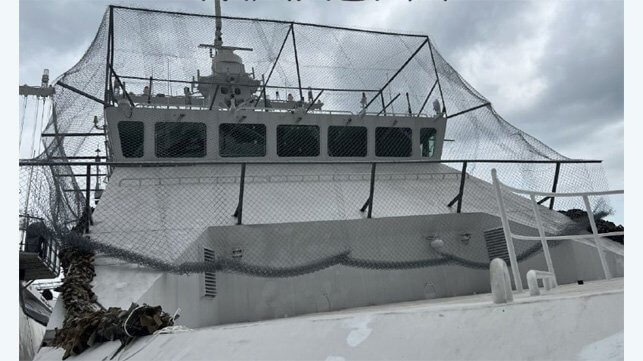
In the more than four years since Russia invaded Ukraine in an all-out war, Ukraine has become proficient in drone technology and has frequently reported its use of its systems to attack Russian warships and other critical infrastructure. Ukrainian media this week spotted photos posted on Russian social media showing an improvised solution to add protection to Russian patrol boats.
The pro-Russian site DVA Major posted pictures showing Russian patrol boats “covered in chain-link fencing!” It says that public funding was used to buy the material and that it has been applied to more than one patrol ship.
The area around the bridge was seen draped with the fencing. It has also been applied to the top of the superstructure.
“This solution isn't a panacea. It won't protect against all types of enemy ammunition. But if nothing is done, nothing will happen,” writes DVA Major.
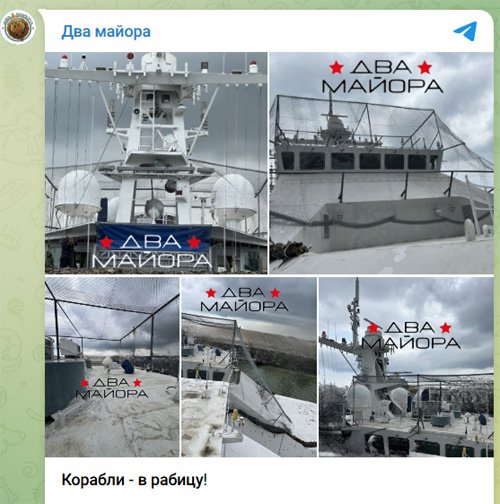
The Ukrainian site Militarnyi studied the pictures, and although the vessel was not named, it believes it has identified the class of ship. It says the structure around the bridge is unique to the Project 22460 patrol ship.
Russia commissioned the first of the vessels in 2009 and uses them for various coastal patrols. The media reports are that four of the vessels are currently based in Crimea, and two more are at Krasnodar Krai.
In February 2026, Ukraine's general staff said it had used drones to hit two border guard ships moored near the town of Inkerman in Crimea, at the easternmost end of Sevastopol Bay. The vessels damaged were Project 22460 Rubin-class fast patrol boats. Further, it was reported that Ukraine had targeted vessels of the same class in December 2025 in the Caspian Sea. Last weekend, Ukraine also reported hitting a different class of patrol ship in Crimea with drones.
.jpg)
Example of Project 22460 patrol ship - note the structure below the bridge -- Aleksandr Markin photo (CC BY-SA 2.0)
The 22460 patrol boats are fast, with a speed of 25 knots and 650 tons displacement. They are 62.5 meters (205 feet) in length, with reports that they have a crew of 20 and space for 14 additional people.
Other pictures were recently online of the Russian Project 21980 class, which is used for anti-sabotage operations. One of those vessels also appeared to have been fitted with a similar netting made of fencing to block drones.
It remains to be seen if it is judged an effective protection and if it will appear on other Russian ships.

No comments:
Post a Comment