The Indictment of Raúl Castro: A New Low in U.S. Cuba Policy
May 22, 2026
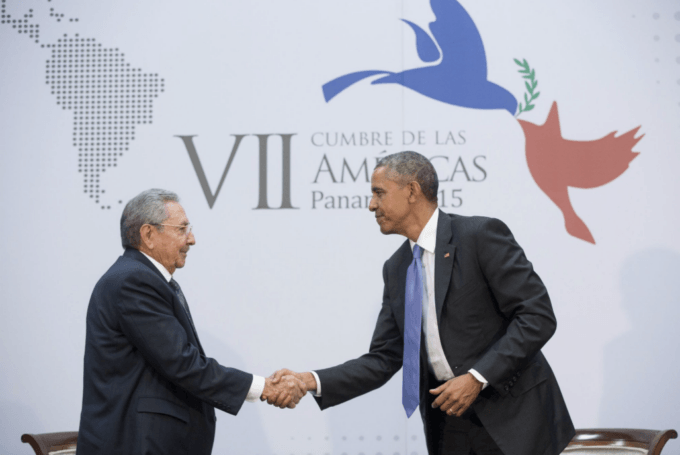
President Barack Obama meets with Cuban President Raúl Castro at the Summit of the Americas in Panama City, April 11, 2015. (Official White House photo)
So apparently the Trump administration has decided that what Cuba really needs right now — after decades of economic strangulation, CIA assassination attempts, sabotage campaigns, invasions, sanctions, blackouts, shortages, and more than half a century of failed regime-change policy — is the indictment of 94-year-old revolutionary icon Raúl Castro.
The United States and Cuba do not have to be enemies. In fact, just 10 years ago, the two countries were normalizing relations. I was in Panama City at the 2015 Summit of the Americas when, to the delight of everyone there, Barack Obama and Raúl Castro famously shook hands, marking the first substantial public interaction between leaders of the two countries in decades. Obama said, “The United States is not interested in being prisoners of the past,” while Raúl Castro thanked Obama for taking steps toward normalization and called him “an honest man.” The opening was a win-win for both countries: an influx of U.S. tourists, a flourishing of private businesses, and new openings for civil society. Then came Donald Trump, who sent relations spiraling downward once again.
Fast forward to today, with the indictment of Raúl Castro for allegedly ordering the 1996 shootdown of the Brothers to the Rescue planes that left four men dead. I was in Cuba at the time leading a group of U.S. CEOs interested in investing on the island. The next day, we were supposed to meet with Fidel Castro. But after the planes were shot down, the meeting was canceled and the business executives rushed to take the next flight back to Miami.
It was a tragic and regrettable incident — not only because of the lives lost, but also because it hardened political attitudes toward Cuba for years to come, paving the way for the codification of the U.S. blockade into law.
But it’s critical to understand the context.
The group’s leader, José Basulto, was a veteran of the disastrous 1961 Bay of Pigs invasion with a long history of anti-Cuban militancy. He openly admitted, “I was trained as a terrorist by the United States.” The group repeatedly violated Cuban airspace and dropped anti-government leaflets over Havana. Basulto himself declared after one such mission: “We want confrontation.” Between 1994 and February 1996, the Cuban Ministry of Foreign Affairs and Cuban civil aviation authorities documented more than 25 serious and systematic violations of Cuban airspace by aircraft associated with Brothers to the Rescue.
The Cuban government repeatedly warned Washington, the FAA, and international aviation authorities that these flights were illegal and dangerous. U.S. officials knew the risks. The National Security Archive’s declassified records, published on May 19, 2026, reveal that high-level U.S. officials understood that continued Cuban airspace violations could lead to disaster. An FAA email from January 22, 1996 — one month before the shootdown — explicitly warned of the “worst case scenario” that “one of these days the Cubans will shoot down one of these planes.” The same document acknowledged that State Department officials understood the overflights could “only be seen as further taunting of the Cuban Government.”
On February 23, 1996, White House Cuba adviser Richard Nuccio warned National Security Advisor Sandy Berger that “tensions are sufficiently high within Cuba… that we fear this may finally tip the Cubans toward an attempt to shoot down or force down the plane.” Yet the FAA refused Nuccio’s request to ground the flights.
While there is disagreement over whether the planes were ultimately shot down in Cuban or international airspace, the pilots had reportedly filed a false flight plan and again approached Cuban airspace despite direct warnings from Cuban controllers.
The hypocrisy of indicting Raúl Castro nearly 30 years later is staggering, given the long history of anti-Cuban extremists operating from U.S. soil to wreak havoc against the island with bombings, sabotage, and airline terrorism. In 1976, terrorists bombed Cubana Flight 455, killing all 73 people onboard, including the entire Cuban national fencing team. In 1997, a 32-year-old Italian tourist was killed in a hotel bombing aimed at destroying Cuba’s tourism industry. Yet men implicated in these horrific acts, including Orlando Bosch and Luis Posada Carriles, were protected by U.S. authorities and allowed to live freely in Miami.
And let’s remember: the same U.S. government now pursuing charges against Raúl Castro has itself been carrying out deadly strikes on alleged drug-smuggling boats in the Caribbean and Pacific, strikes that have killed at least 193 people since September 2025, with no transparency or due process.
This new indictment is simply a cynical escalation in the long U.S. effort to force regime change in Cuba. Will Washington try to use it as a pretext to invade the island and “extract” Raúl Castro, as it did with Nicolás Maduro in Venezuela? Will it once again send U.S. troops to occupy Cuba, as it did in 1898, 1906, and 1912? Will it ignite a civil war? We have no idea.
But we do know this: despite unfounded allegations to the contrary, Cuba poses no threat to the United States. And the United States has absolutely no right — zero — to interfere in Cuba’s internal affairs.
Raúl Castro is 94 years old. Let him live out his final years in the country where he was born and for which he fought his entire life. Instead of tightening the blockade and pushing Cuba toward greater poverty, instability, migration, and despair, the United States should finally abandon its failed policy of domination, lift the sanctions, and allow Cubans — not Washington politicians or Miami hardliners — to decide Cuba’s future.
.jpeg)
In a single day on May 20, Washington charged former Cuban president Raúl Castro with murder, sent a carrier strike group into the Caribbean and offered the island $100mn in aid with important strings attached, in a calculated display of pressure that marks the most dramatic escalation in US-Cuba relations since the Cold War.
Castro, 94, faces one count of conspiracy to kill US nationals, four counts of murder and two counts of aircraft destruction, all stemming from the February 24, 1996 downing of two Cessna planes operated by Cuban exile group Brothers to the Rescue by Cuban air force MiG jets over what international aviation authorities later determined was international waters. Three US citizens and one Cuban-American were killed.
At the centre of the indictment is an 11-minute audio recording, held by US intelligence for decades but never previously acted upon, in which a voice alleged to be Castro's instructs MiG pilots to down the aircraft. "Knock them down into the sea when they reappear," the voice says, according to USA Today.
Acting attorney general Todd Blanche, speaking at Miami's Freedom Tower on Cuba's Independence Day, declined to rule out military action to compel Castro's appearance before a US court. "This isn't a show indictment," he said. "There was a warrant issued for his arrest, so we expect that he will show up here by his own will or by another way." Asked whether the administration would consider military action to seize Castro, Blanche deferred to the White House; the White House referred reporters back to the Justice Department.
The announcement drew an immediate parallel with the January operation against Venezuelan president Nicolás Maduro, who was indicted on drug trafficking charges before being seized in a special forces raid on his Caracas residence and taken to New York to face prosecution. The White House made the connection explicit, writing on May 20, "The indictment and removal of Maduro sent a clear message to his socialist allies in Havana. This is our hemisphere and those that destabilise it and threaten the United States will face consequences."
Florida congresswoman María Elvira Salazar, speaking at a Washington press conference in front of a poster showing Maduro labelled "CAPTURED", the late Iranian supreme leader Ali Khamenei marked "ELIMINATED" and Raúl Castro stamped "PENDING", addressed the former president directly. "You have the option not to wind up where Maduro is. You can leave now," she said, as reported by the Miami Herald.
Cuba's government pushed back forcefully, if predictably. President Miguel Díaz-Canel called the indictment "a political action, lacking any legal basis," and accused Washington of fabricating a case to justify military aggression. Foreign Minister Bruno Rodríguez said the charges rested "on lies" and hid "duly documented historical truths," insisting the shootdown occurred in Cuban airspace and constituted a legitimate act of self-defence.
Yet the indictment's practical prospects remain limited. Castro, who appeared publicly in Cuba earlier this month, faces the death penalty if convicted. The communist-run island has no extradition treaty with the United States, and the Cuban government will not surrender a former president and revolutionary figurehead to American justice. "The prospects that Raúl Castro will end up in a US court are infinitesimal," Orlando J. Pérez, a professor of political science at the University of North Texas at Dallas, wrote on X. "It's hard to see how this ends up as anything other than a huge symbolic show to satisfy the anxieties of the Cuban-American constituency ahead of the midterms." The indictment has nonetheless "created a fig leaf of legality for any military operations to seize or assassinate Raúl Castro," US analyst Peter Kornbluh told Reuters.
The military dimension of the standoff sharpened further on May 20 when US Southern Command announced the arrival of the USS Nimitz carrier strike group in the Caribbean. The vessel, carrying more than 60 combat aircraft including F/A-18E Super Hornets, conducted joint exercises with the Brazilian navy last week before heading north, as reported by The Hill.
The deployment follows a well-worn playbook: before the January 3 operation that captured Maduro, the Pentagon had positioned the USS Gerald R. Ford carrier strike group off the Venezuelan coast, using the carrier's presence as both a military instrument and a signal of intent. President Donald Trump, who repeatedly vowed to "take over" the island in recent months, told reporters the administration had Cuba "on our mind" but stopped short of confirming any military intentions. "I don't want to say that," he replied when asked whether he planned to follow the indictment with military action.
The charges land at a moment of acute crisis on the island. Cuba declared total fuel exhaustion last week, with energy minister Vicente de la O Levy confirming the island held no diesel, no fuel oil and no reserves, triggering the largest street protests in Havana since the US de facto oil blockade was imposed in January. The blockade, put in place after the US-led operation that removed Maduro and severed Cuba's dominant source of subsidised Venezuelan oil, has driven the island to the brink of collapse. Cuba has endured seven nationwide blackouts since 2024, and the United Nations declared the embargo "unlawful." Earlier this week, intelligence cited by Axios revealed Cuba had acquired more than 300 military drones from Russia and Iran and held internal discussions about potential strikes on US installations, including the naval base at Guantánamo Bay.
Renewing a previously floated offer, Secretary of State Marco Rubio offered $100mn in food and medicine aid in a Spanish-language video message released on Cuba's Independence Day, conditioning distribution on the Catholic Church and independent charitable organisations rather than the Cuban state.
Cuba's embassy in Washington was scathing in its response, accusing Rubio of duplicity in offering aid with one hand while maintaining what it called "cruel and ruthless aggression" against the island with the other.
Whether the latest indictment amounts to a prelude to some kind of military action or merely a pressure tactic designed to accelerate a negotiated transition remains, for now, deliberately ambiguous. Limited contacts between the two sides have continued: CIA director John Ratcliffe visited Havana on May 14 to discuss intelligence co-operation and security issues, though analysts said the indictment was likely to narrow those channels further. With a carrier strike group now in the Caribbean, Russian and Iranian drones reportedly capable of striking US installations and an elderly former president facing a murder warrant, the rivalry that has defined hemispheric politics since 1959 has entered uncharted territory.
The Maduro comparison, meanwhile, has its limits. In Venezuela, fragmented loyalties and acting president Delcy Rodríguez's willingness to throw open the country's oil and mining sectors to US investment provided the transition with a ready-made framework. Cuba's power structure is more hermetically sealed, its Marxist-Leninist ideology not a veneer as in Caracas but the founding grammar of the entire state. And unlike Venezuela, it has virtually no organised domestic opposition to fill the space a leadership change would create. Washington may have a playbook, but whether Cuba is a game it can win is a different question entirely.
After Castro Charges, Critics Ask: When Are Indictments Coming for Trump-Hegseth ‘Extrajudicial Murders’?
“Apparently you’re not allowed to kill people in international waters now?” said one progressive organizer.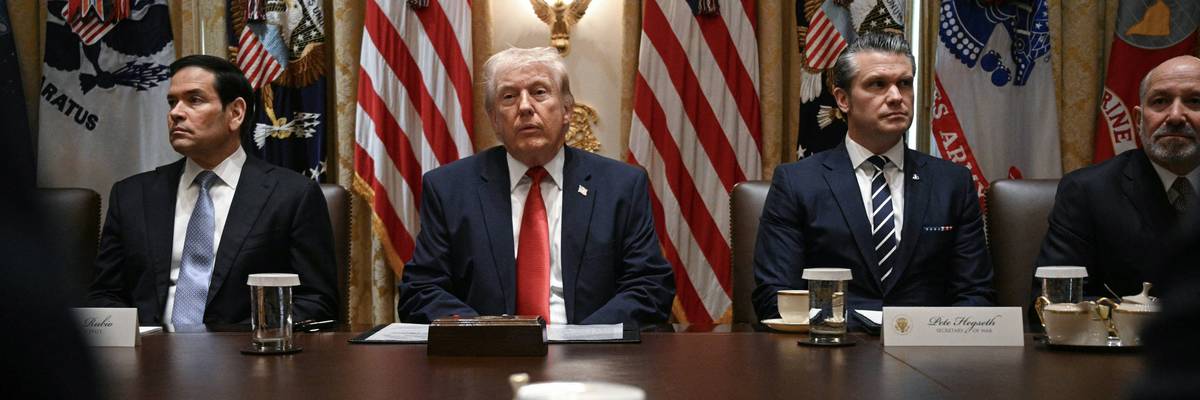
US President Donald Trump hosts a cabinet meeting in the Cabinet Room of the White House in Washington, DC, on March 26, 2026.
(Photo by Jim Watson/AFP via Getty Images)
Julia Conley
May 21, 2026
COMMON DREAMS
Over the last eight months, at the direction of President Donald Trump and Secretary of Defense Pete Hegseth, the US military has bombed at least 57 boats and killed close to 200 people—among them fishermen, a young man known in his town for his indoor soccer playing, and working people who had recently struggled to make ends meet—in what human rights experts have called “murders” and extrajudicial killings.
But the indictment filed this week regarding unlawful killings by government forces in the Caribbean region had nothing to do with Trump’s boat bombing spree, which the White House has claimed it aimed at stopping drug trafficking. Instead, the target of the indictment filed by the US Justice Department was 94-year-old former Cuban President Raúl Castro, who was charged with one count of conspiracy for his alleged role in shooting down planes that flew into Cuba’s airspace in 1996.
The planes were operated by an anti-Fidel Castro group, Brothers to the Rescue, and four Cuban-Americans were killed in the operation.
In expressing support for the indictment, US Rep. Carlos Giménez (R-Fla.), a Cuban-American immigrant, said that “there will be consequences to pay if you harm American citizens in international waters, in international airspace for no reason at all, and believe me, this was no reason at all.”
Michael Galant, a member of the secretariat of the Progressive International, commented with feigned surprise: “Apparently you’re not allowed to kill people in international waters now? Someone tell Hegseth.”
The organization’s co-general coordinator, David Adler, added, “I simply do not understand how we, as a country, tolerate the hypocrisy of indicting Raúl Castro for defending Cuban airspace—while our own government celebrates the extrajudicial assassinations of innocent fishermen sailing across the sea below,” while Ryan Grim of Drop Site News noted the indictment also followed the bombing of a school in Iran—an attack that investigators said was likely carried out by the US.
The indictment of Castro, noted the Progressive International, was set to coincide with Cuba’s Independence Day and came as Secretary of State Marco Rubio, the son of Cuban immigrants who has long desired regime change in the communist country, mused that the Cuban government has “plundered billions of dollars, but nothing has been used to help the people”—echoing his criticism of Iran, another target of the US military under Trump.
The timing of and ramp-up to the indictment was “a piece of political theater calibrated to one audience only: the Miami exile lobby that has spent decades pursuing its commercial and ideological vendetta against the Cuban Revolution,” said the group’s Cabinet.
“US officials themselves acknowledge they do not believe Cuba is an imminent threat, nor actively planning to attack American interests—and yet in the same breath, the administration has laundered a set of alarming claims about Cuban drone acquisitions, presented with all the breathless urgency of a casus belli,” the Progressive International added, referring to Axios’ reporting last weekend on claims from an administration official that Cuba is preparing to attack the US with drones—a report that ultimately acknowledged the Cubans are not planning any preemptive strikes on the US but are rather thought to be strategizing on self-defense as the US intensifies its anti-Cuba rhetoric and continues the oil blockade it imposed in February.
The Cuban embassy in the United Kingdom on Thursday said it rejected US claims about the downing of the Brothers to the Rescue plane, which it called “an irrefutable act of sovereign self-defense” that took place after “25 deliberate, calculated violations of our national airspace” by the exile group.
“To criminalize our nation, the US manipulated the official [International Civil Aviation Organization] investigation, deliberately erasing the first six minutes of radar and radio recordings to conceal the territorial incursion,” the embassy asserted. “The narrative of an attack in international waters is an absolute juridical fraud.”
In a column at Common Dreams Thursday, Codepink co-counder Medea Benjamin added that she was in Cuba in 1996 when the planes were shot down. The leader of Brothers to the Rescue, José Baulto, she said, openly stated that he was “trained as a terrorist by the United States,” and said after one mission in which the group dropped leaflets over Havana that the group was seeking “confrontation.”
“The Cuban government repeatedly warned Washington, the Federal Aviation Administration (FAA), and international aviation authorities that these flights were illegal and dangerous. US officials knew the risks,” wrote Benjamin. “The hypocrisy of indicting Raúl Castro nearly 30 years later is staggering, given the long history of anti-Cuban extremists operating from US soil to wreak havoc against the island with bombings, sabotage, and airline terrorism.”
Those US-based extremists include the perpetrators of the 1976 midair bombing of Cubana Flight 455, a commercial airliner carrying 73 crew and passengers, many of them teenage members of Cuba’s junior Olympic fencing team.
The Trump administration’s boat bombings, meanwhile, have been called likely “war crimes” by some legal experts and “murders” by others. The White House has insisted the US is in an “armed conflict” with drug cartels in Latin America, but no conflict has been officially declared. In at least one instance, US military members were ordered to bomb the survivors of an initial strike—a clear violation of international law.
The US in the past has treated suspected drug trafficking as a criminal issue—not one to be dealt with militarily. Before the boat bombings began, one top military legal adviser warned Pentagon officials, “There is no world where this is legal,” and said carrying out the attacks could expose everyone involved, from top White House officials to rank-and-file service members ordered to carry out the strikes, to legal liability.
“The same US government now pursuing charges against Raúl Castro has itself been carrying out deadly strikes on alleged drug-smuggling boats in the Caribbean and Pacific, strikes that have killed at least 193 people since September 2025, with no transparency or due process,” wrote Benjamin.
Following the Castro indictment, the Progressive International called on “governments, movements, and peoples of conscience everywhere to call out this escalation for what it is—a naked effort to recolonize Cuba and the hemisphere at large—and to stand firmly against it.”
“We have seen this playbook before—in Iraq, in Libya, in Venezuela, and in other sites of manufactured consent for illegal war across the world. The Progressive International will not stand silent as it is deployed against Cuba,” said the group. “Hands off Cuba.”


No comments:
Post a Comment