The Need for US Supreme Court Reform is Clearer Than Ever

Photo by Nathaniel St. Clair
To preserve our democracy, we must reform the Supreme Court.
In its recent Louisiana v. Callais decision, the Court’s Republican majority completed its years-long campaign to neuter the Voting Rights Act. Not coincidentally, they dramatically tilted the electoral playing field in Republicans’ favor.
The case came in the context of drawing congressional districts. The Court “interpreted” the Voting Rights Act to let legislators openly target minority communities and dilute their political influence if they do it for “partisan” reasons.
Before the ink was dry, Republican politicians in Southern states went into action. In Louisiana and Alabama, they cancelled congressional primary elections that had already started so that they could redraw the lines and get rid of majority-Black congressional districts. Tennessee split up the state’s only majority-Black congressional district (Memphis).
South Carolina also held a special session to target that state’s Black voters in time for this year’s midterm elections. Though the effort ultimately didn’t succeed, the lead sponsor openly admitted that the purpose was to ensure that national Republicans retain their majority in the House of Representatives.
The Callais decision was a political gift to Donald Trump, whose popularity is plummeting.
Before Callais, political observers expected Trump’s party to lose the House of Representatives.
Republicans still appear likely to do poorly in the midterm elections. But now, it could take a much larger supermajority of Americans for the congressional results to reflect the will of the people and actually vote them out of power.
It gets worse. Callais empowers Republicans to decimate Black representation and undermine democracy in state legislatures, city councils, and school boards, not just Congress. The justices have undermined decades of work to enfranchise people who had been locked out of power.
This is a red-alert moment for our democracy. And it goes far beyond this latest ruling.
This Court let corporations spend unlimited money buying our elections. They took away women’s access to safe abortion care. They let big companies force you to sign away your right to sue them when they cheat you or find other ways to violate your legal rights. They made it harder for working people to organize for better wages and benefits.
Again and again, this Court has given the most powerful people in our country even more power over the rest of us. And they make it harder for us to do anything about it. The far-right majority has broken our democracy so their friends and allies can take money and power from us with impunity.
Here are three ways to fight back.
Amazingly, the most powerful federal court in the land is the only one without a binding code of ethics. So Justice Alito can fly a flag associated with Trump’s “stop the steal” movement after the 2021 insurrection, then sit on cases involving Trump’s role in that insurrection. And Clarence Thomas can get away with voting for Trump’s position in January 6 cases even though his wife Ginni had urged Trump not to concede the 2020 election.
Congress should make the justices adopt a binding code of ethics.
Second, having justices routinely stay in office for decades is not what the nation’s founders intended. Some presidents don’t appoint any justices during a four-year term, while others appoint two or three. Too much depends on random events such as an unexpected death, or carefully timed retirements to ensure replacement by a like-minded justice.
The Court has become wildly imbalanced. The Constitution lets Congress set term limits for justices. It should do so.
Finally, the next time there is a pro-democracy president, Congress should expand the number of justices. Otherwise, no law that Congress passes to protect our rights is safe from being neutered or completely struck down by the current rogue Supreme Court majority.
Because ultimately, the power in this country belongs to us.
Travis Gettys
May 28, 2026
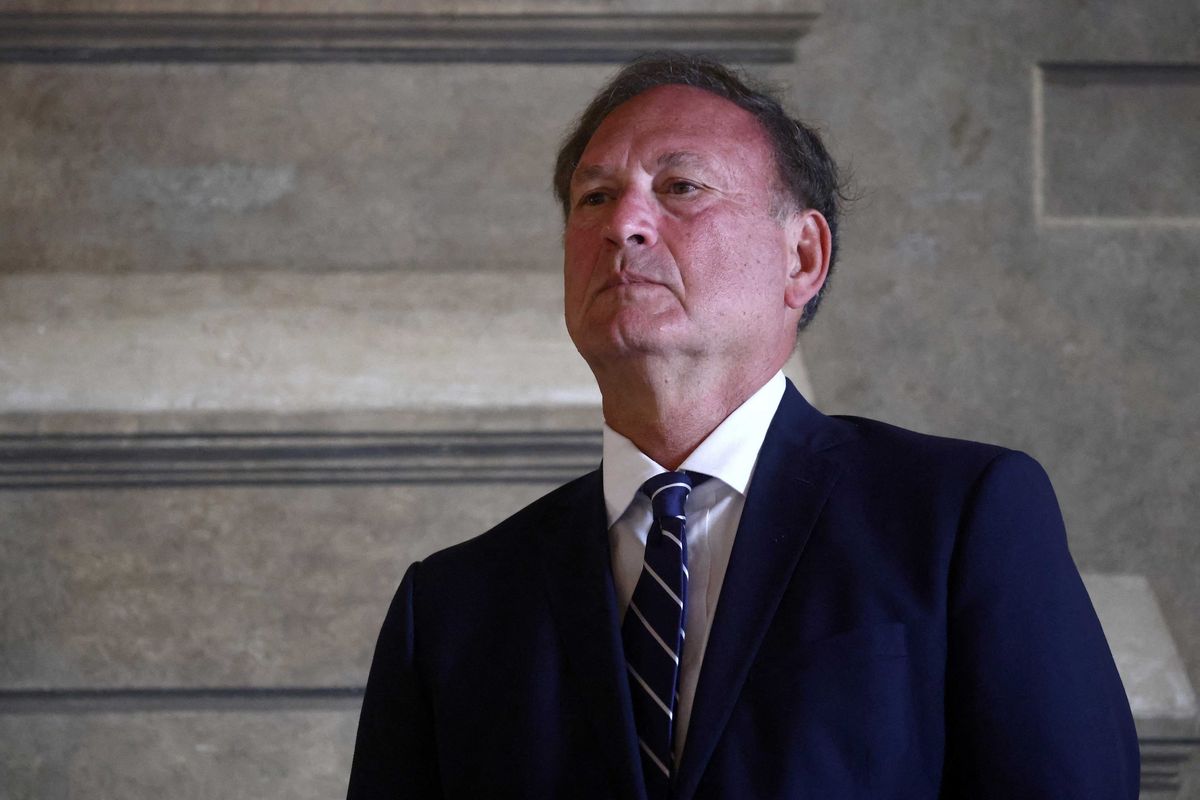
Supreme Court Justice Samuel Alito attends an event organized by the U.S. Embassy to the Holy See, in Rome, Italy, on Sept. 20, 2025. REUTERS/Vincenzo Livier
Supreme Court Justice Samuel Alito's son has been secretly working as a political appointee attorney at the U.S. Treasury Department, raising serious conflict of interest questions as high-stakes cases involving the agency have made their way to the nation's highest court, according to a report.
Philip Alito was hired to Treasury's office of the general counsel in the early months of the second Trump administration, according to four former government officials, yet his presence there has been treated as something close to a state secret, reported NOTUS.
"If people were introducing themselves by first and last name, he'd just say 'Phil,' not Phil Alito," said one former official. "He's a pretty soft-spoken guy."
The younger Alito maintains no public resume, has no LinkedIn profile and his name appears nowhere on the Treasury Department's website. Colleagues recall that he went out of his way to avoid drawing attention to his famous surname.
But the low profile belies the significance of his role. As an attorney-adviser in the general counsel's front office, Philip Alito was briefed on important Treasury matters across the board and offered legal feedback at the highest levels.
"There's no doubt he got that position because of who he is," a second source said.
The Treasury Department's general counsel office handles legal matters related to taxation, economic policy and law enforcement. It could be involved in multiple federal lawsuits challenging Trump's controversial anti-weaponization fund — which allocates public money to individuals claiming unfair targeting by the Justice Department — that could ultimately reach the Supreme Court.
While Philip Alito was working at the Treasury, a lawsuit challenging Trump's use of emergency powers to issue tariffs was argued before the justices in November — with the Treasury Department named as a defendant, but the department never disclosed Philip Alito's employment in court documents.
His father did not recuse himself from the case, ultimately joining a dissent when the majority ruled against the administration in February.
Justice Alito's office did not responded to requests for comment from NOTUS.

No comments:
Post a Comment