US Defense Secretary Pete Hegseth on Saturday marked the 82nd anniversary of the World War II D-Day landings with a visit to Normandy, but did not attend the international ceremony hosted in Langrune-sur-Mer. Residents said his "warlike views" were unwelcome in their village and questioned his commitment to "democratic values".
Issued on: 07/06/2026 -
By: FRANCE 24

US Defense Secretary Pete Hegseth visits the US cemetery to commemorate the 82nd anniversary of the D-Day landings in Colleville-sur-Mer, Normandy, France on June 6, 2026. © Jeremias Gonzalez, AP
US Defense Secretary Pete Hegseth on Saturday travelled to Normandy to commemorate the 82nd anniversary of the World War II D-Day landings.
But after making a speech at the American military cemetery in Colleville-sur-Mer, he conspicuously skipped afternoon’s main international ceremony marking the anniversary of the Allied landings, which helped herald the end of World War II.
His presence was not missed by some residents of the village hosting the ceremony, Langrune-sur-Mer, who said the US official was not welcome there.
"He has very warlike views and it seems to us that this man does not share our democratic values," Sylvie Lamy Thepaut, a member of the municipal association Langrune en commun, told BFM TV.
A message on the association’s website called for Hegseth’s visit to be cancelled on the grounds that the Pentagon chief “espouses values contrary to democracy, human rights and peace” and had made “numerous anti-European remarks”, “warlike statements” and “American supremacist pronouncements".
“The honor of Langrune, that of France, and the memory of the young Allied soldiers – American, British, Canadian – who died on our beaches in the name of democracy would dictate canceling this individual’s visit,” the statement concluded.
Langrune-sur-Mer Mayor Franck Jouy declined to comment on Hegseth's visit, underscoring that the event was a memorial.
“We are here for a commemmoration and I don’t want to make it political,” he told BFMTV. “I’m here to remember the people who came to make sure that France was liberated.”
Attendees of Saturday’s ceremony in Langrune-sur-Mer included veterans from the United States and British Defence Minister John Healey, who hailed the "resilience" of the UK during the war and US allies as "this great people, friends of liberty".
French Prime Minister Sébastien Lecornu paid tribute to the "3,000 men, barely 20 years old", who died on D-Day, offering "the breath of their youth and the sacrifice of their lives".
In his earlier speech at the American military cemetery, Hegseth utilised dehumanising anti-immigrant rhetoric, urging Europe to counter what he termed an "invasion" of its coastline by migrants.
Echoing the rhetoric of the US administration, he also called on European countries to do more to contribute to their own defence. European defence spending has been on the rise.
In an apparent reference to European defence initiatives, Lecornu said the continent had to meet "the challenge of our generation" to build "our autonomy, our capacity to defend ourselves" to face threats that are "getting closer, intensifying and multiplying".
The Normandy landings on June 6, 1944, were the largest amphibious operation in history.
An armada of 6,939 ships and 132,700 British, Canadian, American, Belgian, Norwegian and Polish troops stormed 80 kilometres (50 miles) of beaches in northern France.
The operation contributed decisively to the Allied victory over Nazi Germany, which was also being squeezed by USSR forces to the east.
(FRANCE 24 with AFP)
Pete Hegseth 'backtracks' on 'repugnant' religious policy after GOP beatdown
David Edwards
June 8, 2026

Defense Secretary Pete Hegseth attends a House Armed Services Committee hearing on the Department of Defense's FY27 budget request on Capitol Hill in Washington, D.C., on April 29, 2026. REUTERS/Elizabeth Frantz
Defense Secretary Pete Hegseth reversed course Monday on a Pentagon religious classification policy that had enraged Republican allies — after Sen. Mike Lee (R-UT) called it "repugnant," phoned President Donald Trump directly, and demanded an immediate fix.
The controversy stemmed from a May 20 memo, first reported by Military.com, signed by Under Secretary of Defense Anthony Tata, that slashed the military's religious affiliation codes from 211 to just 31. The overhaul was designed to help chaplains better track and serve troops' beliefs — but the initial redone list left The Church of Jesus Christ of Latter-day Saints out of the Christian category entirely, classifying it separately from every other faith that professes belief in Jesus Christ.
The backlash was swift and bipartisan. Lee, a Utah Republican and Latter-day Saint himself, posted a video Sunday calling the policy an affront to "tens of thousands" of LDS service members. "It's just repugnant to any sense of decency, any sense of our common heritage," he said. Sen. John Curtis (R-UT) called it "unacceptable." Rep. Greg Stanton (D-AZ) insisted Hegseth explain the exclusion to "hundreds of thousands of Latter-day Saints veterans."
Lee then posted that he had spoken with Trump by phone. "I won't speak for him, but I'm thrilled about where this is heading," he wrote.
By Monday afternoon, the Pentagon's rapid response account announced the reversal, framing the original list as containing "redundant and unnecessary labeling" — and an updated Religious Affiliation Codes list now includes "Church of Jesus Christ of Latter-day Saints" as a standalone entry. Capitol Hill correspondent Jamie Dupree described the move plainly: the Pentagon had "backtracked."
Curtis welcomed the fix. "Thank you to the Department of War for listening to our concerns, engaging thoughtfully and respectfully with my office on this issue, and for delivering a swift correction," he wrote on X.
Not everyone was satisfied. Atheist commentator Hemant Mehta argued the revised list still lumps together atheists and agnostics, collapses dozens of smaller faiths into a catch-all "Other Religions" category, and that "the 2017 list was better."
David Edwards
June 8, 2026
RAW STORY
Defense Secretary Pete Hegseth attends a House Armed Services Committee hearing on the Department of Defense's FY27 budget request on Capitol Hill in Washington, D.C., on April 29, 2026. REUTERS/Elizabeth Frantz
Defense Secretary Pete Hegseth reversed course Monday on a Pentagon religious classification policy that had enraged Republican allies — after Sen. Mike Lee (R-UT) called it "repugnant," phoned President Donald Trump directly, and demanded an immediate fix.
The controversy stemmed from a May 20 memo, first reported by Military.com, signed by Under Secretary of Defense Anthony Tata, that slashed the military's religious affiliation codes from 211 to just 31. The overhaul was designed to help chaplains better track and serve troops' beliefs — but the initial redone list left The Church of Jesus Christ of Latter-day Saints out of the Christian category entirely, classifying it separately from every other faith that professes belief in Jesus Christ.
The backlash was swift and bipartisan. Lee, a Utah Republican and Latter-day Saint himself, posted a video Sunday calling the policy an affront to "tens of thousands" of LDS service members. "It's just repugnant to any sense of decency, any sense of our common heritage," he said. Sen. John Curtis (R-UT) called it "unacceptable." Rep. Greg Stanton (D-AZ) insisted Hegseth explain the exclusion to "hundreds of thousands of Latter-day Saints veterans."
Lee then posted that he had spoken with Trump by phone. "I won't speak for him, but I'm thrilled about where this is heading," he wrote.
By Monday afternoon, the Pentagon's rapid response account announced the reversal, framing the original list as containing "redundant and unnecessary labeling" — and an updated Religious Affiliation Codes list now includes "Church of Jesus Christ of Latter-day Saints" as a standalone entry. Capitol Hill correspondent Jamie Dupree described the move plainly: the Pentagon had "backtracked."
Curtis welcomed the fix. "Thank you to the Department of War for listening to our concerns, engaging thoughtfully and respectfully with my office on this issue, and for delivering a swift correction," he wrote on X.
Not everyone was satisfied. Atheist commentator Hemant Mehta argued the revised list still lumps together atheists and agnostics, collapses dozens of smaller faiths into a catch-all "Other Religions" category, and that "the 2017 list was better."
A Disgraceful Hegseth Dishonors Those Who Gave Their Lives on D-Day
It is not surprising that Hegseth cannot identify with the men who fought on D-Day.
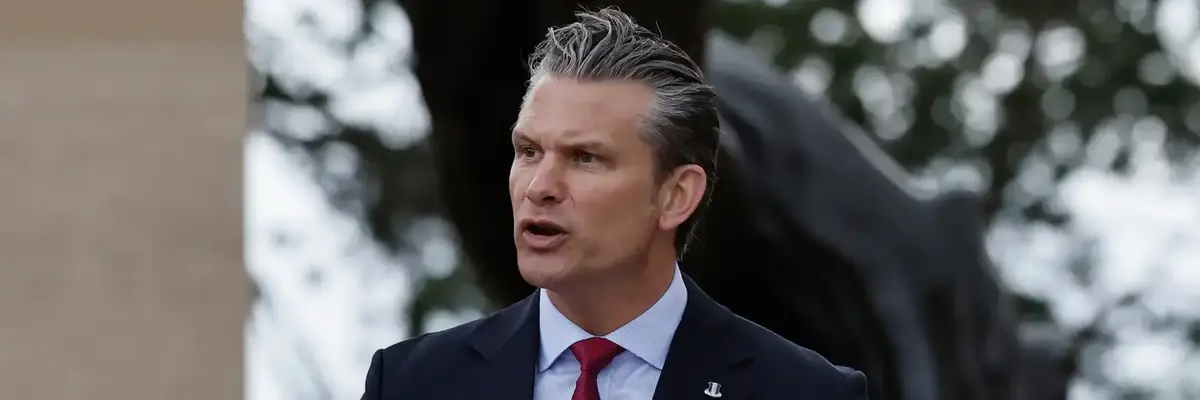
Defense Secretary Pete Hegseth at the U.S. cemetery in Colleville-sur-Mer, France, at a D-Day commemoration, on Saturday, June 6, 2026.
(Photo: Jeremias Gonzalez/Associated Press)
Martin Burns
Jun 08, 2026
It is not surprising that Hegseth cannot identify with the men who fought on D-Day.
Defense Secretary Pete Hegseth at the U.S. cemetery in Colleville-sur-Mer, France, at a D-Day commemoration, on Saturday, June 6, 2026.
(Photo: Jeremias Gonzalez/Associated Press)
Martin Burns
Jun 08, 2026
Common Dreams
If you have ever had the opportunity to visit the Normandy American Cemetery in Colleville-sur-Mer, France it is something that stays with you. The rows of white gravestones silhouetted against green grass and blue sky bear silent and eloquent witness to what happened on June 6, 1944. The cemetery contains the graves of 9,389 of Americans, most of whom lost their lives in the D-Day landings and the battles in France in 1944.
From the cemetery, you can see down to Omaha Beach the bloodiest part of the D-Day battlefield. While estimates vary, 2,400 to 3,600 total American casualties (including killed, wounded, and missing) occurred on Omaha Beach on D-Day, June 6, 1944. For me, the most moving part of the Cemetery is the Walls of the Missing where inscribed 1,557 names of the soldiers and sailors who were missing in action and have never had their bodies recovered.
For decades, American politicians have been visiting the Normandy Beaches to pay tribute to all the Americans and Allies (primarily British and Canadian) who fought on June 6, 1944. Particularly well-known is the speech that President Ronald Reagan made in June of 1984:
The men of Normandy had faith that what they were doing was right, faith that they fought for all humanity, faith that a just God would grant them mercy on this beachhead or on the next. It was the deep knowledge—and pray God we have not lost it—that there is a profound, moral difference between the use of force for liberation and the use of force for conquest. You were here to liberate, not to conquer, and so you and those others did not doubt your cause. And you were right not to doubt. You all knew that some things are worth dying for.
For an American politician, remarks at the Normandy beaches ought to be simple and straightforward. All you have to do is pay tribute as best you can to the extraordinary sacrifice made on June 6, 1944. As hard as it is to believe, US Defense Secretary Pete Hegseth failed this simple task. Rather than just pay tribute to the efforts of those who “hit the beach” on June 6, 1944, Hegseth launched into an anti-immigrant and far-right rant. As the New York Times reported:
In his remarks, Mr. Hegseth said that “freedom is not free” and especially praised the role played by American troops, but said that over the past eight or so decades, some European countries had grown “comfortable.” “Today, different European beaches are stormed by different dangerous ideologies,” he said. “Boats and men arrive. When will European capitals do something about that invasion? Or is it too late?”
I am sure it escaped Hegseth the fact that many of the Americans he heralds for their sacrifice were the sons of immigrants to the United States. To compare refugees coming to Europe fleeing war and economic oppression with Nazi tyranny defies belief.
It is not surprising that Hegseth cannot identify with the men who fought on D-Day. They were not the much hyped “war fighters” ignoring politically correct rules of engagement that Hegseth celebrates. Instead, they were ordinary men doing extraordinary things to defeat the most terrible tyranny the world has ever seen. History will remember the deeds of those who defeated Nazi tyranny, while Hegseth’s far-right rhetoric will be nothing more than a footnote to a sad chapter in American history.
Our work is licensed under Creative Commons (CC BY-NC-ND 3.0). Feel free to republish and share widely.
Martin Burns
Martin Burns has worked as a congressional aide, polling analyst, journalist, and lobbyist. He was on the campaign trail for Harris-Walz in Pennsylvania and North Carolina. In addition to Common Dreams, his work has been published by The Hill, Irish Central, and the Byline Times. Martin resides in Washington, DC with his wife, and regular coauthor, Mary Liz. His website is Martinburns.news.
Full Bio >
If you have ever had the opportunity to visit the Normandy American Cemetery in Colleville-sur-Mer, France it is something that stays with you. The rows of white gravestones silhouetted against green grass and blue sky bear silent and eloquent witness to what happened on June 6, 1944. The cemetery contains the graves of 9,389 of Americans, most of whom lost their lives in the D-Day landings and the battles in France in 1944.
From the cemetery, you can see down to Omaha Beach the bloodiest part of the D-Day battlefield. While estimates vary, 2,400 to 3,600 total American casualties (including killed, wounded, and missing) occurred on Omaha Beach on D-Day, June 6, 1944. For me, the most moving part of the Cemetery is the Walls of the Missing where inscribed 1,557 names of the soldiers and sailors who were missing in action and have never had their bodies recovered.
For decades, American politicians have been visiting the Normandy Beaches to pay tribute to all the Americans and Allies (primarily British and Canadian) who fought on June 6, 1944. Particularly well-known is the speech that President Ronald Reagan made in June of 1984:
The men of Normandy had faith that what they were doing was right, faith that they fought for all humanity, faith that a just God would grant them mercy on this beachhead or on the next. It was the deep knowledge—and pray God we have not lost it—that there is a profound, moral difference between the use of force for liberation and the use of force for conquest. You were here to liberate, not to conquer, and so you and those others did not doubt your cause. And you were right not to doubt. You all knew that some things are worth dying for.
For an American politician, remarks at the Normandy beaches ought to be simple and straightforward. All you have to do is pay tribute as best you can to the extraordinary sacrifice made on June 6, 1944. As hard as it is to believe, US Defense Secretary Pete Hegseth failed this simple task. Rather than just pay tribute to the efforts of those who “hit the beach” on June 6, 1944, Hegseth launched into an anti-immigrant and far-right rant. As the New York Times reported:
In his remarks, Mr. Hegseth said that “freedom is not free” and especially praised the role played by American troops, but said that over the past eight or so decades, some European countries had grown “comfortable.” “Today, different European beaches are stormed by different dangerous ideologies,” he said. “Boats and men arrive. When will European capitals do something about that invasion? Or is it too late?”
I am sure it escaped Hegseth the fact that many of the Americans he heralds for their sacrifice were the sons of immigrants to the United States. To compare refugees coming to Europe fleeing war and economic oppression with Nazi tyranny defies belief.
It is not surprising that Hegseth cannot identify with the men who fought on D-Day. They were not the much hyped “war fighters” ignoring politically correct rules of engagement that Hegseth celebrates. Instead, they were ordinary men doing extraordinary things to defeat the most terrible tyranny the world has ever seen. History will remember the deeds of those who defeated Nazi tyranny, while Hegseth’s far-right rhetoric will be nothing more than a footnote to a sad chapter in American history.
Our work is licensed under Creative Commons (CC BY-NC-ND 3.0). Feel free to republish and share widely.
Martin Burns
Martin Burns has worked as a congressional aide, polling analyst, journalist, and lobbyist. He was on the campaign trail for Harris-Walz in Pennsylvania and North Carolina. In addition to Common Dreams, his work has been published by The Hill, Irish Central, and the Byline Times. Martin resides in Washington, DC with his wife, and regular coauthor, Mary Liz. His website is Martinburns.news.
Full Bio >

No comments:
Post a Comment