This Is How ICE Comes to Europe
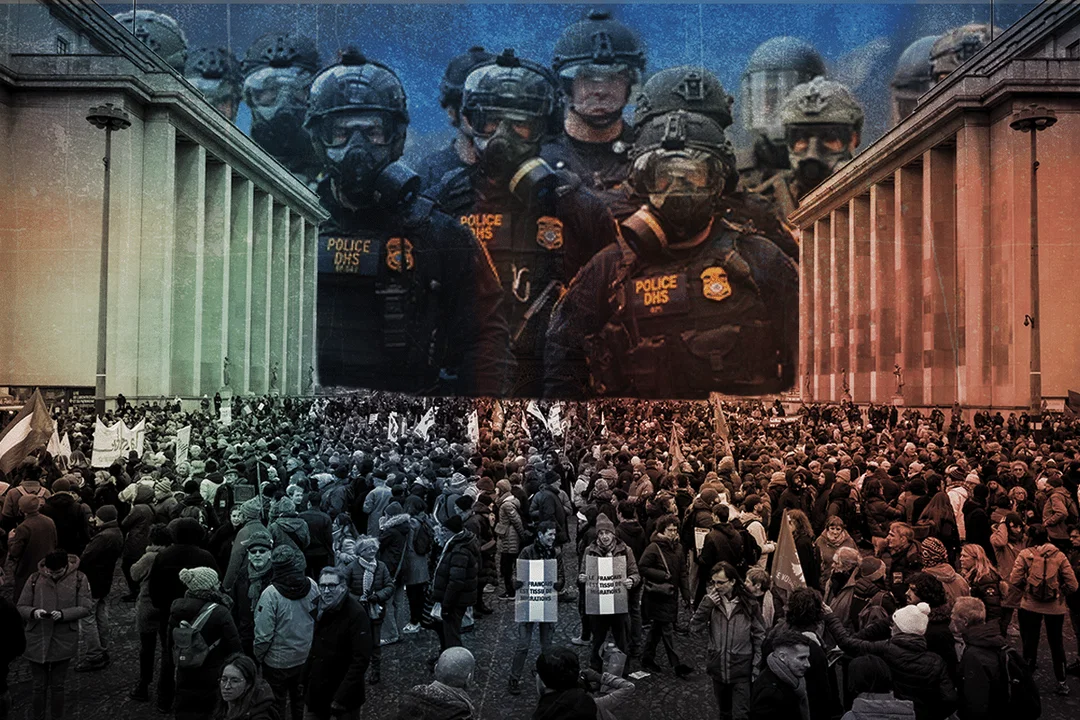
Last June, train stations across France were transformed into impromptu immigration checkpoints. Citing a “surge” in illegal immigration, France’s then-interior minister, Bruno Retailleau, dispatched 4,000 police and immigration agents to more than 800 stations across the country. They boarded more than 1,200 trains and arrested nearly 700 people; around 200 were issued deportation orders, half of whom were returned to the border with Italy. Only a small proportion of those arrested had a criminal record. In one representative case, a 39-year-old undocumented mechanic was stopped by three police plainclothes officers while walking through Paris’s busy Gare du Nord station, given a deportation order and rushed to a detention center.
When the operation concluded on June 19, Retailleau gave a speech at Gare du Nord. “Don’t come to France, we will accept nothing,” he crowed. “This is zero tolerance.” Critics, meanwhile, compared the two-day operation to the roundups and deportations of the Vichy period.
On March 26, Retailleau, who now leads the right-wing Les Républicains party and is an unexpected presidential candidate polling around 10%, celebrated a European Parliament vote to expand his policy ideas across the European Union. Passed by a vote of 389 to 206, the overhaul of EU deportation guidelines owes a lot to Retailleau’s right-hand man and his party’s vice president, a baby-faced former high-school philosophy teacher named François-Xavier Bellamy. In Strasbourg, on France’s border with Germany, Bellamy was on hand to cheer the deportation vote as a “decisive victory” and a “major advancement.”
When formally ratified — which could happen as early as next week — the European Return Regulation will dramatically reshape how the bloc handles irregular migration. It will permit the detention of children and families for up to 24 months; expand rights for police to enter residences and possibly the offices of charities working with migrants; create facilities in third countries known as “return hubs”; extend entry bans; and reduce voluntary departure windows to as few as zero days — meaning a person could receive a deportation order and be forcibly removed within hours.
Critics have condemned the ERR for binding EU member states to a draconian model of immigration enforcement that reminds them of the U.S. Immigration and Customs Enforcement agency. A coalition of more than 250 charities and nongovernmental organizations call the proposal “coercive, traumatizing, and rights-violating” and “part of a broader shift in EU migration policy to characterize human movement as a threat.” In Strasbourg, Melissa Camara, a French Green member of the European Parliament who attempted and failed to soften the final language, blasted the result as a “shameful” deal between traditional right-wing and centrist parties and the far-right. “The legal arsenal serving a xenophobic ideology is now complete,” she said.
If the far-right provided the votes, current and former “traditional” conservatives like Bellamy served as the whip. Marine Le Pen’s National Rally party, the German AfD and the Polish PiS were happy to tag along for the ride, but larger center-right parties were at the wheel. Bellamy’s Les Républicains — descendants of Fifth Republic founder Charles de Gaulle and long styled as the party of “civility” and “decorum” — form part of the European People’s Party, a wide coalition of mainstream centrist and traditional right-wing groups that include German Christian Democrats (the party of former Prime Minister Angela Merkel) and the Partido Popular, which governed Spain between 2011 and 2018. These political movements, once thought of as mainstream, were deeply involved in the policy’s rightward lurch.
“It’s the same alliance everywhere,” Camara told Truthdig. “And Bellamy is at the center of it — a man who presents himself as a philosopher, as someone of culture and civility. That’s what makes it so insidious. The far right is easy to identify. This is harder to see coming.”
Until early March, the negotiations in Strasbourg had centered on a slightly more moderate draft championed by a Dutch member of the European Parliament named Malik Azmani, who attempted to assemble a majority coalition of socialists, liberals and the EPP. But this effort broke down when the socialists drew a red line against some elements of the draft, especially the creation of the return hubs.
That’s when Bellamy appeared with a more hard-line “alternative agreement.” What few knew at the time was that the new text — which arrived in the inboxes of negotiators out of the blue and with little context — had been in the works for weeks. Only later would the German press agency dpa reveal that Bellamy had been secretly coordinating with three far-right groups in a private WhatsApp group to draft their own text. At a closed-door meeting in early March, Bellamy sat down with Mary Khan of the German AfD, Marieke Ehlers of the Dutch far right and Charlie Weimers of the Sweden Democrats — parties that, in U.S. terms, might sit somewhere between the tea party and the extreme right wing of MAGA — to knock out the final text.
To observers, the alignment came as a shock. “We never thought the EPP would go so far as to negotiate with far-right factions once considered untouchable in the European Parliament,” said Camara. Parties like Europe of Sovereign Nations and Patriots for Europe, she noted, include neo-Nazi members and have publicly defended the SS. “With this group text, every firewall had fallen. We said to ourselves, ‘We have crossed a threshold.’”
“I consider François-Xavier Bellamy to be the Trojan Horse of the rapprochement between the right and the far-right,” she added.
According to an EU parliamentary source who spoke on the condition of anonymity, the maneuver represented a break with parliamentary procedure. Normally, the source explained, a text is not brought to a vote until compromise amendments have been agreed to across groups, with the rapporteur leading the process. “What happened instead is that the right blocked that process entirely — counted their seats, went outside official meetings, wrote their own text and had it adopted,” the source said. “That’s not how the European Parliament is supposed to work.”
The text received a vote despite the lack of statutory consultation with civil society organizations or an impact assessment. “There is a real democratic deficit in the way this text has been developed,” said Juliette Cailloux, president of the Observatoire des Camps de Réfugiés, a nongovernmental agency that monitors European migration policy. Olivia Sundberg, EU advocate on migration and asylum at Amnesty International, agreed, noting the atypical speed of the negotiations. “Normally, with EU migration legislation, it’s not unusual for it to take seven or eight years,” she said. “This one moved very, very quickly … and with very little scrutiny.”
Possibly bolstered by domestic concerns — the country will hold presidential elections in 2027 with the far right currently polling ahead by a large margin — France has pushed for the immediate implementation of some of the most controversial measures of the ERR, including an article on home raids, according to several sources.
But the ideological realignment seen on a European level supersedes electoral concerns. The country that once drafted the Declaration of the Rights of Man and of the Citizen has long served as a laboratory for the EU’s oncoming migrant crackdown.
Although it was notable for its scope, enforcement operations like the one overseen by Retailleau last June are a regular occurrence in France.
In Paris, migrant camps are routinely cleared — often aggressively — by police. Along the northern border across from the U.K., migrants taking their chance on crossing the English Channel have been victims of brutal pushbacks, with the NGO Human Rights Observers documenting French border police puncturing inflatable dinghies, confiscating phones and shoes, and using pepper spray on people already in the water. Rights groups regularly decry the country’s racial profiling in public spaces, with one study finding young Black and Arab men in Paris 20 times more likely to be stopped by police than the general population.
“ICE was created precisely to have an internal enforcement police that goes after undocumented people wherever they are, including in sanctuary cities,” said Serge Slama, a professor of public law at the University of Grenoble Alpes. “That way of operating has existed in France for a very long time. We’ve been profiling and stopping people in public transport, at train stations and in neighborhoods where we know there are undocumented migrants.”
France, which issues half of all EU deportation orders, has been quietly pushing the limits of the EU’s immigration enforcement rules for years, both through shock operations in public spaces and slow-burn, Kafkaesque administrative cruelty. The uncertainty leaves immigrants in a state of constant fear. “Our prefectures [regional police headquarters where immigrants go to renew their paperwork] are machines for generating expulsion orders,” said Camara.
When Retailleau was named interior minister in September 2024, he immediately set about supercharging this system, increasing deportations across France by 27% in 2024. The following year, Retailleau published a series of circulars that limited avenues to legal migration, exacerbating the situation for foreigners. If the train raids delivered a loud message, the policymaking behind the scenes inflicted the true damage: more deportation orders, resources diverted from administrative offices in charge of processing paperwork and attacks against charities.
Migrants rights advocates fear that these policies are a teaser for what will soon be institutionalized across the European Union with the adoption of the ERR. “We’ll see at European level what we’re already seeing in Paris, in Calais [where many boats take off for the U.K.], across the whole national territory,” said Yann Manzi, co-founder of the French migrant charity Utopia 56. “When a person is stopped, nobody explains why. They just stop people of color.”
Slama, the public law professor in Bordeaux, noted that the Return Regulation goes beyond anything that’s been done in France. “Even if you can find French precedents for individual measures, we’re shifting to a completely different register with this regulation,” he said. “We’re in a new league.”
Migrants rights organizations like Manzi’s fear the new European regulations will drive undocumented migrants further underground, away from care and paradoxically, toward illegality.
“What concerns us is that people, out of fear of having their papers or personal effects seized, or out of fear of expulsion, will simply stop coming to associations and legal aid offices,” said Olivia Carniel of the French NGO La Cimade, which played a key role in the Resistance against the Vichy regime during World War II. “Those places,” she added, “where people access their rights could become the sites where people are caught and their belongings taken. That’s extremely worrying.”
Bellamy and Retailleau, however, see the regulation as an unambiguous victory for Europe. On June 1, as negotiations on the ERR concluded with a final version that read like a wish list for the far right, Retailleau sounded prideful as he took credit for the text.
“They told me I wouldn’t be able to move things forward,” he said. “And yet, putting this issue on the agenda of the European Interior Ministers’ Council is one of the most important things I did.”


No comments:
Post a Comment