CLIMATE CRISIS
Cloudbursts are causing chaos in parts of India and Pakistan. Here's what they are
Cloudbursts are causing chaos in mountainous parts of India and Pakistan, with tremendous amounts of rain falling in a short period of time over a concentrated area
August 17, 2025
Cloudbursts are causing chaos in mountainous parts of India and Pakistan, with tremendous amounts of rain falling in a short period of time over a concentrated area
August 17, 2025
By Riazat Butt | AP
ISLAMABAD — Cloudbursts are causing chaos in mountainous parts of India and Pakistan, with tremendous amounts of rain falling in a short period of time over a concentrated area. The intense, sudden deluges have proved fatal in both countries.
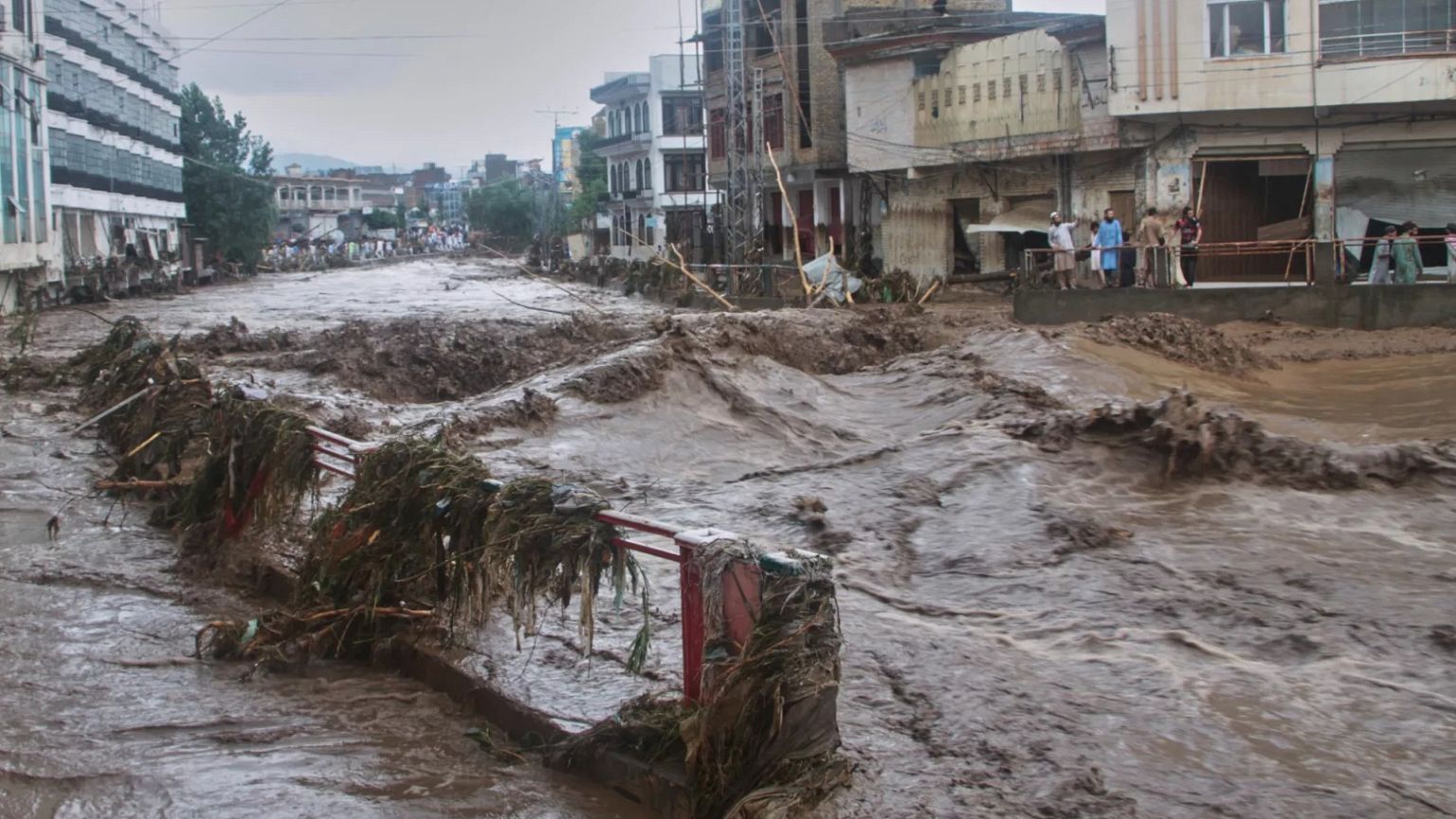
As many as 300 people died in one northwestern Pakistani district, Buner, after a cloudburst. The strength and volume of rain triggered flash flooding, landslides and mudflows. Boulders from steep slopes came crashing down with the water to flatten homes and reduce villages to rubble.
The northern Indian state of Uttarakhand had a cloudburst earlier this month. Local TV showed floodwaters surging down a mountain and crashing into Dharali, a Himalayan village. In 2013, more than 6,000 people died and 4,500 villages were affected when a similar cloudburst struck the state.
They are complex and extreme weather events
A cloudburst occurs when a large volume of rain falls in a very short period, usually more than 100 millimeters (about 4 inches) within an hour over a localized area, around 30 square kilometers (11.6 square miles).
Cloudbursts are sudden and violent, with devastating consequences and widespread destruction, and can be the equivalent of several hours of normal rainfall or longer. The event is the bursting of a cloud and the discharge of its contents at the same time, like a rain bomb.
Several factors contribute to a cloudburst, including warm, moist air rising upward, high humidity, low pressure, instability and convective cloud formation.
Moist air is forced to rise after encountering a hill or mountain. This rising air cools and condenses. Clouds that are large, dense and capable of heavy rainfall form.
Hills or mountains act like barriers and often trap these clouds, so they cannot disperse or move easily. Strong upward currents keep moisture suspended inside the clouds, delaying rainfall.
When the clouds cannot hold the accumulated moisture anymore, they burst and release it all at once.
India and Pakistan have ideal conditions
Cloudbursts thrive in moisture, monsoons and mountains. Regions of India and Pakistan have all three, making them vulnerable to these extreme weather events.
The Himalayas, Karakoram and Hindu Kush mountain ranges are home to the world’s highest and most famous peaks, spanning multiple countries including India and Pakistan.
The frequency of cloudbursts in these two South Asian nations has been steadily rising due to a warming atmosphere, because a warmer air mass can hold more moisture, creating conditions for sudden and intense downpours.
The South Asian region has traditionally had two monsoon seasons. One typically lasts from June to September, with rains moving southwest to northeast. The other, from roughly October to December, moves in the opposite direction.
But with more planet-warming gases in the air, the rain now only loosely follows this pattern.
This is because the warmer air can hold more moisture from the Arabian Sea and Indian Ocean, and that rain then tends to get dumped all at once. It means the monsoon is punctuated with intense flooding and dry spells, rather than sustained rain throughout.
The combination of moisture, mountains and monsoons force these moisture-laden winds upward, triggering sudden condensation and cloudbursts.
They are hard to predict, but precaution is possible
It’s difficult to predict cloudbursts because of their size, duration, suddenness and complex atmospheric mechanisms.
Asfandyar Khan Khattak, a Pakistani official from the northwest province of Khyber Pakhtunkhwa, said there was “no forecasting system anywhere in the world” that could predict the exact time and location of a cloudburst.
The Pakistani government said that while an early warning system was in place in Buner district, where hundreds of people died after a cloudburst, the downpour was so sudden and intense that it struck before residents could be alerted.
Community organization SOST, which is also the name of a border village in Pakistan’s northern Gilgit-Baltistan region, says precautions are possible.
It advises people to avoid building homes right next to rivers and valleys, to postpone any travel to hilly areas if heavy rain is forecast, to keep an emergency kit ready, and to avoid traveling on mountainous roads during heavy rain or at night.
It recommends afforestation to reduce surface runoff and enhance water absorption, and regular clearing and widening of riverbanks and drainage channels.
Climate change is fueling their frequency
Experts say cloudbursts have increased in recent years, partly due to climate change, while damage from associated storms has also increased due to unplanned development in mountain areas.
Climate change has directly amplified the triggers of cloudbursts in Pakistan, especially. Every 1°C rise allows the air to hold about 7% more moisture, increasing the potential for heavy rainfall in short bursts.
The warming of the Indian Ocean and Arabian Sea pushes more moisture into the atmosphere. Melting glaciers and snow alter local weather patterns, making rainfall events more erratic and extreme. Environmental degradation, in the form of deforestation and wetland loss, reduces the land’s ability to absorb water, magnifying flash floods.
Climate change has been a central driver in the destruction seen in Pakistan’s northern areas.
“Rising global temperatures have supercharged the hydrologic cycle, leading to more intense and erratic rainfall,” said Khalid Khan, a former special secretary for climate change in Pakistan and chairman of climate initiative PlanetPulse.
“In our northern regions, warming accelerates glacier melt, adds excessive moisture to the atmosphere, and destabilizes mountain slopes. In short, climate change is making rare events more frequent, and frequent events more destructive.”
___
Associated Press writers Munir Ahmed and Riaz Khan contributed to this report from Islamabad and Peshawar, Pakistan, respectively.
ISLAMABAD — Cloudbursts are causing chaos in mountainous parts of India and Pakistan, with tremendous amounts of rain falling in a short period of time over a concentrated area. The intense, sudden deluges have proved fatal in both countries.
As many as 300 people died in one northwestern Pakistani district, Buner, after a cloudburst. The strength and volume of rain triggered flash flooding, landslides and mudflows. Boulders from steep slopes came crashing down with the water to flatten homes and reduce villages to rubble.
The northern Indian state of Uttarakhand had a cloudburst earlier this month. Local TV showed floodwaters surging down a mountain and crashing into Dharali, a Himalayan village. In 2013, more than 6,000 people died and 4,500 villages were affected when a similar cloudburst struck the state.
They are complex and extreme weather events
A cloudburst occurs when a large volume of rain falls in a very short period, usually more than 100 millimeters (about 4 inches) within an hour over a localized area, around 30 square kilometers (11.6 square miles).
Cloudbursts are sudden and violent, with devastating consequences and widespread destruction, and can be the equivalent of several hours of normal rainfall or longer. The event is the bursting of a cloud and the discharge of its contents at the same time, like a rain bomb.
Several factors contribute to a cloudburst, including warm, moist air rising upward, high humidity, low pressure, instability and convective cloud formation.
Moist air is forced to rise after encountering a hill or mountain. This rising air cools and condenses. Clouds that are large, dense and capable of heavy rainfall form.
Hills or mountains act like barriers and often trap these clouds, so they cannot disperse or move easily. Strong upward currents keep moisture suspended inside the clouds, delaying rainfall.
When the clouds cannot hold the accumulated moisture anymore, they burst and release it all at once.
India and Pakistan have ideal conditions
Cloudbursts thrive in moisture, monsoons and mountains. Regions of India and Pakistan have all three, making them vulnerable to these extreme weather events.
The Himalayas, Karakoram and Hindu Kush mountain ranges are home to the world’s highest and most famous peaks, spanning multiple countries including India and Pakistan.
The frequency of cloudbursts in these two South Asian nations has been steadily rising due to a warming atmosphere, because a warmer air mass can hold more moisture, creating conditions for sudden and intense downpours.
The South Asian region has traditionally had two monsoon seasons. One typically lasts from June to September, with rains moving southwest to northeast. The other, from roughly October to December, moves in the opposite direction.
But with more planet-warming gases in the air, the rain now only loosely follows this pattern.
This is because the warmer air can hold more moisture from the Arabian Sea and Indian Ocean, and that rain then tends to get dumped all at once. It means the monsoon is punctuated with intense flooding and dry spells, rather than sustained rain throughout.
The combination of moisture, mountains and monsoons force these moisture-laden winds upward, triggering sudden condensation and cloudbursts.
They are hard to predict, but precaution is possible
It’s difficult to predict cloudbursts because of their size, duration, suddenness and complex atmospheric mechanisms.
Asfandyar Khan Khattak, a Pakistani official from the northwest province of Khyber Pakhtunkhwa, said there was “no forecasting system anywhere in the world” that could predict the exact time and location of a cloudburst.
The Pakistani government said that while an early warning system was in place in Buner district, where hundreds of people died after a cloudburst, the downpour was so sudden and intense that it struck before residents could be alerted.
Community organization SOST, which is also the name of a border village in Pakistan’s northern Gilgit-Baltistan region, says precautions are possible.
It advises people to avoid building homes right next to rivers and valleys, to postpone any travel to hilly areas if heavy rain is forecast, to keep an emergency kit ready, and to avoid traveling on mountainous roads during heavy rain or at night.
It recommends afforestation to reduce surface runoff and enhance water absorption, and regular clearing and widening of riverbanks and drainage channels.
Climate change is fueling their frequency
Experts say cloudbursts have increased in recent years, partly due to climate change, while damage from associated storms has also increased due to unplanned development in mountain areas.
Climate change has directly amplified the triggers of cloudbursts in Pakistan, especially. Every 1°C rise allows the air to hold about 7% more moisture, increasing the potential for heavy rainfall in short bursts.
The warming of the Indian Ocean and Arabian Sea pushes more moisture into the atmosphere. Melting glaciers and snow alter local weather patterns, making rainfall events more erratic and extreme. Environmental degradation, in the form of deforestation and wetland loss, reduces the land’s ability to absorb water, magnifying flash floods.
Climate change has been a central driver in the destruction seen in Pakistan’s northern areas.
“Rising global temperatures have supercharged the hydrologic cycle, leading to more intense and erratic rainfall,” said Khalid Khan, a former special secretary for climate change in Pakistan and chairman of climate initiative PlanetPulse.
“In our northern regions, warming accelerates glacier melt, adds excessive moisture to the atmosphere, and destabilizes mountain slopes. In short, climate change is making rare events more frequent, and frequent events more destructive.”
___
Associated Press writers Munir Ahmed and Riaz Khan contributed to this report from Islamabad and Peshawar, Pakistan, respectively.
Copyright AP Photo
By Euronews
Published on 16/08/2025 -
Flash floods triggered by torrential rains killed over 280 people in India and Pakistan. Rescuers continued their search for 80 missing in a Himalayan village and evacuated hundreds across the region.
Flash floods triggered by torrential rains killed over 280 people across India and Pakistan in the past 24 hours, with rescuers searching for at least 80 missing in a remote Himalayan village where cloudbursts devastated a Hindu pilgrimage site.
A relief helicopter carrying supplies to flood-hit areas in Pakistan's northwest crashed Friday due to bad weather, killing all five people aboard including two pilots.
In India-controlled Kashmir, at least 60 people died and 80 remained missing after flash floods struck the remote village of Chositi, where more than 200 Hindu pilgrims were eating at a community kitchen when floodwaters swept down the mountain.
At least 50 seriously injured people were treated in local hospitals, many of them rescued from a stream filled with mud and debris. Disaster management official Mohammed Irshad said the number of missing people could increase.
Flash floods triggered by torrential rains killed over 280 people across India and Pakistan in the past 24 hours, with rescuers searching for at least 80 missing in a remote Himalayan village where cloudbursts devastated a Hindu pilgrimage site.
A relief helicopter carrying supplies to flood-hit areas in Pakistan's northwest crashed Friday due to bad weather, killing all five people aboard including two pilots.
In India-controlled Kashmir, at least 60 people died and 80 remained missing after flash floods struck the remote village of Chositi, where more than 200 Hindu pilgrims were eating at a community kitchen when floodwaters swept down the mountain.
At least 50 seriously injured people were treated in local hospitals, many of them rescued from a stream filled with mud and debris. Disaster management official Mohammed Irshad said the number of missing people could increase.
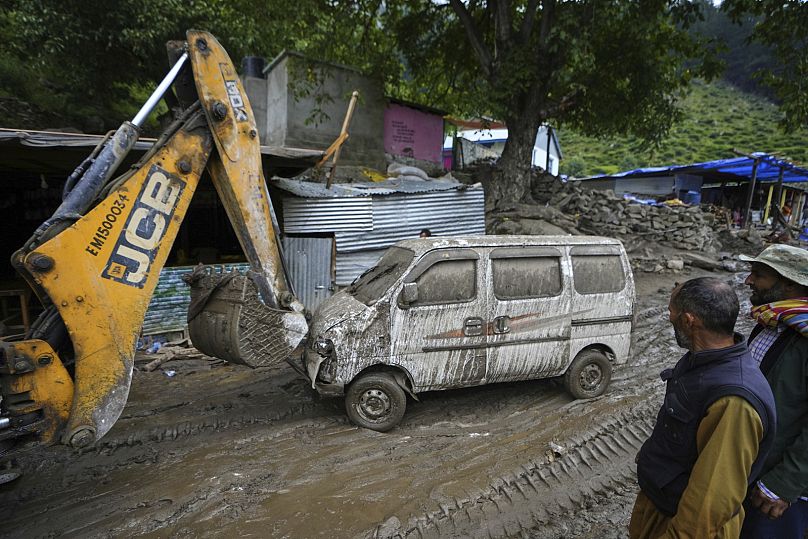
An earth mover clears a road after Thursday's flash floods in Chositi village, Kishtwar district, Indian-controlled Kashmir, 15 August 2025 AP Photo/Channi Anand
Chositi, in Kashmir’s Kishtwar district, is the last village accessible to motor vehicles on the route of an ongoing annual Hindu pilgrimage to a mountainous shrine at an altitude of 3,000 metres.
Officials said the pilgrimage, which began 25 July and was scheduled to end on 5 September, was suspended.
Photos and videos on social media show extensive damage with household goods strewn next to damaged vehicles and homes in the village.
Authorities made makeshift bridges Friday to help stranded pilgrims cross a muddy water channel and used dozens of earthmovers to shift boulders, uprooted trees and electricity poles and other debris.
Kishtwar district is home to multiple hydroelectric power projects, which experts have long warned pose a threat to the region’s fragile ecosystem.
Hundreds of tourists trapped by floods in Pakistan
In northern and northwestern Pakistan, flash floods killed at least 164 people in the past 24 hours, including 78 people who died in the flood-hit Buner district in northwest Pakistan on Friday.
Dozens were injured as the deluge destroyed homes in villages in Buner, where authorities declared a state of emergency Friday. Ambulances have transported 56 bodies to local hospitals, according to a government statement.
The helicopter that crashed on Friday was on a relief mission when it went down in the northwest, provincial Chief Minister Ali Amin Gandapur said.
Chositi, in Kashmir’s Kishtwar district, is the last village accessible to motor vehicles on the route of an ongoing annual Hindu pilgrimage to a mountainous shrine at an altitude of 3,000 metres.
Officials said the pilgrimage, which began 25 July and was scheduled to end on 5 September, was suspended.
Photos and videos on social media show extensive damage with household goods strewn next to damaged vehicles and homes in the village.
Authorities made makeshift bridges Friday to help stranded pilgrims cross a muddy water channel and used dozens of earthmovers to shift boulders, uprooted trees and electricity poles and other debris.
Kishtwar district is home to multiple hydroelectric power projects, which experts have long warned pose a threat to the region’s fragile ecosystem.
Hundreds of tourists trapped by floods in Pakistan
In northern and northwestern Pakistan, flash floods killed at least 164 people in the past 24 hours, including 78 people who died in the flood-hit Buner district in northwest Pakistan on Friday.
Dozens were injured as the deluge destroyed homes in villages in Buner, where authorities declared a state of emergency Friday. Ambulances have transported 56 bodies to local hospitals, according to a government statement.
The helicopter that crashed on Friday was on a relief mission when it went down in the northwest, provincial Chief Minister Ali Amin Gandapur said.

Residents examine damaged cars trapped in a mud following flash flooding due to heavy rains in Mingora, the main town of Swat Valley, northwestern Pakistan, 15 August 2025 AP Photo
Rescuers evacuated 1,300 stranded tourists from the mountainous Mansehra district hit by landslides on Thursday. At least 35 people were reported missing in these areas, according to local officials.
Rescuers backed by boats and helicopters worked to reach stranded residents. Dozens were still missing and the death toll is likely to rise, Kashif Qayyum said.
More than 477 people, mostly women and children, have died in rain-related incidents across the country since 26 June, according to the National Disaster Management Authority.
Rescuers evacuated some 1,600 people from mountainous districts in both countries as sudden downpours triggered floods and landslides across the region.
Cloudbursts to blame
Weather officials forecast more heavy rains and floods in the area.
Pakistan’s disaster management agency has issued fresh alerts for glacial lake outburst flooding in the north, warning travellers to avoid affected areas.
Sudden, intense downpours over small areas known as cloudbursts are increasingly common in India’s Himalayan regions and Pakistan’s northern areas, which are prone to flash floods and landslides.
Rescuers evacuated 1,300 stranded tourists from the mountainous Mansehra district hit by landslides on Thursday. At least 35 people were reported missing in these areas, according to local officials.
Rescuers backed by boats and helicopters worked to reach stranded residents. Dozens were still missing and the death toll is likely to rise, Kashif Qayyum said.
More than 477 people, mostly women and children, have died in rain-related incidents across the country since 26 June, according to the National Disaster Management Authority.
Rescuers evacuated some 1,600 people from mountainous districts in both countries as sudden downpours triggered floods and landslides across the region.
Cloudbursts to blame
Weather officials forecast more heavy rains and floods in the area.
Pakistan’s disaster management agency has issued fresh alerts for glacial lake outburst flooding in the north, warning travellers to avoid affected areas.
Sudden, intense downpours over small areas known as cloudbursts are increasingly common in India’s Himalayan regions and Pakistan’s northern areas, which are prone to flash floods and landslides.

Residents walk next to damaged cars stuck to an electric pole following flash flooding in a neighbourhood of Mingora, 15 August, 2025 AP Photo
Cloudbursts have the potential to wreak havoc by causing intense flooding and landslides, impacting thousands of people in the mountainous regions.
Experts say cloudbursts have increased in recent years partly because of climate change, while damage from the storms also has increased because of unplanned development in mountain regions.
Related
A study released this week by World Weather Attribution, a network of international scientists, found rainfall in Pakistan from 24 June to 23 July was 10% to 15% heavier because of global warming.
In 2022, the country’s worst monsoon season on record killed more than 1,700 people and caused an estimated €34.2 billion in damage.
Nearly 200 Killed in One Day in Pakistan Flooding Fueled by Climate Crisis
"The death toll may rise as we are still looking for dozens of missing people," said a spokesperson for an emergency agency in northwestern Pakistan.
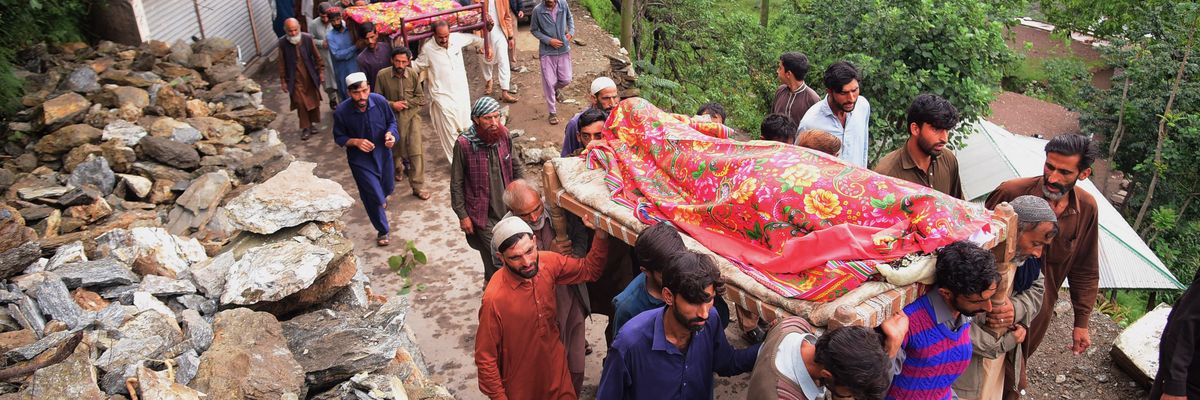
Mourners carry the coffins of people who were killed in flash floods in Naryean Behaak village in Pakistan on August 15, 2025.
(Photo by Sajjad Qayyum/AFP via Getty Images)
Julia Conley
Aug 15, 2025
"The death toll may rise as we are still looking for dozens of missing people," said a spokesperson for an emergency agency in northwestern Pakistan.
Mourners carry the coffins of people who were killed in flash floods in Naryean Behaak village in Pakistan on August 15, 2025.
(Photo by Sajjad Qayyum/AFP via Getty Images)
Julia Conley
Aug 15, 2025
COMMON DREAMS
Five people on a helicopter rescue team were among nearly 200 people killed by extreme rainfall and flooding in Pakistan in a single day on Friday—the country's latest emergency caused by increasingly severe monsoon seasons, which scientists say are being fueled by the human-caused climate crisis.
The vast majority of deaths were recorded in mountainous areas in the northwestern region, with at least 171 people killed on Friday in Khyber-Pakhtunkhwa.
As the Associated Press reported, "cloudbursts," or sudden and intense downpours over small areas, have become increasingly common in India and northern Pakistan in recent years and have caused landslides and flooding.
Pakistan has faced more extreme heatwaves and abnormal torrential downpours during its monsoon season, which typically occurs from June-September. Glaciers like those in the Gilgit-Balistan region, which hold 75% of Pakistan's stored water supply, have also been melting faster due to higher temperatures—another cause of flash floods. Several landslides have been reported along the Karakoram Highway in that region, which is heavily used by tourists and for trade.
International scientists at the World Weather Attribution said last week that rainfall in Pakistan from June 24-July 23 was 10-15% higher than it would have been without planetary heating linked to fossil fuel emissions, which have steadily risen since the 1950s with wealthy countries including the United States being the biggest contributors.
The death toll from the current ongoing extreme weather, which is expected to continue in the coming days, will likely rise significantly, said officials on Friday.
Authorities suspended an annual Hindu pilgrimage to a Sufi shrine in the northwestern Buner district, which began July 25 and was supposed to continue until early September.
About 78 people have been killed in Buner, mostly by floodwaters that swept them away and houses that collapsed.
Officials were helping nearly 4,000 pilgrims evacuate the area on Friday, building makeshift bridges to help people cross waterways and using dozens of excavators to move boulders, uprooted trees, and other debris.
"The death toll may rise as we are still looking for dozens of missing people," provincial emergency service spokesperson Mohammad Suhail told the AP.
A merchant in the Buner district told the New York Times that he had lost thousands of dollars in goods.
"Everything I had, groceries, edible items, is destroyed," Syed Mehmood Bacah said. "I could not save anything."
The disaster comes three years after Pakistan's worst monsoon season on record, in which flooding killed more than 1,700 people and caused an estimated $40 billion in damages.
Pakistan has become the world's fifth-most vulnerable country to climate disasters despite contributing only about 1% of the world's fossil fuel emissions.
The National Disaster Management Authority said the total number of rain-related deaths has now reached at least 556 since June 26, with more than 700 people injured.
Northern India has also been affected by flash flooding this week, with at least 44 people killed and more than 100 others injured in the Indian-controlled part of Jammu and Kashmir.
Five people on a helicopter rescue team were among nearly 200 people killed by extreme rainfall and flooding in Pakistan in a single day on Friday—the country's latest emergency caused by increasingly severe monsoon seasons, which scientists say are being fueled by the human-caused climate crisis.
The vast majority of deaths were recorded in mountainous areas in the northwestern region, with at least 171 people killed on Friday in Khyber-Pakhtunkhwa.
As the Associated Press reported, "cloudbursts," or sudden and intense downpours over small areas, have become increasingly common in India and northern Pakistan in recent years and have caused landslides and flooding.
Pakistan has faced more extreme heatwaves and abnormal torrential downpours during its monsoon season, which typically occurs from June-September. Glaciers like those in the Gilgit-Balistan region, which hold 75% of Pakistan's stored water supply, have also been melting faster due to higher temperatures—another cause of flash floods. Several landslides have been reported along the Karakoram Highway in that region, which is heavily used by tourists and for trade.
International scientists at the World Weather Attribution said last week that rainfall in Pakistan from June 24-July 23 was 10-15% higher than it would have been without planetary heating linked to fossil fuel emissions, which have steadily risen since the 1950s with wealthy countries including the United States being the biggest contributors.
The death toll from the current ongoing extreme weather, which is expected to continue in the coming days, will likely rise significantly, said officials on Friday.
Authorities suspended an annual Hindu pilgrimage to a Sufi shrine in the northwestern Buner district, which began July 25 and was supposed to continue until early September.
About 78 people have been killed in Buner, mostly by floodwaters that swept them away and houses that collapsed.
Officials were helping nearly 4,000 pilgrims evacuate the area on Friday, building makeshift bridges to help people cross waterways and using dozens of excavators to move boulders, uprooted trees, and other debris.
"The death toll may rise as we are still looking for dozens of missing people," provincial emergency service spokesperson Mohammad Suhail told the AP.
A merchant in the Buner district told the New York Times that he had lost thousands of dollars in goods.
"Everything I had, groceries, edible items, is destroyed," Syed Mehmood Bacah said. "I could not save anything."
The disaster comes three years after Pakistan's worst monsoon season on record, in which flooding killed more than 1,700 people and caused an estimated $40 billion in damages.
Pakistan has become the world's fifth-most vulnerable country to climate disasters despite contributing only about 1% of the world's fossil fuel emissions.
The National Disaster Management Authority said the total number of rain-related deaths has now reached at least 556 since June 26, with more than 700 people injured.
Northern India has also been affected by flash flooding this week, with at least 44 people killed and more than 100 others injured in the Indian-controlled part of Jammu and Kashmir.
A severe heatwave continues to grip much of France this Saturday, stretching as far north as southern Brittany, with 54 departments placed under orange alert by Météo-France on the ninth day of a relentless heatwave also affecting the Iberian Peninsula. The hottest temperatures are forecast in the Aude and Hérault regions, with Montpellier expecting a scorching 42°C by Saturday afternoon.
Issued on: 16/08/2025 - RFI

A woman uses an umbrella to protect herself from the sun as she walks past Lyon City Hall during a heatwave, in Lyon, France August 9, 2025. REUTERS - Abdul Saboor
Local authorities in Montpellier have urged residents to seek out cooler places such as community centres for the elderly, swimming pools, museums, and administrative buildings to escape the intense heat.
This marks the second major heatwave of the summer in France and the 51st since 1947, events that experts say are becoming more frequent and severe due to climate change.
Residents are adapting as best they can. In Montpellier, 80-year-old retiree Marie Couture opens her windows early in the morning to bring in cooler air and is considering installing air conditioning after advice from her family.
Meanwhile, 78-year-old Annie Hugot in Nîmes opts for a simple bucket of ice in front of a fan to manage the heat, citing environmental and economic concerns about air conditioning.
Local authorities in Montpellier have urged residents to seek out cooler places such as community centres for the elderly, swimming pools, museums, and administrative buildings to escape the intense heat.
This marks the second major heatwave of the summer in France and the 51st since 1947, events that experts say are becoming more frequent and severe due to climate change.
Residents are adapting as best they can. In Montpellier, 80-year-old retiree Marie Couture opens her windows early in the morning to bring in cooler air and is considering installing air conditioning after advice from her family.
Meanwhile, 78-year-old Annie Hugot in Nîmes opts for a simple bucket of ice in front of a fan to manage the heat, citing environmental and economic concerns about air conditioning.

In France, heatwaves have become more frequent over the last years. REUTERS - Gonzalo Fuentes
The heatwave is worsening fire risks across southern and central France, especially in the Aude, Vaucluse, and Drôme regions, where red alerts are in place for fire danger.
Around 330 firefighters remain deployed tackling a major fire in the Aude that has consumed 16,000 hectares and is not yet contained. Due to these conditions, mountain access in Vaucluse has been restricted, and popular tourist sites like Pic Saint-Loup near Montpellier are closed.
In addition to heat, the Bouches-du-Rhône region faces high ozone pollution levels, leading to continued road traffic restrictions in Marseille.
France registers a record 480 excess deaths during early summer heatwave
Meanwhile, thunderstorms are expected over parts of eastern France and southern Corsica on Saturday, offering some relief in those areas.
The heatwave is projected to ease from the north and west by Sunday and Monday, aided by incoming storms that should bring cooler temperatures and potentially end this prolonged spell of intense heat.
The heatwave is worsening fire risks across southern and central France, especially in the Aude, Vaucluse, and Drôme regions, where red alerts are in place for fire danger.
Around 330 firefighters remain deployed tackling a major fire in the Aude that has consumed 16,000 hectares and is not yet contained. Due to these conditions, mountain access in Vaucluse has been restricted, and popular tourist sites like Pic Saint-Loup near Montpellier are closed.
In addition to heat, the Bouches-du-Rhône region faces high ozone pollution levels, leading to continued road traffic restrictions in Marseille.
France registers a record 480 excess deaths during early summer heatwave
Meanwhile, thunderstorms are expected over parts of eastern France and southern Corsica on Saturday, offering some relief in those areas.
The heatwave is projected to ease from the north and west by Sunday and Monday, aided by incoming storms that should bring cooler temperatures and potentially end this prolonged spell of intense heat.

A Canadair firefighting plane drops water during a wildfire near Saint-Laurent-de-la-Cabrerisse, near Narbonne, southern France, August 6, 2025. © Manon Cruz / Reuters
Across Europe, Spain is also enduring a 14th consecutive day of extreme heat, with forecasts warning of fire risks and multiple active wildfires in the region. Recent fires in Spain and Portugal have claimed several lives, underscoring the harsh impact of these soaring temperatures exacerbated by climate change.
Across Europe, Spain is also enduring a 14th consecutive day of extreme heat, with forecasts warning of fire risks and multiple active wildfires in the region. Recent fires in Spain and Portugal have claimed several lives, underscoring the harsh impact of these soaring temperatures exacerbated by climate change.
Death toll rises as wildfires continue to burn across southern Europe
Copyright Securite Civile via AP
By Emma De Ruiter
Published on 16/08/2025 -
Firefighters in Spain, Portugal, Greece and Turkey continue to battle wildfires that have raged on for weeks. Hot and dry conditions are expected to persist, challenging efforts to contain the blazes.
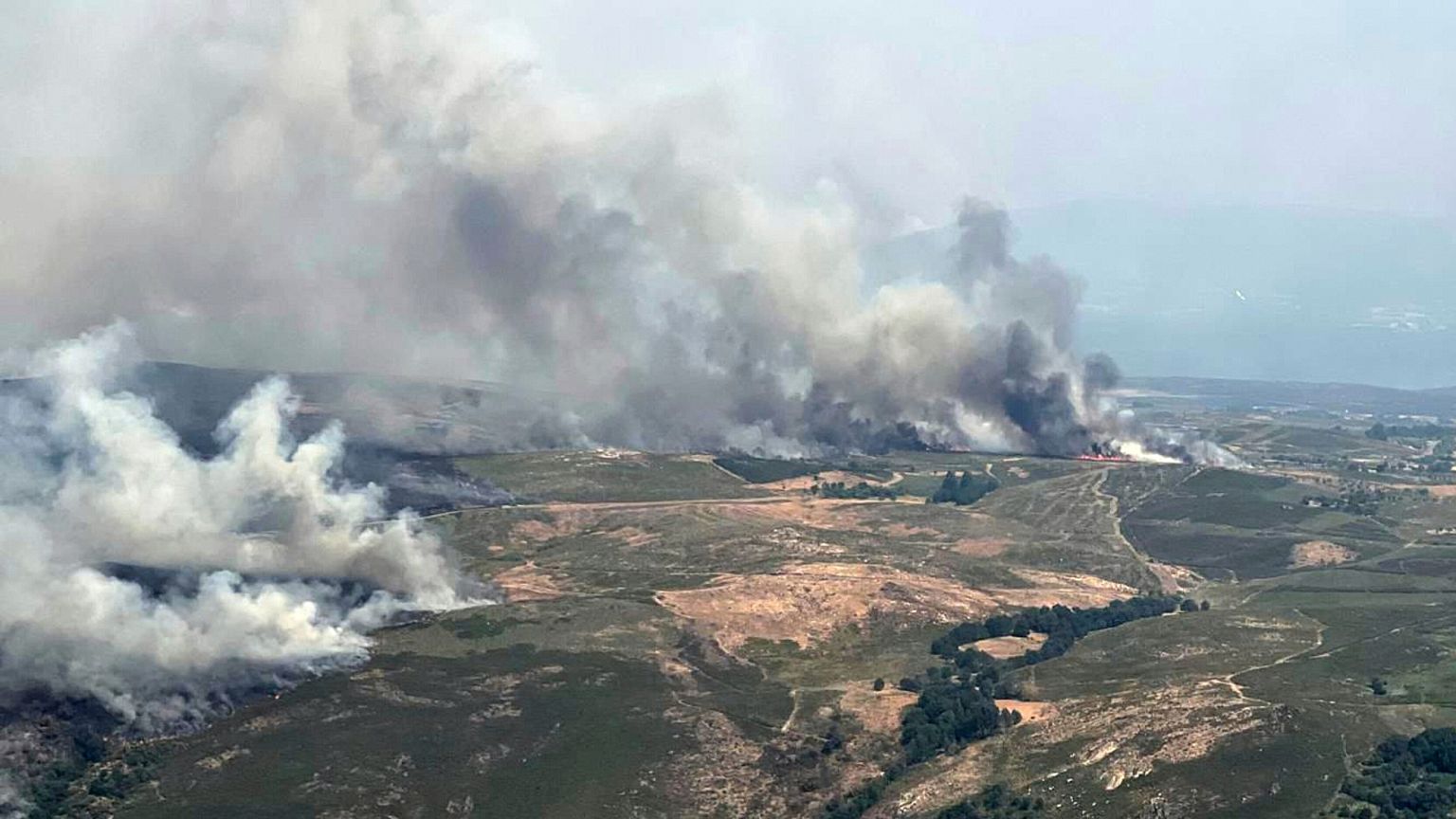
Wildfires continue to burn across southern Europe amid an ongoing heatwave that has challenged efforts to contain the blazes, while temperatures are set to climb over the weekend.
Spain is currently fighting 14 major fires, according to Virginia Barcones, general director of emergency services.
“Today will once again be a very tough day, with an extreme risk of new fires,” Spanish Prime Minister Pedro Sánchez wrote on X.
Three people have died in Spain as a result of the fires, including two volunteer firefighters. Sánchez expressed support for the family of the second volunteer, who died in a hospital in León on Thursday after suffering severe burns.
First death from fires in Portugal
In Portugal, nearly 4,000 firefighters were battling fires on Friday. Seven major fires were active. Authorities extended the state of alert until Sunday as high temperatures are expected to last through the weekend.
In the Guarda district, a lack of resources is hampering efforts to subdue the flames. Fires have spread to the neighbouring municipalities of Pinhel and Trancoso.
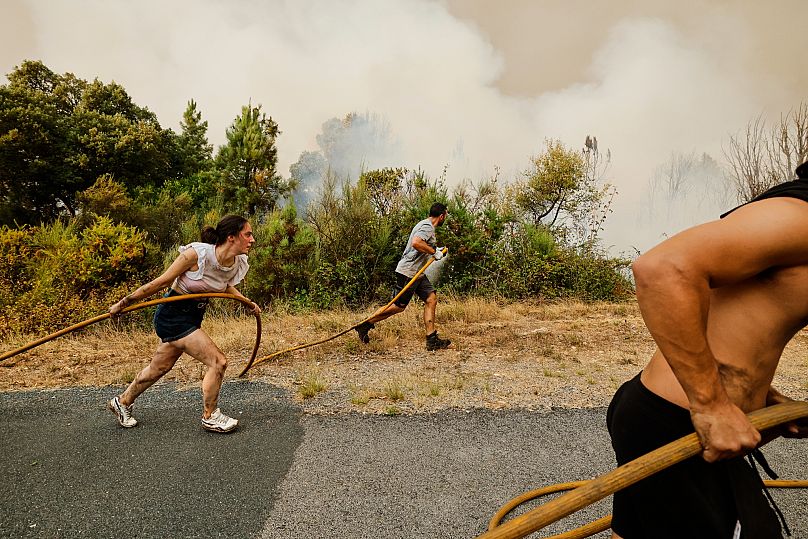
In the village of Alverca da Beira, the flames reached an abandoned house. Concern for other neighbouring houses led dozens of people to try to extinguish the fire with their own means.
Copyright Securite Civile via AP
By Emma De Ruiter
Published on 16/08/2025 -
Firefighters in Spain, Portugal, Greece and Turkey continue to battle wildfires that have raged on for weeks. Hot and dry conditions are expected to persist, challenging efforts to contain the blazes.
Wildfires continue to burn across southern Europe amid an ongoing heatwave that has challenged efforts to contain the blazes, while temperatures are set to climb over the weekend.
Spain is currently fighting 14 major fires, according to Virginia Barcones, general director of emergency services.
“Today will once again be a very tough day, with an extreme risk of new fires,” Spanish Prime Minister Pedro Sánchez wrote on X.
Three people have died in Spain as a result of the fires, including two volunteer firefighters. Sánchez expressed support for the family of the second volunteer, who died in a hospital in León on Thursday after suffering severe burns.
Local residents and volunteers work together to battle an encroaching wildfire in Larouco, northwestern Spain, Aug. 13, 2025. AP Photo/Lalo R. Villar
The national weather agency AEMET warned of extreme fire risk in most of the country, including where the largest blazes were burning in the north and west. A heatwave which brought temperatures exceeding 40C on several days this month is expected to last through Monday.
Fires in the Galicia region forced the closure of several highways. The high speed rail line connecting it to Spain's capital Madrid remained suspended.
The fires in Spain this year have burned 158,000 hectares of land, according to the European Union’s European Forest Fire Information System. That is an area roughly as big as metropolitan London.
The national weather agency AEMET warned of extreme fire risk in most of the country, including where the largest blazes were burning in the north and west. A heatwave which brought temperatures exceeding 40C on several days this month is expected to last through Monday.
Fires in the Galicia region forced the closure of several highways. The high speed rail line connecting it to Spain's capital Madrid remained suspended.
The fires in Spain this year have burned 158,000 hectares of land, according to the European Union’s European Forest Fire Information System. That is an area roughly as big as metropolitan London.
First death from fires in Portugal
In Portugal, nearly 4,000 firefighters were battling fires on Friday. Seven major fires were active. Authorities extended the state of alert until Sunday as high temperatures are expected to last through the weekend.
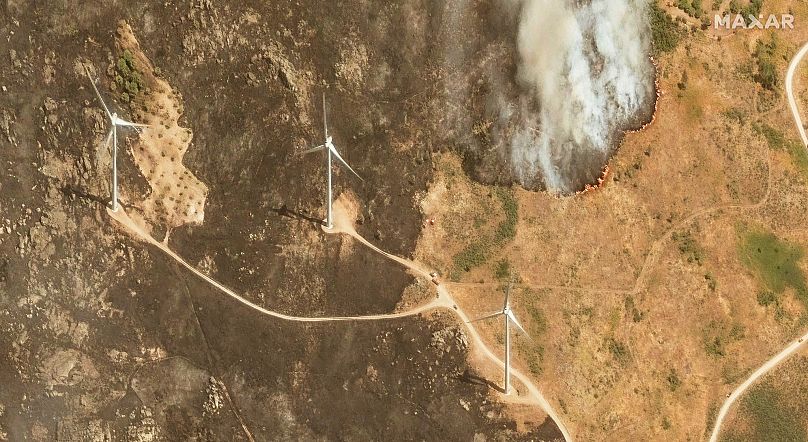
In the Guarda district, a lack of resources is hampering efforts to subdue the flames. Fires have spread to the neighbouring municipalities of Pinhel and Trancoso.
In the village of Alverca da Beira, the flames reached an abandoned house. Concern for other neighbouring houses led dozens of people to try to extinguish the fire with their own means.
This satellite image provided by Maxar Technologies shows an active fire line for a wildfire in Trancoso, Portugal, Tuesday, Aug. 12, 2025. AP/Satellite image
©2025 Maxar Technologies
On Saturday, the charred body of the former mayor of Vila Franca do Deão was found, making him the first fatality of the forest fires ravaging the country this summer.
The Portuguese government had on Friday requested assistance from the EU’s civil protection mechanism, a firefighting force that European countries in need can call upon. A day earlier, Spain received two Canadair water bomber aircraft after requesting EU help to tackle blazes for the first time ever.
In the past week, Greece, Bulgaria, Montenegro and Albania have also requested help from the EU’s firefighting force to deal with forest fires. The force has already been activated as many times this year as the entirety of last year's fire season.
New evacuation orders issued in Greece
On Friday, a wildfire in Greece burned out of control for a fourth day on the island of Chios, prompting several more overnight evacuations.
Two water-dropping planes and two helicopters were operating in the north of the island in the eastern Aegean Sea, where local authorities said a lull in high winds was helping firefighters early Friday.
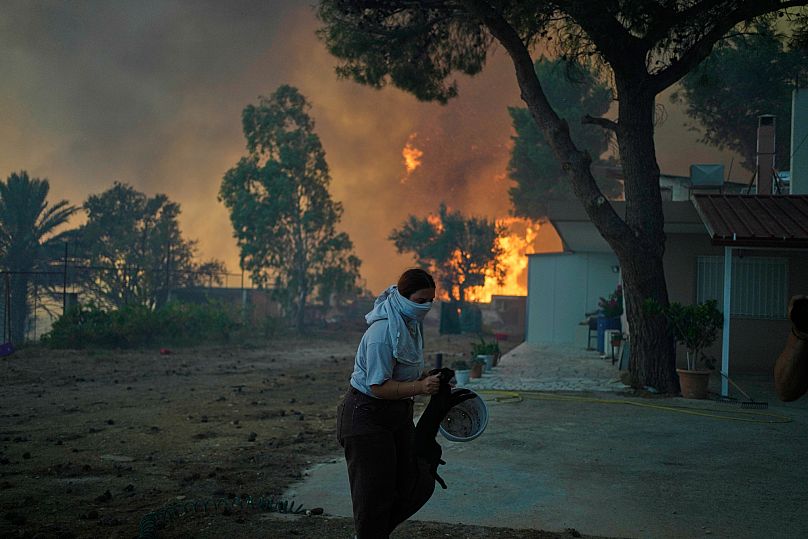
Following a series of large fires in western Greece earlier this week, the fire service was on alert outside Athens and nearby areas in the south of the country where adverse weather conditions elevated the fire risk.
On Saturday, the charred body of the former mayor of Vila Franca do Deão was found, making him the first fatality of the forest fires ravaging the country this summer.
The Portuguese government had on Friday requested assistance from the EU’s civil protection mechanism, a firefighting force that European countries in need can call upon. A day earlier, Spain received two Canadair water bomber aircraft after requesting EU help to tackle blazes for the first time ever.
In the past week, Greece, Bulgaria, Montenegro and Albania have also requested help from the EU’s firefighting force to deal with forest fires. The force has already been activated as many times this year as the entirety of last year's fire season.
New evacuation orders issued in Greece
On Friday, a wildfire in Greece burned out of control for a fourth day on the island of Chios, prompting several more overnight evacuations.
Two water-dropping planes and two helicopters were operating in the north of the island in the eastern Aegean Sea, where local authorities said a lull in high winds was helping firefighters early Friday.
Following a series of large fires in western Greece earlier this week, the fire service was on alert outside Athens and nearby areas in the south of the country where adverse weather conditions elevated the fire risk.
A woman takes away a cat as the fire approaches a house during a wildfire in Patras city, western Greece, Wednesday, Aug. 13, 2025. AP Photo/Thanassis Stavrakis
Firefighters in Turkey also continued to tackle fires across several provinces, and many appeared to be largely contained by Saturday.
Scientists say that climate change is exacerbating the frequency and intensity of heat and dryness in parts of Europe, making the region more vulnerable to wildfires.
The burning of fossil fuels like coal and gas releases heat-trapping gases, which are the primary driver of climate change.
Europe has been warming twice as fast as the global average since the 1980s, according to the EU’s Copernicus Climate Change Service.
The EU monitoring agency says that 2024 was the hottest year on record both globally and in Europe, which experienced its second-highest number of "heat stress" days.
Firefighters in Turkey also continued to tackle fires across several provinces, and many appeared to be largely contained by Saturday.
Scientists say that climate change is exacerbating the frequency and intensity of heat and dryness in parts of Europe, making the region more vulnerable to wildfires.
The burning of fossil fuels like coal and gas releases heat-trapping gases, which are the primary driver of climate change.
Europe has been warming twice as fast as the global average since the 1980s, according to the EU’s Copernicus Climate Change Service.
The EU monitoring agency says that 2024 was the hottest year on record both globally and in Europe, which experienced its second-highest number of "heat stress" days.

No comments:
Post a Comment