‘Palestine recognition is the first, not final, step to achieving a durable peace’
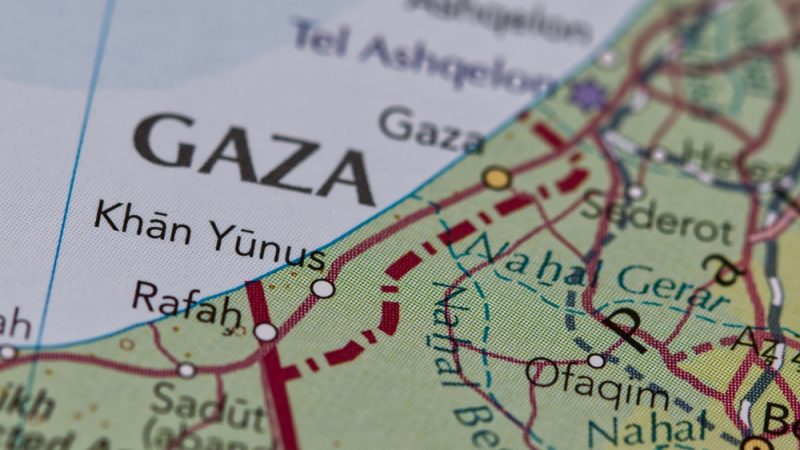
The renewed diplomatic momentum for a political pathway towards peace laid out by the UK, France and Canada marks a defining moment in the pursuit of peace, one that must be met with resolve, not hesitation. This is an existential moment for the Palestinian people and the two-state solution.
Over the past 22 months, we have witnessed atrocities that defy comprehension. Starvation being used as a weapon of war, emaciated infants and babies born into a conflict with no end in sight, Hamas terrorists taking hostages and keeping them captive for months on end, armed settlers terrorising families and torching villages across the West Bank, with clear impunity.
The situation demands political courage, moral clarity and urgent international intervention.
‘The strategy of waiting for conditions to improve has failed’
A meaningful peace process has been absent for decades. The Likud Party’s founding charter rejects the establishment of a Palestinian state, votes in the Israeli Knesset have reaffirmed this position and today’s leadership has been clearly in its aims for full and permanent occupation; the recent approval of 22 new illegal settlements, proposals for internment camps in Gaza, and Minister Smotrich’s declared intent to impose full Israeli sovereignty over the West Bank, underscore a deliberate strategy to eliminate the legal and territorial foundations needed for a viable Palestinian state.
The strategy of waiting in the hope that conditions might improve has failed. In close coordination with our UN partners, the UK is embracing a shift towards a truly multilateral framework; by aligning with the 147 nations that already recognise the State of Palestine, we are laying the foundations for a renewed and credible political process rooted in justice and security, with the aim of securing peace and security for both Israelis and Palestinians.
READ MORE: ‘Unilateral recognition won’t end Gaza’s suffering – a genuine peace process will’
‘This is not about legitimising or rewarding Hamas’
Recognition is neither a reward for one party nor a punishment for another; it is a long-overdue affirmation of the Palestinian people’s unconditional right to exist and live freely in a state of their own. It is a central foundation on which a peaceful future can be built. Peace is not made between occupier and occupied; it can only exist between equals
This is not about legitimising or rewarding Hamas, who need to release the hostages and play no future role in governing Gaza. The PLO, the Palestinian Authority and the Arab nations have publicly and repeatedly rejected any role for Hamas in a future Palestinian state and called for them to disarm. These are the partners for peace with whom need to build the foundations of a two state solution.
Equally, lasting peace in Israel requires credible partners. Prominent former officials—including Prime Ministers, military commanders, and intelligence chiefs—have warned that the current government’s pursuit of full and permanent occupation, including in Gaza, poses a serious threat to Israel’s long-term security and national interests.
The Memorandum of Understanding signed earlier this year by the UK and Palestinian Prime Ministers reaffirmed commitments to state building and governance reforms; the PA cannot be expected to build its capacity, reform, and meet arbitrary standards of statehood when the realities of the occupation are crippling its economy, stability, and territorial viability.
We must support a viable alternative to Hamas, under the authority of the PLO to govern a unified Gaza and West Bank, including East Jerusalem. At the same time, we must stand with pro-peace partners in Israel who are committed to negotiating a just and sustainable future with their Palestinian and regional neighbours. This is what the people of Israel want, to live in peace, security, and mutual recognition with their neighbours.
‘Calls to delay recognition serve only to entrench the status quo’
The only remaining argument against recognition is that the current Israeli government doesn’t want it. That cannot be our guiding principle. Calls to delay recognition until after negotiations serve only to entrench the status quo, granting the occupying power, Israel, an effective veto over Palestinian rights.
Similarly, calls to delay recognition until after the war in Gaza is over gives Hamas control over this which they do not deserve, and gives Israel a reason to continue the war while annexing the West Bank, and Gaza.
Recognition is not the silver bullet that will solve everything, not least the starvation being inflicted on Palestinian children. For that, we need an immediate and permanent ceasefire, the removal of Israeli restrictions on aid entering Gaza and all remaining hostages to be freed.
But the momentum is shifting and a new pathway is emerging, the first step towards a just and lasting peace is clear, recognise the State of Palestine, and work with international partners to build a credible political process that ensures peace, security, and prosperity for both peoples.
Sarah Owen is a co-chair of Labour Friends of Palestine and the Middle East (LFPME).

‘The Palestine Action ban risks being heavy-handed and counterproductive’
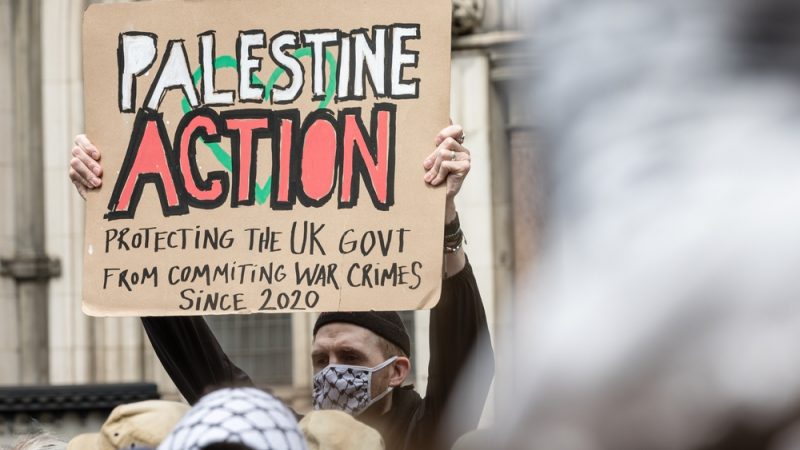
The Home Secretary’s decision to proscribe Palestine Action (PA) as a terrorist organisation has caused a lot of controversy. But is the enforcement of one aspect of the ban – the prohibition on expressing views that support PA in a way that is reckless as to whether those hearing those views will be encouraged to support PA – now causing more problems than it is worth?
There is no doubt that PA met the legal test for proscription under sections 1 and 3 of the Terrorism Act 2000, on the basis of PA’s actions. Its actions included not just the well-publicised attack on RAF facilities at Brize Norton but also attacks on the defence industry, financial firms, charities, universities and government buildings: attacks which included the use of pyrotechnics endangering threats of serious violence against employees and bystanders.
The powers to proscribe under the Terrorism Act include cases where an organisation uses or threatens serious damage to property as a way of influencing the government or intimidating the public in order to advance a political objective.
Whether those powers go too far is a matter of opinion: but those on the left who say that they do go too far should reflect on how they would want to treat an organisation that, say, carried out serious damage to NHS property or medical device producers in support of a campaign to ban abortion.
‘Pressure on a not always obvious distinction’
The main effect of proscription is to make it an offence to be a member of the organisation: it also criminalises conduct relating to meetings, flags and uniforms, support, and funding. But two particular effects have turned out to be more problematic in this case.
The first is the effect spelt out in section 12(1A) of the Terrorism Act. That section makes it an offence to “express an opinion or belief that is supportive of a proscribed organisation” while being “reckless as to whether a person to whom the expression is directed will be encouraged to support a proscribed organisation”. The second is section 13, which (among other things) makes it an offence to carry an item that gives rise to suspicion that you are a supporter of a proscribed organisation.
As it happens, the Court of Appeal has already decided (in a case called ABJ) that section 12(1A) is in principle a proportionate and lawful interference with the right to free expression set out in Article 10 of the European Convention on Human Rights and incorporated into UK law by the Human Rights Act 1998.
However, in this particular case, and given the widespread and passionate support for the Palestinian cause in current circumstances, the effect of proscribing PA has been to put a lot of pressure on the not always obvious distinction between supporting PA and the cause it claims to promote, and on the often tricky question of whether a someone who makes a supportive statement is being reckless as to whether it will encourage support for PA.
‘Consequences that look ridiculous and heavy-handed’
That fact lies behind one of the only two grounds of challenge to the proscription decision accepted by the High Court as being arguable, namely one based on Article 10 ECHR (the other ground being a procedural issue). (As a side note, anyone who claims that decisions of this kind show that there is no difference between Labour and the Tories/Reform should be reminded that under Labour there is no danger of leaving the ECHR or repealing the Human Rights Act.)
But quite apart from the legal issue, the practical difficulty with drawing fine lines of this kind in areas of hot public contention on the streets is that the police are not – and cannot be expected to be – always masters of subtlety or nuance.
So you end up with consequences that look ridiculous and heavy-handed: protesters being warned about (or even arrested for) slogans that support the Palestinian cause rather than PA; and a tendency to forget that a mere statement of support for PA is not enough to amount to an offence (as there also has to be recklessness as to whether it encourages support for PA).
Further, section 13 means that anyone – even an entirely non-violent elderly person – who carries a placard stating that they support PA commits an offence under terrorism legislation: and that section has led to over 500 arrests last weekend.
‘When things are getting silly, time to change course’
What, then, should the government do about it? One obvious course of action that should be considered is some clear guidance to the police (and to protestors) as to what the offence actually is. But as Lord Anderson KC (who is a leading public law barrister and expert on terrorism legislation) pointed out in the debate on the proscription of PA in the House of Lords, section 12(1A) is bound to cause problems when proscribing an organisation whose cause attracts wide public support even though its methods do not: as he put it, that feature takes the proscription of PA into “sensitive territory”. The same point applies to section 13.
So there is in my view a case for looking again at this consequence of a proscription decision. There may be sensible tweaks to be made to the text of section 12(1A) or 13. There may also be a case for not extending the section 12(1A) or 13 prohibitions to all proscribed organisations, especially where the activity of the organisation (seriously harmful though it may be) is not centred around mass murder. A short Bill could be put through Parliament when it resumes next month to do either of those things.
Ultimately, any government needs to bear in mind the Monty Python law of politics: when things are getting silly, it is time to change course.


No comments:
Post a Comment