Partido Lakas ng Masa (the Philippines):
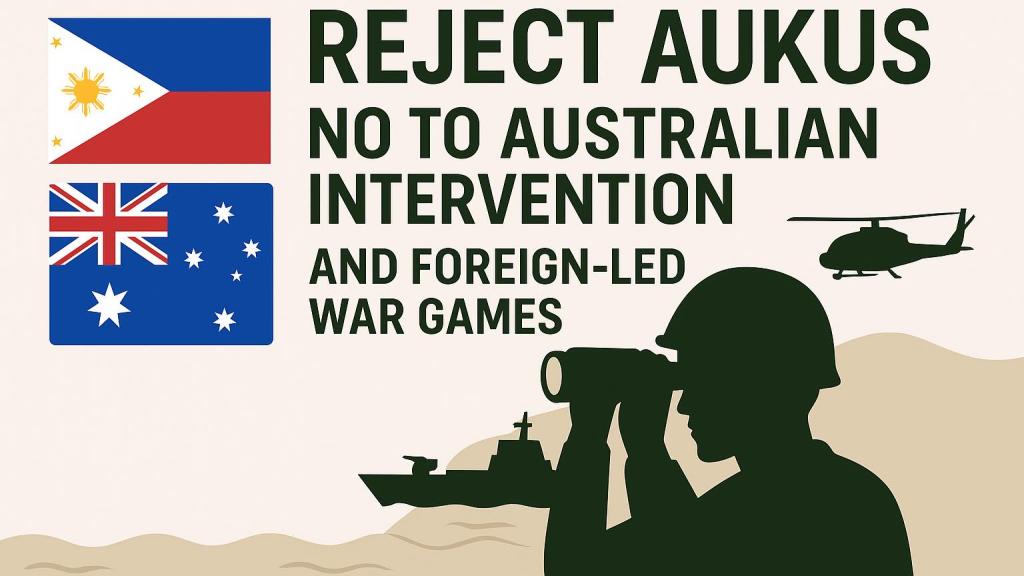
Reject AUKUS, no to Australian intervention and imperialist war games, no to US recolonisation
[Editor’s note: Filipino socialist activists Merck Maguddayao, Reihana Mohideen and Aya Clamor, from the Partido Lakas ng Masa (Party of the Labouring Masses), will be speaking at Ecosocialism 2025, September 5-7, Naarm/Melbourne, Australia. For more information on the conference visit ecosocialism.org.au.]
Exercise Alon 2025, which was staged off the islands of Palawan and Luzon and falsely cloaked in the rhetoric of “maritime security” and a “rules-based international order,” is part of the war games of imperialist powers. It thrusts the Philippines into the frontlines of the US-led strategy to contain China as an economic power, undermines our sovereignty and endangers peace in the region.
More than 3600 soldiers participated in Alon 2025, which took place between August 15-29. The Armed Forces of the Philippines deployed 1525 troops, while Australia sent 1600 troops, an infantry battalion, naval warships and advanced aircraft. The United States Marine Corps was also directly involved: a task group from the Marine Rotational Force — Darwin (MRF-D) joined the exercise with about 350 personnel.
The MRF-D is not a temporary training mission. It is a Marine Air-Ground Task Force permanently forward-deployed to northern Australia at RAAF Base Darwin. Its mission is to provide Washington with a strike-ready force, able to deploy rapidly into Southeast Asia and the South China Sea. By embedding MRF-D into Alon, the US is integrating the Philippines into its permanent Indo-Pacific war-fighting infrastructure.
Australia’s strategic role, AUKUS and Pine Gap
Australia’s role in Exercise Alon reflects more than loyalty to Washington — it is central to the Anglo-imperialist AUKUS military pact with the US and Britain. By committing to nuclear-powered submarines, long-range strike weapons and intelligence-sharing under AUKUS, Australia has tied its entire defence stance to Washington’s confrontation with China.
Australia’s Pine Gap base, near Alice Springs, plays a critical role in this architecture. Operated jointly with the US, Pine Gap is one of Washington’s most important intelligence and targeting hubs. Its satellite systems enable real-time surveillance and guide US drones, missiles and nuclear weapons across Asia.
Importantly, Pine Gap is also linked to the genocidal assault on Gaza. Investigations and whistleblower reports confirm that intelligence and targeting data from Pine Gap has been used to guide Israeli bombing raids, contributing to the mass killing of civilians and the destruction of hospitals, schools and refugee camps. This means that any US or Australian military intervention in our region — including exercises like Alon — is backed by a war machine that is already complicit in the genocide in Gaza.
Together, AUKUS and Pine Gap form the backbone of US-Australia intervention capacity in Asia. Their combined aim is clear:
• To contain China as an economic power, curbing its trade routes and growth;
• To project US and Western imperialist power into Southeast Asia, with the Philippines as a forward base;
• To reinforce Australia’s role as a junior partner and regional enforcer for US interests; and
• To integrate the Philippines into a war-fighting system already proven to facilitate genocide in Gaza.
Historical servility of the Filipino elite
This deepening US grip is not new. It has been enabled by the long history of servility of the Filipino ruling class — across all sides of the political spectrum — to Washington. From the “parity rights” agreements after so-called independence in 1946, to the Military Bases Agreement, the Visiting Forces Agreement (VFA), and today’s Enhanced Defense Cooperation Agreement (EDCA), every Philippine administration has bent to US dictates.
The Left has long referred to these leaders as “Amboy Presidents” — American boys groomed to defend US interests above Filipino sovereignty, trading away independence for their own political survival and class interests.
Military and economic subordination
Military dependence goes hand-in-hand with economic exploitation. Even as Washington deepens its military hold, it has imposed unfair trade measures: under Trump, tariffs of up to 19% on Philippine exports such as steel and agriculture undermine our industries, while US goods continue to enter tariff-free. This demonstrates the one-sidedness of the relationship — military subordination coupled with economic disadvantage.
Recolonisation, not cooperation
The results are clear:
• The Philippines is turned into a launchpad for US and Australian power projection;
• Our territory is being transformed into a battleground of US–China rivalry, not a zone of peace;
• Our economy is weakened by exploitative trade relations;
• Through AUKUS, our region is tied into US nuclear and strike capacity, heightening the risk of war and the very lives of our people; and
• Filipino sovereignty is being compromised by a ruling class that serves as Washington’s loyal clients.
This is not cooperation — it is recolonisation. Filipinos fought and won the removal of US bases in 1991. Today, through EDCA, VFA, AUKUS, Pine Gap and foreign-led war games like Alon 2025, those bases and alliances are being reintroduced in another form, now reinforced by US allies such as Australia.
We must resist this recolonisation. We demand:
• The dismantling of EDCA sites across the Philippines.
• The rejection of AUKUS and nuclear militarisation of the region.
• No to Australian intervention in Filipino and Southeast Asian affairs.
• An end to imperialist military exercises like Alon.
• The assertion of a genuinely independent foreign policy that upholds Philippine sovereignty and promotes peace, not militarisation for imperialist powers.
Partido Lakas ng Masa (Party of the Labouring Masses) International Desk
Think Tanker Demands for AUKUS: What
Australia Should do with US Submarines
The moment the security pact known as AUKUS came into being, it was clear what its true intention was. Announced in September 2021, ruinous to Franco-Australian relations, and Anglospheric in inclination, the agreement between Washington, London and Canberra would project US power in the Indo-Pacific with one purpose in mind: deterring China. The fool in this whole endeavour was Australia, with a security establishment so Freudian in its anxiety it seeks an Imperial Daddy at every turn.
To avoid the pains of mature sovereignty, the successive Australian governments of Scott Morrison and Anthony Albanese have fallen for the bribe of the nuclear-powered Virginia Class SSN-774 and the promise of a bespoke AUKUS-designed nuclear-powered counterpart. These submarines may never make their way to the Royal Australian Navy. Australia is infamously bad when it comes to constructing submarines, and the US is under no obligation to furnish Canberra with the boats.
The latter point is made clear in the 2023 National Defense Authorization Act, which directs the US President to certify to the relevant congressional committees and leadership no later than 270 days prior to the transfer of vessels that this “will not degrade the United States underseas capabilities”; is consistent with the country’s foreign policy and national security interests and furthers the AUKUS partnership. Furthering the partnership would involve “sufficient submarine production and maintenance investments” to meet undersea capabilities; the provision by Australia of “appropriate funds and support for the additional capacity required to meet the requirements”; and Canberra’s “capability to host and fully operate the vessels authorized to be transferred.”
In his March confirmation hearing as Undersecretary of Defense Policy, Eldridge Colby, President Donald Trump’s chief appointee for reviewing the AUKUS pact, candidly opined that a poor production rate of submarines would place “our servicemen and women […] in a weaker position.” He had also warned that, “AUKUS is only going to lead to more submarines collectively in 10, 15, 20 years, which is way beyond the window of maximum danger, which is really this decade.”
The SSN program, as such unrealised and a pure chimera, is working wonders in distorting Australia’s defence budget. The decade to 2033-4 features a total projected budget of A$330 billion. The SSN budget of A$53-63 billion puts nuclear powered submarines at 16.1% to 19.1% more than relevant land and air domains. A report by the Strategic Analysis Australia think tank did not shy away from these implications: “It’s hard to grasp how unusual this situation is. Moreover, it’s one that will endure for decades, since the key elements of the maritime domain (SSNs and the two frigate programs) will still be in acquisition well into the 2040s. It’s quite possible that Defence itself doesn’t grasp the situation that it’s gotten into.”
Despite this fantastic asymmetry of objectives, Australia is still being asked to do more. An ongoing suspicion on the part of defence wonks in the White House, Pentagon and Congress is what Australia would do with the precious naval hardware once its navy gets them. Could Australia be relied upon to deploy them in a US-led war against China? Should the boats be placed under US naval command, reducing Australia to suitable vassal status?
Now, yet another think tanking outfit, the Washington-based Center for Strategic and International Studies (CSIS), is urging Australia to make its position clear on how it would deploy the Virginia boats. A report, authored by a former senior AUKUS advisor during the Biden administration Abraham Denmark and Charles Edel, senior advisor and CSIS Australia chair, airily proposes that Australia offers “a more concrete commitment” to the US while also being sensitive to its own sovereignty. This rather hopeless aim can be achieved through “a robust contingency planning process that incorporates Australian SSNs.” This would involve US and Australian military strategists planning to “undergo a comprehensive process of strategizing and organizing military operations to achieve specific objectives”. Such a process would provide “concrete reassurances that submarines sold to Australia would not disappear if and when needed.” It might also preserve Australian sovereignty in both developing the plan and determining its implementation during a crisis.
In addition to that gobbet of hopeless contradiction, the authors offer some further advice: that the second pillar of the AUKUS agreement, involving the development of advanced capabilities, the sharing of technology and increasing the interoperability between the armed forces of the three countries, be more sharply defined. “AUKUS nations should consider focusing on three capability areas: autonomy, long-range strike, and integrated air defense.” This great militarist splash would supposedly “increase deterrence in both Europe and the Indo-Pacific.”
In terms of examples, President Trump’s wonky Golden Dome anti-missile shield is touted as an “opportunity for Pillar II in integrated air defense.” (It would be better described as sheer science fiction, underwritten by space capitalism.) Australia was already at work with their US counterparts in developing missile defence systems that could complement the initiative. Developing improved and integrated anti-missile defences was even more urgent given the “greatly expanding rotational presence of US military forces in Australia”.
This waffling nonsense has all the finery of delusion. When it comes to sovereignty, there is nothing to speak of and Australia’s security cadres, along with most parliamentarians in the major parties, see no troubles with deferring responsibility to the US imperium. In most respects, this has already taken place. The use of such coddling terms as “joint planning” and “joint venture” only serves to conceal the dominant, rough role played by Washington, always playing the imperial paterfamilias even as it secures its own interests against other adversaries.

No comments:
Post a Comment