Sergei Lavrov’s CCCP Sweatshirt and Putin/Trump’s Nostalgic Imaginations
August 29, 2025
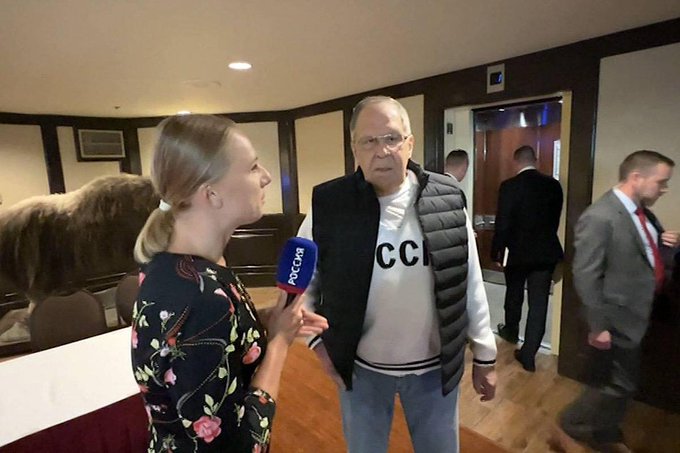
Photograph Source: @shanghaidaily – x.com
Russian Foreign Minister Sergei Lavrov wore a sweatshirt to the recent Alaska summit that vividly displayed his nostalgic imagination. Written in large Cyrillic letters was “CCCP” or USSR. Like Donald Trump’s red cap featuring the slogan “Make America Great Again,” Lavrov indicated that he, like Vladimir Putin, imagined the Russian Federation returning to its past glory as the Soviet Union. The 70-year-old leaders of the United States and Russia are in time warps. Geopolitics exists in linear time. Countries, like individuals, cannot return to their past glories in circular time.
Nostalgia for the past can be an obsession. I’m no exception. Each season I closely follow the results of the New York Yankees and the New York Knicks to see if they can repeat their past glories. (They have not won major championships since 2009 and 1973, respectively.) Mine is not a simple optimism about the Yankees and Knicks winning games; it is an optimism about the teams returning to their former championship status.
Now it is one thing to imagine a sports team returning to a past dominant position, it’s quite another to imagine a country returning to its past hegemonic role. Can countries or empires which were once dominant return to those previous situations? While sports seasons repeat the same number of games and similar formats to win the ultimate title, geopolitics evolves in time with no similar set of rules or formats. Baseball and basketball have regulated rules and procedures; geopolitics does not.
I know what the Yankees and Knicks need to do to win the World Series and NBA crown. I don’t know what has to happen for the Russian Federation to return to the glory of the Soviet Union. Or for the United States to be truly great again.
Edward Gibbon’s The History of the Decline and Fall of the Roman Empire and Paul Kennedy’s The Rise and Fall of Great Powers present similar temporal perspectives. Both describe how empires/hegemons rose and fell. Lavrov’s sweatshirt, and Trump’s omnipresent cap represent a different temporal perspective. Lavrov/Putin and Trump imagine that their empires/hegemons rose, fell, and will rise again.
When President Putin remarked in the post-summit that “a fair balance in the security sphere in Europe and the world as whole must be restored,” the emphasis was on restored. He implied that that is “the root causes” of the crisis with Ukraine. Putin’s nostalgic imagination is that the post 1945 Soviet Union’s regional hegemony and global power should be restored.
Trump’s cap says much the same. The American hegemonic rise also happened after World War II. The Vietnam War – if one needs a specific starting point – saw the decline of the United States. Trump’s cap’s slogan promises that he will return the U.S. to its post 1945 dominant position. When DJT says “Make America Great Again,” the emphasis is on Again.
Instead of linear time moving forward with new technologies and new geopolitics, Lavrov, Putin, and Trump imagine circular time going back to something that was before. Restored and Again are the keywords. So just as sports team repeat how the game is played, the nature of the schedule and the criteria for becoming champions, Lavrov, Putin, and Trump see geopolitics as circular in time as well.
But geopolitics and sports are not the same. European countries like Spain, Portugal, France, England, and the Netherlands all had their historic periods of geopolitical glory. They all had extraterritorial moments of domination. Today, none of their leaders envisions a return to that position. (The British Commonwealth of Nations is not the same as when “the Sun Never Set on the British Empire.”)
Sports teams can return to their previous glory. Individual athletes, politicians, and movie stars may make comebacks; empires/hegemons cannot.
And who is imagining a return to past glory? Sergei Lavrov is 75 years-old, Vladimir Putin 72 years-old, and Donald Trump is 79 years-old. All three are caught in the same nostalgic imagination. All three aging leaders project their temporal decline on a geopolitical imagination of a return to their countries’ past glories under their leadership. All three are caught in the same nostalgic time warp.
Individually, we would all like to remain young and healthy. We would all like to de-age and increase our longevity. Botox, plastic surgery, injections, exercise and pills are all part of that effort to counter linear time. Pictures of Putin’s physical prowess are regularly presented to defy his 72 years. Trump loves to show himself energetically playing golf; he often mocked Joe Biden’s age when he himself was in his late 70s. His favorite songs, the oldies but goodies his staffers play when he is in a bad mood, are “Memory” from Cats, and the Rolling Stones’ “You Can’t Always Get What You Want.”
Lavrov/Putin and Trump have taken the personal narrative of countering aging to a nostalgic, geopolitical level. 70 year-old men’s desires to maintain their youth has become part of a larger geopolitical narrative. Science may have succeeded in the de-extinction of the dire wolf, but there is no indication it will succeed with infinitely prolonging human longevity or restoring a country’s empire. Empires/hegemons rise and fall; they do not rise again. History may repeat itself in different forms, but geopolitics does not. Nostalgia for the past has its limits. And seventy year-old men should act their ages.
Russia’s Foreign Minister Cites NATO Expansion as Cause of Ukraine War
THAT'S THE PARTY LINE

Photograph Source: Kremlin.ru – CC BY 4.0
Russian Foreign Minister Sergei Lavrov told an NBC interviewer last week that the expansion of the North Atlantic Treat Organization was a “violation of Russian security interests” and one of the “root causes” of the war against Ukraine. Russian officials have made these statements in their private meetings with American counterparts, but this is the most explicit public statement since the start of the war three and a half years ago. The conventional wisdom in the United States does not accept NATO expansion as a cause of the war, but I’ve been arguing since the war began that there was such linkage.
Lavrov’s comments make it clear that an end to the war with Ukraine include security guarantees for Russia as well as for Ukraine. It’s unlikely that anyone in the Trump administration understands this linkage, which means that the war is not about to reach a negotiated solution. The United States simplistically blames only President Vladimir Putin for the start of the war, but no Russian leader would have accepted the extensive U.S. and NATO buildup on Russia’s western border.
Lavrov has been critical of Trump’s failure to discuss specifics of a negotiated end to the war, which is typical of Trump’s lack of process in dealing with difficult geopolitical issues. When asked about security guarantees, Trump responded that “We haven’t even discussed the specifics.” Trump still proclaims that he doesn’t know which side to blame for the start of the war. His most absurd statement regarding the war: “We’ll know which way I’m going, because I’m going tot go one way or the other,” he told reporters last week.
In addition to limits on Ukraine’s military buildup and the occupation in Ukraine by western forces, the Russians will push for limits on Western troops based in East Europe, an end to the deployment of a regional missile defense system as well as an end to the permanent deployment of German troops in such Baltic states as Lithuania. Russia will press for limits on U.S. bases in Poland and Romania as well. Even before the war began, Putin in December 2021 proclaimed that Russia demanded talks on the NATO threat to Russian national security.
Lavrov also stated that Ukraine has the “right to exist,” but only if it stops the cultural and linguistic limits on ethnic Russians and Russian speakers who the Kremlin believes “belong to Russian culture.” The majority of the population on the Donbas is ethnic Russian. For the past 30 years, Russian leaders have claimed it is their “duty” to protect those who share the values of the Russian language and the “Russian world” (“Russkiy mir”). Moscow uses the term “near abroad” to defend its support and protection for Russian ethnics throughout the former Soviet empire. Kazakhstan, with its large ethnic Russian population could be a target of similar Russian expansionism.
The Trump administration and U.S. policymakers in general do not seem cognizant of the fact that actions Washington has taken over the past 25 years in East and Central Europe are threatening to Russia. Since the collapse of the Soviet Union in 1991, every U.S. administration has taken advantage of Russia’s national security weakness to expand the U.S. role in the region. Presidents Clinton and Bush ignored warnings not to expand NATO.
Clinton was also responsible for NATO’s bombardment of Serbia 1999 without a UN mandate and without touching base with the Kremlin, which has had a special relationship with Serbia for generations. The Bush administration was a strong supporter of the “color revolutions” in Georgia and Ukraine, where Putin believed there was a strong U.S. and CIA covert role. It was the provocative actions of the Georgian government in disputed territories that led to brief Russian military intervention in 2008. Bush clearly overplayed his hand in threatening Russia by pursuing a special relationship with a strongly nationalistic Georgia.
Bush overlooked the warnings from German Chancellor Angela Merkel to avoid encouraging NATO membership for Georgia and Ukraine. The hardliners in the administration backed off somewhat, but only reluctantly. Bush’s forever wars in Iraq and Afghanistan were perceived as threatening to Moscow because they contributed to greater insurgency and terrorism in areas close to Russia’s borders. The United Sates could have pursued diplomacy to coordinate actions with Russia in these areas, but no U.S. administration was willing to take Moscow seriously in view of Russia’s political, military, and economic weakness. Putin actually offered significant assistance to the United States in the wake of the 9/11 attacks in New York and Washington,
Meanwhile, U.S. policymakers and political analysts as well as the mainstream media totally dismiss the idea that NATO expansion had anything to do with Russia’s use of force. The New York Times and the Washington Post particularly dismissed the idea that “NATO provoked Russia’s invasion.” Again, the conventional wisdom was that Russia was engaging in an “illegitimate response to the hostile actions of a democracy.”
There is good reason for Moscow to believe that the expansion of NATO was a marker of Washington’s return to containment and a threat to its national security. Russia was angered about the expansion from the outset, particularly since President George H.W. Bush and Secretary of State James Baker had assured their Russian counterparts that the United States would not “leap frog” over Germany if the Soviets pulled their 380,000 troops out of East Germany in order to reunify the German state. The past five administrations have pursued a policy of militarism in Europe toward Russia. Contemporary foreign policy experts anticipate a Putin threat to NATO beyond the threat to Ukraine, which portends greater U.S. pressure on Russia. Meanwhile, NATO expansion virtually ensures that a Cold War will exist between the West and Russia for the near future.

No comments:
Post a Comment