WWIII
The Philippines and China accused each other on Sunday of responsibility for a maritime confrontation near disputed islands in the South China Sea, in the latest flare-up of long-simmering territorial disputes over the resource-rich waterway.
Issued on: 12/10/2025
By: FRANCE 24
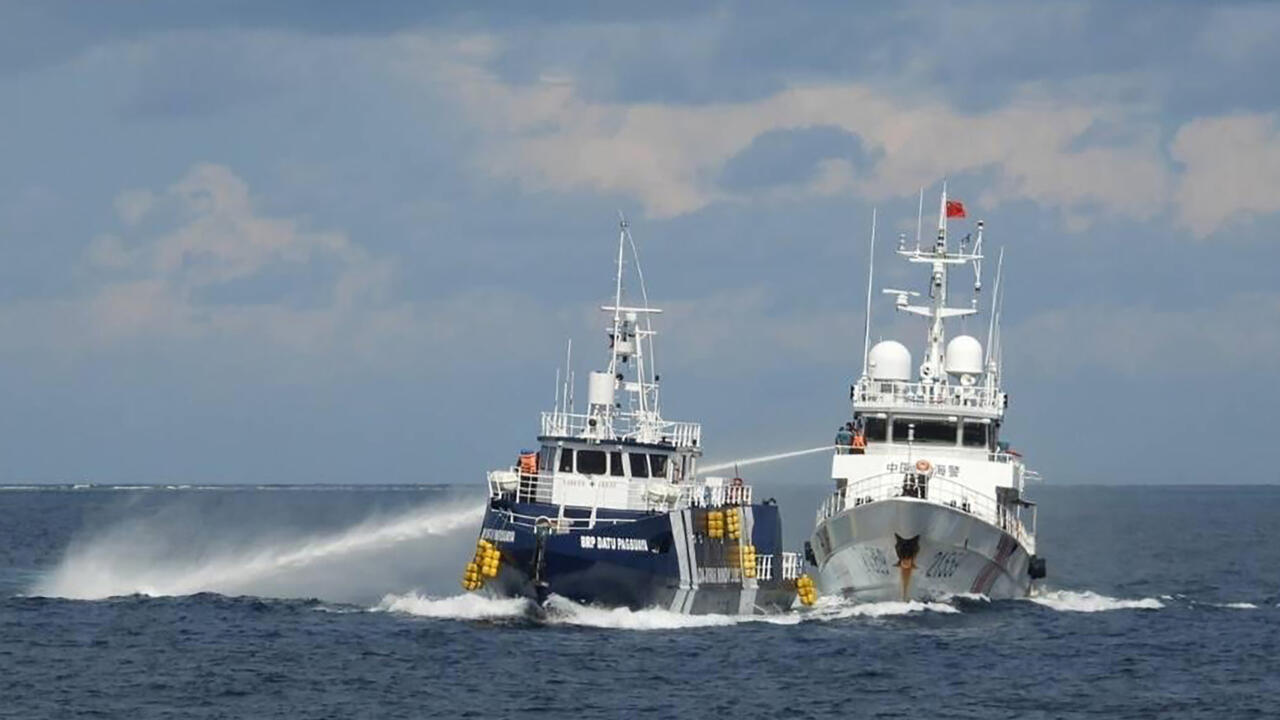
This handout photo taken and released on October 12, 2025 by the Philippine Coast Guard shows a China Coast Guard ship (right) using water cannon against a Philippine Bureau of Fisheries vessel in disputed waters of the South China Sea. © Philippine Coast Guard handout via AFP
The Philippines said a Chinese ship deliberately rammed one of its government vessels in the disputed South China Sea on Sunday, though Beijing blamed Manila for the incident.
Confrontations between Philippine and Chinese vessels occur frequently in the contested waterway, which Beijing claims nearly in its entirety despite an international ruling that its assertion has no legal basis.
The Philippines said a Chinese coast guard ship "fired its water cannon" at the BRP Datu Pagbuaya, a vessel belonging to Manila's fisheries bureau, at 9:15am (0115 GMT) on Sunday.
"Just three minutes later... the same (Chinese) vessel deliberately rammed the stern" of the Philippine boat, "causing minor structural damage but no injuries to the crew", the statement said.
Manila's coast guard said the incident took place near Thitu Island, part of the Spratly Islands where Beijing has sought to assert its sovereignty claims for years.
China's coast guard said the incident occurred after a Philippine vessel entered waters near Sandy Cay, "ignored repeated stern warnings from the Chinese side, and dangerously approached" the Chinese ship.
"Full responsibility lies with the Philippine side," spokesman Liu Dejun said in an online statement.
Photos and videos released by the Philippine Coast Guard showed a China Coast Guard vessel – with its activated water cannon – shadowing a Philippine ship.
"Despite these bullying tactics and aggressive actions... we will not be intimidated or driven away," the Philippine Coast Guard said.
The incident is the latest in a string of recent flare-ups between Beijing and Manila in the South China Sea, a busy waterway through which more than 60 percent of global maritime trade passes.
Last month, the Philippine government said one person was injured when a water cannon attack by a China Coast Guard vessel shattered a window on the bridge of another fisheries bureau ship, the BRP Datu Gumbay Piang, near the Beijing-controlled Scarborough Shoal.
And in August, a Chinese navy vessel collided with one from its own coast guard while chasing a Philippine patrol boat near the same shoal.
China seized control of the fish-rich shoal from the Philippines after a lengthy standoff in 2012.
The Philippines had voiced opposition to China's plans for a "nature reserve" there, calling it a pretext for the eventual occupation of the site.
(FRANCE 24 with AFP)
The Philippines said a Chinese ship deliberately rammed one of its government vessels in the disputed South China Sea on Sunday, though Beijing blamed Manila for the incident.
Confrontations between Philippine and Chinese vessels occur frequently in the contested waterway, which Beijing claims nearly in its entirety despite an international ruling that its assertion has no legal basis.
The Philippines said a Chinese coast guard ship "fired its water cannon" at the BRP Datu Pagbuaya, a vessel belonging to Manila's fisheries bureau, at 9:15am (0115 GMT) on Sunday.
"Just three minutes later... the same (Chinese) vessel deliberately rammed the stern" of the Philippine boat, "causing minor structural damage but no injuries to the crew", the statement said.
Manila's coast guard said the incident took place near Thitu Island, part of the Spratly Islands where Beijing has sought to assert its sovereignty claims for years.
China's coast guard said the incident occurred after a Philippine vessel entered waters near Sandy Cay, "ignored repeated stern warnings from the Chinese side, and dangerously approached" the Chinese ship.
"Full responsibility lies with the Philippine side," spokesman Liu Dejun said in an online statement.
Photos and videos released by the Philippine Coast Guard showed a China Coast Guard vessel – with its activated water cannon – shadowing a Philippine ship.
"Despite these bullying tactics and aggressive actions... we will not be intimidated or driven away," the Philippine Coast Guard said.
The incident is the latest in a string of recent flare-ups between Beijing and Manila in the South China Sea, a busy waterway through which more than 60 percent of global maritime trade passes.
Last month, the Philippine government said one person was injured when a water cannon attack by a China Coast Guard vessel shattered a window on the bridge of another fisheries bureau ship, the BRP Datu Gumbay Piang, near the Beijing-controlled Scarborough Shoal.
And in August, a Chinese navy vessel collided with one from its own coast guard while chasing a Philippine patrol boat near the same shoal.
China seized control of the fish-rich shoal from the Philippines after a lengthy standoff in 2012.
The Philippines had voiced opposition to China's plans for a "nature reserve" there, calling it a pretext for the eventual occupation of the site.
(FRANCE 24 with AFP)
Philippines says China rammed their ship in South China Sea
What did the Philippines say?
The Philippine Coast Guard said three vessels, including the government's BRP Datu Pagbuaya. were anchored near the Manila-controlled island as part of a government program to protect local fishermen when a Chinese ship approached and intimidated them by using water cannon.
An hour later, the Chinese vessel is said to have used water cannon directly at the BRP Datu Pagbuaya.
"Just three minutes later... the same (Chinese) vessel deliberately rammed the stern" of the Philippine boat, "causing minor structural damage but no injuries to the crew", the coast guard's statement said.
How did China respond?
China has blamed the Philippines for the collision, saying it bears "full responsibility."
The Chinese Coast Guard released a statement in response saying two Philippine government vessels "illegally entered" the waters without authorization and "dangerously approached" a coast guard ship, resulting in a collision.
The Chinese Coast Guard "lawfully" took control measures against the said vessels and expelled them, it said.
Edited by: Darko Janjevic
DW with AFP and Reuters
12/10/2025
Manila has decried the incident as a "clear threat" from China, while Beijing insists the Philippines' vessels bear "full responsibility" for the collision in the long-disputed naval region.
The Philippines, on Sunday, accused a Chinese ship of deliberately colliding with a Philippine vessel anchored near an island in the disputed South China Sea.
Chinese maritime forces used water cannon and rammed a Filipino government ship near the Thitu Island, according to Manila. The Philippines' officials described the incident as a "clear threat" from Beijing.
Such confrontations between Chinese and Philippine vessels have grown increasingly common in recent years. China claims nearly all of the South China Sea which is a crucial path for over $3 trillion (€ 2.58 trillion) in annual ship trade.
In 2016, the Permanent Court of Arbitration in The Hague ruled that most of China's claims in the South China Sea, particularly on its resources, had no basis in international law. It was a landmark victory for the Philippines but the issue remains rife nearly a decade later, and China continues raising the pressure on Manila and other naval rivals to comply with Beijing's stance.
Parts of the waters are also claimed by Brunei, Indonesia, Malaysia and Vietnam.
Tensions between Manila and Beijing have been rising steadily through the year, especially over a prime fishing location in the disputed waters.
The Philippines, on Sunday, accused a Chinese ship of deliberately colliding with a Philippine vessel anchored near an island in the disputed South China Sea.
Chinese maritime forces used water cannon and rammed a Filipino government ship near the Thitu Island, according to Manila. The Philippines' officials described the incident as a "clear threat" from Beijing.
Such confrontations between Chinese and Philippine vessels have grown increasingly common in recent years. China claims nearly all of the South China Sea which is a crucial path for over $3 trillion (€ 2.58 trillion) in annual ship trade.
In 2016, the Permanent Court of Arbitration in The Hague ruled that most of China's claims in the South China Sea, particularly on its resources, had no basis in international law. It was a landmark victory for the Philippines but the issue remains rife nearly a decade later, and China continues raising the pressure on Manila and other naval rivals to comply with Beijing's stance.
Parts of the waters are also claimed by Brunei, Indonesia, Malaysia and Vietnam.
Tensions between Manila and Beijing have been rising steadily through the year, especially over a prime fishing location in the disputed waters.
Who's challenging Beijing in the South China Sea? 15:26
What did the Philippines say?
The Philippine Coast Guard said three vessels, including the government's BRP Datu Pagbuaya. were anchored near the Manila-controlled island as part of a government program to protect local fishermen when a Chinese ship approached and intimidated them by using water cannon.
An hour later, the Chinese vessel is said to have used water cannon directly at the BRP Datu Pagbuaya.
"Just three minutes later... the same (Chinese) vessel deliberately rammed the stern" of the Philippine boat, "causing minor structural damage but no injuries to the crew", the coast guard's statement said.
How did China respond?
China has blamed the Philippines for the collision, saying it bears "full responsibility."
The Chinese Coast Guard released a statement in response saying two Philippine government vessels "illegally entered" the waters without authorization and "dangerously approached" a coast guard ship, resulting in a collision.
The Chinese Coast Guard "lawfully" took control measures against the said vessels and expelled them, it said.
Edited by: Darko Janjevic

No comments:
Post a Comment