Beekeepers in eastern France are racing to contain an explosion in numbers of Asian hornets since 2023 that is devastating hives.
Issued on: 16/11/2025 - RFI
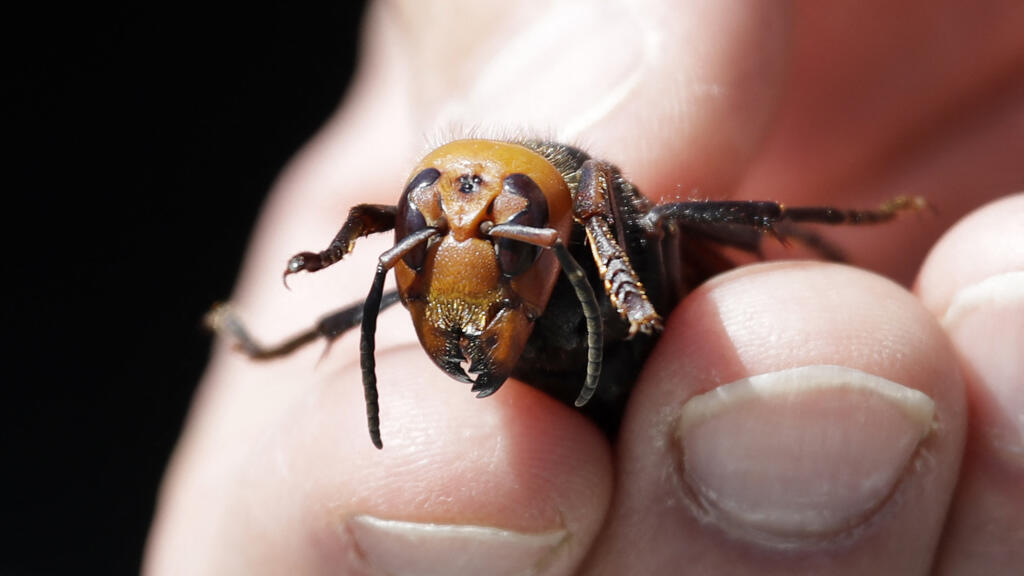
The Asian hornet is one of the best-known invasive alien species in Europe.
AFP - ELAINE THOMPSON
Armed with thermal-imaging binoculars, beekeepers in Alsace have taken to tracking insects with forensic zeal.
Their target is the Asian hornet, an invasive predator whose numbers have surged across the region over the past two years, wreaking havoc on local bee populations.
“For me, nest-hunting has become part of the job. If I want to keep beekeeping, I don’t have a choice,” says Mathieu Diffort, who runs around 100 hives in the rural Sundgau, near the Swiss border.
Diffort and his business partner, Philippe Sieffert of the Api&Co bee and enviromantal protection company, spend much of their season in the painstaking business of locating and destroying hornet nests.
Armed with thermal-imaging binoculars, beekeepers in Alsace have taken to tracking insects with forensic zeal.
Their target is the Asian hornet, an invasive predator whose numbers have surged across the region over the past two years, wreaking havoc on local bee populations.
“For me, nest-hunting has become part of the job. If I want to keep beekeeping, I don’t have a choice,” says Mathieu Diffort, who runs around 100 hives in the rural Sundgau, near the Swiss border.
Diffort and his business partner, Philippe Sieffert of the Api&Co bee and enviromantal protection company, spend much of their season in the painstaking business of locating and destroying hornet nests.
Public reports
The yellow-legged hornet first arrived in France in 2004, but only reached the Haut-Rhin in 2023. It is now firmly entrenched, warns Sean Durkin, the local representative of the Bee Health Defence Group (GDSA), which is scrambling to contain the spread.
Between 15 and 20 nests were reported in the department in 2023, then around 100 the following year, and “this year we will exceed 400,” he said. The number of hives attacked or decimated has soared.
GDSA volunteers are stepping up their communication efforts, urging the public to report any nests they spot in the wild via the website lefrelon.com.
When a nest is reported, a specialist is dispatched to destroy it using a drone, a basket or a pole.
On a November morning, Diffort’s target is perched at the top of an oak tree, 25 metres above the ground. Dressed in thick protective clothing, he uses a telescopic pole to inject organic insecticide powder into the enormous oval concretion.
Public health issue
Local authorities “must set aside a budget” for this kind of intervention, because “the phenomenon is set to grow,” says Olivier Pflieger, deputy mayor of Hirtzbach.
“It’s a problem for beekeeping, but also for public health,” he added. His sister died last year from allergic shock after being stung by a hornet.
In Hirtzbach, a nest was spotted by a former forest ranger. “I had walked past it 20 times and hadn’t seen it,” says Marion Federspiel. One of her six hives, located around 200 metres away, was completely destroyed.
Some colonies can settle in abandoned barns, where she worries no one will notice them.
Diffort first tries to time the insects’ movements, then after being captured with bait, a hornet is marked with a coloured pen and released. The time it takes to return allows him to estimate the distance to its nest. Repeated at least three times, the method can yield a fairly precise location.
Another tactic is to scan the treetops with thermal-imaging binoculars, which help him spot nests from afar thanks to the heat – of around 30 degrees – they emit.
‘We have to live with it'
He is also testing a high-tech approach: attaching a tiny transmitter to the back of a hornet, anaesthetised with CO², so he can track its movements using a rake antenna connected to a smartphone.
The challenge is to find the nest in under three hours, before the transmitter’s battery runs out.
For now, the method is still unreliable and, crucially, expensive – especially as the transmitter can’t always be retrieved.
In this costly and time-consuming endeavour, Diffort admits he feels “a little lonely” and would welcome more funding for research. He stresses that the future of beekeeping and biodiversity is at stake, as well as food security, since bees are vital for pollination.
“We’re working with bits of string, with derisory resources,” Durkin says. The Asian hornet “can’t be eradicated now, so we have to live with it – and try to limit its proliferation as much as possible".
(with newswires)

No comments:
Post a Comment