It’s possible that I shall make an ass of myself. But in that case one can always get out of it with a little dialectic. I have, of course, so worded my proposition as to be right either way (K.Marx, Letter to F.Engels on the Indian Mutiny)
Monday, November 17, 2025
Reducing arsenic in drinking water cuts risk of death, even after years of chronic exposure
A 20-year study of 11,000 adults in Bangladesh found that reducing arsenic in drinking water cut deaths by up to 50 percent—even among people exposed to the toxic contaminant for years
A new 20-year study of nearly 11,000 adults in Bangladesh found that lowering arsenic levels in drinking water was associated with up to a 50 percent lower risk of death from heart disease, cancer and other chronic illnesses, compared with continued exposure.
Published today in the Journal of the American Medical Association, the study provides the first long-term, individual-level evidence that reducing arsenic exposure may lower mortality, even among people exposed to the toxic contaminant for years.
The landmark analysis, led by researchers at Columbia University and New York University, is important for public health because groundwater contamination from naturally occurring arsenic remains a serious issue worldwide. In the United States, more than 100 million people rely on potentially contaminated groundwater sources, especially private wells, for their drinking water. Arsenic is among the most common chemical pollutants.
“We show what happens when people who are chronically exposed to arsenic are no longer exposed,” said co-lead author Lex van Geen of the Lamont-Doherty Earth Observatory, which is part of the Columbia Climate School. “You’re not just preventing deaths from future exposure, but also from past exposure.”
The results provide the clearest evidence to date of the link between arsenic reduction and lower mortality, says co-lead author Fen Wu of NYU Grossman School of Medicine. For two decades, the research team followed each participant's health and repeatedly collected urine samples to track exposure, which they say strengthened the accuracy of their findings.
People whose urinary arsenic levels dropped from high to low had mortality rates identical to those who had consistently low exposure throughout the duration of the study. The larger the drop in arsenic levels, the greater the decrease in mortality risk. By contrast, individuals who continued drinking high-arsenic water saw no reduction in their risk of death from chronic disease.
Arsenic is a naturally occurring element that accumulates in groundwater, and because it has no taste or odor, people can unknowingly drink contaminated water for years. In Bangladesh, an estimated 50 million people have been exposed to drinking water with levels above the World Health Organization’s guideline of 10 micrograms per liter. The WHO has called it the largest mass poisoning in history.
Tracking exposure and mortality
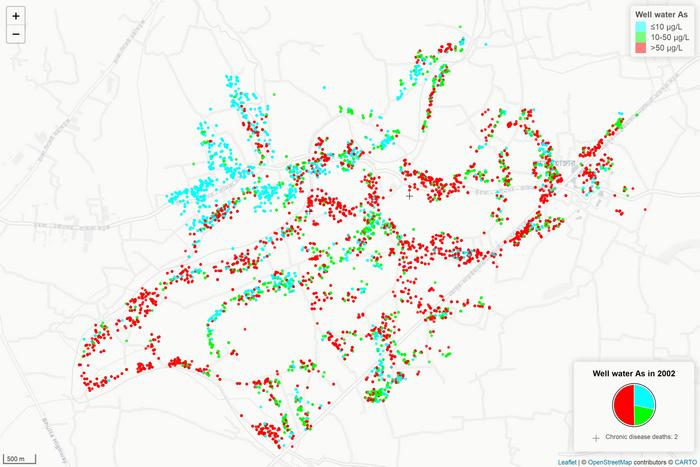
From 2000 to 2022, the Health Effects of Arsenic Longitudinal Study (HEALS) tracked thousands of adults and tested more than 10,000 wells in Araihazar, Bangladesh, where many people rely on shallow tube wells with arsenic concentrations ranging from negligible to extremely high.
Researchers periodically measured arsenic levels in participants’ urine—a marker of ingested arsenic and a proxy for internal exposure—and recorded causes of death. These individual-level data allowed the scientists to compare health outcomes between those who reduced their exposure and those who remained highly exposed.
Throughout the project, national and community programs tested wells in Araihazar for arsenic and labeled them as safe or unsafe, prompting many households to switch to or install safer wells. Others continued using contaminated wells, creating a natural comparison group within the study.
Arsenic exposure dropped significantly in Araihazar over the study period. The average concentration in the wells people relied on fell by about 70 percent because many households switched to safer water sources. Urine tests confirmed the change: participants’ internal arsenic exposure declined by about 50 percent, on average, and remained lower through 2022.
These patterns held even after adjusting for differences in age, smoking, and socioeconomic status. Participants whose exposure remained high, or increased over time, continued to face significantly higher risks of death from chronic diseases.
Van Geen likened the impact of reducing arsenic exposure to quitting smoking: the health risks do not disappear immediately but decline steadily over time.
The findings highlight the importance of ensuring access to arsenic-free drinking water. In Bangladesh, measures such as testing well water, labeling unsafe water sources, drilling private wells and deeper government wells have already delivered measurable improvements for many people.
“Our findings can now help persuade policymakers in Bangladesh and other countries to take emergency action in arsenic ‘hot spots’,” says co-author Kazi Matin Ahmed of the University of Dhaka.
To expand access to safe water, the research team is working with the Bangladeshi government to make well data more accessible. They’re piloting NOLKUP (“tubewell” in Bangla), a free app developed from more than six million well tests. Users can search for specific wells, check arsenic levels and depths, and locate nearby safer sources. The app also helps planners identify communities most in need of new, deeper wells.
By showing that health risks decline even for those already exposed to arsenic, the study highlights a critical opportunity: investing in clean water can save lives within a generation.
“This finding is deeply rewarding. Public health is often the ultimate example of delayed gratification,” says Joseph Graziano, Professor Emeritus at Columbia University’s Mailman School of Public Health and a principal investigator of the decades-long research.
The study team comprised researchers from the New York University Grossman School of Medicine; Lamont-Doherty Earth Observatory and the Mailman School of Public Health at Columbia University; Boston University School of Public Health; Department of Geology, University of Dhaka; and the Institute for Population and Precision Health, University of Chicago.
The HEALS study was launched by Columbia University through the National Institute of Environmental Health Sciences’ Superfund Research Program, with most U.S. collaborators based at Columbia when the project began.
Journal
JAMA
Method of Research
Observational study
Subject of Research
People
Article Title
Reducing Arsenic in Drinking Water Cuts Risk of Death, Even After Years of Chronic Exposure
Article Publication Date
17-Nov-2025
Lower arsenic in drinking water reduces death risk, even after years of chronic exposure
Columbia University's Mailman School of Public Health
A new 20-year study of nearly 11,000 adults in Bangladesh found that lowering arsenic levels in drinking water was associated with up to a 50 percent lower risk of death from heart disease, cancer and other chronic illnesses, compared with continued exposure. The study highlights the importance of ensuring access to arsenic-free drinking water and provides the first long-term, individual-level evidence that reducing arsenic exposure may lower mortality, even among people exposed to the toxic contaminant for years. The findings are published in JAMA.
The landmark analysis, led by researchers at Columbia University, Columbia Mailman School of Public Health and New York University, is important for public health because groundwater contamination from naturally occurring arsenic remains a serious issue worldwide. In the United States, more than 100 million people rely on potentially contaminated groundwater sources, especially private wells, for their drinking water. Arsenic is among the most common chemical pollutants.
“We show what happens when people who are chronically exposed to arsenic are no longer exposed,” said co-lead author Lex van Geen of the Lamont-Doherty Earth Observatory, which is part of the Columbia Climate School. “You’re not just preventing deaths from future exposure, but also from past exposure.”
The results provide the clearest evidence to date of the link between arsenic reduction and lower mortality, according to co-lead author Fen Wu of NYU Grossman School of Medicine. For two decades, the research team followed each participant's health and repeatedly collected urine samples to track exposure, which they say strengthened the accuracy of their findings.
“Seeing that our work helped sharply reduce deaths from cancer and heart disease, I realized the impact reaches far beyond our study—to millions in Bangladesh and beyond now drinking water low in arsenic,” said Joseph Graziano, Professor Emeritus at Columbia Mailman School of Public Health and principal investigator of the NIH-funded program. “A 1998 New York Times story first brought us to Bangladesh. More than two decades later, this finding is deeply rewarding—public health is often the ultimate delayed gratification.”
People whose urinary arsenic levels dropped from high to low had mortality rates identical to those who had consistently low exposure throughout the duration of the study. The larger the drop in arsenic levels, the greater the decrease in mortality risk. By contrast, individuals who continued drinking high-arsenic water saw no reduction in their risk of death from chronic disease.
Arsenic is a naturally occurring element that accumulates in groundwater, and because it has no taste or odor, people can unknowingly drink contaminated water for years. In Bangladesh, an estimated 50 million people have been exposed to drinking water with levels above the World Health Organization’s guideline of 10 micrograms per liter. The WHO has called it the largest mass poisoning in history.
From 2000 to 2022, the Health Effects of Arsenic Longitudinal Study (HEALS) tracked thousands of adults and tested more than 10,000 wells in Araihazar, Bangladesh, where many people rely on shallow tube wells with arsenic concentrations ranging from negligible to extremely high.
Researchers periodically measured arsenic levels in participants’ urine—a marker of ingested arsenic and a proxy for internal exposure—and recorded causes of death. These individual-level data allowed the scientists to compare health outcomes between those who reduced their exposure and those who remained highly exposed.
Throughout the project, national and community programs tested wells in Araihazar for arsenic and labeled them as safe or unsafe, prompting many households to switch to or install safer wells. Others continued using contaminated wells, creating a natural comparison group within the study.
Arsenic exposure dropped significantly in Araihazar over the study period. The average concentration in the wells people relied on fell by about 70 percent because many households switched to safer water sources. Urine tests confirmed the change: participants’ internal arsenic exposure declined by about 50 percent, on average, and remained lower through 2022.
These patterns held even after adjusting for differences in age, smoking, and socioeconomic status. Participants whose exposure remained high, or increased over time, continued to face significantly higher risks of death from chronic diseases.
The researchers likened the impact of reducing arsenic exposure to quitting smoking: the health risks do not disappear immediately but decline steadily over time.
In Bangladesh, measures such as testing well water, labeling unsafe water sources, drilling private wells and deeper government wells have already delivered measurable improvements for many people.
“Our findings can now help persuade policymakers in Bangladesh and other countries to take emergency action in arsenic ‘hot spots’,” says co-author Kazi Matin Ahmed of the University of Dhaka.
To expand access to safe water, the research team is working with the Bangladeshi government to make well data more accessible. They’re piloting NOLKUP (“tubewell” in Bangla), a free app developed from more than six million well tests. Users can search for specific wells, check arsenic levels and depths, and locate nearby safer sources. The app also helps planners identify communities most in need of new, deeper wells.
By showing that health risks decline even for those already exposed to arsenic, the study highlights a critical opportunity: investing in clean water can save lives within a generation.
“Sustainable funding to support the collection, storage and maintenance of precious samples and data over more than 20 years have made this critically important work possible,” said Ana Navas-Acien, MD, PhD, Professor and Chair of Environmental Health Sciences at Columbia Mailman School of Public Health. “Science is difficult and there were challenges and setbacks along the way, but we were able to maintain the integrity of the samples and the data even when funding was interrupted, which has allowed us to reveal that preventing arsenic exposure can prevent disease”.
The study team comprised researchers from the Mailman School of Public Health at Columbia University; the New York University Grossman School of Medicine; Lamont-Doherty Earth Observatory and Boston University School of Public Health; Department of Geology, University of Dhaka; and the Institute for Population and Precision Health, University of Chicago.
The HEALS study was launched by Columbia University through the National Institute of Environmental Health Sciences’ Superfund Research Program, with most U.S. collaborators based at Columbia when the project began.
Columbia University Mailman School of Public Health
Founded in 1922, the Columbia University Mailman School of Public Health pursues an agenda of research, education, and service to address the critical and complex public health issues affecting New Yorkers, the nation and the world. The Columbia Mailman School is the third largest recipient of NIH grants among schools of public health. Its nearly 300 multi-disciplinary faculty members work in more than 100 countries around the world, addressing such issues as preventing infectious and chronic diseases, environmental health, maternal and child health, health policy, climate change and health, and public health preparedness. It is a leader in public health education with more than 1,300 graduate students from 55 nations pursuing a variety of master’s and doctoral degree programs. The Columbia Mailman School is also home to numerous world-renowned research centers, including ICAP and the Center for Infection and Immunity. For more information, please visit www.mailman.columbia.edu.
Journal
JAMA
Lowering arsenic levels in groundwater decreases death rates from chronic disease
NYU Langone Health / NYU Grossman School of Medicine
Reducing amounts of arsenic in drinking water can lower long-term deaths from cardiovascular disease and cancer, a new study shows.
Researchers at NYU Langone Health, Columbia University, and the University of Chicago say their landmark analysis is important for public health because groundwater contamination from naturally occurring arsenic remains a serious issue worldwide. In the United States, more than 100 million people rely on potentially contaminated groundwater sources, especially private wells, for their drinking water. Arsenic is among the most common chemical pollutants.
During the study, the drinking water and health records of 10,977 men and women in Bangladesh were monitored from 2002 to 2022. Results showed that efforts over the 20 years to reduce arsenic in drinking water led to a 70% decrease in levels of the chemical, which in turn halved arsenic levels in tested urine from study participants.
Publishing in the Journal of the American Medical Association (JAMA) online Nov. 17, the researchers compared study participants whose arsenic exposure changed from high to low to those whose arsenic exposure remained high. Results showed that those whose arsenic levels dropped had a 54% reduced risk of death from any chronic disease. Similar decreases were observed specifically for heart diseases (57%) and cancer (49%).
“Our study provides the strongest evidence to date that lowering arsenic in drinking water can lower death rates from chronic disease,” said study co-lead investigator Fen Wu, PhD, a senior research scientist at the NYU Grossman School of Medicine. “Elevated arsenic levels in drinking water remains a pervasive public health issue because arsenic naturally accumulates in groundwater and has no taste or odor, so people can unknowingly consume unsafe levels for years.”
“Our research supports switching to safer water sources as a strategy to improve long-term health around the world,” said study senior investigator Yu Chen, PhD, MPH, a professor in the Department of Population Health at the NYU Grossman School of Medicine. “Improved access to low-arsenic water, periodic testing, and clear signage to mark safer from higher-arsenic water — are useful tools to accomplish this goal.”
Chen says previous research in regions of Taiwan and Chile with high arsenic levels (at greater than 600 micrograms per liter), tied trends of decreasing heart disease and cancer death rates to reducing arsenic levels in drinking water. However, she says her team’s study is the first to offer direct evidence by examining arsenic levels and mortality in each participant over two decades and in a region with moderate arsenic exposure (less than 200 micrograms per liter).
As part of the study, researchers monitored more than 10,000 wells in and around the district of Araihazar, Bangladesh, where arsenic mitigation efforts started in 2000. Wells are labeled to indicate if arsenic levels are high or low, community educators encourage people to switch to safer wells, and new wells are being drilled with lower concentrations of arsenic.
During the investigation, study participants volunteered to have their urine tested six times, periodically allowing researchers to track changes in arsenic exposure over time. Meanwhile, the research team recorded 1,401 deaths among the study participants from chronic disease, including 730 from cardiovascular disease and 256 from cancer.
Bangladesh as a whole has one of the world’s most serious challenges with drinking water contaminated by arsenic. More than 50 million people are exposed to arsenic levels above the World Health Organization standard of 10 micrograms per liter.
Funding support for this study was provided by National Institutes of Health grants R01ES035219, P42ES010349, and P4242ES033719.
Besides Chen and Wu, Mengling Liu, PhD, is a study co-investigator from NYU Langone. Also involved in the study are co-lead investigator Alexander van Geen, PhD, and co-investigators Joseph Graziano, PhD, Vesna Slakovich, MS, Tyler Ellis, MS, and Ana Navas-Acien, PhD, at Columbia University in New York City; co-senior investigator Habibul Ahsan, MD, and co-investigators Muhammad Kibriya, MD, PhD, Farzana Jasmine, PhD, and Mohammad Hasan Shahriar, MD, at the University of Chicago; Kazi Matin Ahmed, PhD, and Imtiaz Choudury, MS, at the University of Dhaka in Bangladesh; Maria Argos, PhD, at Boston University in Massachusetts; and Tariqul Islam, MBBS, Alauddin Ahmed, MBBS, Rabiul Hasan, MA, Salma Akter Shima, MS, and Golam Sarwar, BS, at the University of Chicago and Columbia University Project Office in Dhaka.
###
About NYU Langone Health
NYU Langone Health is a fully integrated health system that consistently achieves the best patient outcomes through a rigorous focus on quality that has resulted in some of the lowest mortality rates in the nation. Vizient Inc. has ranked NYU Langone No. 1 out of 118 comprehensive academic medical centers across the nation for four years in a row, and U.S. News & World Report recently ranked four of its clinical specialties No. 1 in the nation. NYU Langone offers a comprehensive range of medical services with one high standard of care across seven inpatient locations, its Perlmutter Cancer Center, and more than 320 outpatient locations in the New York area and Florida. The system also includes two tuition-free medical schools, in Manhattan and on Long Island, and a vast research enterprise.

No comments:
Post a Comment