Iran: Three Things The New York Times Gets Wrong

by Ted Snider | Nov 17, 2025 |
On November 9, The New York Times published an update on the situation with Iran’s nuclear program. The article contains some valuable material. But it also gets three important things wrong.
The article badly misses the shift in relations in the region. By implying that other countries in the region are more willing to work with the U.S. and insisting that “Iran is more isolated from the West than it has been in decades,” the article presents an Iran who is increasingly alone in the region. Nothing could be further from the truth.
The biggest rift in the region was the rift between Iran and Saudi Arabia. In 2023, Iran and Saudi Arabia stunned the world by announcing that China had brokered an agreement between the opposing regional powers “to resume diplomatic relations between them and re-open their embassies and missions.”
In 2024, Bahrain, who had long ago followed Saudi Arabia in cutting ties with Iran, sent a message to Iran through Russia requesting the re-establishment of diplomatic relations. Soon, Bahrain and Iran would announce that they had agreed to create a framework on initiating talks on resuming diplomatic relations. “The two sides,” a statement said, “agreed in this meeting to establish the necessary mechanisms to begin talks between the two countries to study how to resume political relations between them.” In October 2024, Iran’s Foreign Minister Abbas Araghchi met with King Hamad bin Isa Al-Khalifa in Bahrain.
In 2025, Egypt, whose relations with Iran had been broken since 1979, began to welcome Iran back into the region. Saying that there is now “a mutual desire to develop our relations,” Egypt’s Foreign Minister, Badr Abdelatty, and President el-Sisi met with Iran’s Foreign Minister Abbas Araghchi. Araghchi said that, “[a]fter many years, diplomacy between Iran and Egypt has entered a new phase. The level of political interaction and cooperation, and more importantly, the level of trust and confidence in relations between the two countries, is unprecedented.” The two countries signed an agreement “to launch periodic consultations at the sub-ministerial level to address aspects of bilateral cooperation.”
Most recently, Oman’s Foreign Minister, Badr Al Busaidi, “encouraged fellow Gulf countries to engage with Tehran rather than isolate it.”
Iran’s reintegration into the region has been accompanied by the wider integration into the Shanghai Cooperation Organisation and BRICS. Contrary to picture painted by The Times, Iran is less isolated than it has been in a long time.
And contrary to the implication that regional powers like Saudi Arabia, Egypt and the United Arab Emirates are more willing to work with the United States, increasing Iran’s isolation, those countries have developed a deeper distrust of the U.S. and a greater reluctance to partner with them. Though The Times article enters Saudi Arabia’s recent mutual defense treaty with Pakistan as evidence of Saudi Arabia’s continued concern with a nuclear Iran, that treaty likely had at least as much to do with the Kingdom’s uncertainty with the U.S. as with its uncertainty with Iran.
The Saudi-Pakistani defense agreement is more reasonably seen as a growing realization in the region that their interests are better served by relying on each other – including Iran – than by relying on the United States. The bilateral security agreement joins calls by Turkey, Egypt and Pakistan for a pan-Islamic security alliance. Most recently, Oman’s Foreign Minister, Badr al-Busaidi, called for an regional Gulf security architecture that includes Iran.
As this adjusted picture suggests, The Times article equally misses the mark with its portrayal of the “regional powers… respect[ing] Iran’s ability, however weakened, to create instability” in the region.
While the Gulf states are not fully free of their concerns with Iran’s ability to disrupt, their foreign policy is no longer focused on Iran as the defining threat. Oman’s Foreign Minister, Badr al-Busadi, told the Manama Dialogue in Bahrain on November 1 that “We have long known” that Iran is not “the prime source of insecurity in the region.”
Oman is a close friend of the United States and a highly respected diplomatic broker. It’s assessment of Iran and the security situation in the region turns long standing U.S. policy for the region on its head. As Trita Parsi, Executive Vice president of the Quincy Institute for Responsible Statecraft, points out, Al-Busaidi emphasized that “we have long known” that Iran is not “the prime source of insecurity in the region,” indicating a shift in the region that now allows Arab officials to state that knowledge publicly.
And thirdly, in its discussion of Iran’s nuclear program, the current appearance that negotiations are dead at least for now, and the risk of renewed military strikes on Iranian nuclear facilities, The Times at least includes the qualifier that “Iran has always denied” that it intends to produce a nuclear weapon.
But, while seemingly generous, that formulation is deceptively dangerous. It is not only Iran that has denied that its nuclear program is intent on building a bomb, but the United States. And The New York Times article should have said that.
The 2022 U.S. Department of Defense Nuclear Posture Review concludes that “Iran does not today possess a nuclear weapon and we currently believe it is not pursuing one.” That conclusion was repeated and reinforced by the 2025 Annual Threat Assessment, which “reflects the collective insights of the Intelligence Community,” and which clearly states that U.S. intelligence “continue[s] to assess Iran is not building a nuclear weapon and that [Ayatollah] Khamenei has not reauthorized the nuclear weapons program he suspended in 2003.”
Joining the United States, while Iran’s nuclear facilities were being bombed, IAEA director general Rafael Grossi declared that the IAEA “did not find in Iran elements to indicate that there is an active, systematic plan to build a nuclear weapon” and concluded that “We have not seen elements to allow us, as inspectors, to affirm that there was a nuclear weapon that was being manufactured or produced somewhere in Iran.”
If war in Iran is to be avoided, the truth needs to be told, starting with truthful reporting. Iran is not being isolated by the regional powers but integrated. Iran is not seen by the countries of the region as the primary threat or source of instability. And Iran is not building a nuclear bomb.
Antiwar.com.
Ted Snider is a regular columnist on U.S. foreign policy and history at Antiwar.com and The Libertarian Institute. He is also a frequent contributor to Responsible Statecraft and The American Conservative as well as other outlets. To support his work or for media or virtual presentation requests, contact him at tedsnider@bell.net.
Women riding the streets of Tehran on motorbikes is the latest sign of Iran's societal change
TEHRAN, Iran (AP) — In the beliefs of some conservative clerics and hard-liners, a woman riding a scooter or a motorbike is “tabarruj,” or an excessive flaunting of her beauty prohibited by Islam.
Mehdi Fattahi
November 13, 2025
RNS
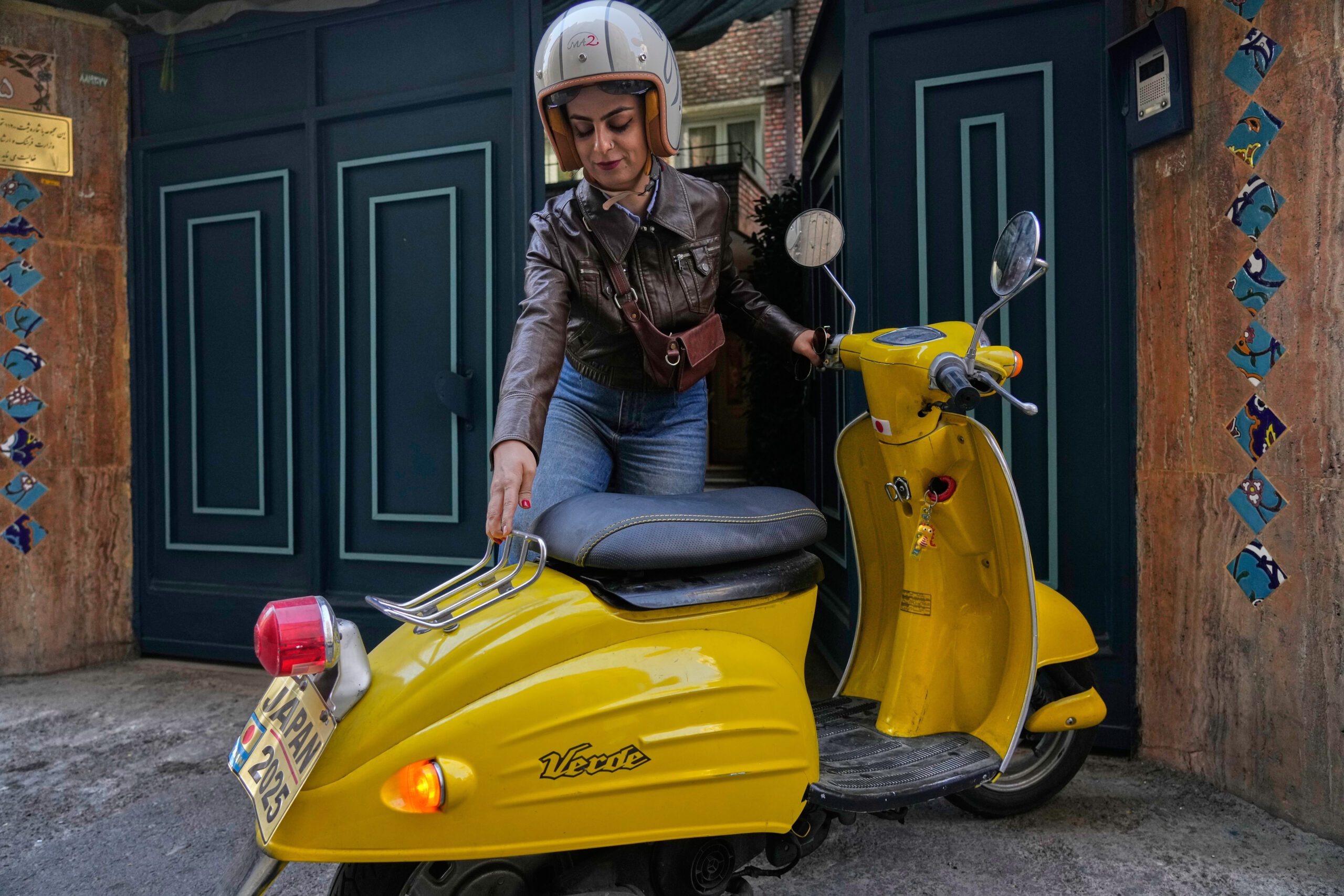
TEHRAN, Iran (AP) — When Merat Behnam first gathered enough courage to ride her yellow scooter through the gridlocked streets of Iran ‘s capital to the coffee shop she runs, traffic wasn’t her main worry.
She instead girded herself for disapproving looks, verbal abuse and even being stopped by the police for being a women riding a motorbike in Tehran, something long frowned upon by hard-liners and conservative clerics in Iran.
But Behnam, 38, found herself broadly accepted on the road — and part of a wider reconsideration by women about societal expectations in Iran.
It’s not all encompassing, particularly as hard-line politicians call for laws on the hijab or headscarf to be enforced as Iran cracks down on intellectuals in the wake of the 12-day Iran-Israel war in June — but it does represent a change.
“It was a big deal for me,” Behnam told The Associated Press after riding up to her café on a recent day. “I didn’t really know how to go about it. In the beginning I was quite stressed, but gradually the way people treated me and their reactions encouraged me a lot.”
‘Exposed to the wind’
Two things in the past prevented women from driving motorbikes or scooters. First of all, police regulations in Iran’s Farsi language specifically refer to only “mardan” or “men” being able to obtain motorcycle licenses. It’s a very gender-specific wording in Farsi, which broadly is a gender-neutral language grammatically.
“This issue is not a violation but a crime, and my colleagues will deal with these individuals, since none of these women currently have a driver’s license and we cannot act against the law,” Gen. Abulfazl Mousavipoor, Tehran’s traffic police chief, said in a report carried by the semiofficial ISNA news agency in September.
Then there’s the cultural aspect. While women can now hold jobs, political office and a car license, since its 1979 Islamic Revolution the country has imposed a strictly conservative, Shiite Islam understanding of conduct by women. That includes Iran’s mandatory hijab law, which sparked mass demonstrations in 2022 after the death of Mahsa Amini, who had allegedly been detained over not wearing a headscarf to the liking of authorities.
In the beliefs of some conservative clerics and hard-liners, a woman riding a scooter or a motorbike is “tabarruj,” or an excessive flaunting of her beauty prohibited by Islam.
“Keeping proper covering for women while riding a motorcycle is very important,” hard-line lawmaker Mohammad Seraj told the semiofficial ILNA news agency in September. “A woman sitting on a motorcycle cannot maintain the modest attire expected of her, since both of her hands are occupied with steering the vehicle and she is exposed to the wind.”
Avoiding congestion charges
For many, the motorbike ban runs directly into the reality of Tehran’s streets, crowded with an estimated over 4 million cars and another 4 million motorcycles on the road daily. For decades, women in the all-encompassing black chador could be seen riding side-saddle on motorbikes driven by men.
But after women began forgoing the hijab, more women began taking the risk and riding their motorbikes through Tehran as well, avoiding the congestion charges levied on cars that run over 20 million rial ($20) a month. While still a small percentage of the overall traffic, their presence on the road has become more common.
“There is not any political manifesto or social agenda here,” Behnam said. “It’s just that since my workplace is downtown and I had to commute every day from (the western neighborhood of) Sattarkhan, the traffic there — and the parking issue, plus the traffic zone restrictions — were driving me crazy.”
‘Symbol of choice and independence’
But for others, it is a political issue. There’s been speculation the administration of reformist President Masoud Pezeshkian, who campaigned on openness to the West before the war, may try to change the regulations to allow women to be licensed. Reformists — those who seek to change Iran’s theocracy from within — also have called for the change.
“It’s time to move past the invisible walls of cultural judgment and bureaucratic rules,” the Shargh newspaper said in September. “For women, riding a motorcycle is not just a way to commute but a symbol of choice, independence and equal presence in society.
Benham, says riding her motorbike also gave her the first positive interaction she’s had with the police.
“For the first time, a police officer — well, actually, a traffic officer — made me feel encouraged and safer. I could feel that there was some kind of support,” she said. “Even the times they gave me warnings, they were technical ones — like where to park, not to do certain things or to always wear a helmet.”

TEHRAN, Iran (AP) — In the beliefs of some conservative clerics and hard-liners, a woman riding a scooter or a motorbike is “tabarruj,” or an excessive flaunting of her beauty prohibited by Islam.
Mehdi Fattahi
November 13, 2025
RNS
TEHRAN, Iran (AP) — When Merat Behnam first gathered enough courage to ride her yellow scooter through the gridlocked streets of Iran ‘s capital to the coffee shop she runs, traffic wasn’t her main worry.
She instead girded herself for disapproving looks, verbal abuse and even being stopped by the police for being a women riding a motorbike in Tehran, something long frowned upon by hard-liners and conservative clerics in Iran.
But Behnam, 38, found herself broadly accepted on the road — and part of a wider reconsideration by women about societal expectations in Iran.
It’s not all encompassing, particularly as hard-line politicians call for laws on the hijab or headscarf to be enforced as Iran cracks down on intellectuals in the wake of the 12-day Iran-Israel war in June — but it does represent a change.
“It was a big deal for me,” Behnam told The Associated Press after riding up to her café on a recent day. “I didn’t really know how to go about it. In the beginning I was quite stressed, but gradually the way people treated me and their reactions encouraged me a lot.”
‘Exposed to the wind’
Two things in the past prevented women from driving motorbikes or scooters. First of all, police regulations in Iran’s Farsi language specifically refer to only “mardan” or “men” being able to obtain motorcycle licenses. It’s a very gender-specific wording in Farsi, which broadly is a gender-neutral language grammatically.
“This issue is not a violation but a crime, and my colleagues will deal with these individuals, since none of these women currently have a driver’s license and we cannot act against the law,” Gen. Abulfazl Mousavipoor, Tehran’s traffic police chief, said in a report carried by the semiofficial ISNA news agency in September.
Then there’s the cultural aspect. While women can now hold jobs, political office and a car license, since its 1979 Islamic Revolution the country has imposed a strictly conservative, Shiite Islam understanding of conduct by women. That includes Iran’s mandatory hijab law, which sparked mass demonstrations in 2022 after the death of Mahsa Amini, who had allegedly been detained over not wearing a headscarf to the liking of authorities.
In the beliefs of some conservative clerics and hard-liners, a woman riding a scooter or a motorbike is “tabarruj,” or an excessive flaunting of her beauty prohibited by Islam.
“Keeping proper covering for women while riding a motorcycle is very important,” hard-line lawmaker Mohammad Seraj told the semiofficial ILNA news agency in September. “A woman sitting on a motorcycle cannot maintain the modest attire expected of her, since both of her hands are occupied with steering the vehicle and she is exposed to the wind.”
Avoiding congestion charges
For many, the motorbike ban runs directly into the reality of Tehran’s streets, crowded with an estimated over 4 million cars and another 4 million motorcycles on the road daily. For decades, women in the all-encompassing black chador could be seen riding side-saddle on motorbikes driven by men.
But after women began forgoing the hijab, more women began taking the risk and riding their motorbikes through Tehran as well, avoiding the congestion charges levied on cars that run over 20 million rial ($20) a month. While still a small percentage of the overall traffic, their presence on the road has become more common.
“There is not any political manifesto or social agenda here,” Behnam said. “It’s just that since my workplace is downtown and I had to commute every day from (the western neighborhood of) Sattarkhan, the traffic there — and the parking issue, plus the traffic zone restrictions — were driving me crazy.”
‘Symbol of choice and independence’
But for others, it is a political issue. There’s been speculation the administration of reformist President Masoud Pezeshkian, who campaigned on openness to the West before the war, may try to change the regulations to allow women to be licensed. Reformists — those who seek to change Iran’s theocracy from within — also have called for the change.
“It’s time to move past the invisible walls of cultural judgment and bureaucratic rules,” the Shargh newspaper said in September. “For women, riding a motorcycle is not just a way to commute but a symbol of choice, independence and equal presence in society.
Benham, says riding her motorbike also gave her the first positive interaction she’s had with the police.
“For the first time, a police officer — well, actually, a traffic officer — made me feel encouraged and safer. I could feel that there was some kind of support,” she said. “Even the times they gave me warnings, they were technical ones — like where to park, not to do certain things or to always wear a helmet.”


No comments:
Post a Comment