(The Conversation) — The term ‘pro-life’ can seem simple – but how Americans and advocacy groups interpret it varies widely.

Pope Leo XIV arrives for his weekly general audience in St. Peter's Square, at the Vatican, on Oct. 22, 2025. (AP Photo/Andrew Medichini)
Anne Whitesell
November 12, 2025
(The Conversation)
As the first American pope, Leo XIV has largely avoided speaking out about domestic politics in the United States.
He waded into controversy, however, by commenting on the Archdiocese of Chicago’s plan to honor U.S. Sen. Dick Durbin, who has represented Illinois since 1997, with a lifetime achievement award for his work on immigration issues. Some Catholic critics were opposed to Durbin, who has supported the right to a legal abortion, receiving such an award – and he ultimately declined it.
On Sept. 30, 2025, when reporters in Italy asked about the situation, Leo said, “It’s important to look at many issues that are related to the teachings of the church.”
He waded into controversy, however, by commenting on the Archdiocese of Chicago’s plan to honor U.S. Sen. Dick Durbin, who has represented Illinois since 1997, with a lifetime achievement award for his work on immigration issues. Some Catholic critics were opposed to Durbin, who has supported the right to a legal abortion, receiving such an award – and he ultimately declined it.
On Sept. 30, 2025, when reporters in Italy asked about the situation, Leo said, “It’s important to look at many issues that are related to the teachings of the church.”
“Someone who says I’m against abortion but is in favor of the death penalty is not really pro-life,” he said. “And someone who says I’m against abortion but I’m in agreement with the inhuman treatment of immigrants in the United States, I don’t know if that’s pro-life.”

The family of a detained man from Ecuador is comforted by a priest on Sept. 25, 2025, in New York City.
Stephanie Keith/Getty Images
In American politics, being “pro-life” is often equated with being opposed to abortion. But as Leo’s comments highlight, it’s not so simple.
In my research into the modern pro-life movement, I have found great variety in how different people and organizations use the term, what issues they campaign for, and how religious convictions drive their work.
Public opinion
If being pro-life means caring about immigrants’ rights and opposing abortion, a minority of Americans appear to subscribe to the pope’s vision.
On Oct. 22, 2025, PRRI – a think tank that researches the intersection of religion, culture and politics – released results from a survey asking respondents about immigration and abortion. The survey was conducted online in August and September.
Among all respondents, 61% say that immigrants, regardless of legal status, should have basic rights and protections, including the ability to challenge deportation in court. Sixty-five percent oppose deporting undocumented immigrants without due process to prisons in other countries.

The Rev. Frank O’Loughlin, an Irish priest, celebrates Mass on Aug. 16, 2025, outside the immigrant detention center known as ‘Alligator Alcatraz’ in Ochopee, Fla., standing in solidarity with those detained.
Chandan Khanna/AFP via Getty Images
Support for immigrants’ rights is less common, however, among people who oppose the right to an abortion.
Overall, 36% of respondents believe abortion should be illegal in all or most cases, while 61% believe the procedure should be legal in all or most cases.
Among people who believe abortion should be illegal, only 40% say immigrants should have basic rights, compared to 75% of respondents who believe abortion should be legal in all or most cases.
When asked whether the government “should detain immigrants who are in the country illegally in internment camps until they can be deported,” only 37% of Americans agree. Among those who oppose legalized abortion, however, that percentage increased to 57%. Among Americans who support legalized abortion, only 27% support detention.
Looking at responses from U.S. Catholics, there are clear patterns based on race and ethnicity.
Forty-two percent of white Catholics believe abortion should be illegal in all or most circumstances, compared to 35% of Hispanic Catholics.
Forty-seven percent of white Catholics, meanwhile, disagree with immigrant detention. Among Hispanic Catholics, that percentage rises to 76%. Similarly, 50% of white Catholics believe immigrants should have basic rights, compared to 76% of Hispanic Catholics.
‘Pro-life’ label
Leo’s comments and public opinion data demonstrate the challenge of defining what it means to identify as pro-life.
In my interviews with pro-life activists and research into their advocacy, I have also observed wide variation within the movement.
Organizations are strategic in choosing the pro-life issues they work on.
Some groups that use that label advocate against abortion and do not see it in their mission to go beyond that. One advocate I interviewed said, “We want to be single-issue. … We want to have a large coalition, and being single-issue is how we do that.”
This advocate works for a secular, national organization that opposes abortion because it ends the life of a human organism. She acknowledged that it can be difficult to decide where to draw the line: “How connected does something have to be to abortion for it to count?” This question arises when the group chooses whether to take a position on policies such as expanding funding for adoption services.

A protester demonstrates in front of a Planned Parenthood clinic on July 12, 2022, in Saint Paul, Minn.
AP Photo/Abbie Parr
Other groups that identify as pro-life are ideologically conservative and often take on other culture war issues. The Center for Christian Virtue, for example, advocates against abortion but also is in favor of school choice and increased funding for “responsible fatherhood initiatives,” such as parenting classes and mentorship programs.
Still other groups focus on both beginning-of-life and end-of-life issues. These organizations are inspired by religious beliefs that life is a gift from God and should be protected from conception until natural death. In addition to abortion, these organizations oppose the use of embryos and fetal stem cells in scientific research and often oppose in vitro fertilization. They also advocate against legalizing euthanasia and physician-assisted suicide.
A fourth type of group has a more expansive definition of pro-life, closely aligned with Leo’s comments. These groups, whose mission statements are often secular, sometimes refer to themselves as protecting life “womb to tomb,” or “pro-life for the whole life.” Groups such as Democrats for Life of America and New Wave Feminists incorporate issues such as economic inequality, systemic discrimination and support for migrants into their advocacy.
Organizations with this type of holistic approach may also describe themselves as following a “consistent life ethic.” Popularized by Cardinal Joseph Bernardin in the 1980s, the term stems from Catholic social teaching but is also used by secular groups. This approach emphasizes human dignity and supporting policies that affirm life at all stages. That may include opposition to the death penalty and support for social programs, such as food and housing assistance.
Role of religion
From my research, I have not found a clear relationship between the policies a group advocates on behalf of and its religious affiliation.
Many explicitly call themselves Catholic or Christian. Their mission statements may mention religion. Their publications may include Bible quotes or prayers. They sponsor events in collaboration with churches.
For example, the American Life League identifies itself as “the oldest grassroots Catholic pro-life education organization in the United States.” Students for Life of America calls its statement of faith “Judeo-Christian,” even though roughly 8 in 10 American Jews support legal abortion.
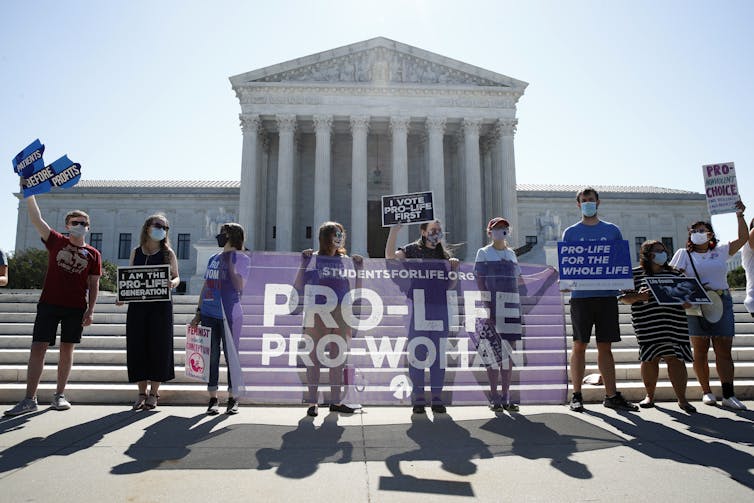
Anti-abortion protesters wait outside the Supreme Court for a decision on the Russo v. June Medical Services LLC case on June 29, 2020.
Patrick Semansky/AP
Even in groups that do not describe themselves as religious, though, some leaders and members say they are drawn to the cause because of their faith. An advocate from one such group described many of the members as “Pope Francis Catholics,” indicating a more progressive view on many social issues.
Another advocate I spoke with described herself as a devout Catholic but recognized that the anti-abortion movement is often “bashed for being religious.” To break away from that stereotype, she said, “That’s why we’re kind of relying on the science. And when I send emails, I never bring in Scripture, and I think people think I might be just agnostic or whatever.”
Other secular groups tie their pro-life advocacy to a broader fight for human rights. Rehumanize International, to name one, says its mission is to “ensure that each and every human being’s life is respected, valued, and protected.” Such groups may hold progressive views such as opposing war and the death penalty, as well as concern about climate change. Political science research indicates that positioning opposition to abortion as a human rights issue, rather than a religious one, may attract more younger Americans.
It would be a mistake to assume that everyone in these movements adheres to one viewpoint, or is interested only in stopping abortion. In reality, there are many motivations that lead to people using the phrase “pro-life.”
(Anne Whitesell, Associate Professor of Political Science, Miami University. The views expressed in this commentary do not necessarily reflect those of Religion News Service.)

Trump confronts 'game-changer' as cruelty provokes 'unbelievably radical' revolt: analysts
Tom Boggioni
November 17, 2025
Comments made by Pope Leo and a widely spread attack on President Donald Trump by Catholic bishops on his harsh immigration policies should give his administration pause that the ground beneath them is shifting — and not in a good way, it was warned Monday.
The hosts of “Morning Joe,” noted the Pope calling the treatment of undocumented immigrants a “grave injustice” and combined that with a statement from America’s Roman Catholic bishops asserting, “We are disturbed when we see among our people a climate of fear and anxiety around questions of profiling and immigration enforcement. We are saddened by the state of contemporary debate and the vilification of immigrants. We are concerned about the conditions in detention centers and the lack of access to pastoral care.”
That led MS NOW's Joe Scarborough to tell his panel, ”One of the most remarkable things I've seen is Pope Leo, Catholic bishops, doing something unbelievably radical. I'm sure the White House thinks this is radical Republicans. They are quoting Jesus Christ, and they are quoting Jesus Christ from the pulpit, and they are showing how un-Christ-like these ICE raids are, where they're ripping children from their mothers' hands.”
“They are going into schools.,They are tearing teachers out. I mean, this is the Catholic bishops and Pope Leo. This is a game changer.”
“I know, I know, people have people outside the faith community may not understand this, but this is a game changer,” he added. “And Pope Leo saying, ‘Oh, really? You call yourself pro-life just because you're against abortion, but you support this inhumane treatment of immigrants?’ No, no, no, those those two don't square up.”
Tom Boggioni
November 17, 2025
RAW STOR
Comments made by Pope Leo and a widely spread attack on President Donald Trump by Catholic bishops on his harsh immigration policies should give his administration pause that the ground beneath them is shifting — and not in a good way, it was warned Monday.
The hosts of “Morning Joe,” noted the Pope calling the treatment of undocumented immigrants a “grave injustice” and combined that with a statement from America’s Roman Catholic bishops asserting, “We are disturbed when we see among our people a climate of fear and anxiety around questions of profiling and immigration enforcement. We are saddened by the state of contemporary debate and the vilification of immigrants. We are concerned about the conditions in detention centers and the lack of access to pastoral care.”
That led MS NOW's Joe Scarborough to tell his panel, ”One of the most remarkable things I've seen is Pope Leo, Catholic bishops, doing something unbelievably radical. I'm sure the White House thinks this is radical Republicans. They are quoting Jesus Christ, and they are quoting Jesus Christ from the pulpit, and they are showing how un-Christ-like these ICE raids are, where they're ripping children from their mothers' hands.”
“They are going into schools.,They are tearing teachers out. I mean, this is the Catholic bishops and Pope Leo. This is a game changer.”
“I know, I know, people have people outside the faith community may not understand this, but this is a game changer,” he added. “And Pope Leo saying, ‘Oh, really? You call yourself pro-life just because you're against abortion, but you support this inhumane treatment of immigrants?’ No, no, no, those those two don't square up.”
This Republican vowed to protect the unborn — then worked to strip moms of healthcare
Megan O'Matz,
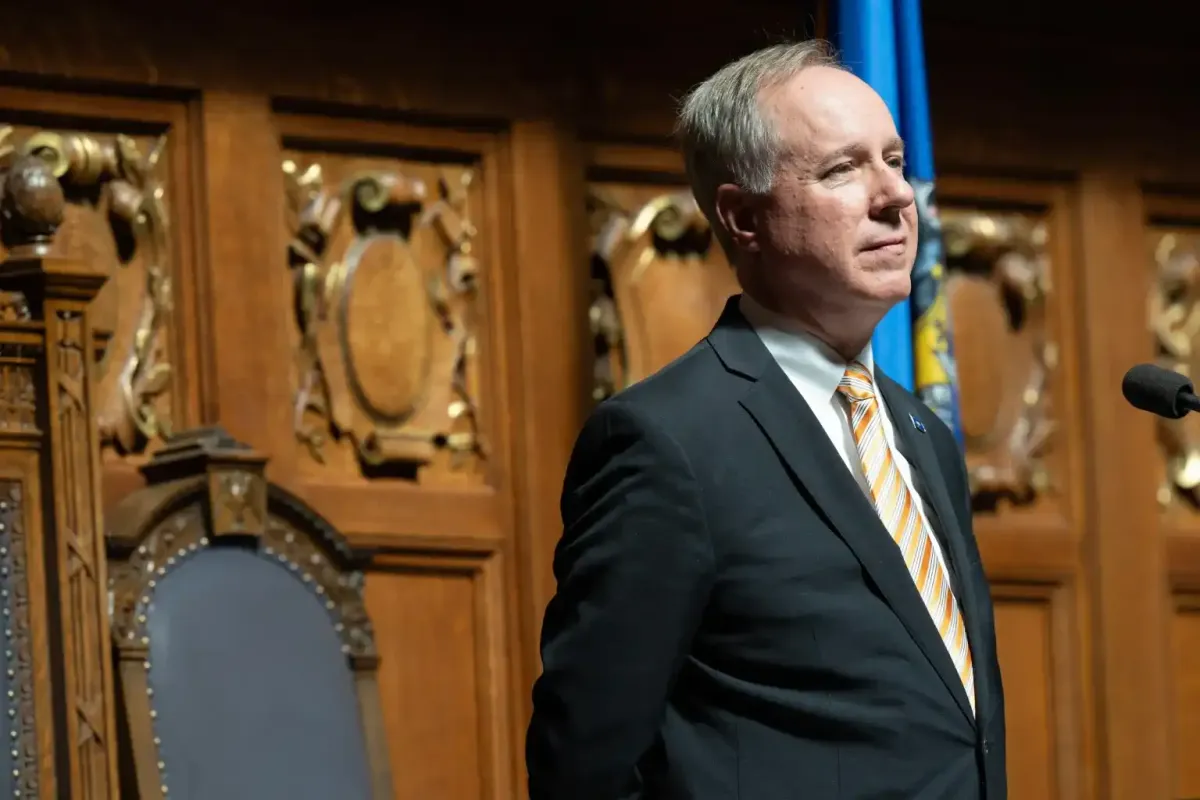
Wisconsin Assembly Speaker Robin Vos during a session at the Capitol in Madison in 2023 Mark Hoffman/Milwaukee Journal Sentinel/Imagn/ProPublica
The most powerful Republican in Wisconsin stepped up to a lectern that was affixed with a sign reading, “Pro-Women Pro-Babies Pro-Life Rally.”
“One of the reasons that I ran for office was to protect the lives of unborn children,” Assembly Speaker Robin Vos told the cheering crowd gathered in the ornate rotunda of the state Capitol. They were there on a June day in 2019 to watch him sign four anti-abortion bills and to demand that the state’s Democratic governor sign them. (The governor did not.)
“Legislative Republicans are committed to protecting the preborn because we know life is the most basic human right,” Vos promised. “We will continue to do everything we can to protect the unborn, to protect innocent lives.”
Now, however, Vos has parted with some in the national anti-abortion movement in its push for a particular measure to protect life: the life of new mothers.
Many anti-abortion Republicans have supported new state laws and policies to extend Medicaid coverage to women for a year after giving birth, up from 60 days. The promise of free health care for a longer span can help convince women in financial crises to proceed with their pregnancies, rather than choose abortion, proponents say. And many health experts have identified the year after childbirth as a precarious time for mothers who can suffer from a host of complications, both physical and mental.
Legislation to extend government-provided health care coverage for up to one year for low-income new moms has been passed in 48 other states — red, blue and purple. Not in Arkansas, where enough officials have balked. And not in Wisconsin, where the limit remains two months. And that’s only because of Vos.
The Wisconsin Senate passed legislation earlier this year that would increase Medicaid postpartum coverage to 12 months. In the state Assembly, 30 Republicans have co-sponsored the legislation, and there is more than enough bipartisan support to pass the bill in that chamber.
But Vos, who has been speaker for nearly 13 years and whose campaign funding decisions are considered key to victory in elections, controls the Assembly. And, according to insiders at the state Capitol, he hasn’t allowed a vote on the Senate bill or the Assembly version, burying it deep in a committee that barely meets: Regulatory Licensing Reform.
Vos’ resistance has put him and some of his anti-abortion colleagues in the odd position of having to reconcile their support for growing families with the failure of the Assembly to pass a bill aimed at helping new moms stay healthy.
“If we can’t get something like this done, then I don’t know what I’m doing in the Legislature,” Republican Rep. Patrick Snyder, the bill’s author and an ardent abortion foe, said in February in a Senate hearing.
Reached by phone, Vos declined to discuss the issue with ProPublica and referred questions to his spokesperson, who then did not respond to calls or emails. Explaining his opposition, Vos once said, “We already have enough welfare in Wisconsin.” And in vowing to never expand Medicaid, he has said the state should reserve the program only for “those who truly need it.”
His stance on extending benefits for new mothers has troubled health care professionals, social workers and some of his constituents. They have argued and pleaded with him and, in some cases, cast doubt on his principles. ProPublica requested public comments to his office from January 2024 to June 2025 and found that the overwhelming majority of the roughly 200 messages objected to his stance.
“I know this is supported by many of your Republican colleagues. As the ‘party of the family’ your opposition is abhorrent. Get with it,” one Wisconsin resident told the speaker via a contact form on Vos’ website.
Another person who reached out to Vos chastised him for providing “lame excuses,” writing: “The women of Wisconsin deserve better from a party that CLAIMS to be ‘pro-life’ but in practice, could care less about women and children. We deserve better than you.”
“A Commonsense Bill”
Donna Rozar is among the Wisconsin Republicans who staunchly oppose abortion but also support Medicaid for new mothers.
While serving as a state representative in 2023, she sponsored legislation to extend the coverage up to one year. Her effort mirrored what was happening in other states following the end of Roe v. Wade and the constitutional right to an abortion. Activists on both sides of the abortion issue recognized that there could be a rise in high-risk births and sought to protect mothers.
“I saw this as a pro-life bill to help mothers have coverage for up to a year, in order to let them know that they would have the help they needed if there were any postpartum complications with their pregnancy,” said Rozar, a retired registered nurse. “I thought it was a commonsense bill.”
Vos, she said, would not allow the bill to proceed to a vote even though it had 66 co-sponsors in the 99-person chamber. “The speaker of the state Assembly in Wisconsin is a very powerful individual and sets the agenda,” she said.
Rozar recalled having numerous “frustrating” conversations with Vos as she tried to persuade him to advance the legislation. “He was just so opposed to entitlement programs and any additional expenditures of Medicaid dollars that he just stuck to that principle.
Well-Funded Opposition
Vos’ opposition echoes that of influential conservative groups, including the Foundation for Government Accountability, a Florida think tank that promotes “work over welfare.” Its affiliated lobbying arm openly opposed the Medicaid extension for new moms when it first surfaced in Wisconsin in 2021, though it has not registered opposition since then. Reached recently, a spokesperson for the foundation declined to comment.
Over the past decade, the foundation has received more than $11 million from a charitable fund run by billionaire Richard Uihlein, founder of the Wisconsin-based shipping supplies company Uline. In recent years, Uihlein and his wife, Liz, also have been prolific political donors nationally and in the Midwest, with Vos among the beneficiaries.
Since 2020, Liz Uihlein has given over $6 million to Wisconsin’s Republican Assembly Campaign Committee, which is considered a key instrument of Vos’ power. And in February 2024, she donated $500,000 to Vos’ personal political campaign at a time when he was immersed in a tough intraparty skirmish.
One concern cited by extension opponents such as the Foundation for Government Accountability is that Medicaid coverage for new moms could be used for health issues not directly related to giving birth. Questions over how expansive the coverage would be spilled into debate in Arkansas in a Senate committee in April of this year.
“Can you explain what that coverage is? Is it just like full Medicaid for any problem that they have, or is it somehow specific to the pregnancy and complications?” asked GOP Sen. John Payton.
A state health official told him new mothers could receive a full range of benefits.
“Like, if they needed a knee replacement, I mean, it’d cover it?” Payton said.
“Yes,” came the reply.
The bill failed in a voice vote.
In Wisconsin, no lawmaker voiced any such concern during the February Senate hearing, which was marked by only positive feedback. In fact, one lawmaker and some medical experts in attendance openly snickered at the thought that Arkansas — a state that ranks low in public health measurements — might pass legislation before Wisconsin, leaving it the lone holdout.
Ultimately, the Wisconsin Senate approved the legislation 32-1 in April, sending it along to the Assembly to languish and leaving Wisconsin still in the company of Arkansas on the issue.
Despite the setbacks and Vos’ firm opposition, Sande of Pro-Life Wisconsin and other anti-abortion activists are not giving up. He thinks Vos can be persuaded and the bill could move out of its purgatory this winter.
“I’m telling you that we’re hopeful,” Sande said.
Rozar is, too, even though she is well aware of Vos’ unwavering stance. “He might have egg on his face if he let it go,” she said.
Megan O'Matz,
ProPublica
November 17, 2025
November 17, 2025
Wisconsin Assembly Speaker Robin Vos during a session at the Capitol in Madison in 2023 Mark Hoffman/Milwaukee Journal Sentinel/Imagn/ProPublica
The most powerful Republican in Wisconsin stepped up to a lectern that was affixed with a sign reading, “Pro-Women Pro-Babies Pro-Life Rally.”
“One of the reasons that I ran for office was to protect the lives of unborn children,” Assembly Speaker Robin Vos told the cheering crowd gathered in the ornate rotunda of the state Capitol. They were there on a June day in 2019 to watch him sign four anti-abortion bills and to demand that the state’s Democratic governor sign them. (The governor did not.)
“Legislative Republicans are committed to protecting the preborn because we know life is the most basic human right,” Vos promised. “We will continue to do everything we can to protect the unborn, to protect innocent lives.”
Now, however, Vos has parted with some in the national anti-abortion movement in its push for a particular measure to protect life: the life of new mothers.
Many anti-abortion Republicans have supported new state laws and policies to extend Medicaid coverage to women for a year after giving birth, up from 60 days. The promise of free health care for a longer span can help convince women in financial crises to proceed with their pregnancies, rather than choose abortion, proponents say. And many health experts have identified the year after childbirth as a precarious time for mothers who can suffer from a host of complications, both physical and mental.
Legislation to extend government-provided health care coverage for up to one year for low-income new moms has been passed in 48 other states — red, blue and purple. Not in Arkansas, where enough officials have balked. And not in Wisconsin, where the limit remains two months. And that’s only because of Vos.
The Wisconsin Senate passed legislation earlier this year that would increase Medicaid postpartum coverage to 12 months. In the state Assembly, 30 Republicans have co-sponsored the legislation, and there is more than enough bipartisan support to pass the bill in that chamber.
But Vos, who has been speaker for nearly 13 years and whose campaign funding decisions are considered key to victory in elections, controls the Assembly. And, according to insiders at the state Capitol, he hasn’t allowed a vote on the Senate bill or the Assembly version, burying it deep in a committee that barely meets: Regulatory Licensing Reform.
Vos’ resistance has put him and some of his anti-abortion colleagues in the odd position of having to reconcile their support for growing families with the failure of the Assembly to pass a bill aimed at helping new moms stay healthy.
“If we can’t get something like this done, then I don’t know what I’m doing in the Legislature,” Republican Rep. Patrick Snyder, the bill’s author and an ardent abortion foe, said in February in a Senate hearing.
Reached by phone, Vos declined to discuss the issue with ProPublica and referred questions to his spokesperson, who then did not respond to calls or emails. Explaining his opposition, Vos once said, “We already have enough welfare in Wisconsin.” And in vowing to never expand Medicaid, he has said the state should reserve the program only for “those who truly need it.”
His stance on extending benefits for new mothers has troubled health care professionals, social workers and some of his constituents. They have argued and pleaded with him and, in some cases, cast doubt on his principles. ProPublica requested public comments to his office from January 2024 to June 2025 and found that the overwhelming majority of the roughly 200 messages objected to his stance.
“I know this is supported by many of your Republican colleagues. As the ‘party of the family’ your opposition is abhorrent. Get with it,” one Wisconsin resident told the speaker via a contact form on Vos’ website.
Another person who reached out to Vos chastised him for providing “lame excuses,” writing: “The women of Wisconsin deserve better from a party that CLAIMS to be ‘pro-life’ but in practice, could care less about women and children. We deserve better than you.”
“A Commonsense Bill”
Donna Rozar is among the Wisconsin Republicans who staunchly oppose abortion but also support Medicaid for new mothers.
While serving as a state representative in 2023, she sponsored legislation to extend the coverage up to one year. Her effort mirrored what was happening in other states following the end of Roe v. Wade and the constitutional right to an abortion. Activists on both sides of the abortion issue recognized that there could be a rise in high-risk births and sought to protect mothers.
“I saw this as a pro-life bill to help mothers have coverage for up to a year, in order to let them know that they would have the help they needed if there were any postpartum complications with their pregnancy,” said Rozar, a retired registered nurse. “I thought it was a commonsense bill.”
Vos, she said, would not allow the bill to proceed to a vote even though it had 66 co-sponsors in the 99-person chamber. “The speaker of the state Assembly in Wisconsin is a very powerful individual and sets the agenda,” she said.
Rozar recalled having numerous “frustrating” conversations with Vos as she tried to persuade him to advance the legislation. “He was just so opposed to entitlement programs and any additional expenditures of Medicaid dollars that he just stuck to that principle.
Vehemently.”
Vos has argued as well that through other options, including the Affordable Care Act, Wisconites have been able to find coverage. While some new mothers qualify for no-cost premiums under certain ACA plans, not all do. Even with no-cost premiums, ACA plans typically require a deductible or co-payments. And next year, when enhanced premium tax credits are due to expire, few people will be eligible for $0 net premiums unless Congress acts to change that.
Rozar lost her race for reelection in August 2024 after redistricting but returned to the state Capitol in February for a Senate hearing to continue advocating for the extension. She was joined by a variety of medical experts who explained the extreme and life-threatening risks women can face in the first year after giving birth.
They warned that without extended Medicaid coverage, women who need treatment and medication for postpartum depression, drug addiction, hypertension, diabetes, blood clots, heart conditions or other ailments may be unable to get them.
One legislative analysis found that on average each month, 700 women fell off the Medicaid rolls in Wisconsin two months after giving birth or experiencing a miscarriage, because they no longer met the income eligibility rules.
Justine Brown-Schabel, a community health worker in Dane County, told senators of a new mother diagnosed with gestational diabetes who lost Medicaid coverage.
“She was no longer able to afford her diabetes medication,’’ Brown-Schabel said. “Not only did this affect her health but the health of her infant, as she was unable to properly feed her child due to a diminishing milk supply.”
She described another new mother, one who had severe postpartum depression, poor appetite, significant weight loss, insomnia and mental exhaustion. Sixty days of Medicaid coverage, Brown-Schabel said, “are simply not enough” in a situation like that.
Currently, new moms with household incomes up to 306% of the poverty line (or $64,719 a year for a single mom and baby) can stay on Medicaid for 60 days after birth. But the mother must be below the poverty line ($21,150 for that mom and baby) to continue with coverage beyond that. The new legislation would extend the current protections to a year.
Bipartisan unity on the legislation is so great that Pro-Life Wisconsin and the lobbying arm of the abortion provider Planned Parenthood, which offers some postpartum services, both registered in support of it before the Senate.
“It’s something that we can do and something that’s achievable given the bipartisan support for it,” Matt Sande, a lobbyist for Pro-Life Wisconsin, said in an interview. “It’s not going to break the bank.”
Once fully implemented, the extended coverage would cost the state $9.4 million a year, according to the state Legislative Fiscal Bureau. The state ended fiscal year 2025 with a budget surplus of $4.6 billion.
With the Assembly bill buried by Vos, Democratic Rep. Robyn Vining tried in July to force the issue with a bit of a legislative end run. She rose during floor debate on the state budget and proposed adding the Medicaid extension to the mammoth spending bill.
All of the Republicans who had signed on to the Medicaid bill, except one absent member, voted to table the proposal, sinking the amendment. They included Snyder, the bill’s sponsor, who in an email to ProPublica labeled the Democrats’ move to raise the issue during floor debate “a stunt.”
“Democrats were simply more concerned with playing political games to garner talking points of who voted against what, than they were in supporting the budget negotiated by their Governor,” he said.
Said Vining of the Republicans who tabled the amendment: “They’re taking marching orders from the speaker instead of representing their constituents.”
Vos has argued as well that through other options, including the Affordable Care Act, Wisconites have been able to find coverage. While some new mothers qualify for no-cost premiums under certain ACA plans, not all do. Even with no-cost premiums, ACA plans typically require a deductible or co-payments. And next year, when enhanced premium tax credits are due to expire, few people will be eligible for $0 net premiums unless Congress acts to change that.
Rozar lost her race for reelection in August 2024 after redistricting but returned to the state Capitol in February for a Senate hearing to continue advocating for the extension. She was joined by a variety of medical experts who explained the extreme and life-threatening risks women can face in the first year after giving birth.
They warned that without extended Medicaid coverage, women who need treatment and medication for postpartum depression, drug addiction, hypertension, diabetes, blood clots, heart conditions or other ailments may be unable to get them.
One legislative analysis found that on average each month, 700 women fell off the Medicaid rolls in Wisconsin two months after giving birth or experiencing a miscarriage, because they no longer met the income eligibility rules.
Justine Brown-Schabel, a community health worker in Dane County, told senators of a new mother diagnosed with gestational diabetes who lost Medicaid coverage.
“She was no longer able to afford her diabetes medication,’’ Brown-Schabel said. “Not only did this affect her health but the health of her infant, as she was unable to properly feed her child due to a diminishing milk supply.”
She described another new mother, one who had severe postpartum depression, poor appetite, significant weight loss, insomnia and mental exhaustion. Sixty days of Medicaid coverage, Brown-Schabel said, “are simply not enough” in a situation like that.
Currently, new moms with household incomes up to 306% of the poverty line (or $64,719 a year for a single mom and baby) can stay on Medicaid for 60 days after birth. But the mother must be below the poverty line ($21,150 for that mom and baby) to continue with coverage beyond that. The new legislation would extend the current protections to a year.
Bipartisan unity on the legislation is so great that Pro-Life Wisconsin and the lobbying arm of the abortion provider Planned Parenthood, which offers some postpartum services, both registered in support of it before the Senate.
“It’s something that we can do and something that’s achievable given the bipartisan support for it,” Matt Sande, a lobbyist for Pro-Life Wisconsin, said in an interview. “It’s not going to break the bank.”
Once fully implemented, the extended coverage would cost the state $9.4 million a year, according to the state Legislative Fiscal Bureau. The state ended fiscal year 2025 with a budget surplus of $4.6 billion.
With the Assembly bill buried by Vos, Democratic Rep. Robyn Vining tried in July to force the issue with a bit of a legislative end run. She rose during floor debate on the state budget and proposed adding the Medicaid extension to the mammoth spending bill.
All of the Republicans who had signed on to the Medicaid bill, except one absent member, voted to table the proposal, sinking the amendment. They included Snyder, the bill’s sponsor, who in an email to ProPublica labeled the Democrats’ move to raise the issue during floor debate “a stunt.”
“Democrats were simply more concerned with playing political games to garner talking points of who voted against what, than they were in supporting the budget negotiated by their Governor,” he said.
Said Vining of the Republicans who tabled the amendment: “They’re taking marching orders from the speaker instead of representing their constituents.”
Well-Funded Opposition
Vos’ opposition echoes that of influential conservative groups, including the Foundation for Government Accountability, a Florida think tank that promotes “work over welfare.” Its affiliated lobbying arm openly opposed the Medicaid extension for new moms when it first surfaced in Wisconsin in 2021, though it has not registered opposition since then. Reached recently, a spokesperson for the foundation declined to comment.
Over the past decade, the foundation has received more than $11 million from a charitable fund run by billionaire Richard Uihlein, founder of the Wisconsin-based shipping supplies company Uline. In recent years, Uihlein and his wife, Liz, also have been prolific political donors nationally and in the Midwest, with Vos among the beneficiaries.
Since 2020, Liz Uihlein has given over $6 million to Wisconsin’s Republican Assembly Campaign Committee, which is considered a key instrument of Vos’ power. And in February 2024, she donated $500,000 to Vos’ personal political campaign at a time when he was immersed in a tough intraparty skirmish.
One concern cited by extension opponents such as the Foundation for Government Accountability is that Medicaid coverage for new moms could be used for health issues not directly related to giving birth. Questions over how expansive the coverage would be spilled into debate in Arkansas in a Senate committee in April of this year.
“Can you explain what that coverage is? Is it just like full Medicaid for any problem that they have, or is it somehow specific to the pregnancy and complications?” asked GOP Sen. John Payton.
A state health official told him new mothers could receive a full range of benefits.
“Like, if they needed a knee replacement, I mean, it’d cover it?” Payton said.
“Yes,” came the reply.
The bill failed in a voice vote.
In Wisconsin, no lawmaker voiced any such concern during the February Senate hearing, which was marked by only positive feedback. In fact, one lawmaker and some medical experts in attendance openly snickered at the thought that Arkansas — a state that ranks low in public health measurements — might pass legislation before Wisconsin, leaving it the lone holdout.
Ultimately, the Wisconsin Senate approved the legislation 32-1 in April, sending it along to the Assembly to languish and leaving Wisconsin still in the company of Arkansas on the issue.
Despite the setbacks and Vos’ firm opposition, Sande of Pro-Life Wisconsin and other anti-abortion activists are not giving up. He thinks Vos can be persuaded and the bill could move out of its purgatory this winter.
“I’m telling you that we’re hopeful,” Sande said.
Rozar is, too, even though she is well aware of Vos’ unwavering stance. “He might have egg on his face if he let it go,” she said.

No comments:
Post a Comment