More Americans Fall Behind on Utility Bills as AI Data Centers, Trump Attacks on Renewables Raise Costs
“It’s hard to see utility bills coming down in this decade,” said one industry analyst.
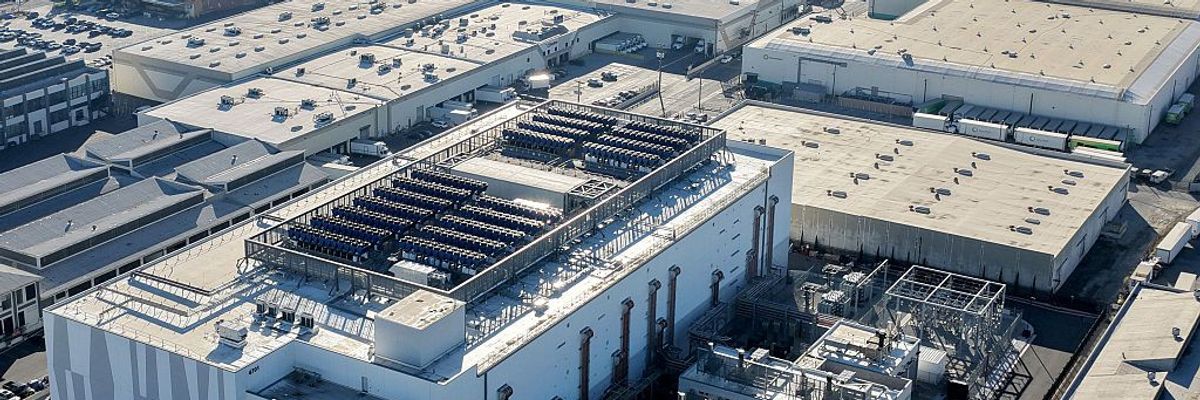
An aerial view of a 33 megawatt data center with closed-loop cooling system, amid warehouses on October 20, 2025 in Vernon, California.
(Photo by Mario Tama/Getty Images)
Brad Reed
Nov 17, 2025
“It’s hard to see utility bills coming down in this decade,” said one industry analyst.
An aerial view of a 33 megawatt data center with closed-loop cooling system, amid warehouses on October 20, 2025 in Vernon, California.
(Photo by Mario Tama/Getty Images)
Brad Reed
Nov 17, 2025
COMMON DREAMS
Although the rising cost of groceries has gotten a lot of attention in recent weeks, US consumers are also increasingly under pressure from the rising cost of electricity.
A new report from researchers at The Century Foundation and financial abuse watchdog Protect Borrowers has found that the average overdue balance on utility bills has surged by 32% over the last three years, going from $597 in 2022 to $789 in 2025. What’s more, the report estimates that roughly 1 out of every 20 US households has utility debt that is “so severe it was sent to collections or in arrears.”
RECOMMENDED...

‘Another Trump Lie’: Despite Campaign Pledges, Electricity Costs Up $100 Per Family
Despite Costs Soaring Under His Watch, Trump Tries to Jack Mamdani’s ‘Affordability’ Message
The increase in overdue utility bill debt has come at a time when electricity costs have been growing significantly faster than the overall rate of inflation, the organizations found.
“Comparing twelve-month moving averages from March 2022 to June 2025 (to adjust for seasonality), monthly energy costs... nationwide rose from $196 to $265—a 35% jump, or nearly three times overall inflation during that period,” noted the report.
The organizations said that the reasons for these price increases are complicated, although factors include “poorly regulated monopolies overcharging customers to the tune of $5 billion a year,” as well as the explosion in the construction of energy-devouring artificial intelligence data centers and the Trump administration’s attacks on renewable energy projects that began under former President Joe Biden’s administration.
AI data center construction has become a major controversy in communities across the US, and a CNBC analysis published late last week found that “in at least three states with high concentrations of data centers,” electric bills have grown “much faster than the national average” over the last year.
Virginia, which has the highest concentration of AI data centers in the country, saw electricity prices surge by 13% over the last year, while data center-heavy states such as Illinois and Ohio saw electricity costs go up by 16% and 12%, respectively.
Rob Gramlich, president of power sector consulting firm Grid Strategies, told CNBC that the massive growth in data centers means that “it’s hard to see utility bills coming down in this decade.”
The Century Foundation and Protect Borrowers conclude that their report paints “a grim picture” of “increasing energy prices, rising overdue balances, and squeezed household budgets that together are pushing families deeper and deeper into debt.”
Although the rising cost of groceries has gotten a lot of attention in recent weeks, US consumers are also increasingly under pressure from the rising cost of electricity.
A new report from researchers at The Century Foundation and financial abuse watchdog Protect Borrowers has found that the average overdue balance on utility bills has surged by 32% over the last three years, going from $597 in 2022 to $789 in 2025. What’s more, the report estimates that roughly 1 out of every 20 US households has utility debt that is “so severe it was sent to collections or in arrears.”
RECOMMENDED...
‘Another Trump Lie’: Despite Campaign Pledges, Electricity Costs Up $100 Per Family
Despite Costs Soaring Under His Watch, Trump Tries to Jack Mamdani’s ‘Affordability’ Message
The increase in overdue utility bill debt has come at a time when electricity costs have been growing significantly faster than the overall rate of inflation, the organizations found.
“Comparing twelve-month moving averages from March 2022 to June 2025 (to adjust for seasonality), monthly energy costs... nationwide rose from $196 to $265—a 35% jump, or nearly three times overall inflation during that period,” noted the report.
The organizations said that the reasons for these price increases are complicated, although factors include “poorly regulated monopolies overcharging customers to the tune of $5 billion a year,” as well as the explosion in the construction of energy-devouring artificial intelligence data centers and the Trump administration’s attacks on renewable energy projects that began under former President Joe Biden’s administration.
AI data center construction has become a major controversy in communities across the US, and a CNBC analysis published late last week found that “in at least three states with high concentrations of data centers,” electric bills have grown “much faster than the national average” over the last year.
Virginia, which has the highest concentration of AI data centers in the country, saw electricity prices surge by 13% over the last year, while data center-heavy states such as Illinois and Ohio saw electricity costs go up by 16% and 12%, respectively.
Rob Gramlich, president of power sector consulting firm Grid Strategies, told CNBC that the massive growth in data centers means that “it’s hard to see utility bills coming down in this decade.”
The Century Foundation and Protect Borrowers conclude that their report paints “a grim picture” of “increasing energy prices, rising overdue balances, and squeezed household budgets that together are pushing families deeper and deeper into debt.”
By AFP
November 16, 2025

Samsung Electronics is already one of the world's top memory-chip makers - Copyright AFP/File Jung Yeon-je
South Korean conglomerate Samsung unveiled on Sunday a plan to invest $310 billion over the next five years mostly in technology powering artificial intelligence, aiming to meet growing demand driven by a global boom.
The business group’s flagship Samsung Electronics is already one of the world’s top memory-chip makers, providing crucial components for the AI industry and the infrastructure it relies on.
South Korea is also home to SK hynix, another key player in the global semiconductor market.
The five-year investment package includes plans to build a new semiconductor facility, Pyeongtaek Plant 5, designed “to meet the needs of memory-chip demands”, Samsung said in a statement.
Once in full operation, “the Pyeongtaek plant is expected to play an even greater strategic role in both the global semiconductor supply chain and South Korea’s domestic chip ecosystem,” it said.
The new line is scheduled to begin operations in 2028.
Samsung SDS, the group’s IT and logistics arm, will establish two AI data centres in South Jeolla and Gumi, the company said, without providing further details.
Samsung Group is a network of affiliated companies with complex cross-shareholdings under the Samsung brand, rather than a single legal holding company.
It is South Korea’s largest chaebol, the family-run conglomerates that dominate the country’s economy.
The $310-billion plan also includes some projects unrelated to AI.
Under the investment package, the company said that Samsung SDI, its electric-vehicle battery affiliate, was exploring the creation of a domestic production line “for next-generation batteries, including all-solid-state batteries”.
The AI boom has delivered a major tailwind for Samsung Electronics and SK hynix, whose high-performance memory chips have become indispensable for AI computing.
Samsung Electronics has reported that its profit increased more than 30 percent year-on-year in the third quarter, driven by AI-fuelled demand.
AI-related spending is soaring worldwide and sky-high tech share valuations have fed concerns of an AI market bubble that could eventually burst, like the dot-com boom that imploded at the turn of the millennium.
The investment package announced on Sunday comes after the South Korean government had pledged to triple spending on artificial intelligence next year.
President Lee Jae Myung has vowed to “usher in the AI era” and make the country one of the world’s top three AI powers, behind the United States and China.

No comments:
Post a Comment