Net Zero: Fantasy, Red Herring, or Reality?
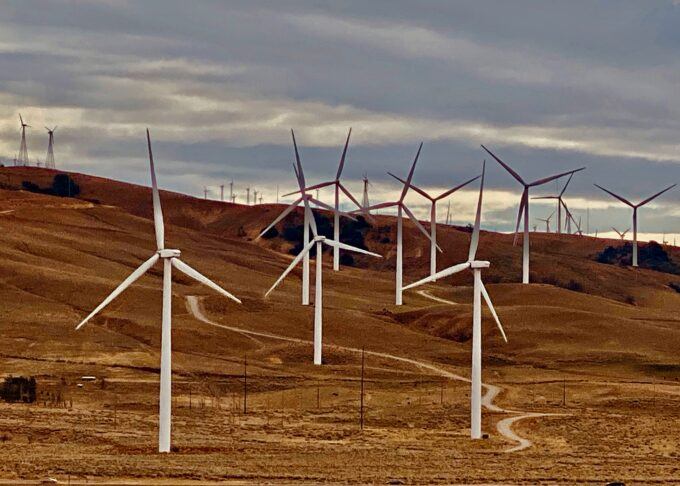
Wind farm near Tehachapi Pass, California. Photo: Jeffrey St. Clair.
Ten years after the 2015 Paris Agreement provided a framework to keep average global temperatures from rising 1.5 °C (2.7 °F) above pre-industrial levels, the world continues to advance towards climate breakdown. Time is running out on a human-induced Anthropocene: a decade of record high temperatures, more disastrous climate events per year, 428.2 ppm atmospheric carbon dioxide (up 3 ppm in 2025). Why can’t we improve our lot rather than making things worse? We have the technology. “Net Zero” is a fundamental concept for good clean living.
Falsehoods abound as vested interests distract from the growing dangers, encouraging business as usual to keep oil sales in the black: Ronald Reagan claiming that trees cause more pollution than cars, George W. Bush rebranding “global warming” as “climate change,” and Donald Trump’s ongoing nonsense about clean coal, cancerous wind mills, and electric vehicle “mandates.” Instead of a change from dirty to clean, the energy transition is becoming an add-on, keeping the cash registers whirling on a 165-year-old petroleum-run world that burns over 80 million barrels each day. The assault on truth goes unchecked, ensuring that a lucrative hydrocarbon-based economy continues to pay out, rather than providing clean green energy for industry, transportation, and buildings.
Others have even done an about-turn, such as Microsoft co-founder Bill Gates, whose 2021 book How To Avoid A Climate Disaster: The Solutions We Have And The Breakthroughs We Need sounded promising, but has shown himself to be more interested in making money than stopping an increasingly warming world. On the nasty issue of transportation emissions (28% in the US), Gates did note, “It’s rare that you can boil the solution for such a complex subject down into a single sentence. But with transportation, the zero-carbon future is basically this: Use electricity to run all the vehicles we can, and get cheap alternative fuels for the rest.” He also added that natural gas cannot act as a bridge fuel if we are serious about net zero by 2050, stating that such “gradualism” throws good money after bad and locks us into a mistaken direction by providing short-term gain yet long-term failure.
Gates had supported all-out zero-carbon electricity and wide-scale electrification, “everything from vehicles to industrial processes and heat pumps” and for greenhouse gas emissions to reach net zero by 2050 to avoid the “catastrophic” impact of man-made global warming. But the world’s formerly richest person now thinks our “doomsday outlook” on global climate is too focussed on reducing emissions, oddly stating that more spending on health is needed to combat the warming world.
Tesla CEO Elon Musk also plays both sides as the progenitor of a clean electric-vehicle future, starting with the 2008 all-electric Lotus Elise inspired Roadster, stuffed full of lithium-ion batteries. Despite having gone off the rails with his anti-government rants (standard billionaire libertarian policy to avoid paying for shared infrastructure) and far-right support (smoke-screen for small, no-regulation government), Musk will be remembered for kick-starting the twenty-first century revolution revolution as well as the global market for chemical battery storage (another potential trillion-dollar industry that conditions power for an intermittent grid). The Ford Motor Co. may have ditched its all-electric F-150 Lightning pickup for now, but is banking on the rapidly expanding electric storage market to the tune of $2 billion (lithium iron phosphate cells, 5 MWh packs).
Musk is also exploring ways to block the sun in an ill-conceived solar radiation management geo-engineering project, literally pie-in-the-sky madness, rather than selling solar for all on hundreds of millions of roofs and thousands of Tesla charging stations. Gates also called for similar, high-investment, centrally controlled solutions, as unworkable as they are unfeasible. Musk’s idea is a satellite array to block the sun, while Gates supports sun-reflecting aerosols.
Trump’s fire-fuel thinking is retrograde in the extreme, including increased oil subsidies, resurrecting dead coal plants (more than 2 times as expensive as solar), and laughable “national security risks” as the reason to “pause” five east-coast offshore wind projects, one of which was almost 70% complete, policies that raise energy costs for consumers and make everyday living less affordable. Commodore Trump is even putting the United States on a collision course with Venezuela – a founding OPEC member that first called for a 50-50 agreement with foreign oil companies to make a return on its own natural resources – as the assembling American “Armada” aims to control the world’s largest petroleum reserves (300 billion barrels, 18%).
War used to be the last resort, but is now being touted as an answer to socialism in the Western Hemisphere by a politically renegade US that calls on foreign citizens to rise up against their governments under the threat of attack. The quaint cover story is to stop fentanyl from destroying American lives, more slimy and brazen than any past US-led coup.
The Russia-Ukraine war has lasted almost four years, refashioned from an EU/NATO bulwark “special military operation” into a natural gas turf war between the United States and Russia (who together control more than one-third of the natural gas export market), driven by American sanctions and tariffs in an old-fashioned, mob-style protection racket. Trump’s simplistic petroleum-centred view hinders American dominance in the growing trillion-dollar green economy, now led by China and Europe. Relishing his role as a green Grinch and Big Oil bagman, Trump even had a bike-sharing hub removed from outside the White House.
Not all free-marketers think green energy is a “scam.” In a 1989 speech to the United Nations, UK prime minister Margaret Thatcher noted that environmental issues had “grown clearer than any other in both urgency and importance.” Berkeley physics professor and former climate skeptic Richard A. Muller did his own global warming study, calculating that average temperatures were increasing because of human activity despite decreasing at a third of the 36,866 test locations, highlighting how weather does not equal climate. Commercial artist Damien Hirst, famous for pickling large animals, fingered waste as a symbol of our times, ever more petroleum-based plastic garbage entering the environment abetted by uncaring and unregulated packaging companies – more than 400 million tons per year!
Unfortunately, the transition is being slowed by private interests and a lunatic American idea that the past is somehow the way forward. Affordability is no longer an issue as electric vehicles (EVs) have already achieved parity with and now undercut internal combustion engine (ICE) gasmobiles. Nor is efficiency a problem with EVs at 95% (conversion of input energy to mobility) compared to a maximum 50% in an ICE gasmobile (mostly lost heat). The efficiency (or inefficiency) of a gasmobile is in fact negative when all externalities are included (extraction, shipping, refining, storage, delivery, pumping, with millions of miles of piping along the way). The same is true for LEDs versus incandescent bulbs (5 times less efficient) – direct conversion of energy to light without heat loss.
What customers and manufacturers want (“letting the market decide”) can’t be the only factor without including all externalities, such as pollution and greenhouse gas emissions. Repealing long-standing fuel-economy standards that increased a woeful miles-per-gallon inefficiency of combustion engines (more completely burning higher-octane gasoline) means more pollution on the streets – more deaths, disease, and dementia from particulate matter, carbon monoxide, NOx, volatile organic compounds, lead, arsenic, …. Pretending plug-in hybrids are a solution is a red herring that postpones the switch to EVs, doing little to counter toxic pollution and global warming. Hybrids are almost as bad as gasmobiles, while an EV is better for the environment after only two years.
While the US goes backwards, Europe is also slowing the transition, calling for a delay in a mandated rollout of 100% EVs by 2035 to 90%. The delayed EU EV transition pleases European carmakers, yet will make manufacturing less competitive with China as does the Trump-backed US about-face on electric vehicles. The EV growth curve is still positive, but manufacturing uncertainty hurts competitiveness and hampers the growth of new supply chains. The 2024 EU Critical Raw Materials Act is of little use if China remains in charge, while supply chains based on old oil routes also increases the likelihood of future conflicts, chiefly with energy-rich Russia.
The rapid increase in the sales of battery-only trucks in China over diesel and natural gas is already impacting oil revenues (9% of sales in the first half of 2024, 22% in 2025, and an expected 60% in 2026), continuing the downward pressure on an uncertain market, while increasing China’s leadership in the green economy. As the post-war rise of Japanese electronics undermined Western dominance in technology, so too will Chinese EVs surpass Western car manufacturing as new sales move from Detroit, Wolfsburg, and Yokohama to Shanghai. Global EV sales in 2025 were 25% (90% in China, 16% EU, and 10% US).
In “Net Zero by 2050,” the International Energy Agency called for “a rapid shift away from fossil fuels” and “huge declines in the use of coal, oil and gas,” while the goals to achieve net zero included “halting sales of new internal combustion engine passenger cars by 2035, and phasing out all unabated coal and oil power plants by 2040.” Of course, the ongoing pushback keeps fossil-fuel industry assets from becoming stranded as more oil investments are curtailed that reduce profitability and increase the financial risk to Big Oil.
According to a 2025 Nature Sustainability report on power plants stranded by climate mitigation, “The top 25 most-exposed firms hold $770 billion in stranded assets under a 1.5°C scenario and $224 billion under a 2°C scenario. Together they emit 4.0 Gt CO2 annually, equivalent to 11% of global emissions. State-owned enterprises dominate the list, with China’s Big Five power producers accounting for $79–134 billion in at-risk coal assets alone.” The fire-fuel industry isn’t ready to trade away the world’s most lucrative commodity.
Happily, there is a viable and profitable future for green energy – new installations in 2025 were 85% renewables and only 5% oil. Although oil still powers more than 50% of all installations, the green count grows year on year. A number of countries recorded 100% renewable days in 2025, including Denmark, Norway, Portugal, Spain, and the UK. Ireland, Germany, and the Netherlands are all more than 40% renewables. Ditto 100% renewable days in California, the world’s fifth-largest economy (after the US, China, Germany, and Japan), while Texas is more than 40% green (mostly wind-powered). Soon, one will talk about varying shades of green states instead of blue and red.
A disruptive design revolution is also helping to reshape a century of oil-centred living in our overcrowded and underfunded urban environments. More people-oriented communal green street spaces (“parklets”) and cycle lanes are cropping up in newly remodelled city landscapes, redefining the idea of street property within the old commons. Noise, exhaust fumes, and me-first living are being challenged as more green space helps us to de-stress amid a fast-pace commuter culture that puts cars before people. Once considered a luxury, the garage may need to be refashioned – workshop, studio, person-cave.
The sharing economy is also growing as drivers look for new ways to get from A to B. Reduced ownership is upsetting mobility trends as high prices impact new sales. Gen Z and Millennial buyers don’t need to spend $50,000 on a lifestyle option that sits in a garage nor the $10,000 associated annual costs, standing a long-established sales model on its head and reducing gasoline demand. Free electrified public transit also helps lower toxic pollution, global warming, and urban congestion as started in 2020 in the city of Luxembourg.
“Paris 1.5” is dead (now +1.55 over 1890 levels), but clear objectives and achievable targets are needed to keep industry from lagging behind the technical competence and needed goals: green transportation, buildings, cement, and steel. As the US slows the transition, EVs remain at a disadvantage, upsetting design to road time, but we can all work together on a green economy that limits the damage of the petroleum era. “Paris 2.0” may be the last gasp.
Why is the concept of “net zero” hard to understand? The two main issues are pollution and warming. Possibly because it is hard to see a slow rise in average temperature within seasonal ups and downs and our own childhood nostalgia. The signal is there (as in any data fit to the temperature record since the start of the Industrial Revolution), but is thought of as noise. Atmospheric warming is also a two-stage concept, where carbon dioxide is added to the atmosphere that then absorbs outgoing infrared radiation and raises temperatures.
Pollution is an easier concept to understand as burnt fossil fuels release a witches brew of toxins directly into the atmosphere (as well as heat-absorbing carbon dioxide and methane) that kills 9 million people per year and contributes to respiratory problems, cancer, dementia, and numerous health issues (90% of the global population are exposed to excessive levels). The atmosphere is also very large and 3 parts per million may seem small. Think of that once-happy frog in a pot of slowly warming water.
Carbon capture and sequester (CCS) also seems like a simple solution, but allows the polluters and warmers to continue polluting and warming. Direct-air-capture CCS could be a solution if it was easy and cheap, but is hard and expensive. One underappreciated possibility is a two-stage CCS process using the oceans and seas. It is easier to remove carbon from water that then reabsorbs carbon from air. Sadly, the oceans are also high in carbon.
Changing from polluting and warming gasmobiles to electric vehicles is simple. The technology and economies of scales exist. Parity has been achieved. And only two years to see the environmental benefit. There is much opposition from the established oil industry supported by beholden politicians. Hence the rise of the hybrid, sold as a solution to keep the refineries and gasoline companies in business. 100 million cars worldwide sold per year ($3 trillion), 20 million barrels of oil a day ($1.2 billion/day). Change was never going to be easy.
The pace of change is always uneven. In the US, widespread adoption of urban electrification took 50 years and another 25 years for American farms to reach 90%. What we take for granted today took decades to achieve after the opening of Thomas Edison’s groundbreaking 1882 Pearl Street Power Station. Same for the personal computer, internet, and cellphone as luxury turns to everyday: affordable, efficient, and reliable.
We can also do our own bit. Less is more, helping define the rebellion against the constant selling of things – the greenest dollar is the one not spent. We must all find a way to net zero. No more denial or delay.


No comments:
Post a Comment