The global rallying cry of the Global South should, by now, be unmistakable. Down with imperialism: not as a slogan of nostalgia, but as a political necessity.
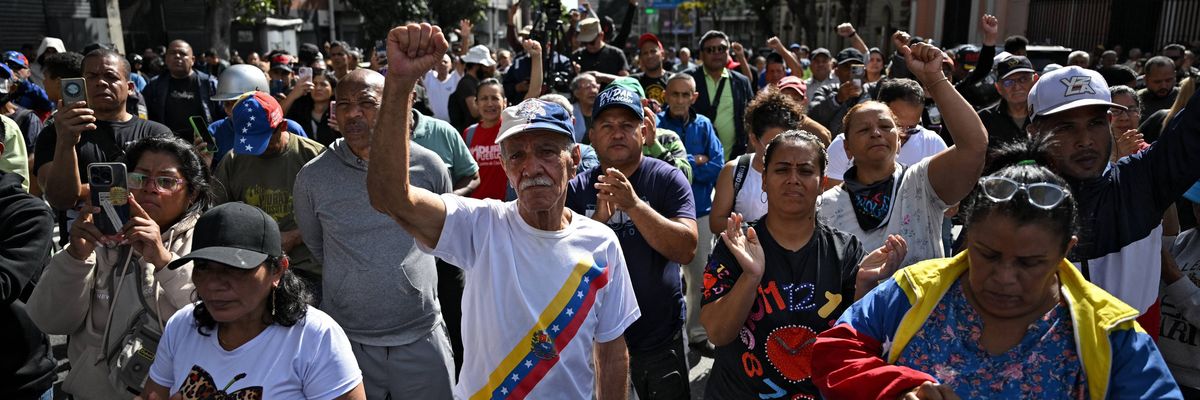
Supporters of Venezuela’s President Nicolas Maduro gather in the streets of Caracas on January 3, 2026, after US forces captured him.
(Photo by Federico Parra / AFP via Getty Images)
Jawad Khalid
Jan 08, 2026
Common Dreams
The seizure of Venezuelan President Nicolás Maduro by the United States marks a dangerous moment in international politics. A sitting head of state was forcibly removed from his country, flown to the United States, and placed on trial under American law. Washington has described this as justice. Under international law, it is an abduction.
President Donald Trump openly justified the attack by invoking the Monroe Doctrine, a 19th-century policy that treats Latin America as the United States’ exclusive sphere of influence. Trump went further, saying the doctrine had been “updated” and renamed, declaring that the United States would “run” Venezuela until it approved a political transition. He also made clear that American oil companies would move in to control Venezuela’s oil reserves, the largest in the world.
This was not hidden. It was stated plainly.
What is happening in Venezuela is not new. It follows a long and well-documented pattern. Latin America has repeatedly been subjected to US-backed coups, regime change operations, and military interventions, all justified under shifting narratives of freedom, security, or democracy.
Without unified voices of resistance, the unshackled advance of empire will continue, reshaping borders, governments, and lives at will.
From the overthrow of Guatemala’s Jacobo Árbenz in 1954 to the CIA-backed coup against Chile’s Salvador Allende in 1973, the region carries the weight of this history. The United States supported military dictatorships across Argentina, Chile, El Salvador, and Guatemala, governments responsible for mass killings, torture, and disappearances. It trained and funded armed groups like the Contras in Nicaragua, whose violence devastated civilian populations. The Monroe Doctrine has always meant one thing in practice: Latin America’s sovereignty is conditional.
Trump’s actions in Venezuela are simply a continuation of this logic.
As expected, Venezuela has now faced the full might of imperial power. Maduro sits in a US courtroom, while American oil companies prepare to rake in profits from the largest proven oil reserves on the planet. And the Global South remains divided and fragmented, offering no unequivocal, unified defense of Venezuelan sovereignty.
We have seen this paralysis before. We have been watching it unfold in Gaza for the past three years. There, too, a neocolonial imperialist order operates with impunity—bombing hospitals, leveling neighborhoods, killing thousands of children while invoking the rhetoric of security and self-defense. And there, too, the response has been fractured. Murmurs of resistance emerge, fragile and disconnected: a statement here, a protest there. Meanwhile, the so-called civilized West offers apathy at best. Even the peoples of the Global South, themselves shaped by histories of colonization and plunder, often look on in exhausted silence.
But is there anything truly new about Venezuela? Have we forgotten Iraq and Afghanistan—empire’s forever wars, launched on lies? Have we forgotten Libya, Syria, or the endless cycle of coups and regime-change operations that have defined Washington’s relationship with Latin America, its so-called backyard? The method remains the same: Violence exercised without consequence, legality bent to power, sovereignty treated as conditional.
What has changed is not the Empire but the resistance. There are no Che Guevaras, no Castros, no Chávezes today with the moral gravity to name imperialism for what it is, without apology or ambiguity. There are no leaders alive who dare to raise, unfiltered, the cry of resistance against empire. Instead, what we increasingly see are local elites who serve as intermediaries of domination, eager to trade sovereignty for approval, legitimacy, or personal gain. Nations are bartered away for access, status, and survival within an imperial order they dare not challenge.
Those who still speak out are swiftly disciplined. The Empire’s media brands them radicals, extremists, pariahs unfit for polite conversation, unworthy of seats at the tables of “civilization” and “progress.” They are sanctioned, silenced, or erased. And the rest? Hollowed out by petty self-interest and political cowardice.
In my own country, we carry a long and inglorious tradition of Napoleonic generals and compliant elites serving foreign empires—a tradition that has not ended, only adapted.
Today it is Gaza and Venezuela. Tomorrow it may be Iran. And one day, inevitably, it will be someone else—perhaps even us. This is how empire advances. Each violation normalizes the next. Each kidnapping, bombing, or occupation becomes the justification for another.
The global rallying cry of the Global South should, by now, be unmistakable. Down with imperialism: not as a slogan of nostalgia, but as a political necessity. Without unified voices of resistance, the unshackled advance of empire will continue, reshaping borders, governments, and lives at will.
The question is no longer whether the imperial order is collapsing. It is whether, in a fractured and conflict-ridden multipolar world, the victims of empire can overcome their divisions long enough to build something better.
And that question remains unanswered.
Our work is licensed under Creative Commons (CC BY-NC-ND 3.0). Feel free to republish and share widely.
Jawad Khalid
Jawad Khalid is a Pakistan-based climate finance and political economy analyst. He writes on climate justice, policy, and geopolitics with bylines in publications such as The Interpreter, Common Dreams, Asia Times, and CounterPunch.
Full Bio >
The seizure of Venezuelan President Nicolás Maduro by the United States marks a dangerous moment in international politics. A sitting head of state was forcibly removed from his country, flown to the United States, and placed on trial under American law. Washington has described this as justice. Under international law, it is an abduction.
President Donald Trump openly justified the attack by invoking the Monroe Doctrine, a 19th-century policy that treats Latin America as the United States’ exclusive sphere of influence. Trump went further, saying the doctrine had been “updated” and renamed, declaring that the United States would “run” Venezuela until it approved a political transition. He also made clear that American oil companies would move in to control Venezuela’s oil reserves, the largest in the world.
This was not hidden. It was stated plainly.
What is happening in Venezuela is not new. It follows a long and well-documented pattern. Latin America has repeatedly been subjected to US-backed coups, regime change operations, and military interventions, all justified under shifting narratives of freedom, security, or democracy.
Without unified voices of resistance, the unshackled advance of empire will continue, reshaping borders, governments, and lives at will.
From the overthrow of Guatemala’s Jacobo Árbenz in 1954 to the CIA-backed coup against Chile’s Salvador Allende in 1973, the region carries the weight of this history. The United States supported military dictatorships across Argentina, Chile, El Salvador, and Guatemala, governments responsible for mass killings, torture, and disappearances. It trained and funded armed groups like the Contras in Nicaragua, whose violence devastated civilian populations. The Monroe Doctrine has always meant one thing in practice: Latin America’s sovereignty is conditional.
Trump’s actions in Venezuela are simply a continuation of this logic.
As expected, Venezuela has now faced the full might of imperial power. Maduro sits in a US courtroom, while American oil companies prepare to rake in profits from the largest proven oil reserves on the planet. And the Global South remains divided and fragmented, offering no unequivocal, unified defense of Venezuelan sovereignty.
We have seen this paralysis before. We have been watching it unfold in Gaza for the past three years. There, too, a neocolonial imperialist order operates with impunity—bombing hospitals, leveling neighborhoods, killing thousands of children while invoking the rhetoric of security and self-defense. And there, too, the response has been fractured. Murmurs of resistance emerge, fragile and disconnected: a statement here, a protest there. Meanwhile, the so-called civilized West offers apathy at best. Even the peoples of the Global South, themselves shaped by histories of colonization and plunder, often look on in exhausted silence.
But is there anything truly new about Venezuela? Have we forgotten Iraq and Afghanistan—empire’s forever wars, launched on lies? Have we forgotten Libya, Syria, or the endless cycle of coups and regime-change operations that have defined Washington’s relationship with Latin America, its so-called backyard? The method remains the same: Violence exercised without consequence, legality bent to power, sovereignty treated as conditional.
What has changed is not the Empire but the resistance. There are no Che Guevaras, no Castros, no Chávezes today with the moral gravity to name imperialism for what it is, without apology or ambiguity. There are no leaders alive who dare to raise, unfiltered, the cry of resistance against empire. Instead, what we increasingly see are local elites who serve as intermediaries of domination, eager to trade sovereignty for approval, legitimacy, or personal gain. Nations are bartered away for access, status, and survival within an imperial order they dare not challenge.
Those who still speak out are swiftly disciplined. The Empire’s media brands them radicals, extremists, pariahs unfit for polite conversation, unworthy of seats at the tables of “civilization” and “progress.” They are sanctioned, silenced, or erased. And the rest? Hollowed out by petty self-interest and political cowardice.
In my own country, we carry a long and inglorious tradition of Napoleonic generals and compliant elites serving foreign empires—a tradition that has not ended, only adapted.
Today it is Gaza and Venezuela. Tomorrow it may be Iran. And one day, inevitably, it will be someone else—perhaps even us. This is how empire advances. Each violation normalizes the next. Each kidnapping, bombing, or occupation becomes the justification for another.
The global rallying cry of the Global South should, by now, be unmistakable. Down with imperialism: not as a slogan of nostalgia, but as a political necessity. Without unified voices of resistance, the unshackled advance of empire will continue, reshaping borders, governments, and lives at will.
The question is no longer whether the imperial order is collapsing. It is whether, in a fractured and conflict-ridden multipolar world, the victims of empire can overcome their divisions long enough to build something better.
And that question remains unanswered.
Our work is licensed under Creative Commons (CC BY-NC-ND 3.0). Feel free to republish and share widely.
Jawad Khalid
Jawad Khalid is a Pakistan-based climate finance and political economy analyst. He writes on climate justice, policy, and geopolitics with bylines in publications such as The Interpreter, Common Dreams, Asia Times, and CounterPunch.
Full Bio >
‘I’m Just Talking About Globally’: Forget Greenland, Says Rubio, US Reserves Right for Military Invasion Anywhere It Wants
“The Trump administration is blatantly colonialist, and proud of it.”
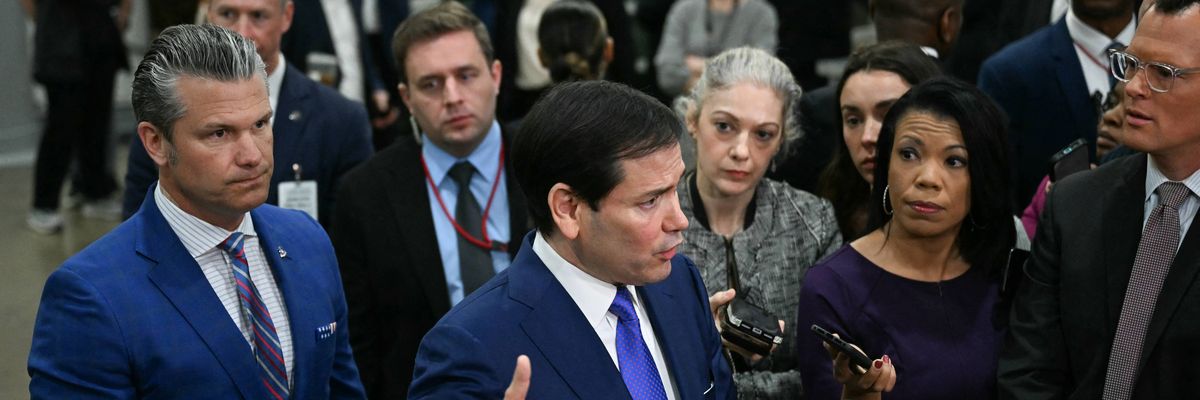
US Secretary of Defense Pete Hegseth and Secretary of State Marco Rubio speak to reporters after they briefed senators on the recent US military actions in Venezuela on Capitol Hill in Washington, DC on January 7, 2026.
(Photo by Brendan Smialowski/AFP via Getty Images)
Stephen Prager
Jan 07, 2026
COMMON DREAMS
On the heels of President Donald Trump’s threats to use military force to conquer Greenland, Secretary of State Marco Rubio suggested during a Wednesday press conference that US presidents reserve the right to do so not only in the Danish territory, but anywhere in the world.
The conference came shortly after Rubio and Defense Secretary Pete Hegseth briefed lawmakers about Trump’s illegal operation to overthrow Venezuelan President Nicolás Maduro last weekend.
‘We Must Stop Him’: Gallego Bill Would Ban Funding for Trump Greenland Invasion
In ‘Unhinged’ Rant, Miller Says US Has Right to Take Over Any Country For Its Resources
After Rubio laid out plans for the US to take control of 30 million to 50 million barrels of Venezuelan oil following a deal with its newly installed government, reporters attempted to ask Rubio to explain the administration’s designs on Greenland.
On Tuesday, amid international outcry, the White House issued a statement that acquiring Greenland was a “national security priority” and that “utilizing the US military is always an option” to annex the Arctic island.
European leaders met on Wednesday to discuss a potential response if Trump were to launch a military operation to seize Greenland, which has been a territory of Denmark—now a NATO member—for over 300 years.
Rubio appeared sheepish about discussing Trump’s saber-rattling. Asked by a reporter whether he’d take military intervention “off the table,” he shrugged: “I’m not here to talk about Denmark or military intervention. I’ll be meeting with them next week.”
Rubio pivoted to discuss the president’s interest in buying Greenland, which he has suggested since his first term in office. But reporters continued to press on what was meant by Trump’s suggestion that the military may be used.
After continuing to stall—and, at one point, interrupting a reporter to tell him he’d “lost a lot of weight”—Rubio obliquely addressed the president’s threats.
He said: “Guys, what I think the White House said yesterday is what I will tell you now, and I’ve always said: The president always retained the option—every president, not this president, every president—always retains the option... I’m not talking about Greenland, I’m talking about globally. If the president identifies a threat to the national security of the United States, every president retains the option to address it through military means.”
“As a diplomat, which is what I am... we always prefer to settle it in different ways,” Rubio continued. “That included in Venezuela. We tried repeatedly to reach an outcome here that did not involve having to go in and grab an indicted drug trafficker. Those were unsuccessful, unfortunately.”
The United Nations Charter, which the US has signed, allows for the use of military force against other sovereign nations only in very narrow circumstances: in self-defense against an imminent attack, or when approved by the UN Security Council as necessary to prevent a threat to peace.
The Trump administration has attempted to stretch this definition to justify its overthrow of the Venezuelan government, claiming that supposed drug trafficking from Venezuela constitutes an imminent threat to the US. But Venezuela is not considered a large player in the global drug trade, and even if it were, drug trafficking has never been considered equivalent to an armed attack under international law.
Rubio did not clarify what “threat” Greenland supposedly poses to the United States. Earlier this week, Trump stated that the US “needs” the island because it is supposedly “covered with Russian and Chinese ships,” which isn’t true, but would not constitute an imminent threat to the US even if it were.
When a reporter then asked Trump what justification the US would have to take Greenland, he responded that “the [European Union] needs us to have it.” Several major EU members, in fact, issued a harsh condemnation of the idea on Tuesday.
International relations scholars agree with virtual unanimity that for the US to forcibly annex Greenland would not be a legitimate use of force. But Section 2(4) of the UN Charter also forbids the threat of military force as a tool of leverage in negotiations, which Trump may be using in a possible bid to buy Greenland.
“International law does not recognize title obtained through unlawful force,” wrote Edmarverson A. Santos, a Dublin-based international law and policy researcher. “The prohibition extends beyond actual armed attack. Contemporary doctrine recognizes that serious threats of force, particularly when coupled with political or military pressure, can fall within the scope of Article 2(4).”
Since its attack on Venezuela, the Trump administration has threatened to use similar force to knock over the governments of several other countries as part of what he has described as a 21st-century revival of the colonial-era “Monroe Doctrine.”
Trump issued threats to Mexico’s President Claudia Sheinbaum and Colombian President Gustavo Petro. Rubio, meanwhile, said that if he were part of Cuba’s socialist government, he’d “be concerned, at least a little bit.”
On Tuesday, André Nollkaemper, a professor of public international law at the University of Amsterdam, warned that Trump’s increasing belligerence toward Europe was the direct outcome of European leaders’ meek response to his attack on Venezuela.
“The long-term impact of US intervention in Venezuela will not be decided in Caracas or Washington, but elsewhere,” he wrote for the German academic site Verfassungsblog. “With intervention now framed as a standard policy instrument of the USA, it is the response of other states—including in Europe—that will determine whether the erosion of international law becomes normalized across regions.”
“In deciding the course and content of its response, Europe might be tempted to assume that this new strategy is limited to Latin America, and that the United States should be given some room there,” he continued. “That would, of course, be irresponsible; in terms of its implications for international law, and with regard to Mexico, Colombia, and Cuba—not to mention Greenland.”
“The Trump administration is blatantly colonialist, and proud of it.”
US Secretary of Defense Pete Hegseth and Secretary of State Marco Rubio speak to reporters after they briefed senators on the recent US military actions in Venezuela on Capitol Hill in Washington, DC on January 7, 2026.
(Photo by Brendan Smialowski/AFP via Getty Images)
Stephen Prager
Jan 07, 2026
COMMON DREAMS
On the heels of President Donald Trump’s threats to use military force to conquer Greenland, Secretary of State Marco Rubio suggested during a Wednesday press conference that US presidents reserve the right to do so not only in the Danish territory, but anywhere in the world.
The conference came shortly after Rubio and Defense Secretary Pete Hegseth briefed lawmakers about Trump’s illegal operation to overthrow Venezuelan President Nicolás Maduro last weekend.
‘We Must Stop Him’: Gallego Bill Would Ban Funding for Trump Greenland Invasion
In ‘Unhinged’ Rant, Miller Says US Has Right to Take Over Any Country For Its Resources
After Rubio laid out plans for the US to take control of 30 million to 50 million barrels of Venezuelan oil following a deal with its newly installed government, reporters attempted to ask Rubio to explain the administration’s designs on Greenland.
On Tuesday, amid international outcry, the White House issued a statement that acquiring Greenland was a “national security priority” and that “utilizing the US military is always an option” to annex the Arctic island.
European leaders met on Wednesday to discuss a potential response if Trump were to launch a military operation to seize Greenland, which has been a territory of Denmark—now a NATO member—for over 300 years.
Rubio appeared sheepish about discussing Trump’s saber-rattling. Asked by a reporter whether he’d take military intervention “off the table,” he shrugged: “I’m not here to talk about Denmark or military intervention. I’ll be meeting with them next week.”
Rubio pivoted to discuss the president’s interest in buying Greenland, which he has suggested since his first term in office. But reporters continued to press on what was meant by Trump’s suggestion that the military may be used.
After continuing to stall—and, at one point, interrupting a reporter to tell him he’d “lost a lot of weight”—Rubio obliquely addressed the president’s threats.
He said: “Guys, what I think the White House said yesterday is what I will tell you now, and I’ve always said: The president always retained the option—every president, not this president, every president—always retains the option... I’m not talking about Greenland, I’m talking about globally. If the president identifies a threat to the national security of the United States, every president retains the option to address it through military means.”
“As a diplomat, which is what I am... we always prefer to settle it in different ways,” Rubio continued. “That included in Venezuela. We tried repeatedly to reach an outcome here that did not involve having to go in and grab an indicted drug trafficker. Those were unsuccessful, unfortunately.”
The United Nations Charter, which the US has signed, allows for the use of military force against other sovereign nations only in very narrow circumstances: in self-defense against an imminent attack, or when approved by the UN Security Council as necessary to prevent a threat to peace.
The Trump administration has attempted to stretch this definition to justify its overthrow of the Venezuelan government, claiming that supposed drug trafficking from Venezuela constitutes an imminent threat to the US. But Venezuela is not considered a large player in the global drug trade, and even if it were, drug trafficking has never been considered equivalent to an armed attack under international law.
Rubio did not clarify what “threat” Greenland supposedly poses to the United States. Earlier this week, Trump stated that the US “needs” the island because it is supposedly “covered with Russian and Chinese ships,” which isn’t true, but would not constitute an imminent threat to the US even if it were.
When a reporter then asked Trump what justification the US would have to take Greenland, he responded that “the [European Union] needs us to have it.” Several major EU members, in fact, issued a harsh condemnation of the idea on Tuesday.
International relations scholars agree with virtual unanimity that for the US to forcibly annex Greenland would not be a legitimate use of force. But Section 2(4) of the UN Charter also forbids the threat of military force as a tool of leverage in negotiations, which Trump may be using in a possible bid to buy Greenland.
“International law does not recognize title obtained through unlawful force,” wrote Edmarverson A. Santos, a Dublin-based international law and policy researcher. “The prohibition extends beyond actual armed attack. Contemporary doctrine recognizes that serious threats of force, particularly when coupled with political or military pressure, can fall within the scope of Article 2(4).”
Since its attack on Venezuela, the Trump administration has threatened to use similar force to knock over the governments of several other countries as part of what he has described as a 21st-century revival of the colonial-era “Monroe Doctrine.”
Trump issued threats to Mexico’s President Claudia Sheinbaum and Colombian President Gustavo Petro. Rubio, meanwhile, said that if he were part of Cuba’s socialist government, he’d “be concerned, at least a little bit.”
On Tuesday, André Nollkaemper, a professor of public international law at the University of Amsterdam, warned that Trump’s increasing belligerence toward Europe was the direct outcome of European leaders’ meek response to his attack on Venezuela.
“The long-term impact of US intervention in Venezuela will not be decided in Caracas or Washington, but elsewhere,” he wrote for the German academic site Verfassungsblog. “With intervention now framed as a standard policy instrument of the USA, it is the response of other states—including in Europe—that will determine whether the erosion of international law becomes normalized across regions.”
“In deciding the course and content of its response, Europe might be tempted to assume that this new strategy is limited to Latin America, and that the United States should be given some room there,” he continued. “That would, of course, be irresponsible; in terms of its implications for international law, and with regard to Mexico, Colombia, and Cuba—not to mention Greenland.”

No comments:
Post a Comment