The USA Today: a Derangement Threatening the World
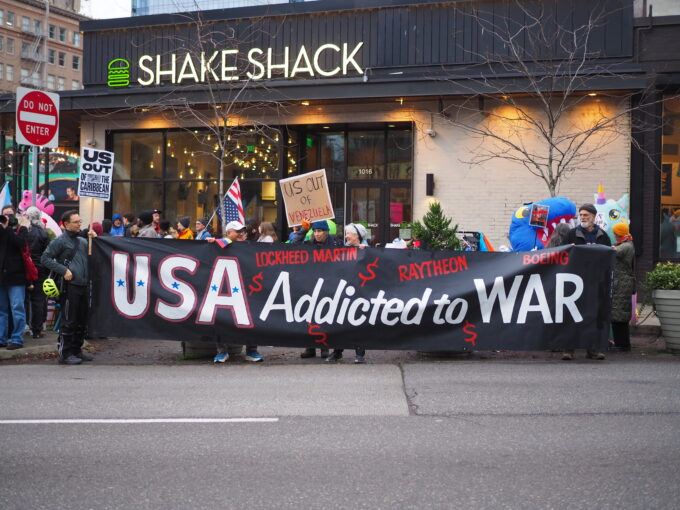
Photograph by Nathaniel St. Clair
Hong Kong.
People around the world walked into 2026 carrying a fragile hope that this year would be better than 2025 and 2024, years defined by the horrific genocide in Gaza. After two years marked by genocide, the collapse of moral restraint, and the reckless shredding of international law, there was a quiet desire to believe that dehumanizing actions had reached their limit. Fatigue itself became optimism. Surely the system would pause. Surely something had been learned.
That hope lasted barely a week.
The attack on Venezuela on January 3rd arrived as confirmation. The coercive removal of a head of state through kidnapping. A clear breach of international law. Executed calmly, justified procedurally, absorbed with disturbing ease.
The world reacted with surprise but not fury. Partly because it has seen this movie before—a telling reminder of humanity’s inured psychological state. Many have almost given up on the possibility of a better future and resigned themselves to growing global lawlessness.
That distinction matters. Outrage enforces norms. Shock without consequence merely rehearses impunity. When illegality triggers analysis instead of cost, it becomes precedent. This is how gangster logic enters global politics: not through chaos, but through repetition.
This was not a failure of the international order. It was the order functioning exactly as designed by the mob masquerading as guardians of the global order.
Western analysts and media moved quickly—remember Iraq—to make the event legible, reasonable, and ultimately forgettable. (Sahlane, Ahmed. “Covering the War on Iraq.” In Discourse, Media, and Conflict, 73–91. Cambridge University Press, April 2022.)
The dominant framings were familiar.
First, energy discipline. Venezuela’s oil reserves the largest in the world are described as “mismanaged,” belonging to the US because it was an early investor. Intervention is implied as corrective rather than coercive. Sovereignty gives way to “global energy stability.” (“Trump Says US Is Taking Control of Venezuela’s Oil Reserves. Here’s What It Means.” CNN Business, January 4, 2026.LINK.)
Second, regional stability. Commentators warn of refugee flows, cartel violence, and spillover risk. The United States is framed as a reluctant stabilizerand even a force for good. (Muñoz-Pogossian, Betilde, and Alexandra Winkler. “The Persistence of the Venezuelan Migrant and Refugee Crisis.” Center for Strategic and International Studies, November 20, 2025.)
Third, geopolitical objectives and hegemony masquerading as law enforcement. Comparisons are drawn to counter-narcotics operations. The language of policing replaces the language of invasion. (“The War on Narco-Terrorism in Latin America.” Steptoe. Accessed January 7, 2026.
Finally, the moral escape hatch: “messy, but necessary.” Legal discomfort acknowledged, then dismissed. Illegality is rendered tolerable when performed by the hegemon and endorsed by Western Allies. (de Wet, Alex. “Can Military Intervention Be ‘Humanitarian’?” Middle East Research and Information Project, May 14, 2017.
And now, Western foreign policy analysts and media are turning a blatant breach of international law by the US into an opportunity to demonise others. They are warning that Trump has set a precedent Beijing could use against Taiwan or Putin against others. (“U.S. Strike on Venezuela Puts China’s Taiwan Saber-Rattling in Focus,” CNBC, January 5, 2026, https://www.cnbc.com/2026/01/05/us-venezuela-strike-taiwan-china-precedent-russia-ukraine.html.)
This is moral evasion dressed as strategic analysis with the goal of diverting attention from the grave crime committed.
It converts American criminality into hypothetical Chinese villainy within hours—erasing what was done by raising panic about what might be done by their enemies. China has not refrained from attacking Taiwan because it was waiting for the United States to set a precedent. (Ryan Hass, “Trump’s Strikes on Venezuela Will Not Embolden China to Invade Taiwan,” Council on Foreign Relations, January 4, 2026, .)
The speed of this deflection is the entire tell : accountability vanishes, anxiety replaces it, and American lawlessness becomes a warning about someone else’s future behaviour.
These narratives launder power. By converting a breach of law into strategic inevitability, agency disappears. Responsibility dissolves. Violence becomes abstract. This is not analysis. It is anesthesia with amnesia.
What remains unspoken is simpler: the United States acts this way because it believes it can, until that suddenly changes. Resistance is growing globally and hurting it in ways it refuses to acknowledge. This denial, masking deep insecurity in a changing world, drives it to act more ruthlessly. In the absence of producing a transformative leader capable of breaking this spiral, it continues to act as every rogue empire has done, absolving itself because it is supposedly a democracy. That propaganda is lazily swallowed by most of its citizens, then lavishly spread by mainstream Western media. After all, if you can deny a live-streaming genocide and convince many of this lie, you can argue that a leader of a sovereign state was not kidnapped but brought to justice in a country where its own president is a convicted felon who evaded justice.
This is where American society enters the picture. Not as a potential source of resistance but instead often as an enthusiastic cheerleader, a silent stabilizer and perverse beneficiary of the nation’s active pursuit of global hegemony. This is a condition layered onto a culture largely wedded to delusional exceptionalism, white supremacy, cheap overconsumption, and constant entertainment, including foreign wars, crassness, and violence.
There will be no mass revolt. There never is. A few commentators will speak up. There will be sporadic protests, but who really cares? This action was against those foreign brown Others. Some campus statements may be made, but students will play it safe. Big city sound and fury on social media, measured alarm. And then… absorption, acceptance, even celebration. Liberal outrage will surface briefly, performing its ritual role, then quickly dissipate. Democratic elections will be invoked as proof of accountability, even as policy remains unchanged. Apologists will cite the often-made claim about America’s ability to always remake itself and produce great leaders, with no proof on offer, as nothing changes in its geopolitical strategy and foreign policy.
This is not apathy. It is the conditioning that has spawned a deranged society.
Silence and tacit support are reframed as exhaustion. Support of acts of terror is framed as apathy and marketed as pragmatism. Moral responsibility is outsourced to institutions structurally incapable of restraining empire. A deranged society does not need to approve of power to enable it. It merely needs to stop resisting.
This is decadence doing its work.
Oscar Wilde once observed that America is the only country that went from barbarism to decadence without passing through civilization. (Oscar Wilde, The Soul of Man Under Socialism, The Fortnightly Review, February 1891.) Wilde was diagnosing a condition over a hundred years ago when American decadence was nothing like it is today. For him, decadence meant abundance without ethics, power without discipline, spectacle without responsibility. American decadence today is on steroids, and most Americans, despite being afflicted with this debilitating condition, simply cannot see it. How else does one explain the gun violence, the killing of children, and the total inability to stop it?
Today, decadence has curdled into something more dangerous. The United States now sits on the edge of derangement. This is a society that arms its military to police the world while arming its children to survive their schools. A nation that exports violence abroad and normalizes it at home. School shootings provoke ritualized grief and immediate forgetting.
Immunity and impunity are not failures of the system. They are its operating logic. You cannot normalize lawlessness abroad and expect reverence for law at home. You cannot build global dominance on coercion and expect domestic cohesion. Violence travels inward.
Liberal America refuses to confront this contradiction. It prefers performance.
Brown, yellow, and black liberals sip lattes, issue statements, and decry genocide in carefully calibrated language, all while remaining structurally loyal to the order that produces it. Representation is mistaken for power. Proximity is mistaken for influence. Visibility substitutes for resistance.
This is not a judgment of individual sincerity. It is a critique of political comfort.
American liberalism has become a lifestyle posture rather than a transformative force or a belief rooted in fairness, justice, and equality. It allows moral expression without political cost. Outrage is encouraged. Disruption is discouraged. The system absorbs dissent while conceding nothing structural.
This is why leadership changes fail to change outcomes. The leaders are mere performers groomed by the plutocracy to take office but not make change. Change the President. Change the Mayor. Change rhetoric. Change the optics. Use soaring language to enhance the performance. The drones will still fly. Sanctions will still strangle civilian economies. Interventions will continue. Thousands in far flung places will be killed.
Empire does not respond to personalities or body bags. It responds to architecture.
Europe understands this hierarchy perfectly. Had Russia or China carried out a comparable act, European capitals would already be mobilizing sanctions, invoking international law, issuing grave warnings. NATO language would dominate the media cycle. When the United States acts, Europe hesitates. It calibrates. It waits. This is not alliance. It is terminal decline manifesting as dependency on a bully. Moral language in Europe is conditional, selectively deployed, and ultimately unserious. It appears where safe and vanishes when costly. The media follows the same logic. Events are described. Systems remain unnamed. Complexity is invoked to defer judgment indefinitely.
Latin America occupies a special place in this architecture and the psyche of America. Not as sovereign nations, but as a testing ground, where subservience is demanded and enforced. A zone where norms are trialed, stretched, and broken with limited consequence. The absence of nuclear deterrence matters. Power does not respect law. It respects cost. Latin America has long been denied the latter and lectured about the former. Intervention there is not an aberration. It is rehearsal.
Asia occupies a different strategic category.
The United States would not attempt such an action in East or South Asia. Not because it has evolved, but because it calculates. Vietnam and Afghanistan were bitter defeats which offered brutal lessons. China, India, Pakistan, and North Korea impose strategic costs that limit external interference. Nuclear deterrence succeeds where international law has repeatedly failed.
But restraint is not respect.
While sovereignty may be preserved strategically, many Asians continue to kneel psychologically. They still measure success through American validation. They still adopt American narratives as universal. They still mistake proximity to power for protection.
This is the deeper danger.
Hegemony does not operate only through force. It operates through desire. Through aspiration. Through the internalization of another civilization’s priorities as one’s own. This is how societies become comfortably numb.
Asia would be wise to catch itself here.
History is crowded with elites who believed accommodation would spare them. It never does. When discipline is required, aspiration becomes a liability.
Sanctions make this logic clear. Economies are strangled. Livelihoods collapse. Unrest follows. That unrest is then cited as evidence of governance failure. Intervention creates the crisis it later condemns. Cause disappears. Symptoms dominate coverage. Iran is the case in point.
What is most alarming is not aggression, but the absence of rage. Everywhere.
Hundreds of commentators now debate tactics, alignment, and risk. Very few say the obvious: a society that can absorb this behavior without fury is deeply unwell. A polity that cannot be shaken by illegality abroad has already accepted it as normal. One that cannot summon anger for injustice elsewhere will eventually excuse it at home.
This is not a moral sermon. It is a structural warning.
Empires do not require universal support. They require sufficient numbness.
We entered 2026 hoping peace might finally follow a year of atrocity. Venezuela reminded us that nothing fundamental had shifted. The machinery still hums. The narratives still hold. The silence still protects power.
Venezuela is not the crisis. It is the mirror.
And what it reflects is an empire mistaking immunity for strength, impunity for legitimacy, decadence for civilization, and drifting toward derangement while far too many, inside and outside it, remain comfortably numb.
Chandran Nair is the CEO of Asia’s leading independent think tank The Global Institute for Tomorrow based in Hong Kong. He is the author of several books including the acclaimed, Dismantling Global White Privilege: Equity for a Post- Western World.

No comments:
Post a Comment