“When government actions tied to foreign resources are preceded and followed by closed-door meetings with the world’s largest oil companies, transparency is not optional—it is essential.”
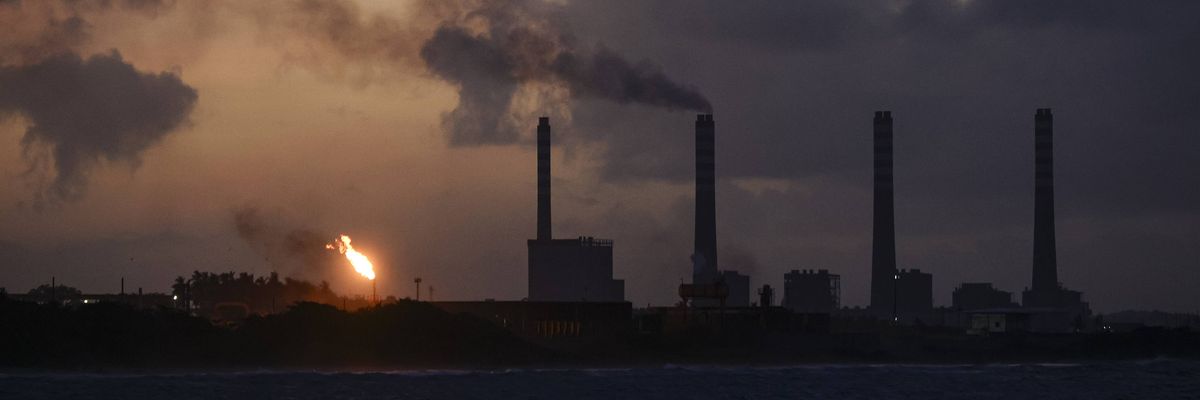
General view of ‘El Palito’ refinery building at dusk during a walk around the outskirts of ‘El Palito’ refinery on December 18, 2025, in Puerto Cabello, Venezuela.
(Photo by Jesus Vargas/Getty Images)
Stephen Prager
Jan 07, 2026
COMMON DREAMS
A legal watchdog group is demanding information about the extent to which the Trump administration planned its attack on Venezuela last weekend with American oil companies, which are expected to profit royally from the takeover of the South American nation’s oil reserves.
The group Democracy Forward filed a series of Freedom of Information Act (FOIA) requests on Monday seeking records and information about the role of US oil companies in the planning of the attack, which killed an estimated 75 people and led to the US military’s abduction of Venezuelan President Nicolas Maduro and his wife.
President Donald Trump did not inform Congress of the operation, which is required under the War Powers Act of 1973, but he told reporters on Sunday that he’d tipped off oil company executives both “before and after” the strike.
According to reporting by the Wall Street Journal, he informed executives roughly a month before the strike to “get ready” because big changes were coming to the country, which had long held state control over the largest oil reserves in the world.
Since toppling Maduro, in an operation that international law experts have widely described as illegal, Trump has said his goal is to “get the oil flowing” to American oil companies to start “taking a tremendous amount of wealth out of the ground.”
On Tuesday, Trump said Venezuela’s interim leaders—who he’s threatened with more attacks if they don’t do what he says—have agreed to hand over 30-50 million barrels of oil to be sold by the US, which will control how the profits are dispersed.
Trump and several members of his Cabinet, including Energy Secretary Chris Wright and Interior Secretary Doug Burgum, are expected to meet with oil executives on Friday at the White House to discuss “security guarantees” for their new spoils.
Democracy Forward has requested information about communications between senior officials at the US departments of Energy and the Interior and executives at top oil companies, including Chevron, ExxonMobil, and ConocoPhillips, prior to the attack. This includes emails, attachments, and calendar invitations exchanged since December 2025.
The group has said it will seek to determine whether these companies were given “privileged access or influence” over the administration’s policy toward Venezuela.
“The president couldn’t find time to brief members of Congress before kidnapping a foreign head of state, but appears to have prioritized discussions with Big Oil. When government actions tied to foreign resources are preceded and followed by closed-door meetings with the world’s largest oil companies, transparency is not optional—it is essential,” said Skye Perryman, the president and CEO of Democracy Forward. “The public deserves to know what interests are shaping decisions that have enormous consequences for global energy markets and democratic accountability.”
FOIA, which was passed in 1967, allows members of the public to request records from any federal agency. However, agencies have broad discretion to deny FOIA requests, including in cases involving national security or interagency communications.
Indefinite U.S. Control of Venezuelan Oil Could Benefit Tankers, Traders
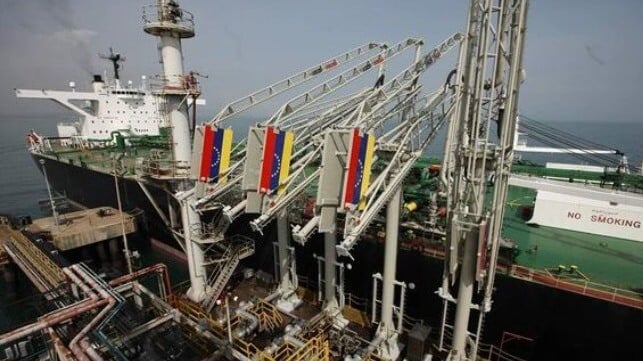
Following the removal of Venezuelan dictator Nicolas Maduro, the Trump administration plans to oversee the country's oil exports, and will take delivery of 30-50 million barrels as a starting point. That initial consignment is just the start, though, and the oil export management arrangement will continue indefinitely, sources at the White House confirmed to CNBC.
"We are going to market the crude coming out of Venezuela, first this backed up stored oil, and then infinitely, going forward, we will sell the production that comes out of Venezuela into the marketplace," energy secretary Chris Wright told an audience at the Goldman Sachs energy conference in Miami, per Bloomberg.
In the long run, the objective is to foster conditions that would be favorable to U.S. energy sector investment, he said. But in the short run, the concept is to stabilize PDVSA's existing state-owned oil production, supply PDVSA with U.S.-produced diluents for reducing the heavy crude's viscosity, reboot imports of spare oilfield parts and services, and take control of all Venezuelan oil exports.
The marketing arrangement will begin with Venezuela's stored crude, including onshore storage tank capacity and floating storage (laden tankers). It will continue indefinitely with ongoing production, Wright said.
In a statement Wednesday, Venezuelan state oil company PDVSA acknowledged that amidst current "challenges," it is negotiating the sale of its oil with the United States "under clear commercial schemes and shared benefits."
Vice President JD Vance told Fox News that the U.S. will also be exerting political control over the Venezuelan government by keeping a grip on its oil exports. "The way that we control Venezuela is we control the purse strings, we control the energy resources, and we tell the regime, 'you’re allowed to sell the oil, so long as you serve America’s national interest,'" Vance said.
Reputable tanker companies stand to benefit from this new arrangement, which will add more ton-miles for reputationally "clean," unsanctioned vessels that are not associated with the shadow fleet. Previously, a large share of Venezuela's long-haul oil exports shipped aboard gray-market vessels with questionable histories, some listed on the U.S. Treasury blacklist. A U.S.-managed Venezuelan oil sector would likely mean the disappearance of shadow fleet tonnage from Venezuela's loading terminals, replaced by new demand for above-board tankers.
Tanker stocks soared on the news, buoyed by the prospect of changing trade patterns and the demonstrated U.S. resolve to seize shadow-fleet tonnage. Scorpio Tankers and CMB.Tech went up eight percent, Teekay and DHT went up nine percent, and Frontline jumped nearly 10 percent.
Oil traders are also showing an interest in the prospects of a reshuffle in trade. Trafigura oil chief Ben Luckock told Bloomberg News that his company was interested in the opportunities in Venezuela, and that it would be talking with the U.S. government about cooperation - once a proper legal framework is in place for the work, as well as the appropriate security measures for foreign nationals on the ground.
The work of trading and trade financing has already begun, according to the U.S. Energy Department. In a statement Wednesday, it said that it has "engaged the world’s leading commodity marketers and key banks to execute and provide financial support for these crude oil and crude products sales."

No comments:
Post a Comment