It’s possible that I shall make an ass of myself. But in that case one can always get out of it with a little dialectic. I have, of course, so worded my proposition as to be right either way (K.Marx, Letter to F.Engels on the Indian Mutiny)
Thursday, January 08, 2026
SPACE/COSMOS
Lunar spacecraft exhaust could obscure clues to origins of life
Exhaust methane could travel pole-to-pole in under two lunar days, half of it settling in regions potentially harboring original ingredients of earthly life
WASHINGTON — Over half of the exhaust methane from lunar spacecraft could end up contaminating areas of the moon that might otherwise yield clues about the origins of earthly life, according to a recent study. The pollution could unfold rapidly regardless of a spacecraft’s touchdown site; even for a landing at the South Pole, methane molecules may “hop” across the lunar surface to the North Pole in under two lunar days.
As interest in lunar exploration resurges among governments, private companies and NGOs, the study authors wrote, it becomes crucial to understand how exploration may impact research opportunities. This knowledge can help inform the creation of planetary protection strategies for the lunar environment, as well as lunar missions designed to minimize impact on that environment — and the clues about our past it may contain.
The study appears in Journal of Geophysical Research: Planets, AGU’s journal for original research in planetary science.
“We are trying to protect science and our investment in space,” said Silvio Sinibaldi, the planetary protection officer at the European Space Agency and senior author on the study. The moon is a natural laboratory ripe for new discoveries, he said — but, paradoxically, “our activity can actually hinder scientific exploration.”
At the moon’s poles, craters cloaked in perpetual darkness (called permanently shadowed regions) hold ice which might contain materials delivered to the moon and Earth via comets and asteroids billions of years ago. Scientists hope those materials might include “prebiotic organic molecules” — key ingredients that, under the right conditions, may have combined to form the original building blocks of life, such as DNA. Finding those molecules in their original form could allow researchers to study how they gave rise to life on Earth.
“We know we have organic molecules in the solar system — in asteroids, for example,” Sinibaldi said. “But how they came to perform specific functions like they do in biological matter is a gap we need to fill.”
Earth’s dynamic, ever-changing surface likely erased any trace of what those original molecules looked like long ago. The moon’s surface, parts of which have remained relatively unaltered for billions of years, may preserve a better record — especially in the permanently shadowed regions, where molecules tend to accumulate due to cold temperatures that slow their movement. Unfortunately, that may also include molecules released by lunar spacecraft, potentially obscuring pristine evidence of life-originating materials.
A molecular mad dash
Sinibaldi and Francisca Paiva, a physicist at Instituto Superior Técnico and lead author of the study, built a computer model to simulate how that contamination might play out, using the European Space Agency’s Argonaut mission as a case study. The simulations focused on how methane, the main organic compound released during combustion of Argonaut propellants, might spread across the lunar surface during a landing at the moon’s South Pole. While previous studies had investigated how water molecules might move on the moon, none had done so for organic molecules like methane. The new model also accounted for how factors like solar wind and UV radiation would impact the methane’s behavior.
“We were trying to model thousands of molecules and how they move, how they collide with one another, and how they interact with the surface,” said Paiva, who was a master’s student at KU Leuven and an intern at the European Space Agency during the research. “It required a lot of computational power. We had to run each simulation for days or weeks.”
The model showed exhaust methane reaching the North Pole in under two lunar days. Within seven lunar days (almost 7 months on Earth), more than half of the total exhaust methane had been “cold trapped” at the frigid poles — 42% at the South Pole and 12% at the North.
“The timeframe was the biggest surprise,” Sinibaldi said. “In a week, you could have distribution of molecules from the South to the North Pole.”
That’s partly because the moon has almost no atmosphere of other molecules to bump into. Impeded only by gravity, methane molecules on the moon bound freely across the landscape like bouncy balls across an empty room, energized by sunlight and slowed by cold.
“Their trajectories are basically ballistic,” Paiva said. “They just hop around from one point to another.” That’s concerning, she explained, because it means there may be no foolproof landing sites anywhere. “We showed that molecules can travel across the whole moon. In the end, wherever you land, you will have contamination everywhere.”
That doesn’t mean there’s nothing to be done to minimize contamination. Colder landing sites, Paiva noted, might still corral exhaust molecules better than warmer ones. There might also be ways around the contamination: Sinibaldi wants to study whether exhaust molecules might simply settle on the icy surfaces of PSRs, leaving material underneath unscathed for research.
Above all, the duo said, the results need confirmation from both additional simulations and real-life measurements on the moon. “I want to bring this discussion to mission teams, because, at the end of the day, it’s not theoretical — it’s a reality that we’re going to go there,” Sinibaldi said. “We will miss an opportunity if we don’t have instruments on board to validate those models.”
Paiva hopes to study whether molecules other than methane, including those in spacecraft hardware like paint and rubber, might also pose risks to research.
“We have laws regulating contamination of Earth environments like Antarctica and national parks,” she said. “I think the moon is an environment as valuable as those.”
Notes for journalists:
This study is published in Journal of Geophysical Research: Planets, an AGU journal. View and download a pdf of the study here. Neither this press release nor the study is under embargo.
Paper title:
“Can Spacecraft-Borne Contamination Compromise Our Understanding of Lunar Ice Chemistry?”
Authors:
Francisca S. Paiva, Instituto Superior Técnico, Lisbon, Portugal
Silvio Sinibaldi, European Space Agency, Noordwijk, The Netherlands; The Open University, Milton Keynes, United Kingdom
AGU (www.agu.org) is a global community supporting more than half a million professionals and advocates in Earth and space sciences. Through broad and inclusive partnerships, AGU aims to advance discovery and solution science that accelerate knowledge and create solutions that are ethical, unbiased and respectful of communities and their values. Our programs include serving as a scholarly publisher, convening virtual and in-person events and providing career support. We live our values in everything we do, such as our net zero energy renovated building in Washington, D.C. and our Ethics and Equity Center, which fosters a diverse and inclusive geoscience community to ensure responsible conduct.
This artist’s illustration depicts 2025 MN45 — the fastest-rotating asteroid with a diameter over 500 meters that scientists have ever found. The asteroid is shown surrounded by many other asteroids, depicting its location within the main asteroid belt. The Sun and Jupiter are shown in the distance.
2025 MN45 is 710 meters (0.44 miles) in diameter, and it completes a full rotation every 1.88 minutes. The discovery was made using data from NSF–DOE Vera C. Rubin Observatory, jointly funded by the U.S. National Science Foundation and the U.S. Department of Energy's Office of Science.
Credit: NSF–DOE Vera C. Rubin Observatory/NOIRLab/SLAC/AURA/P. Marenfeld
Astronomers analyzing data from NSF–DOE Vera C. Rubin Observatory, jointly funded by the U.S. National Science Foundation and the U.S. Department of Energy's Office of Science, have discovered the fastest-ever spinning asteroid with a diameter over half a kilometer — a feat uniquely enabled by Rubin. The study provides crucial information about asteroid composition and evolution, and demonstrates how Rubin is pushing the boundaries of what we can discover within our own Solar System.
As part of the NSF–DOE Vera C. Rubin Observatory First Look event in June 2025, Rubin announced that it had observed thousands of asteroids cruising about our Solar System, about 1900 of which have been confirmed as never-before-seen [1]. Within the flurry, a team of astronomers has discovered 19 super- and ultra-fast-rotating asteroids. One of these is the fastest-spinning asteroid larger than 500 meters (0.3 miles) ever found.
The study was led by Sarah Greenstreet, NSF NOIRLab assistant astronomer and lead of Rubin Observatory’s Solar System Science Collaboration’s Near-Earth Objects and Interstellar Objects working group. The team presents their results in a paper appearing in The Astrophysical Journal Letters, as well as at a press conference at the 247th meeting of the American Astronomical Society (AAS) in Phoenix, Arizona.
Rubin Observatory is a joint program of NSF NOIRLab and DOE’s SLAC National Accelerator Laboratory, who cooperatively operate Rubin. NOIRLab is managed by the Association of Universities for Research in Astronomy (AURA).
“NSF–DOE Rubin Observatory will find things that no one even knew to look for,” says Luca Rizzi, an NSF program director for research infrastructure. “When Rubin's Legacy Survey of Space and Time begins, this huge spinning asteroid will be joined by an avalanche of new information about our Universe, captured nightly.”
The Legacy Survey of Space and Time (LSST) is Rubin’s mission to repeatedly scan the Southern Hemisphere night sky for ten years to create an ultra-wide, ultra-high-definition time-lapse record of the Universe. LSST is expected to start in the coming months.
The study discussed here uses data collected over the course of about ten hours across seven nights in April/May 2025, during Rubin Observatory's early commissioning phase. This is the first published peer-reviewed scientific paper that uses data from the LSST Camera — the largest digital camera in the world.
“The Department of Energy's investment in Rubin Observatory's cutting-edge technology, particularly the LSST Camera, is proving invaluable,” said Regina Rameika, the DOE Associate Director for High Energy Physics. “Discoveries like this exceptionally fast-rotating asteroid are a direct result of the observatory's unique capability to provide high-resolution, time-domain astronomical data, pushing the boundaries of what was previously observable.”
“We have known for years that Rubin would act as a discovery machine for the Universe, and we are already seeing the unique power of combining the LSST Camera with Rubin’s incredible speed. Together, Rubin can take an image every 40 seconds,” said Aaron Roodman, Deputy Head of LSST and professor of Particle Physics and Astrophysics at SLAC. “The ability to find thousands of new asteroids in such a short period of time, and learn so much about them, is a window into what will be uncovered during the 10-year survey.”
As asteroids orbit the Sun, they also rotate at a wide range of speeds. These spin rates not only offer clues about the conditions of their formation billions of years ago, but also tell us about their internal composition and evolution over their lifetimes. In particular, an asteroid spinning quickly may have been sped up by a past collision with another asteroid, suggesting that it could be a fragment of an originally larger object.
Fast rotation also requires an asteroid to have enough internal strength to not fly apart into many smaller pieces, called fragmentation. Most asteroids are ‘rubble piles’, which means they are made of many smaller pieces of rock held together by gravity, and thus have limits based on their densities as to how fast they can spin without breaking apart. For objects in the main asteroid belt, the fast-rotation limit to avoid being fragmented is 2.2 hours; asteroids spinning faster than this must be structurally strong to remain intact. The faster an asteroid spins above this limit, and the larger its size, the stronger the material it must be made from.
The study presents 76 asteroids with reliable rotation periods. This includes 16 super-fast rotators with rotation periods between roughly 13 minutes and 2.2 hours, and three ultra-fast rotators that complete a full spin in less than five minutes.
All 19 newly identified fast-rotators are longer than the length of an American football field (100 yards or about 90 meters). The fastest-spinning main-belt asteroid identified, named 2025 MN45, is 710 meters (0.4 miles) in diameter and it completes a full rotation every 1.88 minutes. This combination makes it the fastest-spinning asteroid with a diameter over 500 meters that astronomers have found.
“Clearly, this asteroid must be made of material that has very high strength in order to keep it in one piece as it spins so rapidly,” says Greenstreet. “We calculate that it would need a cohesive strength similar to that of solid rock. This is somewhat surprising since most asteroids are believed to be what we call ‘rubble pile’ asteroids, which means they are made of many, many small pieces of rock and debris that coalesced under gravity during Solar System formation or subsequent collisions.”
Most fast-rotators discovered so far orbit the Sun just beyond Earth, known as near-Earth objects (NEOs). Scientists find fewer fast-rotating main-belt asteroids (MBAs), which orbit the Sun between Mars and Jupiter. This is mainly because of the main-belt asteroids’ greater distance from Earth, which makes their light fainter and more difficult to see.
All but one of the newly identified fast-rotators live in the main asteroid belt, some even just beyond its outer edge, with the lone exception being an NEO. This shows that scientists are now finding these extremely rapidly rotating asteroids at farther distances than ever before, an achievement made possible by Rubin’s enormous light-collecting power and precise measurement capabilities.
In addition to 2025 MN45, other notable asteroid discoveries made by the team include 2025 MJ71 (1.9-minute rotation period), 2025 MK41 (3.8-minute rotation period), 2025 MV71 (13-minute rotation period), and 2025 MG56 (16-minute rotation period). These five super- to ultra-fast rotators are all several hundred meters in diameter and join a couple of NEOs as the fastest spinning sub-kilometer asteroids known.
“As this study demonstrates, even in early commissioning, Rubin is successfully allowing us to study a population of relatively small, very-rapidly-rotating main-belt asteroids that hadn’t been reachable before,” says Greenstreet.
Scientists expect to find more fast rotators once Rubin begins its 10-year Legacy Survey of Space and Time (LSST). Unlike the dense, rapid First Look observations that enabled this quick burst of discoveries, LSST’s regular, sparser observations will instead uncover fast rotators gradually as the survey accumulates data, providing pivotal information about the strengths, compositions, and collisional histories of these primitive bodies.
Notes
[1] These data were submitted to the IAU Minor Planet Center, making them the first publicly available data from Rubin First Look.
The lightcurve of 2025 MN45 — the fastest-rotating asteroid with a diameter over 500 meters that scientists have ever found. The y-axis shows the asteroid’s brightness, and the x-axis shows its phase, or where it is in its rotation. When plotted, the resulting curve shows the asteroid's fluctuating brightness as it spins. Lightcurves can help scientists determine an asteroid's rotation period (the total time it takes to complete one rotation), size, shape, and surface properties.
The discovery of 2025 MN45 was made using data from NSF–DOE Vera C. Rubin Observatory, jointly funded by the U.S. National Science Foundation and the U.S. Department of Energy's Office of Science. The asteroid is about 710 meters (0.44 miles) in diameter, and it completes a full rotation every 1.88 minutes.
Credit
NSF–DOE Vera C. Rubin Observatory/NOIRLab/SLAC/AURA/J. Pollard Acknowledgement: PI: Sarah Greenstreet (NSF NOIRLab/Rubin Observatory)
More information
This research was presented in a paper titled “Lightcurves, rotation periods, and colors for Vera C. Rubin Observatory’s first asteroid discoveries,” appearing in The Astrophysical Journal Letters. DOI: 10.3847/2041-8213/ae2a30
The team is composed of Sarah Greenstreet (NSF–DOE Vera C. Rubin Observatory/NSF NOIRLab, University of Washington), Zhuofu (Chester) Li (University of Washington), Dmitrii E. Vavilov (University of Washington), et al.
NSF–DOE Vera C. Rubin Observatory, funded by the U.S. National Science Foundation and the U.S. Department of Energy’s Office of Science, is a groundbreaking new astronomy and astrophysics observatory on Cerro Pachón in Chile. It is named after astronomer Vera Rubin, who provided the first convincing evidence for the existence of dark matter. Using the largest camera ever built, Rubin will repeatedly scan the sky for 10 years to create an ultra-wide, ultra-high-definition, time-lapse record of our Universe.
NSF–DOE Vera C. Rubin Observatory is a joint initiative of the U.S. National Science Foundation (NSF) and the U.S. Department of Energy’s Office of Science (DOE/SC). Its primary mission is to carry out the Legacy Survey of Space and Time, providing an unprecedented data set for scientific research supported by both agencies. Rubin is operated jointly by NSF NOIRLab and SLAC National Accelerator Laboratory. NSF NOIRLab is managed by the Association of Universities for Research in Astronomy (AURA), and SLAC is operated by Stanford University for the DOE. France provides key support to the construction and operations of Rubin Observatory through contributions from CNRS/IN2P3. Rubin Observatory is privileged to conduct research in Chile and gratefully acknowledges additional contributions from more than 40 international organizations and teams.
The U.S. National Science Foundation (NSF) is an independent federal agency created by Congress in 1950 to promote the progress of science. NSF supports basic research and people to create knowledge that transforms the future.
The DOE’s Office of Science is the single largest supporter of basic research in the physical sciences in the United States and is working to address some of the most pressing challenges of our time.
The scientific community is honored to have the opportunity to conduct astronomical research on I’oligam Du’ag (Kitt Peak) in Arizona, on Maunakea in Hawai‘i, and on Cerro Tololo and Cerro Pachón in Chile. We recognize and acknowledge the very significant cultural role and reverence of I’oligam Du’ag (Kitt Peak) to the Tohono O’odham Nation, and Maunakea to the Kanaka Maoli (Native Hawaiians) community.
SLAC National Accelerator Laboratory explores how the Universe works at the biggest, smallest, and fastest scales and invents powerful tools used by researchers around the globe. As world leaders in ultrafast science and bold explorers of the physics of the Universe, we forge new ground in understanding our origins and building a healthier and more sustainable future. Our discovery and innovation help develop new materials and chemical processes and open unprecedented views of the cosmos and life’s most delicate machinery. Building on more than 60 years of visionary research, we help shape the future by advancing areas such as quantum technology, scientific computing, and the development of next-generation accelerators. SLAC is operated by Stanford University for the U.S. Department of Energy’s Office of Science.
Artist's rendition of the space weather around M dwarf TIC 141146667. The torus of ionized gas is sculpted by the star's magnetic field and rotation, with two pinched, dense clumps present on opposing sides of the star.
Credit: llustration by Navid Marvi, courtesy Carnegie Science.
Phoenix, AZ—How does a star affect the makeup of its planets? And what does this mean for the habitability of distant worlds? Carnegie’s Luke Bouma is exploring a new way to probe this critical question—using naturally occurring space weather stations that orbit at least 10 percent of M dwarf stars during their early lives. He is presenting his work at the American Astronomical Society meeting this week.
We know that most M dwarf stars—which are smaller, cooler, and dimmer than our own Sun—host at least one Earth-sized rocky planet. Most of them are inhospitable—too hot for liquid water or atmospheres, or hit with frequent stellar flares and intense radiation. But they could still prove to be interesting laboratories for understanding the many ways that stars shape the surroundings in which their planets exist.
“Stars influence their planets. That’s obvious. They do so both through light, which we’re great at observing, and through particles—or space weather—like solar winds and magnetic storms, which are more challenging to study at great distances,” Bouma explained. “And that’s very frustrating, because we know in our own Solar System that particles can sometimes be more important for what happens to planets.”
But astronomers can’t set up a space weather station around a distant star.
Or can they?
Working with Moira Jardine of the University of St. Andrews, Bouma homed in on a strange type of M dwarf called a complex periodic variable. They are young, rapidly rotating stars that observations show experience recurring dips in brightness. Astronomers weren’t sure if these dips in brightness were caused by starspots or by material orbiting the star.
“For a long time, no one knew quite what to make of these oddball little blips of dimming,” Bouma said. “But we were able to demonstrate that they can tell us something about the environment right above the star’s surface.”
Bouma and Jardine answered that question by creating “spectroscopic movies” of one of these complex periodic variable stars. They were able to demonstrate that they are large clumps of cool plasma that are trapped in the star’s magnetosphere—basically being dragged around with the star by its magnetic field—forming a kind of doughnut shape called a torus.
“Once we understood this, the blips in dimming stopped being weird little mysteries and became a space weather station,” Bouma exclaimed. “The plasma torus gives us a way to know what's happening to the material near these stars, including where it’s concentrated, how it’s moving, and how strongly it is influenced by the star’s magnetic field.”
Bouma and Jardine estimate that at least 10 percent of M dwarfs could have plasma features like this early in their lives. So, these space weather stations could help astronomers learn a great deal about particles from stars contribute to planetary conditions.
Next, Bouma hopes to reveal where the material in the torus comes from—the star itself or an external source.
“This is a great example of a serendipitous discovery, something we didn’t expect to find but that will give us a new window into understanding planet-star relationships,” Bouma concluded. “We don't know yet if any planets orbiting M dwarfs are hospitable to life, but I feel confident that space weather is going to be an important part of answering that question.”
An X8.2 class solar flare flashes in the edge of the Sun on Sept. 10, 2017. This image was captured by NASA's Solar Dynamics Observatory and shows a blend of light from the 171 and 304 angstrom wavelengths.
Solar physicists say they have found a key source of intense gamma rays unleashed when Earth’s nearest star produces its most violent eruptions.
In findings published in Nature Astronomy, scientists at NJIT’s Center for Solar-Terrestrial Research (NJIT-CSTR) have pinpointed a previously unknown class of high-energy particles in the Sun’s upper atmosphere responsible for generating the long-puzzling radiation signals observed during major solar flare events for decades.
The signals were traced back to a localized region in the solar corona during a powerful X8.2-class flare that erupted on September 10, 2017, where trillions upon trillions of particles were measured at energies of several million electron volts (MeV) — hundreds to thousands of times more energetic than typical flare particles and moving near the speed of light.
Researchers believe these particles generate gamma rays through a process known as bremsstrahlung — a mechanism in which lightweight charged particles, such as electrons, emit high-energy light when they collide with material in the Sun’s atmosphere.
The team says the discovery fills critical gaps in our understanding of solar flare physics and could improve models of solar activity that ultimately enhance space weather forecasting.
“We knew solar flares produced a unique gamma-ray signal, but that data alone couldn’t reveal its source or how it was generated,” said Gregory Fleishman, NJIT-CSTR research professor of physics and lead author of the study. “Without that crucial information, we couldn’t fully understand the particles responsible or evaluate any potential impact on our space weather environment. By combining gamma-ray and microwave observations from a solar flare, we were finally able to solve this puzzle.”
To find the source, the NJIT team combined observations of the 2017 flare from NASA’s Fermi Gamma-ray Space Telescope and NJIT's Expanded Owens Valley Solar Array (EOVSA), a state-of-the-art radio telescope array in California.
Fermi provided crucial measurements of high-energy gamma-ray emissions during the flare, while EOVSA delivered spatially resolved microwave imaging that captured the signatures of accelerated particles in the solar corona.
By analyzing these datasets together, the team identified a distinct region in the solar atmosphere — called Region of Interest 3 (ROI 3) — in addition to two previously studied areas, ROI 1 and ROI 2, where microwave and gamma-ray signals converged.
This convergence pointed to a unique population of particles energized to MeV levels.
“Unlike the typical electrons accelerated in solar flares, which usually decrease in number as their energy increases, this newly discovered population is unusual because most of these particles have very high energies, on the order of millions of electron volts, with relatively few lower-energy electrons present,” explained Fleishman.
Using advanced modeling, the team linked the energy distribution of these particles directly to the observed gamma-ray spectrum, pointing to bremsstrahlung emission — high-energy light usually produced when electrons collide with solar plasma — as the elusive source of the gamma-ray signals.
Fleishman also says their observations within ROI 3 — located near regions of significant magnetic field decay and intense particle acceleration — support long-standing theories about how solar flares accelerate particles to extreme energies and sustain them.
“We see clear evidence that solar flares can efficiently accelerate charged particles to very high energies by releasing stored magnetic energy. These accelerated particles then evolve into the MeV-peaked population we discovered,” said Fleishman.
For now, Fleishman says key questions remain about these extreme particle populations.
Future observational insights could soon come from NJIT’s Expanded Owens Valley Solar Array (EOVSA), currently being upgraded to EOVSA-15. This project, led by NJIT-CSTR professor of physics and EOVSA director Bin Chen — a co-author on the study — is funded by the National Science Foundation and will enhance the array with 15 new antennas and advanced ultra-wideband feeds.
“One big unknown is whether these particles are electrons or positrons,” Fleishman said. “Measuring the polarization of microwave emissions from similar events could provide a definitive way to tell them apart. We expect to gain this capability soon with the EOVSA-15 upgrade.”
The team's study, "Solar Flare Hosts MeV-peaked Electrons in a Coronal Source," was supported by funding from the National Science Foundation and NASA.
Dr. Rupak Mahapatra, an experimental particle physicist, holds a SuperCDMS detector. The highly sensitive devices, which are fabricated at Texas A&M University, are deepening the search for dark matter and have potential applications in quantum computing.
Credit: Texas A&M University Division of Marketing and Communications
When it comes to understanding the universe, what we know is only a sliver of the whole picture. Dark matter and dark energy make up about 95% of the universe, leaving only 5% “ordinary matter,” or what we can see. Dr. Rupak Mahapatra, an experimental particle physicist at Texas A&M University, designs highly advanced semiconductor detectors with cryogenic quantum sensors, powering experiments worldwide and pushing the boundaries to explore this most profound mystery.
Mahapatra likens our understanding of the universe — or lack thereof — to an old parable: “It’s like trying to describe an elephant by only touching its tail. We sense something massive and complex, but we’re only grasping a tiny part of it.”
Dark matter and energy are so named because what they are comprised of is unknown. Dark matter accounts for most of the mass in galaxies and galaxy clusters, shaping their structure on the largest scales. Dark energy, on the other hand, refers to the force driving the universe’s accelerated expansion. In other words, dark matter holds things together, while dark energy is pulling them apart.
Despite their abundance, neither emits, absorbs or reflects light, making them nearly impossible to observe directly. Yet, their gravitational effects shape galaxies and cosmic structures. Dark energy is even more dominant than dark matter: it makes up about 68% of the universe’s total energy content, while dark matter is about 27%.
Detecting whispers in a hurricane
At Texas A&M, Mahapatra’s group is building detectors so sensitive they can pick up signals from particles that interact rarely with ordinary matter, signals that could reveal the nature of dark matter.
“The challenge is that dark matter interacts so weakly that we need detectors capable of seeing events that might happen once in a year, or even once in a decade,” Mahapatra said.
The team contributed to a world-leading dark matter search using a detector called TESSERACT. “It’s about innovation,” he said. “We’re finding ways to amplify signals that were previously buried in noise.”
Mahapatra’s work builds on a long history of pushing detection limits, with world-leading searches through his participation in the SuperCDMS experiment for the past 25 years. In a landmark 2014 paper in Physical Review Letters, he and collaborators introduced voltage-assisted calorimetric ionization detection in the SuperCDMS experiment — a breakthrough that allowed researchers to probe low-mass WIMPs, a leading dark matter candidate. This technique dramatically improved sensitivity for particles that were previously beyond reach.
More recently, in 2022, Mahapatra co-authored a study exploring complementary detection strategies — direct detection, indirect detection and collider searches for a WIMP. This work underscores the global, multi-pronged approach to solving the dark matter puzzle.
“No single experiment will give us all the answers,” Mahapatra notes. “We need synergy between different methods to piece together the full picture.”
Understanding dark matter isn’t just an academic exercise, it’s key to unlocking the fundamental laws of nature. “If we can detect dark matter, we’ll open a new chapter in physics,” Mahapatra said. “The search needs extremely sensitive sensing technologies and it could lead to technologies we can’t even imagine today.”
What Are WIMPs?
WIMPs (Weakly Interacting Massive Particles) are one of the most promising candidates for dark matter. They’re hypothetical particles that interact through gravity and the weak nuclear force, making them incredibly hard to detect.
Why they matter: If WIMPs exist, they could explain the missing mass in the universe.
How we search: Experiments like SuperCDMS and TESSERACT use ultra-sensitive detectors cooled to near absolute zero to catch rare interactions between WIMPs and ordinary matter.
The challenge: A WIMP might pass through Earth without leaving a trace, so scientists need years of data to spot even a single event.
By Lesley Henton, Texas A&M University Division of Marketing and Communications
Spontaneous generation of athermal phonon bursts within bulk silicon causing excess noise, low energy background events, and quasiparticle poisoning in superconducting sensors
Texas A&M University experimental particle physicist Dr. Rupak Mahapatra with a R&D detector mounted in a dilution fridge that cools it to 100,000 times cooler than room temperature.
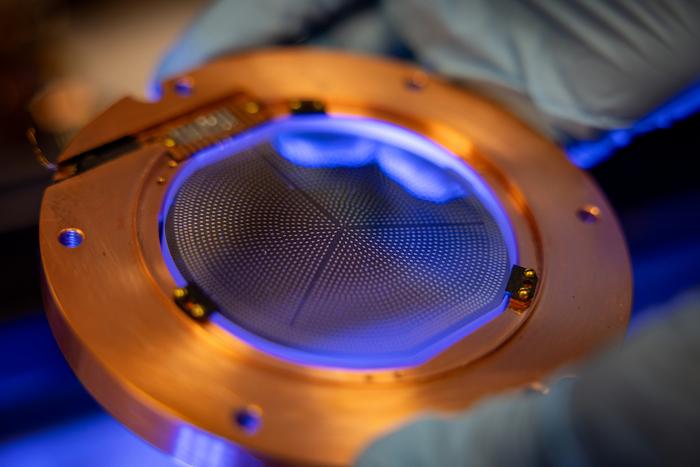
A wafer with many different designs of chips for the TESSERACT project.
Texas A&M University graduate students, from left, Keith Hunter, Bailey Pickard and Mahdi Mirzakhani mounting detectors.
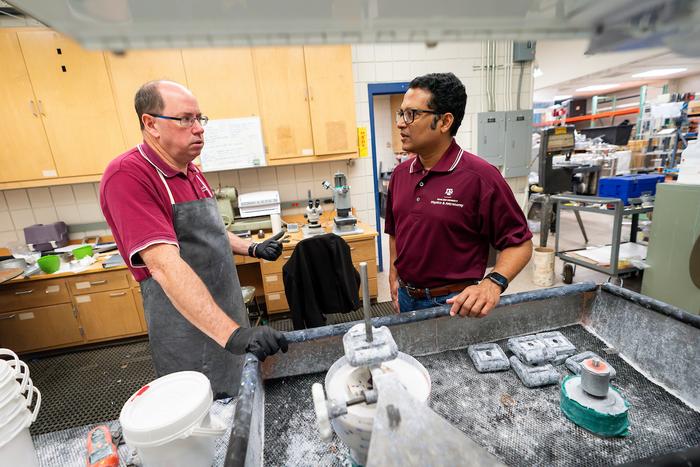
Texas A&M University engineer Mark Platt (left) and experimental physicist Dr. Rupak Mahapatra in the fabrication facility, where the critical first step occurs: polishing a semiconductor crystal to a flatness 1/100th the thickness of a human hair.
A MINER detector that is used to search for low-energy neutrinos at the Texas A&M TRIGA reactor. This sapphire detector can be used for both dark matter searches and for detection of reactor neutrinos that can not only provide evidence of new physics but also enable nuclear non-proliferation.
Credit
Texas A&M University
International project awarded £215K to unlock the secrets of the universe’s rarest elements
Plans to deliver the first-ever precision measurements of some of the rarest and most unstable atomic nuclei could reshape our understanding of nuclear structure and how chemical elements are formed under extreme cosmic events, such as supernovae, neutron-star collisions and X-ray bursts. The University of Surrey is working with researchers in Japan to develop state-of-the-art instruments capable of measuring previously inaccessible isotopes – forms of matter that exist only fleetingly at the edges of nuclear stability.
The project has received £215,100 from the Royal Society’s International Science Partnership Fund and is a collaboration with Japan’s Kyushu University and Radioactive Isotope Beam Factory (RIBF) at the RIKEN laboratory – a world-leading facility where the most intense exotic beams can be created for experiments.
The research will investigate fundamental properties of unstable atomic nuclei, with a focus on both neutron-rich and neutron-deficient isotopes. These nuclei do not occur naturally on Earth and can only be created for brief moments in advanced physics laboratories. Measuring how heavy they are (their mass) and how quickly they decay (their half-life) will provide invaluable insights to refine theoretical models in nuclear structure and help to understand the origin of chemical elements in nuclear astrophysics.
Dr Ragandeep Singh Sidhu, Future Fellow at the University of Surrey’s School of Mathematics and Physics, and project co-lead, said:
“These extremely rare isotopes are among the most difficult atomic nuclei to study, but they hold crucial clues about how nuclear matter behaves at its limits. Measuring their mass and half-lives for the first time will allow us to significantly improve the models used to understand both atomic nuclei and the cosmic processes that create the heaviest elements in the universe. This work would not be possible without close collaboration with our partners in Japan and access to world-leading facilities at RIBF, RIKEN.”
Experiments will be carried out at the Rare-Radioactive Isotope Ring (R3) at RIBF, RIKEN – a unique facility capable of storing and repeatedly observing these short-lived nuclei. Using state-of-the-art detection techniques, researchers will be able to access regions of the nuclear landscape that have never been experimentally measured before.
The Surrey team will play a central role in the project, leading the development and testing of advanced detector and data-acquisition systems in the UK before the experimental campaign starts in Japan.
The three-year project will also strengthen international collaboration between the UK and Japan, supporting the development of advanced experimental tools and helping to maintain the UK’s position at the forefront of nuclear physics research.
Dr Masaomi Tanaka, Assistant Professor at Kyushu University and project co-lead, said:
“One of the most exciting aspects of this project is the opportunity to study how nuclear shells behave in some of the heaviest and most neutron-rich nuclei ever measured. For some of these isotopes, we currently have almost no experimental data, so these measurements will directly challenge and improve our understanding. Through this collaboration, we aim to map the nuclear landscape in new and previously inaccessible detail.”

No comments:
Post a Comment