The Cowardice of the Powerful: Educational Leadership in DEI
Every year my institution measures faculty productivity by requiring us to submit a report of our annual activities. This year I noticed that two sections had silently disappeared.
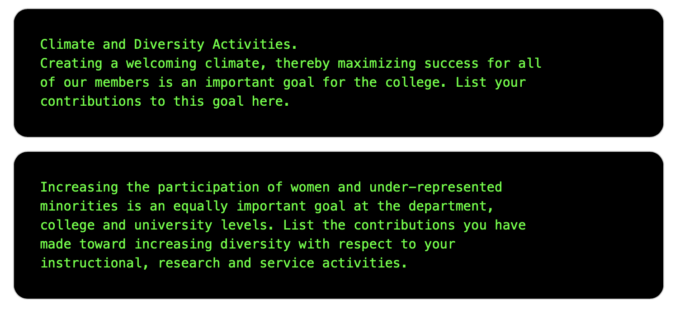
The entries still exist in the awful web platform through which we are forced to submit our responses. But when you generate the report, those headings and any responses are simply not included in the document. There was no announcement, no policy change, just a silent elision of our work. The current university administration was installed in 2022. Although the new provost is a laughable AI-atollah, as far as we can tell none of them seem to be fascists. But in that time we have not been able to construct an instrument sufficiently powerful to detect their integrity.
My disgust at this development prompted me to write the following. I submitted an abridged version of it in my portfolio, as space permitted.
I feel the need to stress the word “disgust.”
Reading history requires context
The continuing attack on “diversity, equity, and inclusion” must be contextualized within the continuing attack on education broadly. Indeed, in the broadest context, the attack on science itself resembles and reinforces the attack on the arts and humanities. Both attacks share deep historical roots in this culture, and both share the same political aims.
Setting personal politics aside—setting morality aside—there are urgent, strictly professional responsibilities that compel educators to defend these values and the institutional activities that uphold them.
Establishing authority in the classroom requires establishing trust with all of the students. It requires establishing trust between and among all of the students. Carrying out effective pedagogy requires creating an engaging environment for every student. An engaging environment must be many things, but it cannot be a hostile environment.
Every component of the educational mission is directly undermined within an institution that permits the perception of indifference to injustice. In short, education requires cooperation, which in turn requires social morality.
Representing and supporting marginalized students
My wife and I are both first-generation college graduates. We both have (invisible) disabilities. We both earned bachelor’s and doctoral degrees from globally preeminent public universities. We both subsequently devoted our careers to teaching at public universities. (I was also a non-traditional student: I was obliged to leave college without a degree, eked out a living for three years, and returned to finish a bachelor’s degree at age 28. Statistically speaking, I dramatically beat the odds.)
Education ennobled both of us. Science and literature are ennobling, travel and languages are ennobling, so many of the things for which education opened doors for us have been ennobling. Do you know what else is ennobling? Being able to pay our fucking bills. The security that nobody in our families had enjoyed before we did is ennobling.
We both staked our careers on the core belief that we have a responsibility to contribute back to the system that produced us, to uphold the standards of excellence to which we were held, to provide each and every student with all of the support that we received (or, did not receive), and to represent ourselves to our students and to our colleagues as who we are.
Incidentally, my maternal grandmother’s entire extended family were murdered in Nazi death camps, except for her sister and mother who somehow survived. So I suppose that’s another thing to which I am forced to bear witness, including in the classroom.
Protecting vulnerable students
What are we even talking about when we say “diversity, equity, and inclusion?” It means recognizing, at least, this: every person is unique. A human being is not an instantiation of a category. This observation, like many truisms, circumscribes and transcends the fractal outline traced between the trivially mundane and the transcendently profound. This insight is worth ruminating deeply about. It contains the deep meaning of the slogan “Representation Matters.”
Each human exists independently of categories. Conversely, programs of intimidation targeting human categories purposely elicit very real terror in actual individuals.
I simply refuse to permit any students to feel threatened in my classroom. When I noticed that foreign students stopped attending my classes after the immigration raids of early 2025, I took it personally, because it is both a political and a professional affront. When queer students confide to me their fear of violence on campus, I take it personally, because it is both a political and a professional affront. I am confronted with students who before my very eyes tremble with the fear of being deported, students who can’t afford food, students male and female visibly scarred by a pervasive culture of rape, students who have accustomed themselves to the spectre of mass death from assault rifles in the auditorium—all intolerable, all familiar.
Threats to our students are direct attacks on the educational mission and tangible disruptions to our work. I repeat: our professional responsibilities compel our active defense of social values. If this conclusion is “political,” it is because the political, the very ugliest political, has violated the academy.
In this context, every educator is called to represent themselves as a visible advocate of civil values. Every institution must protect space for this representation.
Each of these modes of representation matters. Public expression of solidarity matters even more. Institutional support of these values matters even more.

No comments:
Post a Comment