Analysis
The president of the United States links the threat of higher taxes to the fate of far-right ex-president Jair Bolsonaro. An unprecedented approach in more ways than one.
Published: 10/07/2025 - FRANCE24
By: Sébastian SEIBT
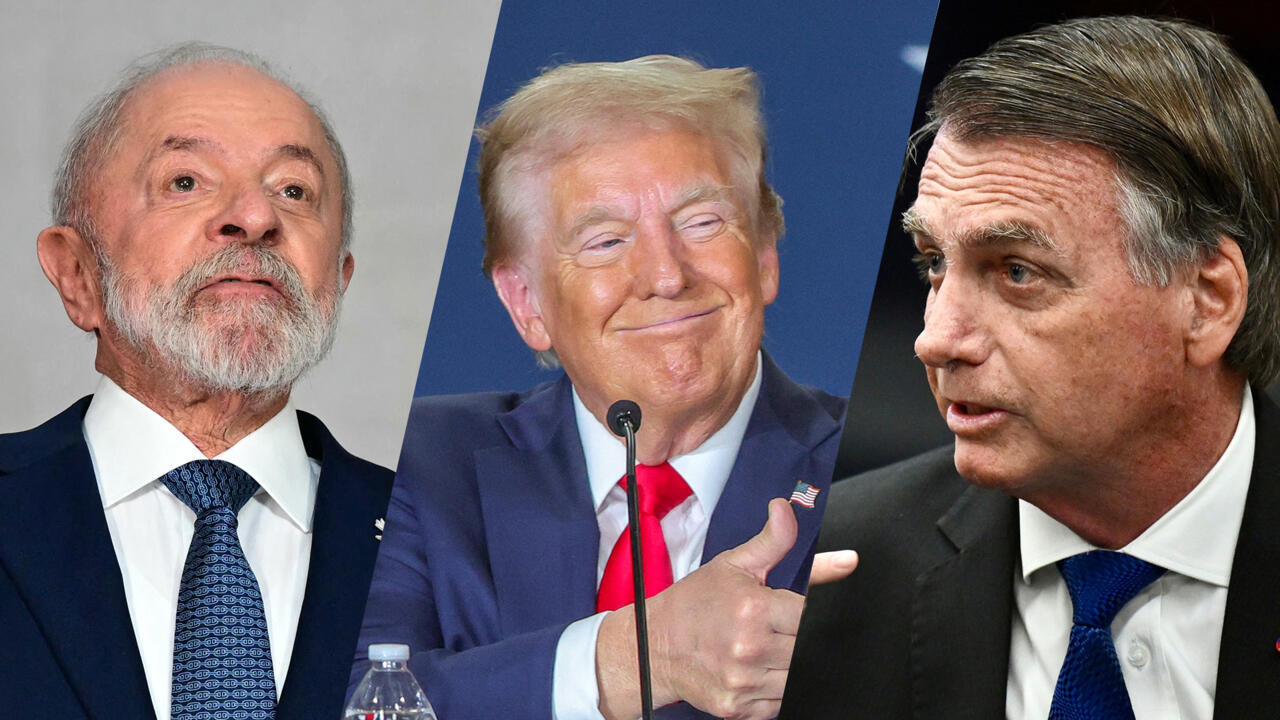
Brazilian President Lula (left) is under pressure from Donald Trump (center), who wants to help former Brazilian president Jair Bolsonaro (right), who is accused of plotting a coup. © Graphic Studio France Médias Monde
For Donald Trump, this is a personal matter. The letter he sent to Brazilian President Lula on Wednesday, July 9, begins with "I". This style is very different from the models of the missives he has also sent to several Asian leaders since the beginning of the week to inform them of American intentions in terms of customs duties.
"I knew, and I had to deal with, former President Jair Bolsonaro [2019-2022, editor's note] whom I respect a lot," Donald Trump said in the preamble. What does this have to do with US tariffs? However, they are the raison d'être of his letters sent by the American president to kick off possible negotiations before the imposition of American taxes on Brazilian exports to the United States, scheduled for August 1.
Tariffs to end 'witch hunt'
In this case, Donald Trump is making a direct link between the fate of Jair Bolsonaro and the 50% tariffs that the U.S. president wants to impose on Brazilian products. The former Brazilian president is accused of trying to organize a coup d'état at the end of 2023 to overturn the results of the last presidential election that saw the victory of Lula... whom he would also have sought to have assassinated. Jair Bolsonaro faces a sentence of up to 40 years in prison if the court finds him guilty of the facts.
But for Donald Trump, his "Brazilian friend" is the victim of a "witch hunt" that must stop "immediately". The president of the United States "does not bother to provide an economic justification for his threats of tariffs," Paul Krugman, the 2008 Nobel Prize in Economics who has become a great critic of Donald Trump, said on his blog.
For Donald Trump, this is a personal matter. The letter he sent to Brazilian President Lula on Wednesday, July 9, begins with "I". This style is very different from the models of the missives he has also sent to several Asian leaders since the beginning of the week to inform them of American intentions in terms of customs duties.
"I knew, and I had to deal with, former President Jair Bolsonaro [2019-2022, editor's note] whom I respect a lot," Donald Trump said in the preamble. What does this have to do with US tariffs? However, they are the raison d'être of his letters sent by the American president to kick off possible negotiations before the imposition of American taxes on Brazilian exports to the United States, scheduled for August 1.
Tariffs to end 'witch hunt'
In this case, Donald Trump is making a direct link between the fate of Jair Bolsonaro and the 50% tariffs that the U.S. president wants to impose on Brazilian products. The former Brazilian president is accused of trying to organize a coup d'état at the end of 2023 to overturn the results of the last presidential election that saw the victory of Lula... whom he would also have sought to have assassinated. Jair Bolsonaro faces a sentence of up to 40 years in prison if the court finds him guilty of the facts.
But for Donald Trump, his "Brazilian friend" is the victim of a "witch hunt" that must stop "immediately". The president of the United States "does not bother to provide an economic justification for his threats of tariffs," Paul Krugman, the 2008 Nobel Prize in Economics who has become a great critic of Donald Trump, said on his blog.
Indeed, until now, Donald Trump's tariff vendetta was presented as a way of sanctioning countries that were accused of "profiting commercially" from the United States. Which, in Trumpian language, amounted to putting all the countries with a trade surplus in the same basket. And Brazil is one of the few countries to have a trade deficit with the United States.
In other words, "it is difficult not to consider the latest threats of tariffs as a kind of personal and political vendetta by Donald Trump against the Brazilian government," said Natasha Lindstaedt, an expert on authoritarian regimes at the University of Essex.
"The two leaders have a very bad relationship," the expert continues. Donald Trump criticises Lula not only for the way his government "treats" Jair Bolsonaro, but also for his very left-wing political positioning and "the barriers that the country has erected against the penetration of the Brazilian market by US digital platforms [X, Facebook etc.]", adds Thiemo Fetzer, an economist at the University of Warwick who has worked on the trade war led by Donald Trump.
Tariffs as an ideological tool
The US president also refers in his letter to what he calls Brazil's "insidious attacks" against these North American social networks. Brazil had blocked access to X, accused of being a tool of disinformation, in the summer of 2024.
For Thiemo Fetzer, Donald Trump's "technological" grievances against Lula are not just a footnote in the ideological tug-of-war between the two presidents. "Americans see these barriers to entry for their digital services in a market as large as Brazil as a danger to the projection of North American soft power," the economist said.

The guest at the heart of the France 24 news ©
12:36
This is not the first time that the United States has used an economic weapon for political or geopolitical purposes. "But until now, it has been more under the guise of advancing the democratic cause in the world, as for example when they reduced military aid to the Philippines at the end of Ferdinand Marcos' reign in 1985 [to promote democratic reforms]," Lindstaedt said.
For her, Donald Trump is hijacking this strategy for the purpose of promoting authoritarian leaders. "He is using tariffs as an ideological tool to punish Lula and a government that has been particularly at the forefront of the fight against autocratic excesses in his country," Lindstaedt said. According to her, this is a way for Washington to make the rest of the world understand the risks that a government runs if it places itself in the "wrong" ideological camp in the eyes of Donald Trump.
But Brazil also has to pay because Lula's government "is one of the main promoters of an international tax system within the G20 and, in particular, the taxation of billionaires. And this is something that Donald Trump does not want or rather an area where the United States wants to impose its solution," says Thiemo Fetzer. In other words, the threat of exorbitant tariffs would also aim to bring Brazil back into line.
12:36
This is not the first time that the United States has used an economic weapon for political or geopolitical purposes. "But until now, it has been more under the guise of advancing the democratic cause in the world, as for example when they reduced military aid to the Philippines at the end of Ferdinand Marcos' reign in 1985 [to promote democratic reforms]," Lindstaedt said.
For her, Donald Trump is hijacking this strategy for the purpose of promoting authoritarian leaders. "He is using tariffs as an ideological tool to punish Lula and a government that has been particularly at the forefront of the fight against autocratic excesses in his country," Lindstaedt said. According to her, this is a way for Washington to make the rest of the world understand the risks that a government runs if it places itself in the "wrong" ideological camp in the eyes of Donald Trump.
But Brazil also has to pay because Lula's government "is one of the main promoters of an international tax system within the G20 and, in particular, the taxation of billionaires. And this is something that Donald Trump does not want or rather an area where the United States wants to impose its solution," says Thiemo Fetzer. In other words, the threat of exorbitant tariffs would also aim to bring Brazil back into line.
Backlash for Washington?
But are customs duties the best weapon to make Brazil give in? "Coercion only works if the targeted country does not have the means to retaliate and if it really needs to have access to the American market for its exports," said Manfred Elsig, deputy director of the World Trade Institute at the University of Bern.
In both respects, Brazil may not be as dependent on the United States as Donald Trump might believe. Lula has already announced that his country will retaliate against a possible increase in customs duties. "Americans' breakfast is likely to cost more because a third of the coffee they drink and half of the oranges they consume come from Brazil," said the Spanish daily El Pais.
In addition, "Lula will be all the more inclined not to negotiate with Donald Trump because he has built part of his popularity on his desire to stand up to the United States," adds Natasha Lindstaedt.
And then exports to the United States represent only 2% of Brazilian GDP. The economic shock should be able to be absorbed by Brazil. Ironically, the first trade war launched by Donald Trump in 2018 against Beijing "greatly benefited Brazil, which was able to increase its exports to China," says Thiemo Fetzer.
In other words, Donald Trump has, in turn, made Brazil less likely to be subject to North American trade blackmail. And for the experts interviewed, these new threats could bring Brazil even closer to China, "which would be the opposite of what Donald Trump is looking for".

No comments:
Post a Comment