Amazon summit seals climate deal without fossil fuel plan
Belém (Brazil) (AFP) – Nations clinched a deal at the UN's COP30 climate summit in the Amazon Saturday without a roadmap for phasing out fossil fuels as demanded by the European Union and other countries.
Issued on: 22/11/2025 - RFI
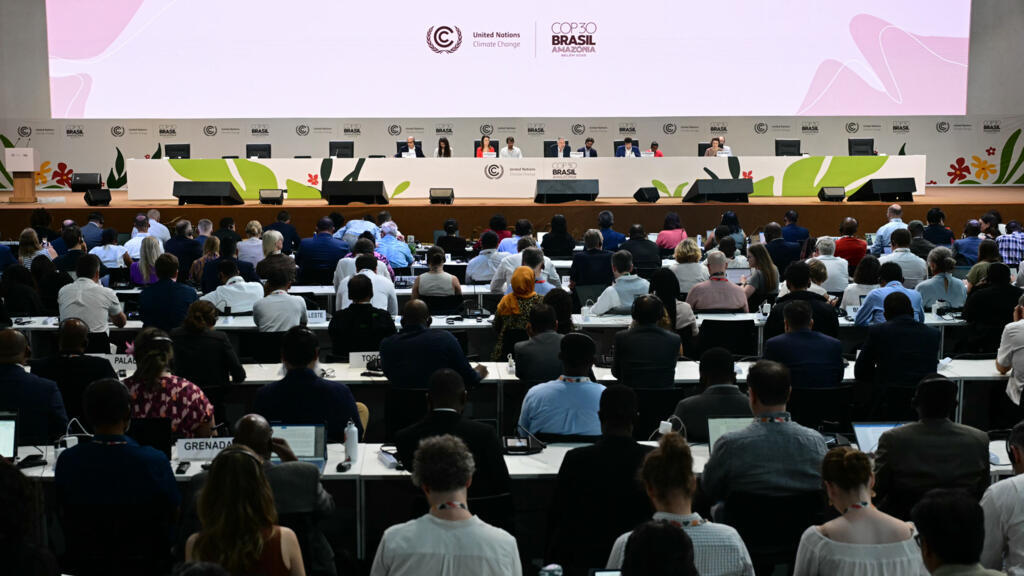
Nearly 200 countries approved the deal by consensus after two weeks of fraught negotiations in the Brazilian city of Belem, with the notable absence of the United States as President Donald Trump shunned the event.
Applause rang out in the plenary session after COP30 president and Brazilian diplomat Andre Correa do Lago slammed a gavel signalling its approval.
The EU and other nations had pushed for a deal that would call for a "roadmap" to phase out fossil fuels, but the words do not appear in the text.
Instead, the agreement calls on countries to "voluntarily" accelerate their climate action and recalls the consensus reached at COP28 in Dubai. That 2023 deal called for the world to transition away from fossil fuels.
The EU, which had warned that the summit could end without a deal if fossil fuels were not addressed, accepted the watered-down language.
"We're not going to hide the fact that we would have preferred to have more, to have more ambition on everything," EU climate commissioner Wopke Hoekstra told reporters.
"We should support it because it is at least going in the right direction," said Hoekstra.
More than 30 countries including European nations, emerging economies and small island states had signed a letter warning Brazil they would reject any deal without a plan to move away from oil, gas and coal.
But a member of an EU delegation told AFP that the 27-nation bloc was "isolated" and cast as the "villains" at the talks.
The push to phase out oil, coal and gas – the main drivers of global warming – grew out of frustration over a lack of follow-through on the COP28 agreement to transition away from fossil fuels.
French ecological transition minister Monique Barbut had accused oil-rich Saudi Arabia and Russia, along with coal producer India and "many" other emerging countries, of refusing language on a fossil-fuel phaseout.
She said Saturday the text was bland but that there was "nothing extraordinarily bad in it."
The deal caps a chaotic two weeks in Belem, with Indigenous protesters breaching the venue and blocking its entrance last week and a fire erupting inside the compound on Thursday, forcing a mass evacuation.
Money and trade
Finishing without a deal would have been a black eye for Brazilian President Luiz Inacio Lula da Silva, who had staked political capital in the success of what he called the "COP of truth".
It was also a major test for international cooperation when Trump decided to skip COP30.
"We also have to weigh the backdrop of geopolitics, and in the end there is no other process we have," German environment state secretary Jochen Flasbarth told AFP.
Developing nations, for their part, had pushed the EU and other developed economies to pledge more money to help them adapt to the impact of climate change, such as floods and droughts, and move toward a low-carbon future.
The EU had resisted such appeals but the deal calls for efforts to "at least triple" adaptation finance by 2035.
"Intergovernmental negotiations work on a minimum common denominator, but our fight will continue," a negotiator from Bangladesh told AFP in a muted reception of the terms.
The EU had also rejected language on trade in the text, as demanded by China and other emerging countries. The final deal calls for "dialogue" on trade issues.
The head of China's delegation at COP30, Li Gao, told AFP that the summit will go down as a success.
"I'm happy with the outcome," Li said. "We achieved this success in a very difficult situation, so it shows that the international community would like to show solidarity and make joint efforts to address climate change."
ByAFP
November 22, 2025

Belem in northern Brazil is known as the gateway to the Amazon rainforest - Copyright AFP Carlos Fabal
Nearly 200 nations on Saturday pushed through a modest deal at the UN’s COP30 climate summit in the Amazon region of host country Brazil.
It was welcomed by some as a decent outcome amid fraught negotiations — and the absence of the United States — but dismissed as falling short by others.
Here’s a round-up of key reactions:
– Lula –
Brazilian President Luiz Inacio Lula da Silva — who had staked political capital in the success of what he dubbed “the COP of truth” — applauded that “science prevailed” and “multilateralism won” during the talks.
“We mobilized civil society, academia, the private sector, indigenous peoples, and social movements, making COP30 the COP with the second-highest participation in history.”
– Europe –
“We’re not going to hide the fact that we would have preferred to have more, to have more ambition on everything,” EU climate commissioner Wopke Hoekstra told reporters, while saying the deal was still “the right direction.”
French ecological transition minister Monique Barbut was more frank: “I couldn’t call this COP a success,” she said.
But while “this deal won’t raise our overall level of ambition,” she said “it doesn’t disrupt any of the previous momentum” either.
British energy secretary Ed Miliband told AFP “that’s what this COP process is like. You look over the long sweep of history — it had delivered change.”
“Every COP has frustrations.”
– Colombia –
The president of Colombia Gustavo Petro slammed the deal’s lack of plan to phase out fossil fuels, saying Colombia “does not accept” that the declaration “doesn’t say with clarity, as science does, that the cause of the climate crisis is fossil fuels.”
– India, South Africa, Brazil, China –
But India praised the deal as “meaningful.”
“We fully support the (COP30) presidency and recognize the outstanding efforts of the presidency team, including spending many sleepless nights working to ensure that we leave with something meaningful from Belem,” said a representative from India, speaking on behalf of the BASIC coalition of Brazil, South Africa, India, and China.
China meanwhile was “happy with the outcome.”
China’s Vice Minister of Ecology and Environment, Li Gao, told AFP that COP 30 would go down as “success in a very difficult situation.”
– Less-developed countries –
Evans Njewa, who represented a group of 44 less-developed countries, said “we didn’t win on all fronts, but we got tripling adaptation finance by 2035.”
“Thanks for siding with 1.6 billion vulnerable people,” Njewa said of the inhabitants of the African, Asian and island countries he reps. “This was our priority, and we made it a red line.”
And the Alliance of Small Island States called the deal “imperfect” but still a step towards “progress.”
– Guterres –
The head of the United Nations commended the weeks of efforts but said he understood that “many may feel disappointed” with the results, including Indigenous people, youth, and those now feeling the worst impacts of climate change.
“I cannot pretend that COP30 has delivered everything that is needed,” read a statement from Secretary-General Antonio Guterres, who said “the gap between where we are and what science demands remains dangerously wide.”
“I will continue pushing for higher ambition and greater solidarity.”
– NGOs –
The talks also were closely watched by non-governmental organizations working in the climate sector.
The head of the World Resources Institute, Ani Dasgupta, heralded COP30 for delivering “breakthroughs to triple adaptation finance, protect the world’s forests and elevate the voices of Indigenous people like never before.”
But the formal negotiations fell short in many respects, he said, notably on the lack of a fossil fuel phaseout plan, leading to a “weakened” deal.
Ilan Zugman, Latin American and Caribbean director for the organization 350.org, said that “the lack of concrete commitments in the final text of COP30 shows us who is still benefiting from the delay: the fossil fuel industry and the ultrarich, not those living the climate crisis every day.”
Why the Suits Are Skipping Climate Summits
- Corporate representation at COP30 has sharply declined since the 2021 Glasgow summit, replacing high-profile marketing stunts with caution and minimalism.
- This shift is primarily driven by the political climate, specifically the new US administration's anti-green energy rhetoric which has weaponized climate as a culture war issue, increasing the risk for corporate visibility.
- The post-pandemic economic environment and a return to shareholder primacy have made the expense and "green grandstanding" of large COP delegations harder for blue-chip firms to justify amid cost-cutting drives.
Reclining on stage at the 26th COP summit in his native Glasgow, Alan Jope was at home both literally and spiritually.
The Unilever chief executive had spent three years establishing himself as one of the corporate world’s most passionate climate and diversity advocates, vowing to accelerate his predecessor, Paul Polman’s, environmental, social and governance leadership. And with his company a principal partner at the biggest climate summit in history, the Scotsman’s efforts had reached their natural apogee.
“We think there are three existential challenges in the world: climate change, the loss and destruction of nature, and growing inequality,” he told a Bloomberg Green event. “None of these issues are good for our business… so I’ve been delighted to see the representation of business here in Glasgow.”
Corporate presence was – as the ‘Uni-lifer’ observed – hard to miss at the environmental jamboree of the year; one which the then Prime Minister Boris Johnson had billed as the “world’s moment of truth”. Outside the main hangar, pharma giant GSK had installed an inflatable air purifier. Utilities giant SSE had commissioned an entire Imax screening event – called Hydro – devoted to hydroelectric power. And in the world of haute couture, Stella McCartney’s Future of Fashion exhibition showcased her label’s efforts to leverage “the limitless possibilities of material innovation”.
Where have all the suits gone?
Four years on, with the 30th iteration of the annual Conference of the Parties (COP) in Brazil now in its second week, the agenda items that range from youth-led climate forums and fraught political negotiations look similar to those at Scotland’s edition in 2021. Environment ministers, official delegations and third-sector titans are, as they were in Glasgow, also out in force. What is missing, however, are the clean-cut executives and no-cost-spared marketing stunts from the blue-chip firms – and their consultants – that viewed the 2021 summit as the consummate platform for burnishing their green credentials.
“Before, if you weren’t doing something around COP, then questions would be asked,” said one senior corporate affairs executive. “Now it’s totally different.”
“My clients have definitely sent fewer people to this year’s summit,” added a director at a UK-based PR agency. “Expense is a massive reason, but so is the political environment.”
What is COP30?
Organised under the auspices of the United Nations, COP has, for decades, been the world’s best-attended, and most consequential environmental gathering. Since its establishment at a 1992 treaty signed in Rio de Janeiro, an assortment of presidents, prime ministers, chief executives and campaigners have descended on a different city each year to agree how best to limit the effects and extent of what’s become known as the climate crisis.
Over three decades it became a temple to the political consensus which held that the changing climate posed an existential threat to humanity, and that the world – largely via a series of agreements at COP – needed to do everything it could to stop it. Heads of state would use the jamboree as a platform to commit their nations to ambitious transition targets. Campaigners would make hay from the eyes of the world’s science and environmental media being trained on one place at the same time. And executives would trumpet the painstaking but important lengths to which their companies were going to reduce their own contribution to the crisis at hand.
But as the world exited from the pandemic and entered the energy price shock of 2022, that consensus was punctured. Aided by the outbreak of a hot war in Europe – and an aggressive rate-hiking cycle from the western world’s central banks – lawmakers’ priorities evolved from energy sustainability to energy security.
Drill, baby, drill
Initially, that shift happened quietly – and even sheepisly. Or at least it did until, last year, the man vying to be the 47th President of the United States turned climate into one of the most salient topics of the primary and presidential campaigns.
Efforts to boost green energy were, Donald Trump said during the primaries, a “scam”. Instead the US needed to “drill, baby, drill” if it wanted to improve living standards, maintain its position as the world’s largest natural gas exporter and keep energy prices down.
Since taking office in January, the president as followed through on his unstinting rhetoric. He quickly sought to block all offshore wind projects – even those that were very close to completion – and launched a legislative tirade against companies that set ESG targets and strategies.
Political climate keeps firms away from COP
According to Charlie Tarr, chief executive of corporate affairs consultancy Woodrow, the direction in which Trump has taken his second term is the primary reason for firms’ low-key turnout this year.
“The glossy pavilions, the huge delegations, the climate grandstanding that we’ve seen in previous years is just over,” he says. “Now, we’ve got caution, we’ve got minimalism, we’ve got private conversations. US politics has weaponised climate as a culture war issue. That has fundamentally changed the calculus for corporate visibility.”
Where once firms would once dispatch six or seven senior staff, this year they are sending two, Tarr adds. And where chief executives used to block their calendar months in advance to be seen on a panel with a former presidential candidate or feted naturalist, now they are more likely to delegate that job to their senior sustainability officer.
One senior PR executive, who worked with several blue-chip firms in the run-up to Glasgow’s COP, said the judgement call Western firms made in 2021 was, if your business wasn’t doing something big around it, consumers and shareholders would demand to know why.
“We had entire COP strategies that fleshed out how we were going to engage with stakeholders, working out the business opportunities on the ground, etc,” she said. “Association with it was almost universally positive.”
Another PR agency director added: “It has dropped off the agenda of, for example, the big asset managers, and big banks who will have occasionally dipped their toe into COPs in the past.”
Logistical and political difficulties
But according to some, the lack of corporate representation is not just down to the fresh political scrutiny emanating from the White House.
Michael Hartt, who leads international affairs at Fleishmanhillard and is advising several firms on their COP 30 communications strategies, said the logistical issues around this year’s summit, which is being held in the heart of the Amazon, are just as important as politics.
“A mix of practical factors…. and wider forces, including political pressure in some countries… means some companies have adjusted their presence,” he told City AM.
And according to others, a patchy track record, and several missteps including controversial locations, meant firms were beginning to lose faith in the value the summit brings to the climate debate, and its track record for delivery amid a testing macroeconomic backdrop.
“There’s no doubt that we’re seeing [clients] row back on COP engagement,” said Imogen Sackey, senior associate director at the Romans. “But I think it reflects a bigger question about COP’s role in global climate leadership.
“[It] feels increasingly abstract… and we’re seeing businesses afraid to break the binary between ‘good for business’ and ‘good for the planet,” she added.
Firms finding COP outlay harder to justify
That binary trade-off may – as Sackey claims – be myopic, but it is a core component of executives’ decision-making. As the era of cheap money that characterised the post-financial crisis global economy shuddered to a halt in 2022, corporates across the world tighten their belts.
Shareholder primacy returned to the ascendancy. And shareholders, for their part, relearned the importance of a robust bottom line. All of which meant blue-chip firms, many of whom had recruited rapidly over the pandemic, felt forced to cut back on staff levels, employee benefits and marketing spend to sate increasingly scrupulous investors.
“Looking at large-cap companies – and including S&P500 businesses – they are just scaling back,” said Woodrow’s Tarr. “They’re wary of optics on cost-grounds because some have been been laying people off.”
One company keeping a markedly lower profile at this year’s instalment – and which has, itself, been engaged in a major cost-cutting drive – is Alan Jope’s erstwhile employer, Unilever.
The consumer giant has – like many in its category – been on a striking financial and rhetorical journey since the Glaswegian stepped down at the end of 2023. After years of underperformance, Jope’s replacement, Hein Schumacher, scaled back the firm’s ambitious climate targets just four months into the job, saying the group needed “to be more focused in its allocation of resources”.
His successor, Fernando Fernandez, has doubled down on that direction. In his first set of public remarks in September, the new chief executive conceded that Unilever had “lost its focus on volume growth”, blasting the “many pockets of mediocrity” that existed in the company’s ranks.
Despite having led the firm’s Brazilian division for nearly 10 years, Fernandez will not be showing his face at COP 30. Instead, his focus for the firm was made abundantly clear in a Linkedin post published just a fortnight before COP got underway.
“We know what we need to do to make Unilever a marketing and sales machine, and we are doing it at speed,” he wrote in late October. “Let’s go!”
By City AM
COP30 Drops Draft on Transition Away from Fossil Fuels

The COP30 climate summit is ditching an earlier draft of a roadmap to transition away from fossil fuels, according to the latest draft of negotiating texts at the global gathering in Belem, Brazil.
Many countries at COP30 have mobilized and supported a so-called “roadmap” to transition away from fossil fuels. But the latest draft document of the summit has removed reference to transitioning away from fossil fuels entirely, Reuters reports.
While more than 80 countries joined the call for a roadmap to move away from fossil fuels, others have resisted any deal on phasing out of oil, gas, and coal.
The delegates at COP30 are still discussing language for the final communique that will be published and agreed on unanimously by the countries attending the summit, so Friday’s version of the draft may not be final.
Yet, signs point that there won’t be an explicit reference to transitioning away from fossil fuels.
Even the European Union has backed off supporting the roadmap.
As many as 82 countries earlier this week called for a clear roadmap toward the phase-out of fossil fuels—but the European Union, which aims to lead by example in the global push to net zero, was not among these.
Many EU countries backed the 82-nation-strong push to ditch fossil fuels, but the EU-27 did not formally support the initiative as such backing needs the unanimous approval of all 27 member states, Politico reports.
The joint effort to abandon the use of fossil fuels globally was supported by the EU’s biggest economy, Germany, as well as Colombia, the United Kingdom, and Kenya.
The pledge to “transition away from fossil fuels” was made two years ago at COP28 in Dubai in 2023 in what was for the first time in decades that the end of fossil fuels was mentioned in a negotiating text. However, the topic did not evolve at the following COP29 in Azerbaijan last year.
By Tsvetana Paraskova for Oilprice.com

No comments:
Post a Comment