Trump forces Zelensky into a corner with plan to end war on Russian terms
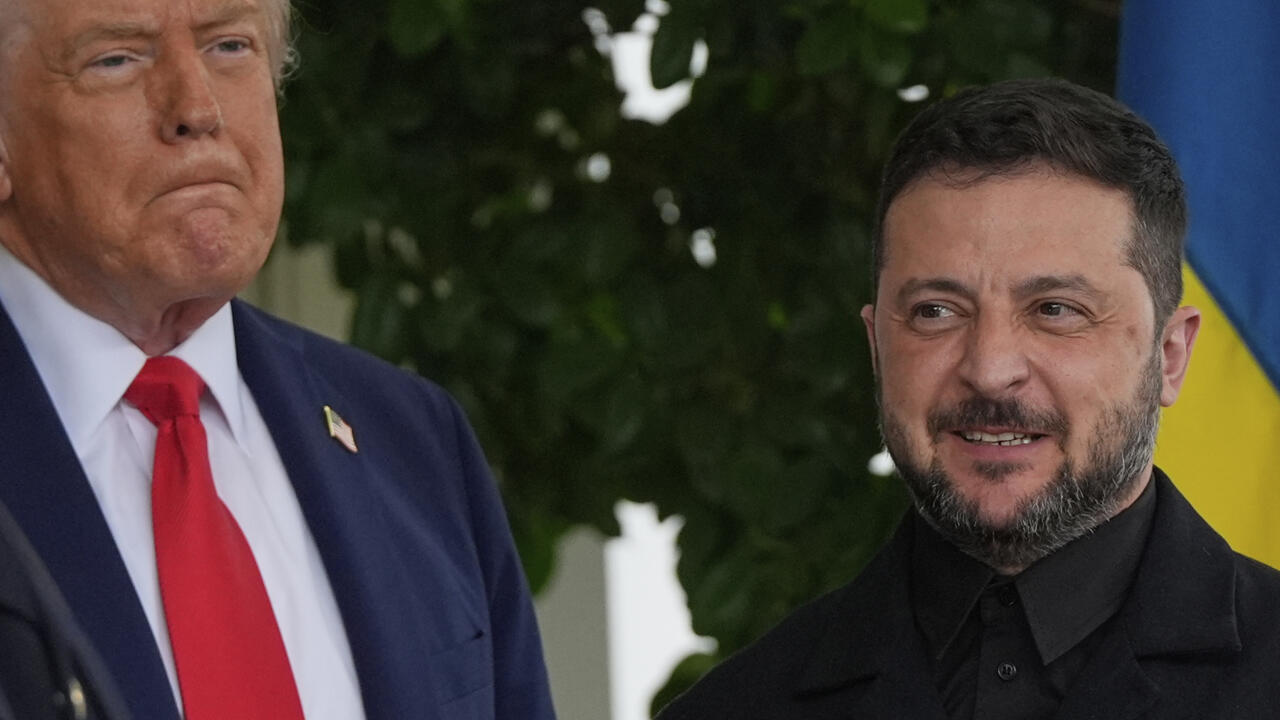
Ukraine's President Volodymyr Zelensky has said his country faces a pivotal choice between standing up for its sovereign rights and preserving critical support from Washington as it faces intense pressure to agree to a US peace proposal that meets many of Russia's main war aims.
Issued on: 23/11/2025
Video by: Gulliver CRAGG
03:05
With his new 28-point plan to end Russia’s war in Ukraine, US President Donald Trump is resurfacing his argument that Ukrainian President Volodymyr Zelensky doesn't “have the cards” to continue on the battlefield and must come to a settlement that heavily tilts in Moscow's favour.
Trump, who has demonstrated low regard for Zelensky dating back to his first term, said Friday he expects the Ukrainian leader to respond to his administration's new plan to end the war by next Thursday.
“We think we have a way of getting peace,” Trump told reporters in an Oval Office appearance. “He’s going to have to approve it.”
Buffeted by a corruption scandal in his government, battlefield setbacks and another difficult winter looming as Russia continues to bombard Ukraine's energy grid, Zelensky says Ukraine is now facing perhaps the most difficult choice in its history.
Zelensky has not spoken with Trump since the plan became public this week, but has said he expects to talk to the Republican president in coming days. It's likely to be another in a series of tough conversations the two leaders have had over the years.
The first time they spoke, in 2019, Trump tried to pressure the then newly minted Ukrainian leader to dig up dirt on Joe Biden ahead of the 2020 election. That phone call sparked Trump's first impeachment.
Trump made Biden's support for Ukraine a central issue in his successful 2024 campaign, saying the conflict had cost US taxpayers too much money and vowing he would quickly bring the war to an end.
Then early this year in a disastrous Oval Office meeting, Trump and Vice President JD Vance tore into Zelensky for what they said was insufficient gratitude for the more than $180 billion the US had appropriated for military aid and other assistance to Kyiv since the start of the war. That episode led to a temporary suspension of US assistance to Ukraine.
And now with the new proposal, Trump is pressing Zelensky to agree to concessions of land to Moscow, a massive reduction in the size of Ukraine’s army, and agreement from Europe to assert that Ukraine will never be admitted into the NATO military alliance.
“Now Ukraine may find itself facing a very difficult choice: either loss of dignity, or the risk of losing a key partner,” Zelenskyy said in a video address Friday.
'You don't have the cards'
At the center of Trump's plan is the call on Ukraine to concede the entirety of its eastern Donbas region, even though a vast swath of that land remains in Ukrainian control. Analysts at the independent Institute for the Study of War have estimated it would take several years for the Russian military to completely seize the territory, based on its current rate of advances.
Trump, nevertheless, insists that the loss of the region – which includes cities that are vital defense, industrial and logistics hubs for Ukrainian forces – is a fait accompli.
“They will lose in a short period of time. You know so,” Trump said Friday when asked during a Fox News Radio interview about his push on Ukraine to give up the territory. “They’re losing land. They’re losing land.”
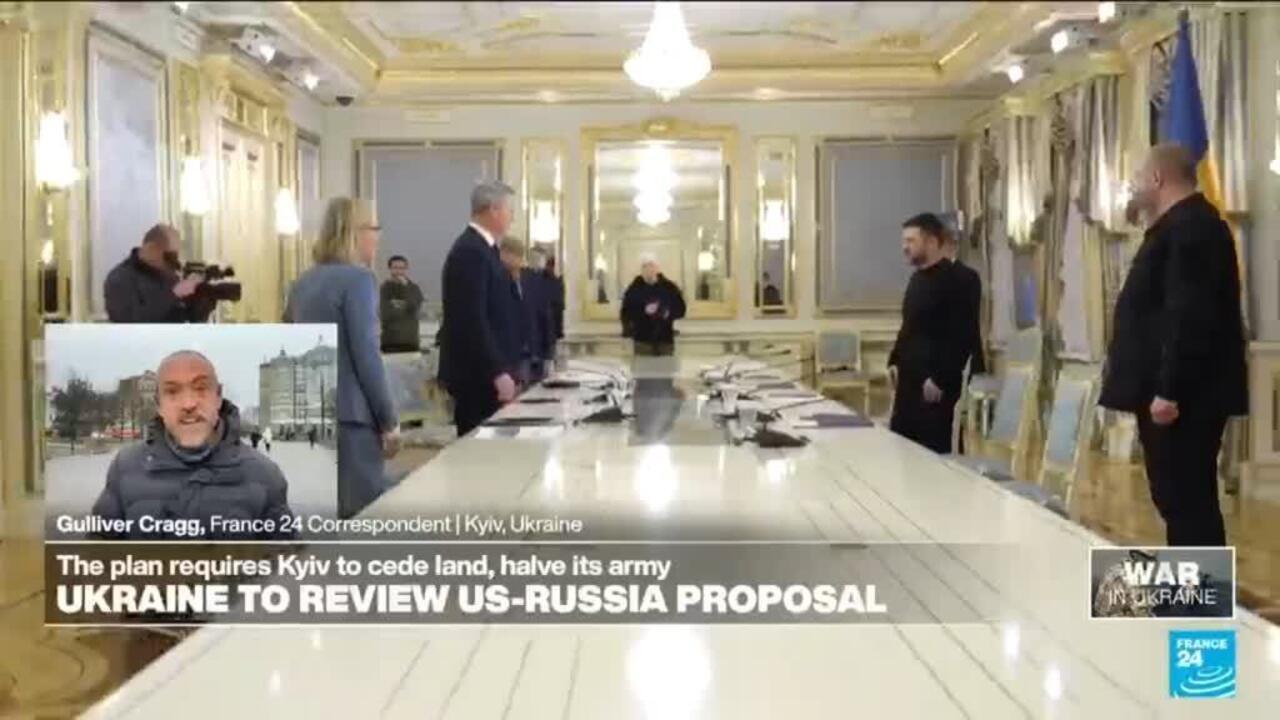
The Trump proposal was formally presented to Zelensky in Kyiv on Thursday by Dan Driscoll, the US Army secretary. The plan itself was a surprise to Driscoll’s staffers, who were not aware as late as Wednesday that their boss would be going to Ukraine as part of a team to present the plan to the Ukrainians.
07:05
Army officials walked away from that meeting with the impression that the Ukrainians were viewing the proposal as a starting point that would evolve as negotiations progressed, according to a US official, who spoke on condition of anonymity to discuss the sensitive talks.
It's unclear how much patience Trump has for further negotiation. White House press secretary Karoline Leavitt said Thursday that Trump's new plan reflects “the realities of the situation” and offers the “best win-win scenario, where both parties gain more than they must give.”
Asked about Zelensky's initial hesitant response to the proposal, Trump recalled the February Oval Office blow-up with Zelensky: “You remember, right in the Oval Office, not so long ago, I said, ‘You don’t have the cards.’”
The mounting pressure from Trump comes as Zelensky is dealing with fallout over $100 million in kickbacks for contracts with the state-owned nuclear energy company. The scandal led to resignations of top Cabinet ministers and implicated other Zelensky associates.
Konstantin Sonin, a political economist and Russia expert at the University of Chicago, said “what Donald Trump is certainly extremely good at is spotting weak spots of people.”
Back against the wall
One of the 28 elements of Trump’s proposal calls for elections to be held within 100 days of enactment of the agreement.
“I think it’s a rationalistic assessment that there is more leverage over Zelensky than over Putin,” Sonin said. He added, “Zelensky’s back is against the wall” and “his government could collapse if he agrees” to the US proposal.
All the while, Ukraine is increasingly showing signs of strain on the battlefield after years of war against a vastly larger and better equipped Russian military. Ukraine is desperately trying to fend off relentless Russian aerial attacks that have brought rolling blackouts across the country on the brink of winter.
Kyiv is also grappling with doubts about the way ahead. A European plan to finance next year’s budget for Ukraine through loans linked to frozen Russian funds is now in question.
02:58
The Trump proposal in its current form also includes several elements that would cut deeply into Ukrainian pride, said David Silbey, a military historian at Cornell University.
One provision calls on Russia and Ukraine to abolish “all discriminatory measures and guarantee the rights of Ukrainian and Russian media and education,” and “all Nazi ideology and activities must be rejected and prohibited.” That element could be seen by the Ukrainian side as giving credence to Putin's airing of distorted historical narratives to legitimize the 2022 invasion.
Putin has said the war is in part an effort to “denazify” Ukraine and complained of the country's “neo-Nazi regime” as a justification for Russia’s invasion. In fact, in Ukraine’s last parliamentary election in 2019, support for far-right candidates was 2%, significantly lower than in many other European countries.
The plan's provision is “very clearly an attempt to build up Putin's claim to Russian cultural identity within Ukraine,” Silbey said. He added, “From territory loss to the substantial reduction of the Ukrainian military to cultural concessions that have been demanded, I just don’t think Zelensky could do this deal and look his public in the eye again.”
(FRANCE 24 with AP)
Who wrote the US psonsored 28-point peace plan to end the war in Ukraine. The initial knee-jerk reaction by the anglophone press is that it is a Kremlin wishlist of Putin's maximalist demands, but as more details come out parts were clearly Ukrainian sugests and others appeare to be US additions. / bne IntelliNews
By Ben Aris in Berlin November 23, 2025
A mystery has emerged over the identity of the authors of the 28-point peace plan floated last week to bring the war in Ukraine to an end. It’s important as the knee-jerk reaction to initial reports is that it is a Kremlin sponsored wish-list, as more details emerge it appears that all three players of Russia, Ukraine and the US have contributed points.
Initially reported to be the work of US Special Envoy to the Middle East Steve Witkoff and the head of Russia’s sovereign wealth fund, Kirill Dmitriev, over the weekend, Secretary of State Marco Rubio claimed that the plan was drawn up by the White House, “with inputs from Russia and Ukraine.”
The distinction is important as some of the points in the plan, like the very large size of the Ukrainian army, will be unacceptable to the Kremlin. Other points in the plan, like Ukraine conceding its hold on the whole of the Donbas region, will be hard for Bankova to swallow. And other points like setting up a demilitarised zone (DMZ) in Donbas, look sponsored by the US and will be unacceptable for both Ukraine and Russia.
Polish Prime Minister Donald Tusk said on X that Ukraine's allies were ready to work on the plan, but that before doing so "...it would be good to know for sure who is the author of the plan and where it was created."
Nevertheless, real progress seems to have been made on the first day of talks between US, Ukrainian and European officials in Geneva on November 23.
In a press conference following the first day of talks, Secretary of State Marco Rubio said a “great deal of progress” had been made and he was “very optimistic” about the talks but highlighted that its an “on going process” and the terms of the deal.
“Today was the best day we have had in the entire ten months of these talks,” Secretary of State Marco Rubio.
Some real common ground has appeared that could lay the ground for real progress in the ceasefire talks which had stalled after US President Donald Trump’s abortive attempt to organise the Budapest trilateral meeting in October.
America wrote the plan
Negotiations on the plan started during a two day meeting between Special Envoy to the Middle East Steve Witkoff and head of Russia’s sovereign wealth fund, Kirill Dmitriev, in a meeting in Miami on October 24-26, where the main points were thrashed out, according to reports.
The source of the original leak that led to a story in Axios on November 19 has also become controversial. After the story broke, Witkoff seemed to suggest Dmitriev was the source of the leak. Reportedly in what was supposed to be a private message, Witkoff accidently posted on social media: “He must have got this from K,” in an apparent reference to Kirill Dmitriev.

The full 28-point list appeared at the end of the same day, leaked by Ukrainian politician Oleksiy Honcharenko, a member of former president Petro Poroshenko’s European Solidarity party. Dmitriev himself denied being the source of the leak and blamed Honcharenko.
Rubio was adamant that the US has led the drafting of the plan. Rubio and Trump's son-in-law Jerad Kushner subsequently reviewed and approved the draft, according to other reports. Trump was also informed of the plan and reportedly approved it.
"The peace proposal was authored by the US It is offered as a strong framework for ongoing negotiations," Rubio said in a post on social media. "It is based on input from the Russian side," Rubio added. "But it is also based on previous and ongoing input from Ukraine."
The plan offered by Washington is, “the sound base for talks on the settlement in Ukraine,’ he added.
Senator Mike Rounds, a Republican, told reporters at a conference in Halifax, Nova Scotia, that Rubio had called him and other senators. "He made it very clear to us that we are the recipients of a proposal that was delivered to one of our representatives," Rounds said. "It is not our recommendation, it is not our plan."
Many US senators are unhappy with the plan and are becoming frustrated by what they see as an unwinnable war.
In a rare break with Trump, Senator Lindsey Graham openly criticized the new peace plan on November 22, saying it was “problematic” calling on Trump to reconsider. Graham has been an ardent supporter of Ukraine and proposed a bi-partisan law that would impose 500% tariffs on any country that continues to do business with Russia: namely India and China’s ongoing imports of Russian oil.
“While there are many good ideas in the proposed Russia-Ukraine peace plan, there are several areas that are very problematic and can be made better,” Graham wrote on X.
EU leaders unhappy
European leaders have also cast doubt on the US claim that it drew the draft proposal up.
"There are many things that cannot simply be an American proposal, which requires broader consultation," said French President Emmanuel Macron.
Brussel’s reaction to the plan has been overwhelmingly negative after it was excluded from the process yet again. Most European capitals claim the first they heard of it was from the Axios report on November 19.
However, it has emerged that the EU may not have been entirely excluded. The Berliner Zeitung reported that the German Chancellor’s was briefed on a meeting between US Special Envoy to the Middle East Steve Witkoff and the head of Russia’s sovereign wealth fund, Kirill Dmitriev, in Miami on October 24 on a few days after it happened and the Chancellor himself was informed on the talks on November 4, but took no action.
Robert Davis
November 23, 2025
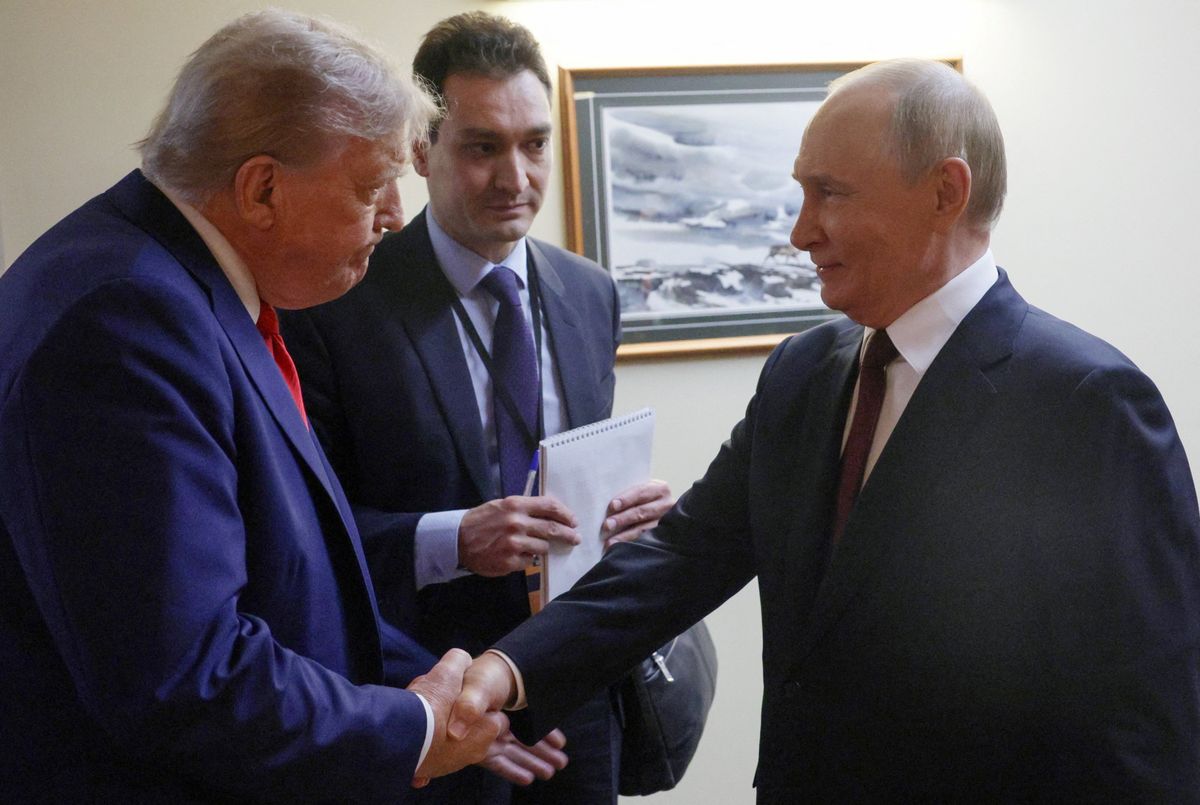
U.S. President Donald Trump shakes hands with Russian President Vladimir Putin before a joint news conference following their meeting at Joint Base Elmendorf-Richardson in Anchorage, Alaska, U.S., August 15, 2025. Sputnik/Gavriil Grigorov/Pool via REUTERS
A former U.S. ambassador to Russia bashed the latest peace plan for Russia's war in Ukraine offered by President Donald Trump, arguing that it "reveals American weakness" and does not serve the country's interests.
Michael McFaul, ambassador to Russia from 2012 to 2014, penned a new op-ed in The Kyiv Independent that sharply criticizes the 28-point peace plan the Trump administration has reportedly pressured the Ukrainians to accept. The plan would prohibit Ukraine from joining NATO, require to to give up its long-range missiles, and give up land occupied by Russian forces, including parts of the country that Russia does not fully control.
Experts have noted that the plan heavily reflects Russian negotiating points.
"This Putin plan does not serve American national interests," McFaul wrote. "The sooner Trump and his team amend it or abandon it, the better it will be for U.S. security and prosperity."
"Endorsing this plan embarrassingly underscores that all of Trump’s courtship of Putin, punctuated by rolling out the red carpet for the Russian imperialist dictator in Alaska in August, has yielded not a single substantive concession from Russia," he added.
McFaul also argued that the plan includes several "egregious" points, such as placing a cop on the size of Ukraine's army going forward.
"The United States needs a strong Ukraine to help contain Putin’s Russia," McFaul argued. "Many of these provisions do the exact opposite; they weaken Ukraine."
Read the entire op-ed by clicking here.
Robert Davis
November 23, 2025
RAW STORY
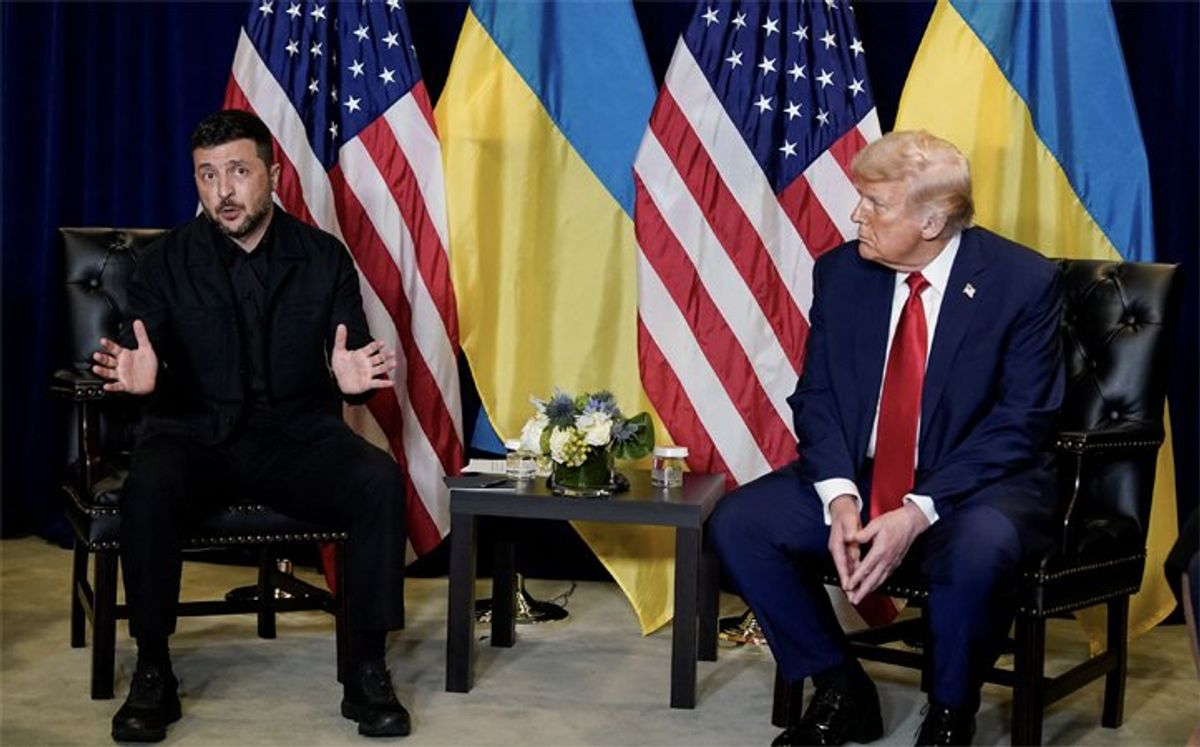
U.S. President Donald Trump meets with Ukrainian President Volodymyr Zelenskyy during the 80th United Nations General Assembly, in New York City, New York, U.S., September 23, 2025. REUTERS/Al Drago
The Trump administration's latest pivot in its efforts to end Russia's war in Ukraine unsettled a war expert, who argued in a new Substack essay published on Sunday that the move exposes the administration's strategy as a "con."
Last week, the administration released a 28-point peace plan for the war in Ukraine, which experts noted seemed to have been authored by Russian authorities. The plan calls for Ukraine to drastically scale down its military, give up land occupied by Russian forces, and destroy its long-range missiles.
Phillips P. O'Brien, a professor of strategic studies at the University of St. Andrew, argued in a new Substack essay that the deal shows the Trump administration is a "mouthpiece" for the Russian government.
"Not only has the Trump administration ended its 'Long Con'...the con being that Trump and his acolytes were actually honest brokers and wanted to work with Putin and might hammer Russia," O'Brien argued. "It has even gone further. The Trump administration is now a mouthpiece for Russian demands and an agent to have Russian wishes met."
He also argued that the Trump administration can no longer be considered "honest brokers or even supporters of Ukraine."
"The idea that Trump and his administration could be honest brokers or even supporters of Ukraine was a con," he wrote. "They changed tack when their first strategy of bullying Ukraine blew up in their faces. Since then, they have bided their time, done a great deal of playacting, but were always going to return to what they were—Putin supporters because of Trump’s basic wishes to work with the Russian dictator."
"The reality that the administration seems happy to take text directly from Russian documents and pass that on as official US positions, I hope, ends any debate over this," he added.
Read the entire essay by clicking here.
\\
\\
Sunday 23 November 2025, by Oleksandr Kyselov
Exhausted by over three years of Russian attacks, Ukrainians are increasingly ready to accept unfair political compromises and harsh territorial concessions to end the war. Yet it’s far from clear that this hard choice will actually bring lasting peace.
s speculation mounts about another Trump-brokered peace plan for Ukraine, much of today’s debate feels like déjà vu. There are the same denunciations of “vested interests” in the conflict, the condemnations of warmongers, and the cries for “urgent talks.” In Ukraine, we didn’t just hear these arguments. We made them ourselves.
In summer 2014, after Russia annexed Crimea and the war in Donbass was already flaring, activists from Ukraine, Russia, and Belarus issued a “New Zimmerwald” declaration criticizing the surge of chauvinism and xenophobia in their countries. They called for a broad antiwar movement, an immediate ceasefire, and mutual disarmament. Ukraine’s newly formed Sotsialnyi Rukh (Social Movement) echoed that spirit in 2015, advocating direct negotiations involving trade unionists and rights defenders from both sides, and the disbandment of security agencies. It was a genuine attempt at internationalist peace — and it failed.
None of it stopped Russia’s aggression in 2022. Yet Russian leftists, apart from a brave minority, again retreated into pacifist formulas, blaming the war on both sides and pointing fingers at NATO, Boris Johnson, and the “neo-Nazi oligarchic regime in Kyiv.” Ukrainians, under fire, had no such luxury. They resisted the occupying troops, and too many have already lost their lives.
The Left internationally, when not limiting itself to short boilerplate statements, largely oscillates between instinctive revulsion at injustice and the desperate plea for peace. But can either be a guide to action?
The Price of Justice
There is no shortage of people denouncing any compromise with the Kremlin as downright betrayal that would set a precedent of rewarding aggression. In absolute terms, they are right. Yet justice always comes at a price: if not for the activist demanding it, then for someone else.
Ukraine’s resources are stretched to breaking point. Defense spending in 2025 has reached $70 billion, exceeding domestic tax revenues. The budget deficit hovers near $40 billion, and continued foreign aid is not a given. The cost of reconstruction has already climbed over half a trillion dollars. Public debt stands at $186 billion and keeps rising.
Almost two-thirds of Ukrainians expect the war to last for more than a year, and experts agree. President Volodymyr Zelensky underlines that his country would need all available support to fight the Russian army for another two to three years. At the same time, Ukraine’s Armed Forces are strained not only by shortages of arms and munitions but also by dwindling manpower.
Over 310,000 cases of desertion and absence without leave have been registered since 2022, with more than half occurring in 2025. Many soldiers who left cite exhaustion, psychological unpreparedness for extreme combat intensity, endless deployments, and corrupt commanders treating them as expendables. Some are ready to return once conditions improve, but only a fraction did so under the amnesty.
More than half of Ukrainian men say they are ready to fight, but a million and a half still haven’t updated their military records. After recruitment was introduced in 2024, only 8,500 volunteered in a year. Even offering $24,000 in sign-up bonuses for the one-year contracts to the youth failed to attract many. Once travel restrictions for eighteen-to-twenty-two-year-olds were eased, nearly one hundred thousand men crossed the border in the first two months, many to leave for good.
The grim reality is that Ukrainian resistance relies on “busification” — forcibly seizing men from streets or workplaces and pressing them into military service. The Ombudsman has acknowledged that these abuses are now systemic. Even so, Ukraine’s Supreme Court has ruled that mobilization remains legally irreversible, even when carried out unlawfully. Meanwhile, social media feeds ever more often feature violent clashes with draft officers.
The public mood mirrors this fatigue, and recent graft scandals involving the President’s closest associates hardly help. Polls show that sixty-nine percent now favor a negotiated end to the war and nearly three-quarters are ready to accept freezing the front line, even if not on Russia’s terms. Ukrainians continue to insist on security guarantees, which for them include arms deliveries and EU integration.
The dream of “fighting to victory,” no matter what, ignores these limits. Unless Western “unwavering support” includes a readiness to open a second front, what should we expect? The logic of desperation points towards lowering the draft age, extending the military duty to women, deporting draft-age Ukrainian refugees from abroad, to fill trenches, and then introducing barrier troops and field executions to prevent desertion.
The Pacifist Illusion
This bleak situation is not merely a domestic failure. It reflects the exhaustion of carrying the heaviest burden alone — and of fighting tooth and nail for material support from those who think that strong condemnations and humanitarian aid are enough to stop Russia’s invasion. The harder it gets, the more tempting it becomes for some abroad to imagine that the struggle itself must be the problem.
Hence the idea that Western arms only “prolong the suffering,” and that cutting this lifeline to Ukraine would push it to accept “necessary concessions.” It’s a comforting illusion built on flawed rationale. If words alone could end oppression, then strikes and revolutions would have been replaced with eloquence contests.
The arms deliveries do not block diplomacy but are what allow Ukraine to even participate in negotiations. President Zelensky has signaled his openness to talks and even to hard decisions. But only a side that can stand its ground can negotiate on equal terms. To disarm Ukraine would be forcing it to yield. Moscow knows this and exploits contradictions to sow confusion and divide the ranks.
The Kremlin has repeatedly rejected a ceasefire, making it clear that it is only interested in Ukraine’s effective capitulation. Even if Russia’s maximalism is partly bluff, a “frozen” conflict or even Ukraine ceding Donbass would not indeed “address the root causes” of the war, as Vladimir Putin alleges. Moscow has secured its land bridge to Crimea but lacks the resources to seize the rest of the Kherson and Zaporizhzhia oblasts that it also claims. Ukraine will never recognize losses, even if formally forced to. The resentment will cement Russia as an eternal enemy, creating potential for another outbreak of conflict.
Putin’s own maxim — “If the fight is inevitable, strike first” — makes the next step predictable, looking at the map. A push toward the Russian outpost in Transnistria would trap Moldova, secure the Black Sea corridor and strangle what remains of Ukraine’s maritime trade, while also delivering Odesa, once a Russian imperial jewel, central to the mythology of the “Russian Spring.”
For European states to abandon Ukraine would bring no détente. New NATO members Finland and Sweden abandoned neutrality precisely because of Russia’s new way of “resolving disputes.” Five countries withdrew from the Ottawa Treaty landmine ban in 2025 for the same reason. Poland’s military spending is on track to triple since 2022, and the Baltics are racing toward spending 5 percent of GDP on defense. Watching a neighbor dismembered by a former overlord wouldn’t soothe but drive them to arm further.
Blind Spot
Moscow’s December 2021 ultimatum made its ambitions clear: NATO must withdraw to the 1997 borders and recognize a Russian sphere of influence in central-eastern Europe. The demand sounded absurd until the shots were fired in February 2022. But Putin’s blitzkrieg against Ukraine failed, and he holds “European ruling elites” to blame.
No one expects Russian tanks reaching Berlin. But the Baltic states, squeezed between Russia and its militarized exclave in Kaliningrad, fit the pattern. Former imperial provinces, which separate Moscow from its territory on the coast, are a tempting target. The rhetoric about “nonhistoric nations” plagued by Russophobia is already in place.
Should the Kremlin decide to bridge the Suwałki Gap — the narrow strip of Polish and Lithuanian territory between Kaliningrad and Russian ally Belarus — amid another round of Western infighting over sanctions, energy policy or common defense strategy, who would risk World War III?
Somewhere along the way, parts of the Left lost the ability to distinguish resistance from militarism. By treating NATO’s expansion as the cause of the war — and thereby finding a cure in its simple rollback — antimilitarists quietly concede that vast regions beyond Russia belong to its “natural” domain.
The core question is, If Russia gets to settle historical grievances and address “legitimate security concerns” by force, why can’t others? The actual victory for the military-industrial complex would not be shipments to Ukraine or even the rearmament programs, but a Europe in permanent crisis, where every border becomes contestable and defense spending spirals without end.
Resentful Revisionism
The real threat is not Ukrainian nationalism. It is neither uniquely sinister nor more chauvinist than that of any small state under siege. Even those most affected by the war are more often concerned with surviving the missile strikes and drone attacks. This doesn’t imply an approval of nationalist mythmaking. But fixating on the excesses of Ukraine’s cultural policies is a convenient distraction, an excuse to relativize aggression and distance oneself from what’s really at stake.
What we face now is a militarizing, expansionist petro-empire cloaking resentment in talk of “historic justice,” draping its neotraditional revival against the “decadent West,” and willing to use any means to claim its “rightful place in the world.” This politics of resentful revisionism isn’t unique to Moscow, but echoes from Washington to Beijing, and must be confronted before any talk of disarmament becomes meaningful.
Li Andersson, a former chair of Finland’s Left Alliance, has already called for an anti-fascist foreign and security policy. She rejects the illusion that fascism can be reasoned with, accepts building EU states’ defense capabilities and strategic autonomy as a precondition for peace, and upholds international law as a mechanism of prevention against authoritarian subversion.
It is, as Andersson argued, high time to offer a credible alternative in debates on security that neither surrenders to militarized neoliberalism nor fetishizes purity. The far right is surging in the polls, and defense budgets are swelling while social spending, climate adaptation, and development aid are slashed. Yet, the problem here is the elites who are exploiting this crisis to push this agenda, not Ukrainians for refusing to bow in subservience to Putin.
Resisting this course means insisting on two things. First, resilient social institutions and robust public infrastructure are as essential to withstanding shocks and those who can use them as weapons. Second, economic democracy, political inclusivity, and public control make any cause worth fighting for in the first place. As lessons from Ukraine show, without these, any talk of standing together is a sham.
No Ready-Made Solution
Everyone wants the war to end, yet no one has a ready-made solution — perhaps there are none. We owe each other the honesty this moment demands. Anything short of Russia’s full withdrawal from Ukraine is profoundly unjust and outright dangerous, but an uncompromising pursuit of justice can also bring us to the point of no return.
Survival itself — enduring as an independent nation despite Putin’s history lectures — is already a victory for Ukraine. But the story won’t end there. Greedy states attack not because they are provoked, but because they can do so. Stopping them will take more than moral force.
21 November 2025
Source: Jacobin.
Attached documentsukraine-faces-an-unbearable-choice_a9276-2.pdf (PDF - 899.4 KiB)
Extraction PDF [->article9276]
Ukraine
We fight, we have rights: How soldiers’ democracy powers Ukraine’s resistance
Free public transport in Ukraine
No concessions to any imperialism! The Zapatistas’ Clear Stand on Ukraine
Anarchists in wartime. The experience of Solidarity Collectives in Ukraine
“We Wanted to Show the Whole Range of Anti-War Resistance in Russia”
Oleksandr Kyselov from Donetsk is a member of Sotsialnyi Rukh (Ukraine). currently a research assistant at Uppsala University in Sweden.
International Viewpoint is published under the responsibility of the Bureau of the Fourth International. Signed articles do not necessarily reflect editorial policy. Articles can be reprinted with acknowledgement, and a live link if possible.
Issued on: 23/11/2025 - FRANCE24
Washington signalled room for negotiation on a 28-point plan to end the Ukraine war, denying claims by some US senators that it is a Russian "wish list", as Kyiv and European allies criticised the proposal ahead of Sunday talks in Geneva. Caroline Baum reports.
Elizabeth Preza
November 23, 2025
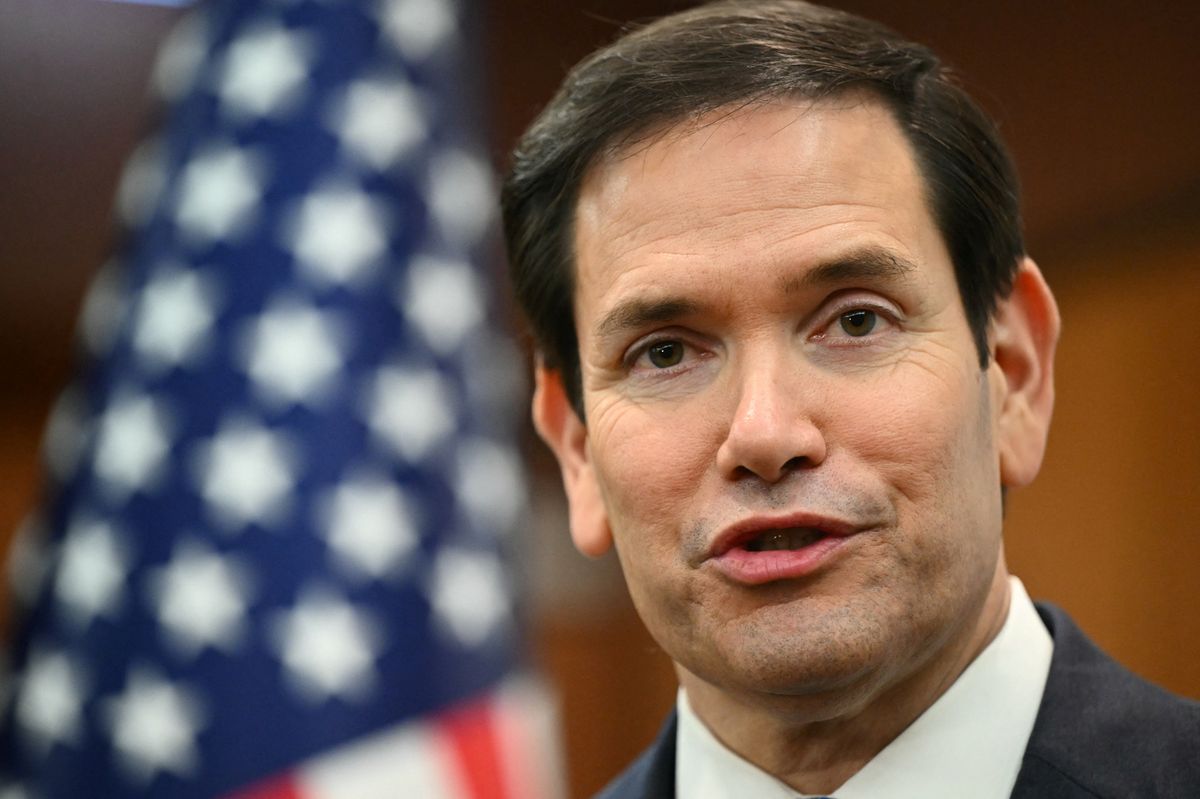
US Secretary of State Marco Rubio gives a media briefing during the ASEAN Foreign Ministers' Meeting at the Convention Centre in Kuala Lumpur, Malaysia on July 11, 2025. MANDEL NGAN/Pool via REUTERS
The U.S. State Department on Saturday pushed back on claims from U.S. lawmakers about the origin of a leaked peace plan for Ukraine after one Republican senator told reporters U.S. Secretary of State Marco Rubio “made it very clear … it is not our peace plan.”
The leaked 28-point peace deal “demands sweeping territorial and security concessions from Kyiv while offering Moscow major economic and political incentives,” the Wall Street Journal reported Friday.
Speaking on the proposed plan at a Halifax press conference Saturday, a gaggle of senators claimed Rubio had distanced the U.S. from the deal.
“Secretary Rubio did make phone call to us this afternoon,” Senate Armed Services Committee member Sen. Mike Rounds (R-SD) said Saturday at a Halifax press conference. “I think he made it very clear to us that we are a the recipients of a proposal that was delivered to one of our representatives. It is not our recommendation, it is not our peace plan.”
“It is a proposal that was received and as an intermediary, we have made arrangements to share it,” Rounds continued. “And we did not release it, it was leaked. It was not released by our members.”
Sen. Angus King (I-ME), who also sits on the Senate Armed Services Committee, told reporters the plan is not the “administration’s position — it is essentially the wish list of the Russians,” Newshour Foreign Affairs and Defense Correspondent Nick Schifrin reported Saturday.
According to Politico,“The lawmakers said the call came at their request after they grew alarmed by the proposal and heard global leaders railing against it. Rubio, they said, agreed to walk them through the situation and gave the lawmakers permission to describe what he told them.”
As Reuters reported Saturday, “many senior officials inside the State Department and on the National Security Council were not briefed” on the plan, citing “two people familiar with” the draft.
“One senior U.S. official said Secretary of State Marco Rubio was read in on the 28-point plan, but did not clarify when he was briefed,” Reuters added.
According to the report, “The situation has sparked worries inside the administration and on Capitol Hill that [U.S. special envoy Steve] Witkoff and [President Donald Trump's son-in-law Jared] Kushner skirted the interagency process and that the discussions with [Russian businessman Kirill] Dmitriev have resulted in a plan that favors Russian interests."
As the senators' Halifax press conference made the rounds Saturday, senior administration officials began “refuting what 3 U.S. senators say Rubio told them,” Wall Street Journal reporter Robbie Gramer wrote on X.
“This is blatantly false,” State Department Principal Deputy Spokesperson Tommy Pigott said Saturday. “As Secretary Rubio and the entire Administration has consistently maintained, this plan was authored by the United States, with input from both the Russians and Ukrainians.”
Rubio himself appeared to contradict the senators, insisting on X the proposal “was authored by the U.S.”
“The peace proposal was authored by the U.S. It is offered as a strong framework for ongoing negotiations[.] It is based on input from the Russian side,” Rubio said. “But it is also based on previous and ongoing input from Ukraine.
As Bloomberg reporter Steven Dennis noted, Rubio’s statement was “oddly all in passive voice.”
“A truly bizarre series of events,” Punchbowl News Senior Congressional Reporter Andrew Desiderio wrote Saturday. “Senators from both parties said in Halifax that Rubio told them via phone today that the Ukraine peace plan is actually a Russian document, not a U.S. proposal. State Department [spokesperson] says that’s not true, it’s a U.S.-authored proposal.”
Desiderio noted that “after the State Department essentially [accused] Sens. Rounds and King of lying about their phone call with Rubio,” Rounds issued a statement appearing to contradict his own Halifax remarks.
“I appreciate Secretary Rubio briefing us earlier today on their efforts to bring about peace by relying on input from both Russia and Ukraine to arrive at a final deal,” Rounds wrote late Saturday on X.
As Desiderio noted, while Rubio's statement insisted the plan was authored by the U.S., he didn't "address what he said or didn’t say to senators.”
“Also notable Rubio is framing it as ‘a strong framework for ongoing negotiations’ even though the [Trump administration] gave Ukraine [until] Thursday to accept it,” Desiderio wrote.
The Punchbowl News congressional reporter added that the Reuters report describing “worries” inside the Trump administration “is being passed around among senior Hill staffers in both parties who want to zero in on Witkoff’s role here.”
Reacting to the alarming back-and-forth Saturday, former defense department official Dan Shapiro exclaimed, “Holy hell. Can these people get their act together?"
“If Congress functioned, there would be hearings about this entire train wreck starting on Monday,” reporter Mike Rothschild wrote Saturday on X.
“What a complete mess,” journalist Aaron Parnas added.

Rep. Don Bacon of Nebraska on May 16, 2024 (Philip Yabut/Shutterstock.com)
Rep. Don Bacon (R-NE), who sits on the House Armed Services Committee, on Saturday demanded "some people ... get fired" over the fallout from a proposed peace plan to end the war in Ukraine.
Bacon was specifically referring to a statement from State Department Principal Deputy Spokesperson Tommy Pigott, who on Saturday refuted claims made by U.S. senators at a press conference in Halifax, Nova Scotia.
According to Sens. Angus King (I-ME) and Mike Rounds (R-SD), Secretary of State Marco Rubio distanced the United States from the proposed plan, telling senators the leaked 28-point plan "is not of the administration's position."
The senators cited a phone call from Rubio which "came at their request," Politico reports.
"Rubio, they said, agreed to walk them through the situation and gave the lawmakers permission to describe what he told them," according to Politico.
In a statement on X, King described the plan as "essentially the wish list of the Russians."
"This is blatantly false," Pigott wrote Saturday on X in response to King's tweet. "As Secretary Rubio and the entire administration has consistently maintained, this plan was authored by the United States, with input from both the Russians and Ukrainians."
Responding to Pigott's statement, Bacon called the peace plan fallout "gross buffoonery" and demanded accountability for the saga.
"Some people better get fired on Monday for the gross buffoonery we just witnessed over the last four days," he wrote on X.
"This hurt our country and undermined our alliances, and encouraged our adversaries," Bacon added.
Bacon had previously spoken out against the leaked plan, which Politico reports sparked alarm among lawmakers as "global leaders railed] against it."
"President Trump’s plan to force Ukraine to give up more territory, to cut its Army by more than half, to never join NATO nor let foreign troops in its territory is an abomination," Bacon wrote Friday on X. "Freedom loving Americans must tell the President that we reject the worst appeasement seen since 1938. ... What makes President [Donald] Trump think we can now trust [Russian President Vladimir] Putin? This agreement weakens Ukraine and leaves them vulnerable to new Russian invasions in the years to come."
David McAfee
November 23, 2025

Anna Paulina Luna speaking with attendees at the 2022 Student Action Summit at the Tampa Convention Center in Tampa, Florida. (Gage Skidmore/Flickr)
A MAGA lawmaker is in hot water as her latest comments are causing some to accuse her of being a Russian asset.
Rep. Anna Paulina Luna turned some heads when she embraced a controversial plan many have said was written by Russians and disseminated to Ukrainian officials by the State Department. Luna said of the deal, "A strong deal is on the table for Ukrainians — and we need to get it done. This war must end. Russia has signaled it’s ready to come to the table, and the U.S. supports a path to peace."
To that, former marine sergeant Harrison Lansing replied with, "It's a Russia-written surrender document not a deal."
Luna added an additional statement on the topic, saying, "The U.S. is leading the charge on peace negotiations and building the framework for a real deal."
"Don’t listen to the fake news or the pro-war psychos claiming otherwise. [Marco Rubio] and [Trump] have it under control. Thank you for your attention to this matter," she added.
That also sparked responses.
Popular legal analyst emptywheel chimed in, "Luna is right: You should listen to someone fronting for Dmitriev."
Jonathan Eyal, associate director of Royal United Services Institute for Defence and Security Studies, said, "Tell us a bit more about your dealings with Russia's favourite oligarch. Thank you for your attention to this matter."
Ron Filipkowski, a former federal prosecutor, said, "She doesn’t even try to hide that she’s a spokesperson for Putin serving in the US Congress."
"Post after post, day after day, echoing Russian propaganda," he added. "Truly sad that people in Pinellas County have chosen this as their representation."
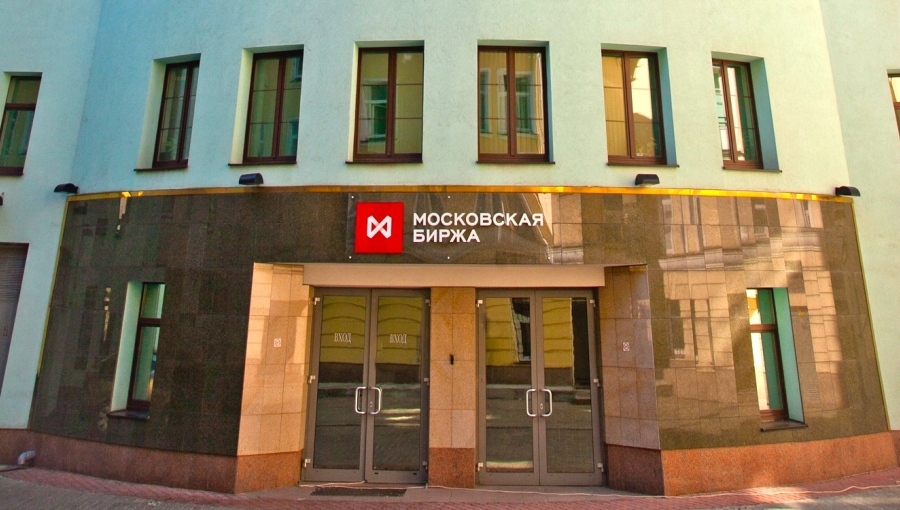
Russian equities rallied strongly at the start of trading on November 21 after details of the US 28-point peace plan were released the previous evening.
Investor sentiment got a fillip as a possible deal is on the cards. The White House is reportedly pushing for Kyiv to accept the plan before the Thanksgiving holiday on November 27 and anticipates closing the deal in early December.
Bankova has been polite, but restrained in its response and Ukrainian President Volodymyr Zelenskiy is widely expected to reject the deal and come back with a counteroffer as the terms include various no-go conditions, including ceding the Donbas to Russia.
Nevertheless, the restart of peace talks, which were dead in the water after the failure of a Budapest trilateral meeting between Russian President Vladimir Putin, US President Donald Trump and Zelenskiy, triggered gains across the board on the Moscow Exchange (MOEX).
The MOEX Russia Index rose 2.4% at the opening bell to reach 2,691 points, with most blue-chip stocks advancing between 3% and 5%, the Moscow Times reports. That is a significant gain, but still below the post war high of over 3,500 the index reached last year. As bne IntelliNews reported, Russia’s stock market has started to come back to life fuelled by domestic investment and a flow of IPOs.
Just this week, Russian state mortgage and housing agency Dom.RF held a widely anticipated IPO on MOEX to placing 10.1% of its shares at the maximum guidance of RUB1,750 per share and raising a total of RUB31.7bn giving the firm a valuation of RUB315bn ($4bn), RBC reported. Demand for Dom.RF’s IPO exceeded RUB80bn–RUB125bn, 4–5x the offer. Over 40 institutional and 50,000 retail investors submitted bids.
Energy firms and state-backed corporations led this rally, as shares in Tatneft and Aeroflot gained around 4%, while Gazprom, Sberbank and Lukoil each added 3%.
The energy stocks, and Lukoil in particular, have been helped by the appearance of a new peace plan as Trump’s new oil sanctions are due to come into force on November 21, but he has a long history of delaying the implementation of sanctions if fresh talks with the White House start.
The rebound began late November 20 after Ukrainian President Volodymyr Zelenskiy signalled openness to discussions with the US and Europe over the peace proposal.
“I am ready for honest work with our partners for a dignified peace,” Zelenskiy said, while emphasising that any settlement must respect Ukraine’s sovereignty, suggesting strongly that a final agreement is still far off.
One of the key items on the list is sanctions relief for Russia if the war ends. A ceasefire would also bring the Russian economy a large peace dividend by taking the military spending pressure off the budget and bringing down still painfully high inflation.
Investment professionals said that the MOEX index could rise back towards its previous highs and reach 3,400 points if negotiations move forward successfully.
EXPLAINER
A draft 28-point plan backed by US President Donald Trump would require Ukraine to cede Crimea and areas of the Donbas to Russia and permanently give up its NATO ambitions in exchange for US security guarantees. Russia would codify in law a promise not to invade Ukraine or the rest of Europe in exchange for holding onto parts of east Ukraine and a reintegration into the global economy.
Issued on: 21/11/2025 -
By: FRANCE 24
Video by: Solange MOUGIN
A draft of the 28-point plan reviewed by AFP:
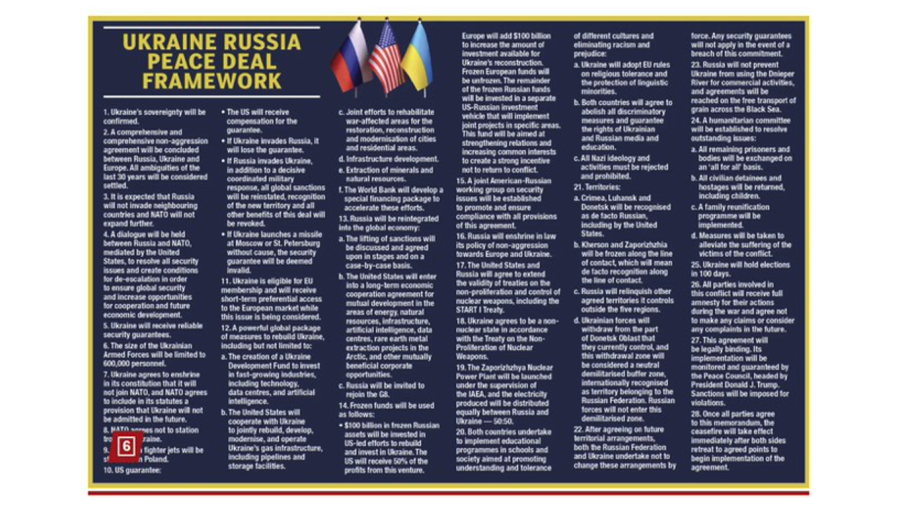
1. Ukraine's sovereignty will be confirmed.
2. A comprehensive non-aggression agreement will be concluded between Russia, Ukraine and Europe. All ambiguities of the last 30 years will be considered settled.
3. It is expected that Russia will not invade neighbouring countries and NATO will not expand further.
4. A dialogue will be held between Russia and NATO, mediated by the United States, to resolve all security issues and create conditions for de-escalation.
5. Ukraine will receive reliable security guarantees.
6. The size of the Ukrainian Armed Forces will be limited to 600,000 personnel.
7. Ukraine agrees to enshrine in its constitution that it will not join NATO, and NATO agrees to include in its statutes a provision that Ukraine will not be admitted in the future.
8. NATO agrees not to station troops in Ukraine.
9. European fighter jets will be stationed in Poland.
10. The US will receive compensation for the security guarantees it provides. If Ukraine invades Russia, it will lose the guarantee. If Russia invades Ukraine, in addition to a decisive coordinated military response, all global sanctions will be reinstated and recognition of its new territories and all other benefits of this deal will be revoked. If Ukraine launches a missile at Moscow or St. Petersburg without cause, the security guarantee will also be deemed invalid.
11. Ukraine is eligible for EU membership and will receive short-term preferential access to the European market while this issue is being considered.
12. A powerful global package of measures to rebuild Ukraine will be established, including the creation of a Ukraine Development Fund, the rebuilding of Ukraine's gas infrastructure, the rehabilitation of war-affected areas, the development of new infrastructure and a resumption of the extraction of minerals and natural resources, all with a special finance package developed by the World Bank.
13. Russia will be reintegrated into the global economy, with discussions on lifting sanctions, rejoining the G8 group and entering a long-term economic cooperation agreement with the United States.
14. Some $100 billion in frozen Russian assets will be invested in US-led efforts to rebuild and invest in Ukraine, with the US receiving 50 percent of the profits from the venture. Europe will add $100 billion to increase the amount of investment available for Ukraine's reconstruction. Frozen European funds will be unfrozen, and the remainder of the frozen Russian funds will be invested in a separate US-Russian investment vehicle.
15. A joint American-Russian working group on security issues will be established to promote and ensure compliance with all provisions of this agreement.
16. Russia will enshrine in law its policy of non-aggression towards Europe and Ukraine.
17. The United States and Russia will agree to extend the validity of treaties on the non-proliferation and control of nuclear weapons, including the START I Treaty.
18. Ukraine agrees to be a non-nuclear state in accordance with the Treaty on the Non-Proliferation of Nuclear Weapons.
19. The Zaporizhzhia Nuclear Power Plant will be launched under the supervision of the UN's International Atomic Energy Agency (IAEA), and the electricity produced will be distributed equally between Russia and Ukraine.
20. Both countries undertake to implement educational programmes in schools and society aimed at promoting understanding and tolerance.
21. Crimea, Luhansk and Donetsk will be recognised as de facto Russian, including by the United States. Kherson and Zaporizhzhia will be frozen along the line of contact, which will mean de-facto recognition along the line of contact. Russia will relinquish other agreed territories it controls outside the five regions. Ukrainian forces will withdraw from the part of Donetsk Oblast that they currently control, which will then be used to create a buffer zone.
22. After agreeing on future territorial arrangements, both the Russian Federation and Ukraine undertake not to change these arrangements by force. Any security guarantees will not apply in the event of a breach of this commitment.
23. Russia will not prevent Ukraine from using the Dnieper River for commercial activities, and agreements will be reached on the free transport of grain across the Black Sea.
24. A humanitarian committee will be established to resolve prisoner exchanges and the return of remains, hostages and civilian detainees, and a family reunification programme will be implemented.
25. Ukraine will hold elections in 100 days.
26. All parties involved in this conflict will receive full amnesty for their actions during the war and agree not to make any claims or consider any complaints in the future.
27. This agreement will be legally binding. Its implementation will be monitored and guaranteed by the Peace Council, headed by US President Donald Trump. Sanctions will be imposed for violations.
28. Once all parties agree to this memorandum, the ceasefire will take effect immediately after both sides retreat to the agreed points to begin implementation of the agreement.
(FRANCE 24 with AFP)


No comments:
Post a Comment