The World’s First Thorium Molten Salt Reactor
- China’s experimental thorium molten salt reactor has reportedly achieved sustained thorium-to-uranium fuel conversion, marking a major scientific first.
- The breakthrough could ease China’s dependence on Russian-enriched uranium and accelerate its rise as the world’s dominant nuclear power.
- With thorium abundant domestically, the technology could transform China’s long-term energy security and global nuclear influence.

An experimental Chinese nuclear plant reportedly just crossed a historic threshold, successfully operating the world’s first thorium-based molten salt reactor (TMSR). The Chinese Academy of Sciences’ Shanghai Institute of Applied Physics has broken a major scientific barrier by successfully converting thorium to uranium in a historic first.
The Hong Kong-based South China Morning Post reports that the breakthrough, which took place at an experimental reactor out in the Gobi Desert, is “poised to reshape the future of clean sustainable nuclear energy.”
The process works by using a “precise sequence of nuclear reactions” in which naturally occurring thorium-232 absorbs a neutron, becoming thorium-233. Through a decay process, that isotope breaks down into protactinium-233 and then finally into uranium-233, a potent form of nuclear fuel that can sustain chain reactions for nuclear fission.
While this breakthrough was just publicized this month by a report by Science and Technology Daily, the TMSR has apparently been operational for years. Li Qingnuan, Communist Party secretary and deputy director at the Shanghai Institute of Applied Physics, told the outlet that “since achieving first criticality on October 11, 2023, the thorium molten salt reactor has been steadily generating heat through nuclear fission”.
If the reports are true, this breakthrough would signal an incredible leap forward in a nuclear technology race that China is already winning handily. Although the United States is still the world’s biggest producer of nuclear energy, that status won’t last much longer. In the same time period that the United States built the overdue and over-budget Plant Vogtle, China built 13 reactors of similar scale, and has 33 more on the way. Beijing is also making major forays into the nuclear sectors of emerging economies, with particularly concerted efforts in Africa.
“The Chinese are moving very, very fast,” Mark Hibbs, senior fellow at the Carnegie Endowment for International Peace and expert on the Chinese nuclear sector, told the New York Times. “They are very keen to show the world that their program is unstoppable.”
But while China has invested huge sums of money and manpower into becoming a global nuclear energy innovator and superpower, the nation lacks sufficient uranium to power its lofty goals. While nuclear power production growth is dominated by China, uranium supply chains are dominated by Russia, which is home to nearly half (approximately 44 percent) of all global uranium enrichment capacity.
China has been buying up more and more of Russia’s uranium, but reliance on exports is both risky and antithetical to China’s ethos of domestic energy independence and international energy dominance. Russia’s outsized presence in the nuclear fuel supply chain has resulted in some degree of risk and market volatility, as the Kremlin has shown that it is not afraid to use enriched uranium for political leverage.
“The nuclear energy supply chain sits atop the clean technology risk pyramid,” warned a recent article from the Carnegie Endowment for International Peace. “Beyond standard supply chain considerations, nuclear exports are subject to a suite of safety and security concerns, and overreliance on a single technology or fuel provider can create significant dependencies given the limited number of suppliers and distinct intellectual property (IP).”
By sidestepping the uranium supply chain issue by using thorium instead, China is leaping over a critical hurdle and straight over the finish line for global nuclear power sector domination. Thorium is much more accessible and abundant than uranium, and could theoretically solve all of China’s nuclear fuel problems. According to the South China Morning Post, just one mining site in Inner Mongolia “ is estimated to hold enough of the element to power China entirely for more than 1,000 years.”
By Haley Zaremba for Oilprice.com
Nuclear energy can power Russia’s AI, says Putin

Putin, speaking at a conference on AI (artificial intelligence) in Moscow this week, said that AI could be "one of the largest technological projects in human history" and "we cannot allow critical dependence on foreign systems. For Russia, this is a question of state, technological, and, one could say, value sovereignty. Therefore, our country must possess a complete range of its own generative artificial intelligence technologies and products".
He said the country had to develop data centres to "allow us to guarantee data sovereignty, so that user information remains within the borders of Russia … the most critical and fundamental task is to ensure a constant, stable, and reliable energy supply for data centres".
"This is a serious challenge, but it is one we are equipped to overcome, as we are perhaps the only country in the world currently capable of, ready for, and already producing and utilising small nuclear power plants … in locations with large nuclear units, specific research and preparation can be carried out. However, to guarantee the rapid delivery of necessary information - with timeframes, as I have just been informed, measured in seconds and fractions of a second - and to ensure operational efficiency, small nuclear power plants can also be deployed. The imperative is to execute this swiftly," he said.
He said that the country plans to build 38 nuclear power units over the next two decades, doubling current nuclear capacity and he said the "growing potential of our domestic nuclear energy sector will enable us to consistently expand the computational capabilities required for artificial intelligence".
Demand for 24/7, reliable and carbon-free power for data centres was cited in the latest World Energy Outlook from the International Energy Agency as one of the key drivers for its forecast that global nuclear power capacity is set to increase by at least one-third to 2035.
Niigata governor consents to restart of Kashiwazaki-Kariwa reactors
_70610.jpg)
The seven-unit Kashiwazaki-Kariwa plant was unaffected by the March 2011 earthquake and tsunami which damaged Tokyo Electric Power Company's (Tepco's) Fukushima Daiichi plant, although the plant's reactors were previously all offline for up to three years following the 2007 Niigata-Chuetsu earthquake, which caused damage to the site but did not damage the reactors themselves. While the units were offline, work was carried out to improve the plant's earthquake resistance. All units have remained offline since the Fukushima Daiichi accident.
Although it has worked on the other units at the Kashiwazaki-Kariwa site, Tepco is concentrating its resources on units 6 and 7 while it deals with the clean-up at Fukushima Daiichi. These 1356 MWe Advanced Boiling Water Reactors began commercial operation in 1996 and 1997, respectively, and were the first Japanese boiling water reactors to be put forward for restart. Tepco received permission from the Nuclear Regulation Authority to restart units 6 and 7 in December 2017. Restarting those two Kashiwazaki-Kariwa units - which have been offline for periodic inspections since March 2012 and August 2011, respectively - would increase the company's earnings by an estimated JPY100 billion (USD638 million) per year.
Tepco is prioritising restarting Kashiwazaki-Kariwa unit 6, where fuel loading was completed in June. The company has until September 2029 to implement anti-terrorism safety measures at unit 6, and it could operate until that time, pending local approval. Kashiwazaki-Kariwa 6 would become the first reactor owned by Tepco to restart following the Fukushima Daiichi accident. However, Tepco has yet to obtain the Niigata prefectural government's consent.
Niigata Governor Hideyo Hanazumi has now given his consent to the restart of the unit.
"The government's policy is to promote nuclear power generation, which boasts excellent supply stability and technological self-sufficiency," he said in a statement. "Based on this policy, the restart of the Kashiwazaki-Kariwa Nuclear Power Plant is considered extremely important in light of the vulnerability of the power supply structure in eastern Japan, the disparity in electricity rates between east and west Japan, and the need to secure economic growth opportunities through decarbonised power sources."
Hanazumi said that as part of his approval he will call on the government to take seven steps to ensure the safety of the plant and of nearby residents. These include continuing to provide "thorough, easy-to-understand explanations" abut the plant's safety; continuing to improve the safety of the plant; promoting public awareness and understanding of evacuation procedures among residents; the construction of new roads to allow evacuation; the monitoring of Tepco's performance; and reviewing the current allocation of subsidies for areas hosting nuclear power plants.
"We will strongly urge the national government and Tepco to demonstrate through their actions and results that they are prioritising safety in the operation of the Kashiwazaki-Kariwa Nuclear Power Plant, which will help restore the trust of the prefecture's residents," he said. Hanazumi added: "Tepco has announced that it will contribute approximately JPY100 billion over approximately 10 years from revenues from operations to the prefecture to contribute to improving safety and security in the prefecture and revitalising the local economy. Tepco will also make new business investments in the prefecture to promote local industry and create jobs. We view this as a sign of Tepco's commitment to coexisting with the local community and working hand in hand with it."
A survey of Niigata residents showed earlier this month that 50% are in support and 47% against restarting Kashiwazaki-Kariwa unit 6, while nearly 70% said they are concerned about Tepco being responsible for operating the reactor, the Kyodo news agency reported.
Last month, Tepco President Tomoaki Kobayakawa informed the Niigata Prefectural Assembly that the utility is considering decommissioning Kashiwazaki-Kariwa units 1 and 2, which are 1,067 MW boiling water reactors that began supplying power in February 1985 and February 1990, respectively.
KEPCO and ENEC enhance cooperation in nuclear energy
_27928.jpg)
The new MoU builds on the long-standing strategic partnership between the UAE and South Korea following the successful delivery of the Barakah nuclear power plant, with Korea Electric Power Corporation (KEPCO) as prime contractor as part of a broader Korean consortium of companies.
The MoU was signed on 18 November, during a UAE–Korean presidential summit, by Emirates Nuclear Energy Company (ENEC) Managing Director and CEO Mohamed Al Hammadi and KEPCO President and CEO Dong-Cheol Kim. It deepens existing cooperation on advanced nuclear technologies, including joint assessment of small modular reactors (SMRs), advanced reactor systems, fuel cycle innovation, radioactive waste management and nuclear safety research.
The MoU also covers artificial intelligence and digital transformation, including AI-based predictive maintenance, plant optimisation tools, digital twins and machine learning to enhance safety and efficiency, supported by a joint ENEC–KEPCO AI Innovation Laboratory. ENEC and KEPCO will also identify cooperation opportunities for third-country clean energy projects, leveraging the successful Barakah model in other markets.
"This MoU marks a positive step forward in our efforts to advance civil nuclear innovation, digital transformation, and the deployment of AI solutions, further strengthening our cooperation on technologies that enhance performance and support safe, reliable and sustainable civil nuclear operations," Al Hammadi said. "Through this MoU with our partners in the Republic of Korea, we are reaffirming our commitment to fostering knowledge exchange, developing next-generation talent and contributing to global efforts to accelerate the clean energy transition."
KEPCO said: "This MoU is significant in that it establishes a commitment between the two companies to further develop their friendly relationship through cooperation on future new nuclear power projects. It also provides new business opportunities for the nuclear power industries of both countries. Furthermore, building on the success of the Barakah nuclear power plant, it is expected to further enhance the nuclear power export competitiveness of both countries through joint advancement into the global nuclear power market."
A second MoU was signed by Mohamed Al Braiki, General Manager of ENEC Consulting and Group Chief Operating Officer of ENEC, and Sang-Hyung Park, President of KEPCO Knowledge Data Network (KDN). It focuses on accelerating digital transformation across nuclear operations in the UAE and wider Middle East through AI-based technologies. Cooperation includes joint research and deployment of AI and data-driven solutions, including digital twins, predictive maintenance and intelligent monitoring systems, to enhance the efficiency, safety and reliability of nuclear energy plants. ENEC Consulting and KDN will localise and implement KDN's AI, cybersecurity and data analytics solutions across the UAE energy sector, explore a regional joint venture for AI and digital transformation services, and promote AI-based digital projects across the UAE and Gulf Cooperation Council energy organisations.
A joint working group will be formed for the two MoUs to evaluate opportunities, drive implementation, and provide recommendations supporting their objectives.
Under a USD20 billion deal announced in December 2009, four Korean-designed APR1400 reactors have been built at the Barakah site in the UAE by a consortium led by KEPCO. First concrete for Barakah 1 was poured in July 2012, while that for units 2-4 was poured in April 2013, September 2014 and July 2015, respectively. The units entered commercial operation between April 2021 and September 2024. The plant provides about 25% of the UAE's electricity needs.
A concrete recycling plan for Sizewell A to C
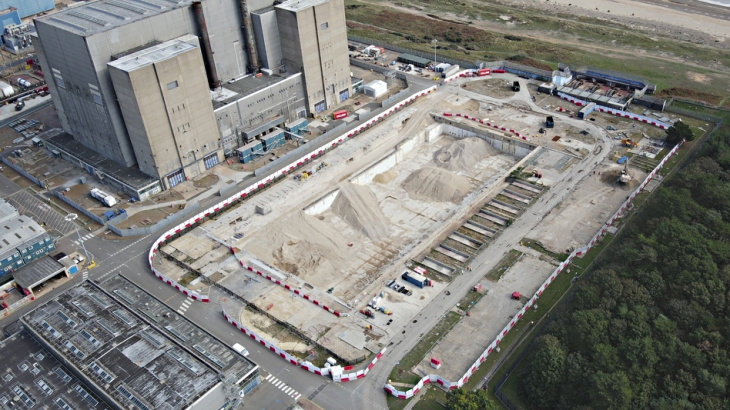
The demolition of the turbine hall and adjoining structures at Sizewell A was completed in June by UK Nuclear Decommissioning Authority subsidiary Nuclear Restoration Services (NRS). The football-pitch-sized turbine hall was razed to the ground using a series of "innovative and forward-thinking techniques" which meant the completed work was achieved in a significantly quicker timeframe than if traditional decommissioning and dismantling approaches had been followed, the company said. Up to 700 kgs of explosives were used last November to weaken the four reinforced concrete plinths on which two 65-tonne turbogenerators stood.
More than 17,000 tonnes of concrete and rubble were removed from the turbine hall, fire station and electrical annexe structures at Sizewell A. This waste has been crushed, processed and reused for ongoing construction projects. About 35 miles of cable have also been removed. A scrap metal contract has raised income from the sale of the 11,000 tonnes removed during the de-plant and demolition phases. This revenue will be used to offset decommissioning costs.
Under an innovative circular economy agreement between NRS and Sizewell C, more than 15,000 tonnes of the crushed concrete from the turbine alternator plinths will be reused at Sizewell C.
Since September, Sizewell A has been carrying out the crushing, testing, and certification of the concrete to ensure it meets the WRAP (Waste and Resources Action Programme) Quality Protocol. Once certified, all the material has now been transported to Sizewell C's main construction area as recycled aggregate. The recycled concrete is planned to be used in the sub-bases for various foundation platforms at the new plant.
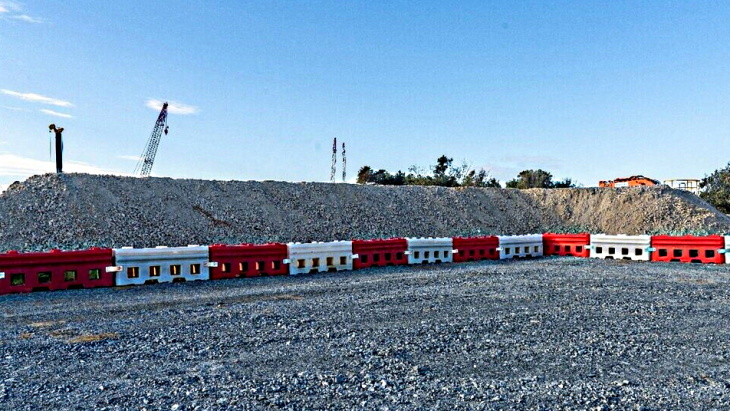
The reusable aggregate pile at Sizewell C (Image: NRS)
"This landmark collaboration significantly reduces shared costs and carbon emissions, and the need for newly mined aggregates," NRS said.
"This is another example of how Sizewell C is working with local projects to maximise benefits, not just for us, but for the local community," said Damian Leydon, Site Delivery Director, Sizewell C. "By reusing this material, we're reducing the number of trucks transporting aggregate through East Suffolk, while further reaffirming our commitment of minimising our environmental impact during construction. This is great news all round."
Wendy Heath, NRS Senior Project Manager at Sizewell, added: "This innovative approach has prevented 28 tonnes of CO₂ emissions by diverting waste from landfill, completing the circular economy for this material. This marks a first-of-its-kind achievement for NRS and showcases how collaborative working is enabling sustainable decommissioning. By reducing waste and minimising traffic on local roads, we're actively supporting the future of clean energy. It's a clear demonstration of NRS values in action - placing safety, sustainability, and community impact at the heart of everything we do."
Sizewell A's two 210 MWe Magnox gas-cooled reactors operated from 1966 until 2006. Defuelling began in 2009, with fuel removed from the reactors placed in the site's used fuel storage ponds before being packaged in transport containers for shipment to the Sellafield complex for reprocessing. The final flask of fuel was shipped to Sellafield in August 2014. Sizewell A was declared completely fuel-free in February 2015. The decommissioning milestone marked the removal of 99% of the radioactive hazard from the former Magnox nuclear power station. Planning consent was given to demolish the turbine hall and electrical annexe in August last year. The empty land that now lies where the flattened turbine hall once stood will eventually be restored and released for re-use. The whole site Sizewell A site is expected to be completely cleared by 2077.
The Sizewell C plant will feature two EPR reactors producing 3.2 GW of electricity, enough to power the equivalent of around six million homes for at least 60 years. It would be a similar design to the two-unit plant being built at Hinkley Point C in Somerset, with the aim of building it more quickly and at lower cost as a result of the experience gained from what is the first new nuclear construction project in the UK for about three decades. A final investment decision for the Sizewell C project was taken in July this year.
Brazil aims to start construction of Centena repository in 2026
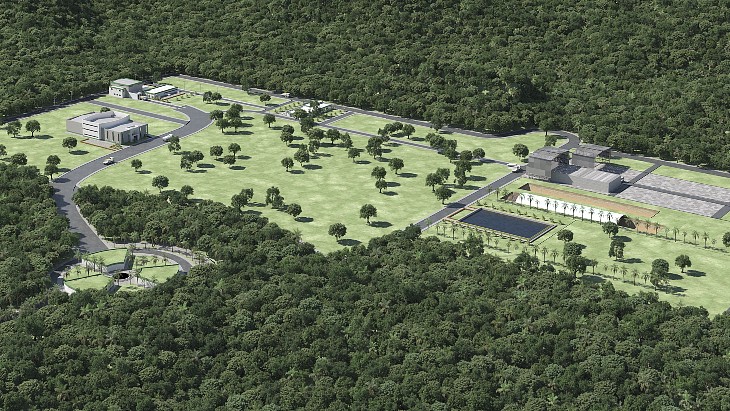
The Centena (Centro Tecnológico Nuclear e Ambiental) Project says it will be the first radioactive waste repository in Latin America. It will be a permanent storage solution for low- and medium-level radioactive waste material with a radioactive half-life limited to 30 years - as well as housing a technology centre for studies related to radioactive waste management.
In its 'clarification response' to reports suggesting Angra 1 and 2 might have to shut in 2030 if there is no new waste storage, the National Nuclear Energy Commission (CNEN) said progress was being made following the selection of a preferred site.
"The next step is the completion of the studies characterising the geophysical parameters, necessary for both nuclear and environmental licensing. CNEN has already hired a consultancy that is evaluating the documentation and the project itself, with construction expected to begin in 2026 and be completed in 2030. In other words, if the project starts in 2026, the repository could be completed in 2030, compatible with the 2031/2032 deadline for the storage capacity of the current repositories at the Angra dos Reis Nuclear Power Plant," the commission statement said.
It added: "If there are any delays in the construction and, consequently, in the completion of Centena, Eletronuclear is working with two possibilities. The first would be the reorganisation of the current storage facilities, which does not require a new environmental licensing process. There is also the possibility of constructing another waste storage facility, which would require a new licensing process, both nuclear and environmental."
"Financing of the construction and removal of the waste to this final repository ... will be provided by the Decommissioning Fund of the Angra 1 and Angra 2 plants, which was also established for this purpose.”
CNEN says the repository facilities in the southeast of the country, will cost approximately BRL130 million (USD24.2 million). It says that the existence of such a repository is a requirement for the environmental licensing process for the Angra 3 nuclear power unit, as well as that for the Brazilian Multipurpose Reactor.
At the moment Brazil stores low- and intermediate-level radioactive waste at facilities by its existing nuclear power plants or in intermediate repositories. It says that the Centena project "brings a national solution for the safe storage of radioactive waste generated by the use of radioisotopes and nuclear energy in Brazil".
Brazil currently has two operating power reactors - Angra 1 and Angra 2 - which generate about 3% of the country’s electricity. Work on the Angra 3 project - to feature a Siemens/KWU 1405 MW pressurised water reactor - began in 1984 but was suspended two years later, before construction began. The scheme was resurrected in 2006, with first concrete in 2010. However, amid a corruption probe into government contracts, construction of the unit was halted for a second time in 2015, when it was 65% complete. It has since restarted and been halted again, with a decision currently awaited on completing it.
The aim is for construction on the Brazilian Multipurpose Reactor to begin in 2026 and to be completed in 2030 with operations scheduled to begin in 2031. It descibes it as a priority for the country's nuclear sector.
Valar Atomics project achieves early criticality milestone
The company said its NOVA Core achieved zero-power criticality at LANL's National Criticality Experiments Research Center on 17 November.
_91849.jpg)
Valar said it is collaborating with Los Alamos National Laboratory's (LANL) National Criticality Experiments Research Center in Project NOVA (Nuclear Observations of Valar Atomics). The project is a series of criticality experiments on Valar's graphite-moderated core using high-assay low-enriched uranium (HALEU) TRISO fuel, carried out under the oversight of the Department of Energy National Nuclear Security Administration. The NOVA Core builds on LANL's 2024 Deimos experiment, which was the first criticality experiment using HALEU fuel to be carried out in the USA in more than 20 years.
Valar, a startup launched in 2023, plans to build nuclear "gigasites" with "clusters of thousands of high-temperature reactors designed to supply the energy, industrial heat, and carbon-neutral fuels that modern industry and AI infrastructure demand". It says its TRISO (tri-structural isotropic) fuelled, helium-cooled cooled and graphite-moderated reactors are "inherently safe and capable of operating at much higher temperatures than conventional plants".
The company was announced earlier this year as one of the initial selectees under the US Department of Energy's Nuclear Reactor Pilot Program, which aims to see at least three of them achieve criticality before 4 July 2026. In September, the company broke ground at Utah San Rafael Energy Lab (USREL), a unit within the Utah Office of Energy Development, for its first test reactor, called Ward250, and has completed a non-nuclear prototype called Ward Zero. It has also been selected by the department alongside Terrestrial Energy, TRISO-X and Oklo for a pilot programme to build advanced nuclear fuel lines.
Zero-power - or "cold" - criticality is a self-sustaining chain reaction of uranium-235 within a nuclear core, but without reaching full operating temperatures or actively removing heat with a working fluid, Valar explained. Zero-power criticality allows Valar to gain a greater understanding of the neutronic characteristics of the core and verify assumptions about fuel, moderators, active reactivity control and burnable poisons.
NOVA Core's configuration models the Ward250 core, which the company says is scheduled to begin power operations next year. NOVA uses the same fuel, moderator and reactivity-control scheme as Ward250, enabling LANL researchers to collect high-fidelity neutronics data and validate Valar Atomics' physics models ahead of Ward250 power operations.
Valar Atomics Founder and CEO Isaiah Taylor described the cold criticality milestone as the dawn of a new era in US nuclear engineering. "Zero power criticality is a reactor’s first heartbeat, proof the physics holds,” he said. "I’m incredibly proud of the Valar team that took this from blueprint to splitting the atom, securing the first criticality ever achieved by a venture-backed company. We extend our gratitude to the phenomenally talented team at Los Alamos and especially NCERC for their close partnership on Project NOVA."
INL begins irradiation testing of Lightbridge fuel samples
Samples of enriched uranium-zirconium alloy fuel material are being irradiated in the lab's Advanced Test Reactor, a significant step forward in the development and testing programme which is part of a Cooperative Research and Development Agreement between Lightbridge and INL.
_94675.jpg)
The irradiation testing campaign is designed to collect key material performance data for the Lightbridge fuel design, Lightbridge said. The start of irradiation follows the successful fabrication and loading of enriched uranium-zirconium coupon samples into an experiment assembly earlier this year.
Irradiation testing involves exposing materials to intense irradiation conditions, to study the effects of those conditions on reactor materials and fuels. The Advanced Test Reactor (ATR) at Idaho National Laboratory is a one-of-a-kind pressurised water test reactor which operates at very low pressures and temperatures compared to a large commercial nuclear power plant, and produces neutrons - rather than heat - as its main output. It is the only US research reactor capable of providing large-volume, high-flux thermal neutron irradiation in a prototype environment.
The irradiation testing campaign is expected to provide essential data on the fuel alloy's microstructural evolution, thermal conductivity properties, and other data as a function of burnup that are critical to the qualification and licensing of Lightbridge Fuel for future commercial use.
Some irradiated samples will be removed at various burnup levels during the testing campaign, to undergo post-irradiation examination at INL to assess the fuel alloy's performance. This will support further design qualification for licensing report submissions.
Jess Gehin, Associate Laboratory Director for Nuclear Science & Technology at INL, said the start of irradiation testing of the samples represents a major achievement for both INL and Lightbridge. "The ATR provides a world-class platform for evaluating advanced nuclear materials under realistic conditions, and we look forward to analysing the results of this important experiment," Gehin said.
"The start of capsule irradiation testing marks a pivotal step in demonstrating the performance of Lightbridge Fuel," Lightbridge Vice President of Engineering Scott Holcombe said. "The data generated in this phase will help us validate some key thermo-mechanical properties of our fuel alloy and how these properties vary with irradiation, moving us closer toward commercial deployment of Lightbridge Fuel in existing and new water-cooled reactors."
Lightbridge Fuel is described by the company as a proprietary next-generation nuclear fuel technology for existing light-water reactors and pressurised heavy-water reactors which it says significantly enhances reactor safety, economics, and proliferation resistance. It is also developing Lightbridge Fuel for new small modular reactors.

No comments:
Post a Comment