Organised crime has steadily gained ground across Africa since 2019, while efforts to combat it have weakened, according to the 2025 Africa Organised Crime Index. The new analysis found that corruption, disregard for law and lack of accountability are helping criminal networks to proliferate in several regions across the continent.
PRIMITIVE ACCUMULATION OF CAPITAL
Issued on: 23/11/2025 - RFI
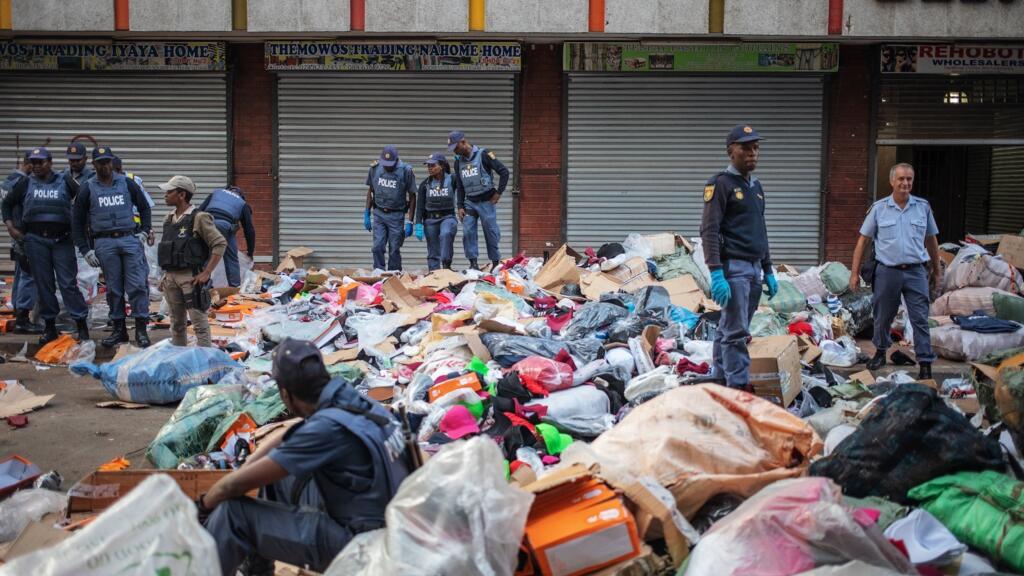
South African police officers seize sacks of allegedly counterfeit goods in central Johannesburg on 7 August 2019. Trade in counterfeit goods is one of the fastest-growing criminal markets across Africa, according to new analysis. © Michele Spatari / AFP
By:Zeenat Hansrod
Africa has become deeply embedded in the global criminal economy, serving as a source, transit hub and destination for various illicit markets – often in overlapping roles.
The 2025 Africa Organised Crime Index – released this week by Enact (Enhancing Africa's Response to Transnational Organised Crime), an EU-funded project that analyses transnational organised crime in Africa – indicates that criminality has increased steadily since 2019, while resilience to crime has declined.
Based on experts' assessment of the scale of criminal markets, influence of criminal actors and effectiveness of resilience, the country with the highest overall criminality ranking is the Democratic Republic of Congo, followed by South Africa, Nigeria, Kenya and Libya.
The index identifies the most pervasive criminal activities as financial crimes, human trafficking, non-renewable resource crimes, the trade in counterfeit goods and arms trafficking.
“What is the motivation and driver behind organised crime? It’s money, big money and quick money for these gangs and these syndicates in order to move forward,” said Willem Els, senior training coordinator for the Enact project at the Institute for Security Studies (ISS).
“One of the target areas for that, especially in Africa, is counterfeit goods.”
By:Zeenat Hansrod
Africa has become deeply embedded in the global criminal economy, serving as a source, transit hub and destination for various illicit markets – often in overlapping roles.
The 2025 Africa Organised Crime Index – released this week by Enact (Enhancing Africa's Response to Transnational Organised Crime), an EU-funded project that analyses transnational organised crime in Africa – indicates that criminality has increased steadily since 2019, while resilience to crime has declined.
Based on experts' assessment of the scale of criminal markets, influence of criminal actors and effectiveness of resilience, the country with the highest overall criminality ranking is the Democratic Republic of Congo, followed by South Africa, Nigeria, Kenya and Libya.
The index identifies the most pervasive criminal activities as financial crimes, human trafficking, non-renewable resource crimes, the trade in counterfeit goods and arms trafficking.
“What is the motivation and driver behind organised crime? It’s money, big money and quick money for these gangs and these syndicates in order to move forward,” said Willem Els, senior training coordinator for the Enact project at the Institute for Security Studies (ISS).
“One of the target areas for that, especially in Africa, is counterfeit goods.”
Cancer of corruption
The counterfeit trade and financial crimes are the two fastest growing sectors, the report says, a pattern that matches international trends.
Els added that counterfeit goods find a way into African countries because of misconduct that makes borders “porous”.
“It is not because the borders are not patrolled or fenced or well manned,” he explained. “The main reason for porous borders is corruption. State-embedded actors are compromised by these gangs in order to facilitate the transfer of illicit goods into the countries.”
According to the report, state-embedded actors, or corrupt government officials, have increased their influence and drive criminality in Africa.
“It goes from top to bottom. Corruption is like a cancer, once it starts to infiltrate, it just seems to snowball and snowball,” said Els.
“It starts, in many cases, with some of your most senior politicians down to custom officials. It trickles through police, national prosecution authorities, and in some cases, even the bench [judiciary].”
Financial hubs a target
Measures aimed at driving economic development and increasing trade between Africa and the rest of the world have also provided opportunities for criminal organisations.
“Organised crime syndicates thrive in financial hubs where they've got the opportunity and financial systems to operate,” Els told RFI.
“Three of the countries where criminality levels are very high are also financial hubs targeted by these gangs.
“Nigeria is the financial hub for West Africa. South Africa is the financial hub for Southern Africa. And Kenya is a financial giant for East Africa.”
Beyond these patterns, criminal markets show considerable diversity across the continent.
East Africa stands out for high human trafficking, arms trafficking and human smuggling. North Africa leads globally in cannabis trade and ranks second for financial crimes.
Non-renewable resource crimes dominate Central Africa, cocaine trade dominates West Africa, and wildlife trade is most prevalent in Southern Africa.
Consequences are key
Els insists that political will to enforce good governance is of vital importance in strengthening Africa’s capacity to push back organised crime.
“If you do not have political will and leadership, we are going to sit here in five years or 10 years' time and we are going to have the same discussion,” he said.
“It starts with good governance. It also starts with consequences.”
For Els, criminals must face the consequences of their crime whether they are in a gang, a government official, a white-collar criminal or in the private sector.
“That comes with effective policing and investigation, the legislation in place, effective prosecution in courts that are free from corruption,” he added.
“The bottom line, when it comes to fighting crime, is a country’s capacity to apply consequences when crimes are perpetrated.
“If they are not prosecuted, if they don’t face the music, then there will not be a change. It will just be business as usual.”
Els cited the example of the ongoing Madlanga Commission in South Africa, a judicial inquiry into whether criminal syndicates have infiltrated law enforcement and other parts of the criminal justice system, as well as whether senior officials may have aided illicit activity.
South African President Cyril Ramaphosa ordered the probe following allegations that the country's police minister had shielded allies with ties to the criminal underworld.

No comments:
Post a Comment