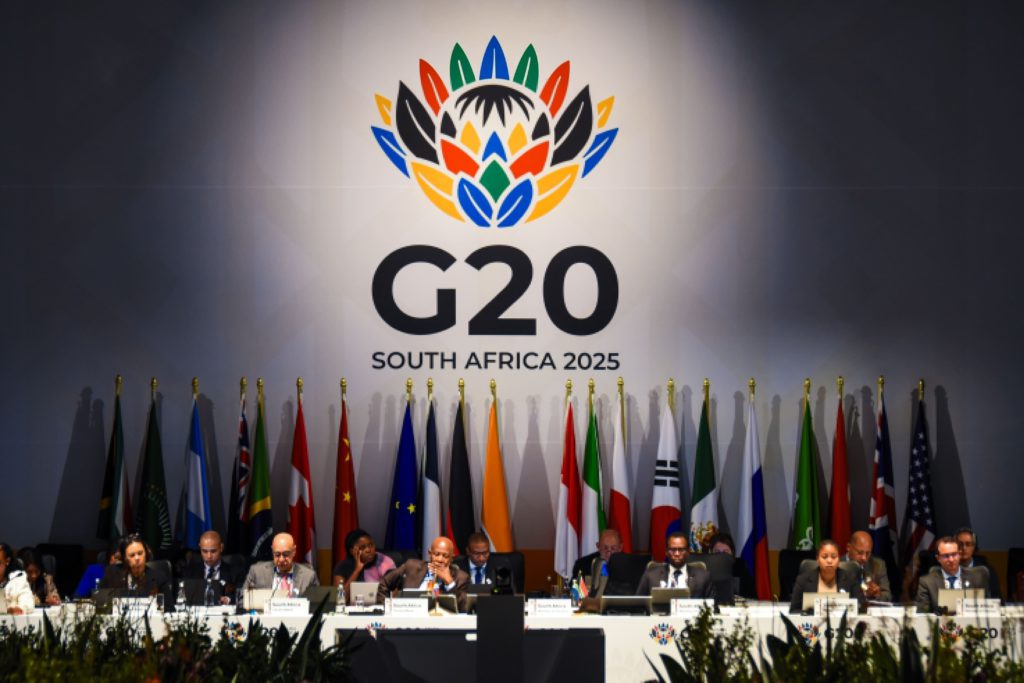
The G20 summit in Johannesburg closed on Sunday with South Africa claiming a diplomatic victory after securing agreement on a wide-ranging declaration – despite a boycott by the United States and warnings from several leaders that the forum is struggling to remain relevant in a fragmenting world.
Issued on: 23/11/2025 - RFI
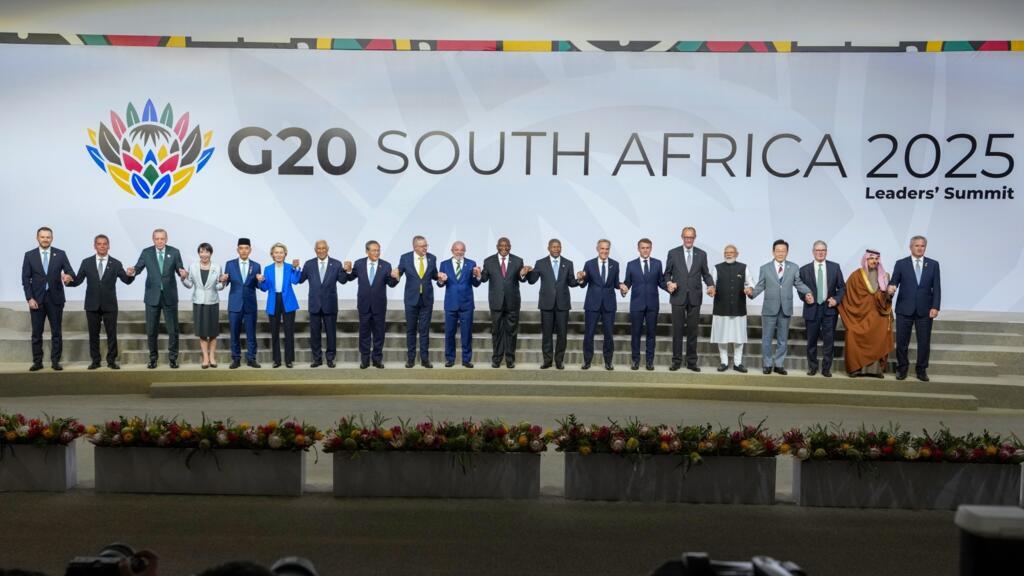
South Africa's President Cyril Ramaphosa said on Sunday that the Leaders' Declaration from this weekend's Group of 20 summit reflected a "renewed commitment to multilateral cooperation".
As host of the Johannesburg summit, Ramaphosa pushed through the declaration addressing global challenges like the climate crisis, despite opposition from the US.
Addressing the summit's closing ceremony on Sunday, Ramaphosa said the declaration showed that world leaders' "shared goals outweight our differences".
The Trump administration boycotted the event because of allegations – widely debunked – that South Africa's black majority government persecutes its white minority. It also said South Africa's priorities – inculding cooperation on trade and climate – ran counter to its policies.
In an unprecedented move, Pretoria released the 122-point declaration at the start of the two-day meeting on Saturday – a decision that broke with G20 protocol and annoyed Washington.
Diplomatic tensions overshadowed the final hours of the summit as South Africa refused to stage the traditional handover of the rotating presidency, scheduled to pass to the United States for 2026. President Donald Trump plans to hold the summit at a Florida golf club he owns.
What was agreed?
The declaration called for more global attention on issues that specifically affect poor countries, such as the need for financial help to recover from climate-related disasters, debt relief and support for the transition to greener energy sources.
Leaders representing 19 countries, the EU and the African Union called for climate-related funding to increase “from billions to trillions globally”, echoing commitments made as Cop30 concluded in Brazil.
The text also emphasises the “imperative” of tackling global disparities in wealth and access to development, though it stops short of endorsing the international panel on inequality championed by South Africa.
On energy transition and resources, the declaration urged efforts to secure supply chains for critical minerals amid intensifying geopolitical tensions.
Regarding security, it said the organisation will work for a comprehensive and lasting peace in Sudan, the Democratic Republic of Congo, the occupied Palestinian territory and Ukraine.
The summit marked an important moment for African nations, more than 20 of which attended as guests.
Germany announced new investments through the pan-African insurer ATIDI, while the Compact with Africa programme – launched at the G20 in 2017 – received fresh commitments. The United Arab Emirates pledged US$1 billion to expand artificial intelligence infrastructure across Africa.
"South Africa has used this presidency to place the priorities of Africa and the Global South firmly at the heart of the G20 agenda," Ramaphosa said.
G20 outcomes are not binding so it's not clear whether the declaration will translate into concrete action.
Several of South Africa’s ambitions – including stronger language on taxing billionaires – were watered-down.
Geopolitical crises
The summit came at a time of heightened tensions between world powers over Russia's war in Ukraine, and fraught climate negotiations at Cop30 in Brazil.
The declaration made just one reference to Ukraine, calling for a “just, comprehensive and lasting peace” based on the UN Charter, despite gathering the vast majority of the world's leaders.
"Meeting for the first time on the African continent marks an important milestone," said French President Emmanuel Macron, but added the G20 bloc was "struggling to have a common standard on geopolitical crises” and "may be coming to the end of a cycle".
British Prime Minister Keir Starmer agreed, saying: “There’s no doubt, the road ahead is tough.”
China’s premier, Li Qiang – filling in for President Xi Jinping – said “unilateralism and protectionism are rampant”, and warned of mounting pressure on global solidarity.
Still, some praised the summit as a significant symbolic moment for the G20, which is actually a group of 21 members formed in 1999 as a bridge between rich and poor nations to confront global financial crises.
“This is the first ever meeting of world leaders in history where the inequality emergency was put at the centre of the agenda,” said Max Lawson of Oxfam – the international charity working to alleviate global poverty.
(with newswires)
G20 leaders meeting in South Africa on Sunday hailed the virtues of multilateral cooperation even as they grappled with a splintering world order plagued by growing political rivalries and US disengagement. The final day of the weekend summit attended by leaders from the world's major economies began with talks on G20's future in a fragmented world.
Issued on: 23/11/2025 -
By: FRANCE 24
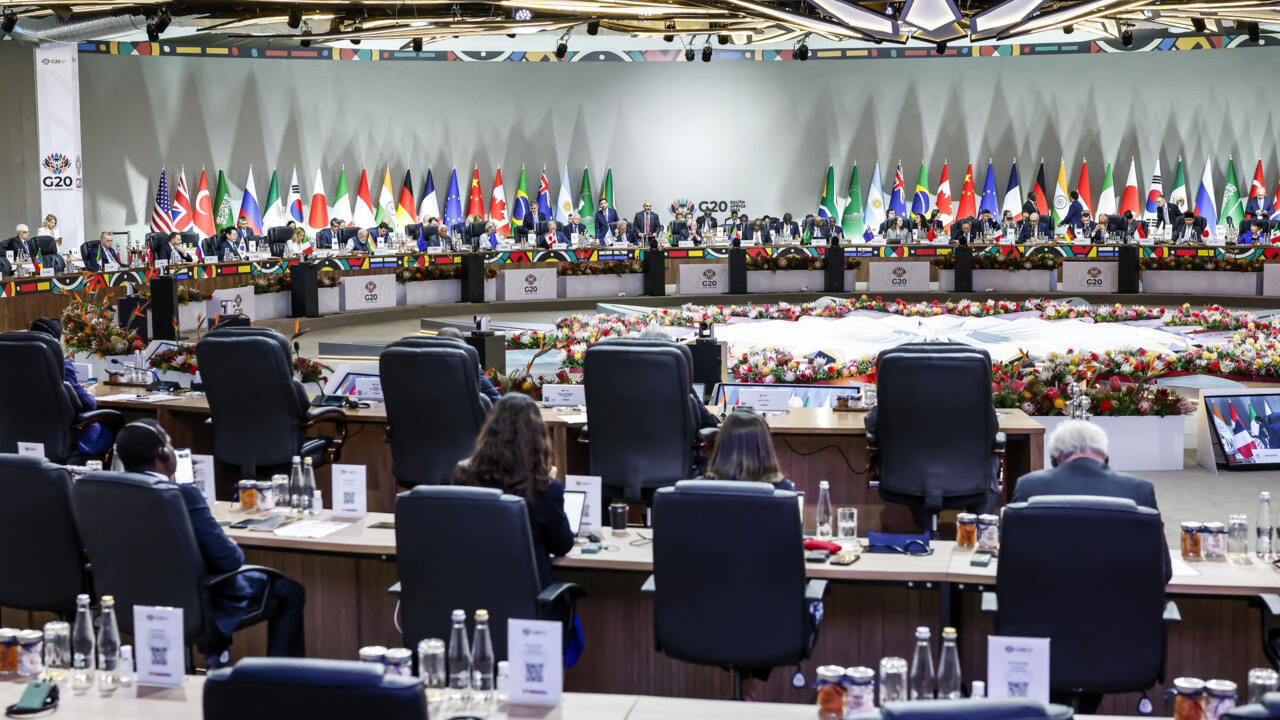
G20 leaders gathered Sunday in South Africa hailed multilateralism – even as they struggled to adapt to a changing world order beset by go-it-alone US policies, wars and deepening geopolitical rivalries.
The final day of their weekend summit – boycotted by the United States – kicked off with a searching discussion on how the G20 can survive in a fragmenting world.
"We are not experiencing a transition, but a rupture," acknowledged Canadian Prime Minister Mark Carney to journalists just before the summit session.
"Too many countries are retreating into geopolitical blocs or the battlegrounds of protectionism," he said, but added: "In every rupture resides the responsibility to build – nostalgia is not a strategy."
 'Nostalgia is not a strategy,' Canadian Prime Minister Mark Carney said. © Marco Longari, Pool, AFP
Dozens of leaders from key economies around the world – including Europe, China, India, Japan, Turkey, Brazil and Australia – attended the summit, the first to be held in Africa.
US President Donald Trump's government snubbed the event, saying South Africa's priorities – including cooperation on trade and climate – ran counter to its policies.
The United States is retreating from multilateral forums as it stokes trade volatility with sweeping tariffs and reverses commitments to fight global warming.
Trump's officials have also made unfounded accusations of a "white genocide" in South Africa.
'Fragmentation'
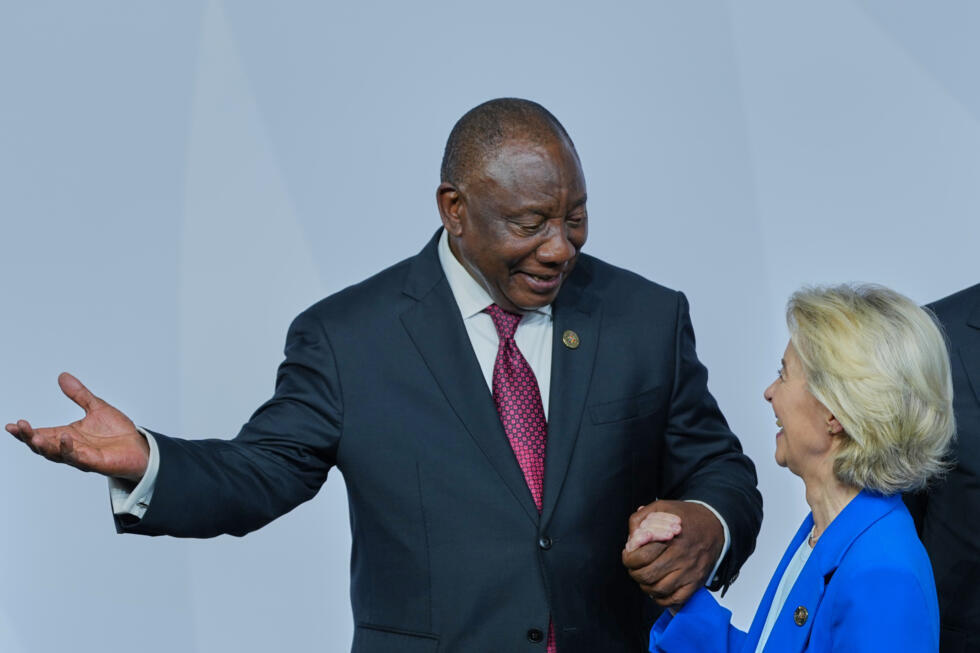
In a joint G20 statement issued Saturday, the leaders present said they were meeting "against the backdrop of rising geopolitical and geo-economic competition and instability, heightened conflicts and wars, deepening inequality, increasing global economic uncertainty and fragmentation".
South African President Cyril Ramaphosa admitted "challenges", but said: "The G20 underscores the value of the relevance of multilateralism."
The leaders' declaration was issued despite Washington objecting to the summit making any statement in the name of the G20.
The UK-based Oxfam charity said "South Africa has set an example to the world in ensuring the G20 stood firm and collectively agreed on a leader’s declaration – defending multilateralism – despite powerful opposition".
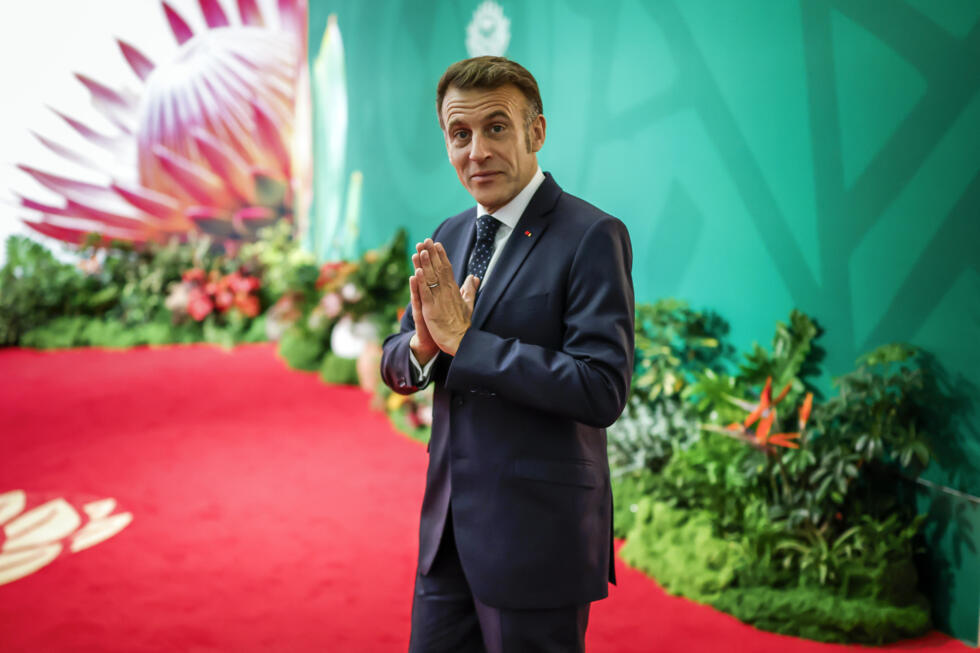
Nevertheless, French President Emmanuel Macron on Saturday said that "the G20 may be coming to the end of a cycle".
It needs to refocus its priorities on strategic economic issues going forward, he said, noting "difficulties" in the G20 finding common approaches to armed conflicts around the world.
That somewhat reflected a US intention to limit G20 discussions to just macroeconomic topics as it takes on hosting duties next year – when Trump plans to hold the summit at a Florida golf club he owns.
'Lifeline' to multilateralism
The G20 – comprising 19 nations plus the European Union and the African Union – was founded in the wake of the 1997-1998 Asian financial crisis as a forum to boost global economic and financial stability.
Over time, its discussions have broadened to also cover climate change, sustainable development, global health and conflicts.
While those areas have economic implications, they are also political – often resulting in impasses or omissions in drafting summit declarations.
Divisions have only widened over Russia's war in Ukraine and the Israel-Hamas conflict in Gaza.
Carney – whose country this year holds the G7 presidency, to be taken up by France next year – also said that "the centre of gravity in the global economy is shifting", implying that the G20 needed to take greater note of emerging economies and the global South.
"Bringing emerging powers and developing countries was like creating a whole new world into the G20 and that actually helped to neutralise the Trump absence," he said.
"This summit has actually thrown a lifeline to multilateralism, breathing new life into it," he said.
(FRANCE 24 with AFP)
ByAFP
November 22, 2025

South Africa's G20 summit endorsed a declaration the touched on issues of access to critical minerals and measures to cope with climate change - Copyright AFP EMMANUEL CROSET
Julie BOURDIN
Leaders from the G20 group of top economies endorsed Saturday a declaration at a summit in South Africa that highlights issues related to access to critical minerals and measures to cope with climate change.
South Africa chose “Solidarity, Equality, Sustainability” as the theme of its presidency of the G20, which comprises 19 countries and two regional bodies, the European Union and the African Union and accounts for 85 percent of global GDP.
Here are some highlights from the declaration from the first G20 summit on the African continent which was boycotted by the United States.
– Critical minerals –
Leaders said they would seek to protect the global value chain of critical minerals from “disruption”, whether due to geopolitical tensions, unilateral trade measures inconsistent with World Trade Organization (WTO) rules, pandemics, or natural disasters.
Many countries are intensifying efforts to secure access to these minerals, which are abundant in African and essential to the transition to green energy, used in electronics from phones to solar panels and electric cars.
China’s dominance of critical mineral supply chains has emerged as growing area of concern for the world’s industrialised democracies.
The declaration also supported “increased exploration of critical minerals, particularly in developing countries” for which they said the resource should be a driver of development and value-addition “rather than just raw material exports”.
– Just, lasting peace –
The declaration addressed major global conflicts underway by calling for a “just, comprehensive, and lasting peace” in Ukraine, Sudan, the Democratic Republic of Congo and the “Occupied Palestinian Territory” on the basis of the UN Charter.
It called on countries to “refrain from the threat or use of force … against the territorial integrity and sovereignty or political independence of any state”.
While Ukraine was only mentioned once in the 30-page document, Western leaders attending the summit also scrambled on the sidelines to respond to a unilateral plan pushed by US President Donald Trump to end the war in Ukraine on terms favouring Russia.
– Inequality –
South Africa placed the fight against inequality as one its main G20 priorities, with President Cyril Ramaphosa commissioning an expert report on the problem and supporting a call to establish an international panel on wealth disparities.
While the declaration did not specifically mention the report’s recommendation, it underlined the “imperative” to address “disparities in wealth and development both within and between countries”.
The leaders also called for efforts to reform international financial systems to help low-income countries cope with their debt, which was hindering development and eating into investments into infrastructure, disaster resilience, healthcare and education.
They called for more transparency from lenders, including in the private sector, and backed a review of the International Monetary Fund as well as work to establish global minimum taxes.
The declaration’s language on taxation of the super-rich was less robust than in the previous G20 declaration in Rio de Janeiro where leaders agreed to ensure the world’s billionaires “are effectively taxed”.
– Climate –
Endorsed on the same day that the COP30 UN climate talks concluded in Brazil, the declaration recognised the need to “rapidly and substantially” scale up climate finance “from billions to trillions globally from all sources”.
It highlighted inequalities in access to energy, particularly in Africa, and called for increasing, de-risking and diversifying investments for sustainable energy transitions.
The leaders said they would promote the development of early warning systems for people at risk of climate-linked disasters, recognising that some of those most impacted were from least developed countries.
The text, however, fell short of mentioning a phaseout from fossil fuels.
Africa G20 hosts bid to become mineral powerhouse
As global leaders land in Johannesburg for the first G20 summit on African soil, hundreds of climate protesters took to the streets to demand leaders give ordinary people more control over the continent’s coveted critical minerals.

Several mineral experts and African leaders agree with the protesters: the G20 global leaders summit is an opportunity to call for these minerals like lithium and cobalt to benefit the continent where they are found.
“It’s important to have a G20 that includes communities so proper conversations can be had about the development of Africa,” said Lazola Kati, campaign manager of Fossil Ad Ban, an initiative by climate group Fossil Free South Africa, on the sideline of the protest.
“We are so rich in resources. What this can look like is job creation, skills transfer… our own energy sector,” said Kati as protesters from Uganda to Zimbabwe sang and held up placards.
Africa is home to 30% of the world’s critical minerals needed for the transition away from fossil fuels to clean technology, as well as the digital infrastructure for AI data centres.
But for centuries Africa has endured what has become known as the “resource curse” – a paradox where abundant natural resources lead to conflict, corruption and slower economic growth.
The G20, which gathers leaders representing 80% of the world’s economy together, is being hosted in Africa for the first time. The African Union became a permanent member in 2023.
Policy experts believe that this gives African governments more leverage to call for global investment into local mineral processing to create jobs, as demand surges.
“Think of it this way: selling raw cobalt is like exporting flour when you could be exporting bread,” said Maxwell Gomera, United Nations Development Programme (UNDP) resident representative in South Africa during a speech at a Johannesburg event this month
“The world is in a new scramble for Africa’s minerals” he added. “We must make sure the new green order doesn’t become the old colonial order.”
Industrialization message
The continent needs to negotiate as a bloc to leverage its mineral bargaining power, said Deprose Muchena, program director at the Open Society Foundations (OSF), a human rights funding organization.
“The African Union is a member of the G20 now, which means even when South Africa is off the stage, the AU remains to continue the powerful industrialization message,” said Muchena.
The Africa Green Minerals Strategy, endorsed by the African Union in 2025, aims to promote mineral-related industrialization across the continent.
It outlines responsible mining practices, the needs for skills development and attracting investment for local mineral processing, or beneficiation.
More than a dozen African nations, including the Democratic Republic of Congo (DRC), Nigeria and Namibia, have restricted such exports intermittently, or banned them outright to promote beneficiation, according to World Bank research.
Zambia and the DRC are creating special economic zones to manufacture batteries using local minerals, the UN says.
One of the three main themes for the South African G20 summit is the future of critical minerals for Africans.
But the continent captures less than 5% of the value generated from energy technologies, according to The International Energy Agency, a global energy institution.
South African President Cyril Ramaphosa signed a critical minerals deal with the European Union on Thursday that he called “unprecedented”. He said South Africa intended to increase mineral processing to “move up the value chain”.
“Resources are finite”
But key political players will not be visiting South Africa for the G20, including US President Donald Trump and Chinese President Xi Jinping.
Both countries have key interests, capital and investments in global critical minerals.
“It is better when Trump and the like are not there,” said Kati from Fossil Free South Africa.
“This is the time where we can define development and investment, so when they come back we are ready with an African-defined program,” she said.
But mining is only one element of Africa’s development, said OSF’s Muchena.
Despite the G20 emphasis placed on critical minerals, it is important to remember that mining has a limited time span, he said.
“We know resources are finite and at some point the demand for critical minerals will go down due to potential technologies that could replace the need for these resources, the same way diamonds are being replaced by synthetics,” he said.
The financial benefit of these resources had to be used wisely during the mines’ lifespans.
Muchena estimates that between 2023 and 2024, Africa exported close to $250 billion worth of revenue from its critical minerals, with $1.6 trillion expected in the next 25 years.
“If these are the numbers, they should be finding their way back into the communities to transform them, to provide energy directly,” he said, referencing the 600 million Africans without reliable electricity.
At the mineral protest, Congolese bishop and activist Raphael Bahebwa from the Congolese Solidarity Campaign took the microphone to speak about mining abuses in his home country, where roughly 70% of the world’s cobalt is found.
“Everyone carrying a cellphone is carrying the blood of our people,” said Bahebwa, referring to the exploitative mining practices behind the cobalt found in most cellphones.
“When mining companies come with their contracts, the people must be honoured on their land so that they can benefit as well,” he said.
(By Kim Harrisberg; Editing by Jack Graham and Jon Hemming)
G-20 Tries to Box In Critical Mineral Disruption
By Julianne Geiger - Nov 21, 2025
The G-20 is tiptoeing around China with a sledgehammer. In a draft declaration seen by Bloomberg, leaders called for shielding the global critical-minerals value chain from “unilateral trade measures inconsistent with WTO rules”—a diplomatic way of saying: everyone noticed what China did this year. Beijing’s licensing chokehold on dysprosium, terbium, and other heavy rare earths rattled supply chains from missile makers to EV plants, and the repercussions are still rolling through the system.
Over the past six months, the U.S. and its allies have sprinted to stitch together mine-to-magnet supply chains outside Chinese control. Washington is taking minority stakes in North American rare-earth firms; MP Materials and Aclara are racing to commission heavy-rare-earth separation lines by 2026-2028; and Europe is now openly funding magnet plants to avoid being caught flat-footed again. Even so, the math is bleak—China refines over 90% of global rare earths and produces 94% of the permanent magnets that make missiles maneuver, turbines spin, and EVs accelerate without melting down.
That dominance is exactly what made China’s export curbs so effective. Earlier this year, U.S. defense contractors warned they were burning through “safety stock” of germanium, gallium, and heavy rare earths, with some inputs inflating five or sixty times in price. One supplier flat-out admitted it would miss deliveries if the squeeze continued.
So when the G-20 talks about making mineral supply chains more “resilient,” that’s because Beijing recently reminded everyone how asymmetric the playing field really is.
The draft declaration is non-binding, voluntary, and diplomatic to a fault. It will not unwind Chinese dominance. But it does show how much the strategic conversation has shifted. Critical minerals—once a niche topic for mining conferences—now sit next to Ukraine, Middle East conflicts, and global trade fights on the world’s main stage.
The G-20 isn’t calling China out by name, but everyone already knows who holds the cards—and who’s scrambling to redraw the deck.
By Julianne Geiger for Oilprice.com

No comments:
Post a Comment