White House releases names of board members tasked with temporary governance of Gaza
The White House has released the names of some of members of various boards who will play a role in guiding Gaza through the next steps of the ceasefire deal between Hamas and Israel, brokered by Trump in October.
The White House released the names of some of the leaders who will play a part in overseeing the next steps in Gaza after the Palestinian committee set to govern the enclave under US supervision met for the first time in Cairo on Friday.
The committee’s leader, Ali Shaath, an engineer and former Palestinian Authority official from Gaza, pledged to get to work quickly to improve living conditions for the territory’s 2.1 million population.
“The Palestinian people were looking forward to this committee, its establishment and its work to rescue them,” Shaath said after the meeting, in a television interview on Egyptian media outlets.
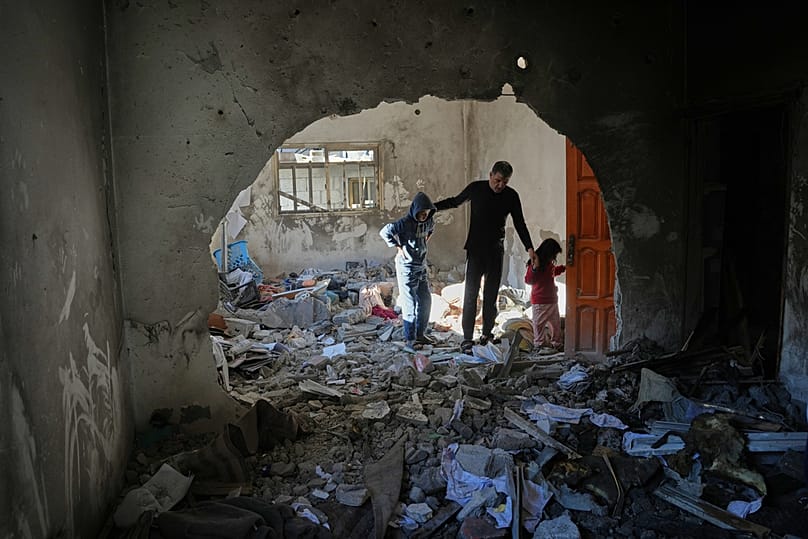
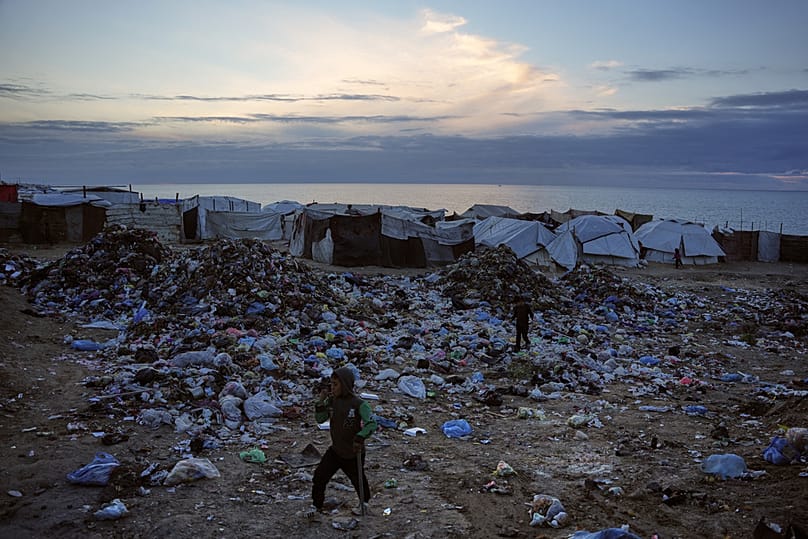
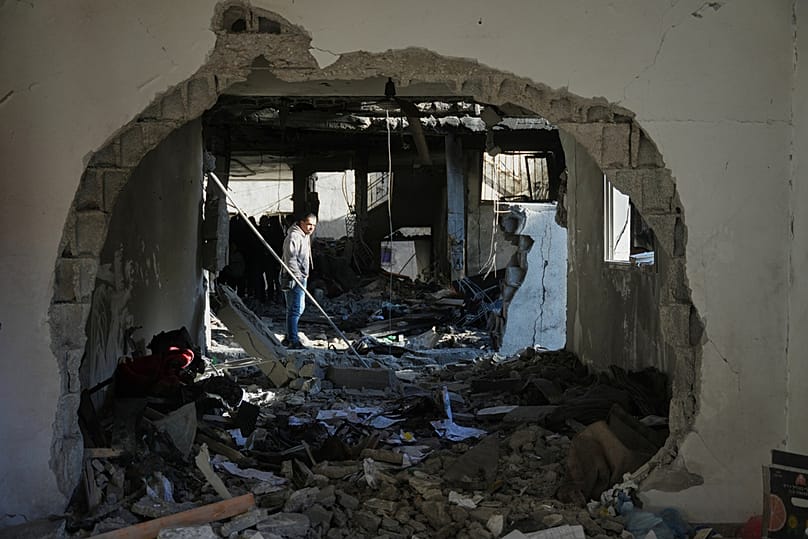
US President Donald Trump supports the group's efforts to govern Gaza after the two-year war between Israel and Hamas. Israeli troops withdrew from parts of Gaza after the ceasefire took effect on 10 October, while thousands of displaced Palestinians have returned to what is left of their homes.
A number of huge challenges still await in the next phase of the truce, including the deployment of an international security force to supervise the ceasefire deal and the difficult process of disarming Hamas.
Under Trump's plan, Shaath's technocratic committee will run day-to-day affairs in Gaza under the oversight of a Trump-led “Board of Peace,” whose members have not yet been named.
The White House said on Friday that an executive board will work to carry out the vision of the Board of Peace.
The executive board’s members include US Secretary of State Marco Rubio, Trump envoy Steve Witkoff, Trump's son-in-law Jared Kushner, former British Prime Minister Tony Blair, Apollo Global Management CEO Marc Rowan, World Bank President Ajay Banga, and Trump’s deputy national security adviser Robert Gabriel.
Nickolay Mladenov, a former Bulgarian politician and United Nations Middle East envoy, is to serve as the executive board’s representative overseeing day-to-day matters.
The White House also announced the members of another board, the “Gaza Executive Board,” which will work with Mladenov, the technocratic committee and the international stabilisation force.
Witkoff, Kushner, Blair, Rowan and Mladenov will also sit on that board. Additional members include Turkish Foreign Minister Hakan Fidan, Qatari diplomat Ali Al-Thawadi and Director of Egypt’s General Intelligence Agency Hassan Rashad.
The board will also include Emirati minister Reem Al-Hashimy, Israeli entrepreneur Yakir Gabay and the Netherlands’ former deputy prime minister and a Middle East expert, Sigrid Kaag.
Washington has not yet announced direct roles each of the named people will play, or when they’re expected to commence, but noted that details will be released in the coming weeks.
Stalemate In Gaza – OpEd
January 17, 2026
President Donald Trump’s Gaza peace plan would appear to be stuck. Whatever covert preparations may be in hand to implement its later stages, the clock seems to have stopped.
The first stages of the 20-point “Comprehensive Plan to End the Gaza Conflict”, signed by Israel and Hamas in Sharm elSheikh on October 9, 2025, required an immediate ceasefire, the return of all the hostages both alive and dead, the transfer of Palestinian prisoners in exchange, and a substantial increase in the flow of humanitarian aid. Having released the live hostages, Hamas chose to eke out the return of the dead over a period of six weeks, and still holds on to the remains of Ran Gvili.
So the first stage has not been completed and Gaza is effectively trapped. A fragile ceasefire is in place, the IDF have withdrawn to the “yellow line,” there is increased humanitarian access – but all are subject to ongoing violations.
As for conditions in the Strip, most media reports suggest that, rather than advancing the peace process, the ceasefire has reduced Gaza’s significance on the world scene. It has changed little on the ground. Large parts of Gaza remain in ruins, hundreds of thousands of Palestinians are still displaced, and aid distribution is even more difficult because of new restrictions placed by Israel on some 37 humanitarian agencies that refuse to reveal whether their staff are connected to Hamas.
The 20point Trump plan was not originally issued as “three phases”. It was first presented essentially as a single 20point framework, and the text adopted as Annex 1 to UN Resolution 2803 is also structured as 20 numbered points. It was media and policy coverage that quickly reframed the 20point scheme into three phases:
Phase 1: immediate ceasefire, hostage–prisoner exchanges, frontline freeze, humanitarian surge.
Phase 2: demilitarization, destruction of Hamas’s offensive infrastructure, progressive Israeli withdrawal and deployment of the International Stabilization Force.
Phase 3: governance transition and reconstruction, including the Board of Peace and multiyear rebuilding of Gaza. Finally, “when the PA reform program is faithfully carried out, the conditions may finally be in place for a credible pathway to Palestinian self-determination and statehood.”
Any sort of progress is blocked by unfinished business from Phase One. The unresolved issue of hostage Ran Gvili’s missing body has become a precondition for any further Israeli withdrawals, for changes at the Rafah crossing, or for movement to the next stage. In practice, this traffic jam maintains the territorial “yellow line”– in other words, the continued presence of the IDF in eastern Gaza.
In any case implementation of Phase Two is beset with obstacles. It seems obvious that the bargaining positions of Hamas and Israel are mutually incompatible. Hamas has declared that any disarmament on its part is tied to the prior achievement of Palestinian statehood and a restoration of Palestinian control over Gaza. Israel rejects Hamas disarmament on that basis, or indeed any outcome that concedes Palestinian statehood under pressure.
Hamas’s position is, of course, quite at odds with the Trump plan which it has signed. That places the issue of Palestinian self-determination at point 19 of the 20-point plan, namely well after the total disarmament of Gaza in general and Hamas in particular. The result of Hamas’s intransigence is deadlock as regards further progress. Hamas will not voluntarily disarm and Israel cannot realistically force full disarmament without collapsing the ceasefire.
On the face of it the Trump peace plan is at an impasse. Despite reports of negotiations in hand, there is as yet no agreed path to the demilitarization, international force deployment, or new governance that would mark a genuine implementation of Phase Two.
Trump, however, is unlikely to sit idly by while Hamas plays fast and loose with a peace agreement it has signed. The president has repeatedly coupled the Gaza peace plan with threats that if Hamas does not comply, “all hell” or direct military action will follow. Trump’s Venezuela operation is no blueprint for what is likely in Gaza; US or allied operations against Hamas are not currently in prospect. The characteristic Trump ambiguity, however, is deliberate, and designed to coerce Hamas while keeping options open.
What is more relevant, perhaps is Trump’s warning as he unveiled the 20point plan. If Hamas rejected it, he said, “Israel would have the full backing of the US to proceed with any actions it sees fit.”
In subsequent posts and remarks, he repeatedly referred to his peace proposal as Hamas’s “one last chance” and warned that if agreement was not reached “all hell, like no one has ever seen before, will break out against Hamas.” In short, his consistent core message has been that refusal to comply with the plan and disarm will bring severe, potentially direct, force against Hamas.
Several forms of action are more plausible than a dramatic new USled offensive. The most credible is Trump’s repeated assurances that, if Hamas blocks key steps like disarmament or the transfer of authority, Israel will enjoy “full backing” to intensify targeted operations against remaining Hamas infrastructure and leadership. He has publicly pledged his “complete support” to Israel to “finish the job” and “do what you need to do” against Hamas.
An alternative scenario could involve incremental coercive measures applied to Hamas, short of invasion. These could include tighter financial and travel sanctions on Hamas leadership, increased pressure on Qatar and other mediators to curtail Hamas’s external operations, and further restrictions or conditioning of reconstruction money and crossings on verifiable disarmament steps.
Trump observers will be aware that the language about “all hell” functions as strategic ambiguity. Without any specified timelines or specific troop deployments (both of which would be resisted by allies and Congress), it is designed to convince Hamas that the US and its partners might ultimately enforce disarmament militarily.
Taken together, these factors suggest that Trump’s recent threats are best read as signaling, designed to push Hamas toward implementing its disarmament, ahead of a greenlight to the IDF to “finish the job” with Washington’s backing.
Hamas, well aware that world opinion would castigate the US and Israel if the Gaza war was resumed, might calculate its best course is to maintain the stalemate.
Neville Teller's latest book is ""Trump and the Holy Land: 2016-2020". He has written about the Middle East for more than 30 years, has published five books on the subject, and blogs at "A Mid-East Journal". Born in London and a graduate of Oxford University, he is also a long-time dramatist, writer and abridger for BBC radio and for the UK audiobook industry. He was made an MBE in the Queen's Birthday Honours, 2006 "for services to broadcasting and to drama."

No comments:
Post a Comment