“The government has used this power in the past to target people it views as political opponents,” said a law professor.
By Shireen Akram-Boshar ,
June 10, 2026
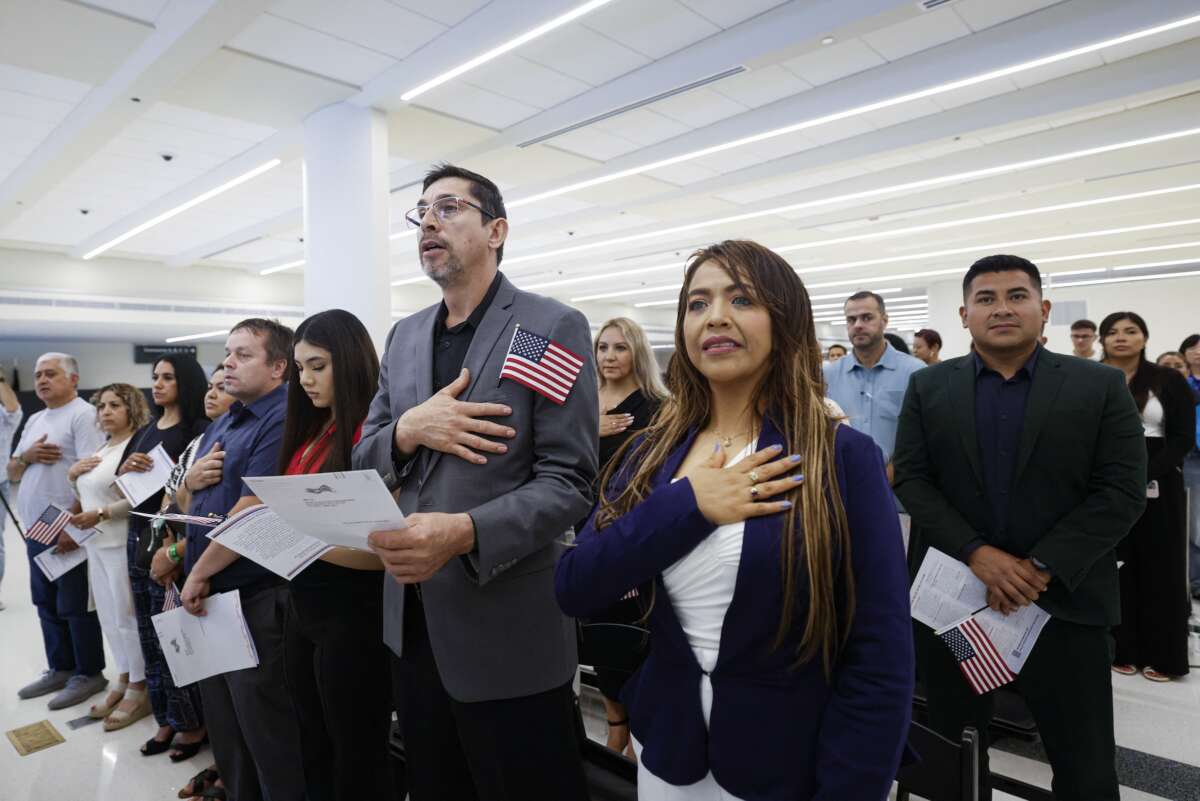
New US citizens stand for the national anthem before receiving their naturalization certificates during a formal ceremony in Chicago, Illinois, on June 25, 2025.Kamil Krzaczynski / AFP
Did you know that Truthout is a nonprofit and independently funded by readers like you? If you value what we do, please support our work with a donation.
On Monday, the Trump administration announced that it is seeking to strip the citizenship of 17 Americans born outside the U.S. in the largest denaturalization effort in decades.
The administration claims that the individuals committed serious crimes and failed to disclose them during the naturalization process. But this is only the latest maneuver in President Donald Trump’s attempt to ramp up denaturalization and target immigration, including legal immigration.
Of the 17 targeted individuals, 11 are from countries in Latin American and the Caribbean, three are from Asia, two from Africa, and one is European.
Last month, the administration announced that it would begin the process to denaturalize 12 other citizens.
Trump has moved to ramp up denaturalizations since his first term, and even more so in his second.
Did you know that Truthout is a nonprofit and independently funded by readers like you? If you value what we do, please support our work with a donation.
On Monday, the Trump administration announced that it is seeking to strip the citizenship of 17 Americans born outside the U.S. in the largest denaturalization effort in decades.
The administration claims that the individuals committed serious crimes and failed to disclose them during the naturalization process. But this is only the latest maneuver in President Donald Trump’s attempt to ramp up denaturalization and target immigration, including legal immigration.
Of the 17 targeted individuals, 11 are from countries in Latin American and the Caribbean, three are from Asia, two from Africa, and one is European.
Last month, the administration announced that it would begin the process to denaturalize 12 other citizens.
Trump has moved to ramp up denaturalizations since his first term, and even more so in his second.

Trump Administration Sets Goal to Denaturalize Thousands of US Citizens in 2026
Immigration officials have reportedly issued guidance setting a quota of 100 to 200 denaturalization cases a month. By Sharon Zhang , Truthout December 18, 2025
In December, the Trump administration directed U.S. Citizenship and Immigration Services (USCIS) to supply the Department of Justice with 100 to 200 denaturalization cases per month.
In April, the administration identified 384 Americans born outside the U.S. whose citizenship it wants to revoke. The administration also stated that it would use regular prosecutors in regional courts, rather than those within the Department of Justice’s Office of Immigration Litigation, to accelerate the pace of denaturalizations.
Denaturalization cases have been relatively rare since the 1990s. Between 1990 and 2017, the U.S. government filed an average of 11 denaturalization cases per year. The process is known to require a high bar of evidence.
Trump’s efforts appear to include an attempt to lower this bar. In one case during Trump’s first term, the Justice Department stripped the citizenship of a New Jersey man born in India after declaring that he had arrived in the U.S. without travel documents or proof of identity, and that he had used a different name.
In a more recent case, a U.S. citizen born in Mexico was denaturalized for drug dealing, and the case rested on whether or not he had begun selling drugs – largely marijuana – before or after his naturalization. The Department of Justice revoked his citizenship after concluding that he had started selling drugs the year before becoming a citizen, though his attorney insists this is false.
Amanda Frost, a law professor at the University of Virginia, told The New York Times in April that expanded denaturalization sends the message “that naturalized citizens don’t have the same rights and stability as native-born citizens.”
“The government has used this power in the past to target people it views as political opponents,” she warned.
Cassandra Robertson, a law professor at Case Western Reserve University, told NPR this month that the denaturalization efforts “are an attempt to suppress the political speech of naturalized citizens.”
“Although the cases that have been brought first are maybe people who’ve committed some pretty bad crimes, the government’s rhetoric is certainly not limited to that,” she said.
“Once it becomes easy to take somebody’s citizenship away,” she added, “it becomes easy to take anybody’s citizenship away.”
While the U.S. has denaturalized infrequently since the 1990s, the last widespread government effort to denaturalize U.S. citizens was during the McCarthy period. During the Red Scare of the 1940s and ‘50s, the U.S. government denaturalized thousands of foreign-born Americans accused of communist sympathies.
But in 1967, a Supreme Court ruling drastically limited denaturalization. Since then, it has largely been limited to whether or not an individual failed to disclose previous crimes or convictions in their naturalization process. But this, too, can be up to interpretation – as the naturalization application does not define what it considers to be a crime.
But even in the years before Trump, some cases of denaturalization were highly political. In the case of Rasmea Odeh, the Palestinian community activist was deported in 2017 after a years-long case. Odeh was arrested by the Department of Homeland Security in 2013 – under Obama’s administration – and charged with ‘unlawful procurement of naturalization’ for failing to mention her conviction and imprisonment by Israel, where she had been tortured and sexually assaulted.

No comments:
Post a Comment