
“Those who remain silent in the face of this growing unlawfulness and aggressiveness assume a grave responsibility,” said the head of the International Association of Democratic Lawyers.

People protest the internationally condemned US blockade of Cuba and the Trump administration's military threats against the socialist nation, in Brussels on February 7, 2026.
(Photo by Peter Mertens/X)
Brett Wilkins
Jun 10, 2026
COMMON DREAMS
An international group of leftist lawyers on Tuesday condemned the US blockade, sanctions, and war threats against Cuba, and the mounting repression of solidarity with the long-suffering Cuban people.
The International Association of Democratic Lawyers (IADL) held a virtual press conference “to condemn escalating United States measures against Cuba and to call for renewed international action in defense of international law, Cuban sovereignty, and the rights of the Cuban people.”
“The United States continues to threaten Cuba while imposing unilateral coercive economic measures designed to destabilize the country and facilitate regime change,” IADL noted. “In recent months, restrictions on fuel shipments have further intensified the hardships faced by the Cuban people, with severe consequences for daily life.”
“For more than three decades, the United Nations General Assembly has overwhelmingly called for an end to the US blockade of Cuba, with the United States and Israel consistently standing alone in opposition to the international consensus,” the group added. “While these annual resolutions represent a powerful condemnation of the blockade, symbolic measures alone are insufficient. International law imposes obligations on states to act in the face of ongoing violations.”
Speakers at the press conference warned that the Trump administration’s recent actions—including war threats and a deadly fuel blockade—are serious violations of international law that threaten the rights and well-being of millions of Cubans.
“The illegality of the blockade is not in doubt. What is at stake today is the impunity that allows it to continue,” IADL general secretary Micòl Savia said. “What is at stake is the complete disregard of the United States for international law and collective institutions and their contempt for the common values of humankind.”
“The actions of successive US administrations against Cuba make it very clear that they do not consider themselves bound by the principles of sovereign equality, peaceful coexistence, and self-determination that form the foundation of the international legal order,” she continued.
“Another dimension of the blockade and sanctions against Cuba is the pressure imposed on third countries,” Savia said. “The threat of punishment against institutions, banks, companies, and individuals that seek to establish commercial, financial, or diplomatic relations with Cuba is an intervention not only against Cuba, but also into the sovereign sphere of other countries.”
“This shows how broad and arbitrary the sanctions policy has become as a tool of coercion,” she added. “The threat of sanctions against companies from third countries that trade with Cuba violates their sovereignty.”
Speakers at the event excoriated the Trump administration’s escalating war threats and politically motivated indictment of former Cuban President Raúl Castro, a hero of his country’s successful revolution against a US-backed dictatorship.
“Cuba is now under the direct threat of [a] US imperialist war of aggression after a long period of economic and financial blockade,” said Filipino jurist Edwin De La Cruz of the Amistad Philippines-Cuba Friendship Association and National Union of People’s Lawyers.
“Serious transgressions on Cuba’s sovereignty, from failed efforts to foment unrest among the population, to the personal assault on the integrity of Comrade Raúl Castro by [President] Donald Trump intensified, with a threat of armed invasion tweeted by Donald Trump himself,” he continued.
“Cuba and the Philippines share a common history of US imperialist domination. We share a common enemy and a common struggle,” De La Cruz noted, pointing to the so-called Spanish-American War, in which the United States conquered both countries, along with Puerto Rico and Guam, from Spain under the false pretense of a Spanish attack on the battleship USS Maine. The US colonized the Philippines from 1898-1946, except for a brief period of Japanese occupation during World War II.
Deborah Jackson, president of the US group National Conference of Black Lawyers, called the Castro indictment “a transparently political prosecution that serves no legitimate law enforcement purpose.”
Castro—who served as Cuba’s president for a decade after his older brother, Fidel Castro, stepped down in 2008—was indicted by the US Department of Justice (DOJ) last month for his alleged role in the 1996 shoot-down of planes operated by Brothers to the Rescue, a counter-revolutionary group founded by a CIA-trained operative and Bay of Pigs veteran, after repeated warnings that they had violated Cuban airspace.
Critics noted Trump’s ongoing campaign of illegal boat bombings in the Caribbean Sea and Pacific Ocean, as well as the long history of US state terrorism against Cuba and support for the perpetrators of attacks carried out by right-wing Cuban exiles, including the 1976 bombing of a commercial flight with 73 people aboard.
Jackson said the charges against Castro “are clearly invalid... attempts to criminalize legitimate acts of self-defense by a sovereign nation” that “have been brought nearly three decades after the incident in question against a 94-year-old former head of state who will never be extradited to the United States.”
Kerry McLean, an international human rights attorney with the National Lawyers’ Guild in the United States, warned that “the indictment of Castro, a foreign leader and former head of state, threatens a repeat of the illegal abduction on January 3, 2026 of Venezuela’s president and his wife.”
Trump ordered the invasion and arrest of President Nicolás Maduro and Cilia Flores on dubious drug trafficking, illegal weapons possession, and narco-terrorism charges. The DOJ has since admitted that the cartel which Trump claimed was led by Maduro does not, in fact, exist.
McLean added that the US invasion of Venezuela—during which more than 75 people, including 32 Cuban members of Maduro’s security team, were killed—violated the UN Charter, a treaty that, under the US Constitution, is “the supreme law of the land.”
Speakers at the IADL event also decried US efforts to intimidate, investigate, and criminalize solidarity organizations.
“Like the designation of Cuba as a ‘state supporter of terror’ and the designations of many of the leading organizations and figures of the Cuba solidarity movement, these organizations and individuals are designated and targeted to impose state terror on the Palestine and Cuba solidarity movements, divide people from their homelands, and blunt the effectiveness of any opposition to US imperialism,” IADL deputy general secretary Charlotte Kates said.
“The aim of such designations is not only to prohibit financial transactions, but to isolate those organizations and individuals that the US views as key networks of solidarity against imperialism and to prevent meaningful action to bring its crimes to an end,” she contended.
Savia said, “Those who remain silent in the face of this growing unlawfulness and aggressiveness assume a grave responsibility, particularly when such conduct is carried out by one of the most powerful and heavily armed states in the world.”
“By letting these policies continue unabated,” she added, “and by applying double standards and selectivity while granting widespread impunity to rich and powerful states, they contribute to the erosion of the international legal order and pave the way for a world without the rule of law.”
8,000+ Italian Medical Professionals Sign Open Letter Decrying US Blockade of Cuba
“Italy is indebted to Cuba,” the letter states. “Every day of silence has a cost in human lives.”
“Italy is indebted to Cuba,” the letter states. “Every day of silence has a cost in human lives.”
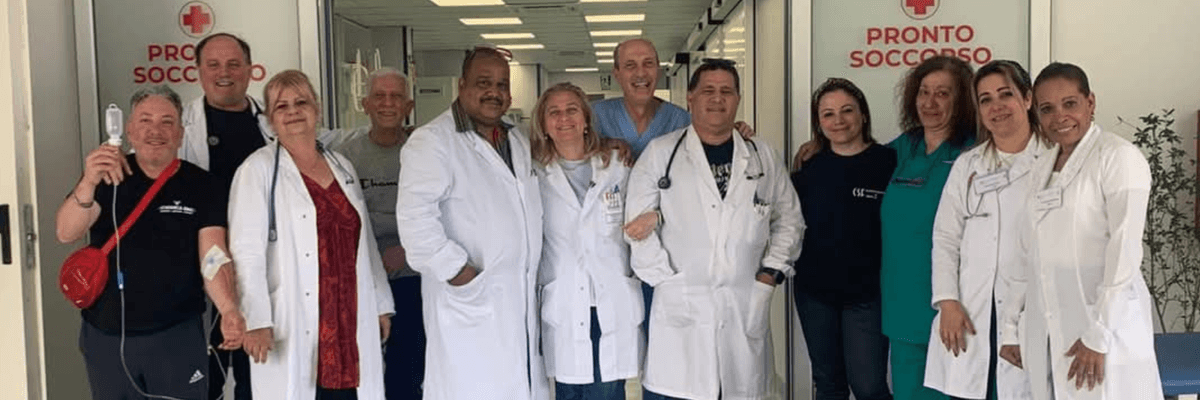
Members of the Cuban medical mission to Calabria pose for a photo with their Italian colleagues in Cosenza, Italy on May 23, 2025.
(Photo: Misión Médica Cubana en Calabria/X)
Brett Wilkins
Jun 10, 2026
As of Wednesday, more than 8,000 Italian medical and scientific professionals have signed an open letter acknowledging their indebtedness to Cuban doctors and condemning the tightening of the 65-year US embargo on Cuba by President Donald Trump as he threatens “take” the island.
“Over the decades, Cuba has built a health system that was considered an international model, capable of guaranteeing universal access to care even in limited resource conditions. Since 1963, more than 600,000 Cuban health workers have served in more than 160 countries, including Italy,” states the letter addressed to Italian Prime Minister Giorgia Meloni and Health Minister Orazio Schillaci.
“That system is currently in a state of collapse,” the letter continues. “Survival in childhood cancers has fallen from 80% to 65% due to the lack of first-line drugs.”
The publication notes that “96,000 people—almost 1% of the population—including 11,000 children are on the waiting list for surgery. If the situation does not change, the list could affect 160,000 patients by the end of 2026. Over 300 pediatric surgeries per week are compromised by shortages of drugs, oxygen, anesthetics, and consumables.”
“The crisis has its roots in a combination of factors that have progressively worsened,” the letter continues. “The tightening of the economic embargo during the first Trump administration, Covid-19, and, since January 2026, the near-total blockade of energy supplies following the Venezuelan crisis have deprived the island of fuel, electricity, and access to international drug and medical device markets.”
A report published in April by researchers at the Center for Economic Policy and Research confirmed an “unprecedented increase” in Cuba’s infant mortality rate, which soared 148% between 2018 and 2025.
Report co-author Joe Sammut said that “the blockade has had a particularly dire effect on Cuba’s healthcare infrastructure, with frequent power outages” exacerbated by the US oil blockade “interrupting the use of critical equipment for the treatment of patients, including incubators for premature babies, and ventilators to help sick newborns breathe.”
The United Nations General Assembly has overwhelmingly condemned the broader US embargo—which Cuba’s government says has cost the island’s economy more than $1 trillion over seven decades—33 times.
“The collapse of a health system is not just a local tragedy: It is a violation of fundamental human rights that requires a response from the global community, beyond any political assessment of the Cuban regime,” the Italian letter argues.
“Italy cannot remain indifferent or silent, also because it is indebted to Cuba for the help received during the Covid-19 pandemic and for the current work of Cuban doctors in the Calabria Region to guarantee the functioning of the local health service,” the publication adds.
The Trump administration has been pressuring Italy to curb its use of Cuban doctors, who are essential to Calabria’s healthcare system.
“It is the duty of the global health community—doctors, researchers, institutions, scientific journals—but also of the civil community to act without ambiguity, in compliance with the fundamental principles of humanitarian law,” the letter concludes. “Every day of silence has a cost in human lives.”


No comments:
Post a Comment