EU Commences Mediterranean Dark Fleet Stop and Search Operations
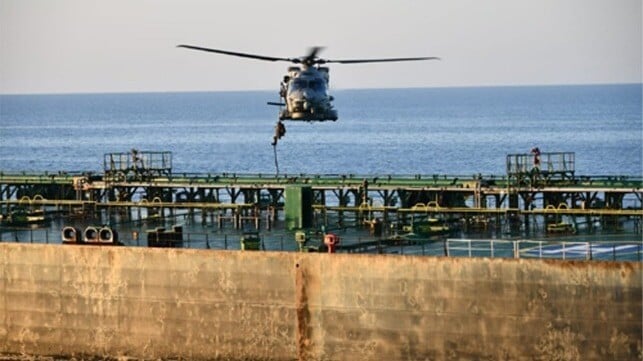
The European Union has launched a coordinated campaign to crack down on vessels that are false-flagged, fraudulently certified, or are in breach of maritime safety and labor laws.
The move, announced after an agreement between EU defense ministers at a meeting in Nicosia on June 8, utilizes the pre-existing mandate for Operation Irini, which was originally established in 2020 under a UN mandate to enforce an arms embargo on Libya in the Mediterranean. It is not clear how or whether the refreshed operation announced by EU Foreign Policy chief Kaja Kallas has also inherited the same UN mandate, but it has explicitly been relaunched with the aim of supporting Ukraine by cracking down on Russian dark fleet activities. It nonetheless gives member nations the authority of an EU mandate to board suspicious ships.
Operation Irini suffered initially in 2020 from a weak mandate. Tasked with monitoring and interdicting arms supplies to the different warring factions in Libya, whenever it sought to board and inspect a ship, it was initially required to secure the permission of the ship’s flag nation in accordance with UNCLOS. When the ship was Turkish, with arms destined for the faction it was supporting, permission was invariably refused. Operation Irini nonetheless has continued.
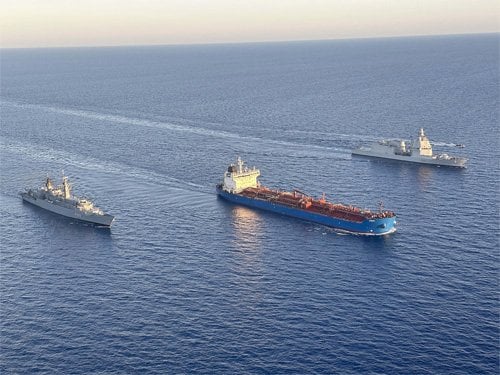
Irini reports stopping three tankers since the effort began in May (Irini)
Currently, the naval forces committed to Operation Irini are headquartered in Rome and under the command of Italian RAdm RADM (UH) Marco Casapieri. The force consists of the Italian Thaon di Revel Class offshore patrol vessel ITS Francesco Morosini (P431), the Greek Elli Class frigate HS Kanaris (F-464). The force is supported by a Beechcraft B300 King Air 350 maritime surveillance aircraft provided by Luxembourg, which is forward-based in Malta, and a PZL M28B Bryza maritime surveillance aircraft provided by Poland.
The new, expanded anti-dark fleet mandate does not appear to have gotten off to a good start, suffering as others have done from the limited justifications in UNCLOS for intercepting ships at sea, even if they are sanctioned, and there are registration irregularities.
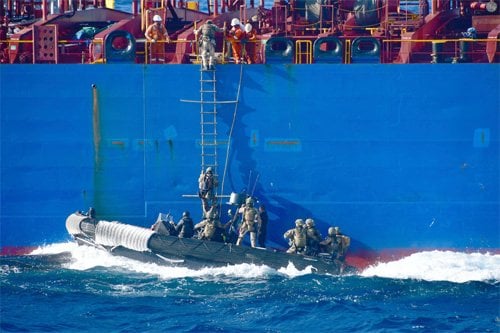
(Irini)
Since the launch of the expanded mission, Irini reports it has stopped three vessels. It conducted a flag verification boarding of EU and UK-sanctioned Sandhya (37,159 dwt), an Indian-owned, Cameroon-flagged product tanker, on June 7. According to its AIS signal, the vessel was coming from Brazil bound for Turkey.
On June 1, an inspection team boarded the Cameroon-flagged and EU-sanctioned Aframax Oneiroi (105,585 dwt) in international waters in the Mediterranean. The 244-meter (800-foot) Oneiroi has a capacity of about 100,000 barrels of oil. It had loaded at Primorsk on May 11. Notwithstanding the stop and search, the Oneiroi still managed to reach Port Said on June 5 and is expected to unload at Vadinar in Gujarat on June 16.
A second Cameroon-flagged Suezmax, Nelsa (156,760 dwt), reportedly owned by a company in Azerbaijan and sanctioned by the EU and UK, was the first vessel stopped by Irini on May 11. The 274-meter (899-foot) Nelsa loaded at Novorossiysk, came through the Bosporus on June 2. Notwithstanding its interception, it is also now through the Suez Canal and heading for India.
It is not clear what the Irini inspections found or why the vessels were allowed to proceed.
Ukraine Expands Campaign Including Targeting Mariupol and Shadow Tanker
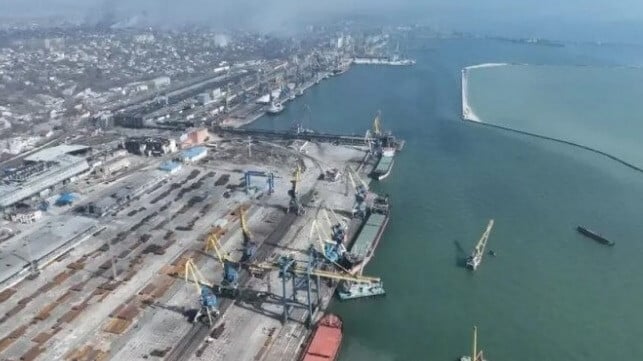
Ukraine is accelerating its campaigns, focusing on Russia’s logistical operations in response to a series of heavy attacks launched by Russian forces. The occupied port of Mariupol was one of the key focuses, while other attacks continued to target the energy infrastructure and another shadow fleet tanker in the Black Sea.
These attacks came as Ukraine also celebrated its Unmanned Systems of the Armed Forces of Ukraine. President Volodymyr Zelensky declared June 11 an annual day of celebration for the unique unit that is greatly contributing to the war. According to media reports, the unit was formed in 2022 by a former grain trader and has become an elite drone unit responsible for the long-range attacks.
The unit was a key participant along with other units of the military in the overnight attacks on Mariupol, which has been occupied by the Russians since the first weeks of the war in 2022. Located on the Azov Sea, Ukraine contends Russia is using the port to support military operations as well as to export grain, coal, and metals from the occupied region.
The drones were used to strike the energy infrastructure, repair, and administrative structures in the port. According to the reports, the port was left without power and suffered significant damage, which is significantly limiting its operations. Russia is reported to have used the port to move personnel and resources across southern Ukraine. The reports indicate that transport routes through the city have also been restricted.
The port’s control tower, radar equipment, and electrical substations were all heavily damaged. The sanctioned cargo vessel Lady Augusta (6,830 dwt) that docked in the port was also damaged. The vessel is listed as laid up since August 2023 and registered in the Marshall Islands.
The strikes on Mariupol came after the General Staff reported other attacks carried out on June 5 that destroyed eight fuel storage tanks and damaged nine others in the same port area. It also struck a key bridge linking the port to the occupied regions of Crimea.
Other strikes in the campaign included the VNIR-Progress plan in the city of Cheboksary, which was reported to be a key manufacturer of navigation equipment, including satellite receivers for precision-guided weapons. The Kuibyshevsk oil refinery at Samara was also struck. Drones from the SBU destroyed warehouses with ammunition and engineering equipment in the Donetsk region.
The General Staff also said that it had struck a shadow fleet product tanker without providing details on the timing or location. The tanker West Horizon (50,548 dwt) was in the Black Sea when it was struck, with the General Staff saying the propeller and rudder were damaged. The vessel is listed as being managed from Turkey and is registered in Guinea-Bissau.
Ukraine's Ports Authority, however, was also reporting that two commercial vessels heading for its ports were damaged. In a posting on social media, the authority reported the vessels were a cargo ship under the flag of Panama and another registered in Barbados. One was inbound to load metals, and the other was outbound from the Desa area with a cargo of wheat. A fire broke out on board one of the vessels, which was quickly extinguished by the crew. There were no injuries and both ships were continuing their voyages.
Dutch Arrest Captain and Stop Containers Violating Russian Sanctions
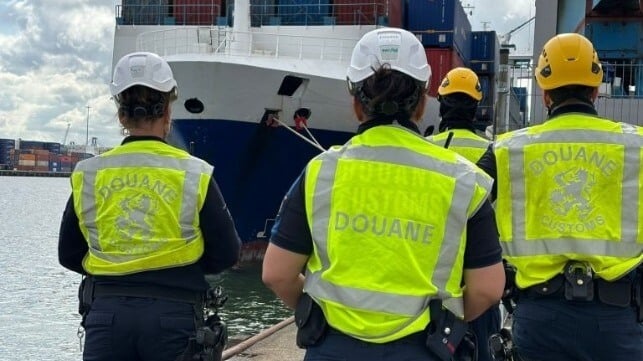
Dutch Customs reports it has started a crackdown, intercepting sanctioned goods bound for Russia through the Port of Rotterdam. Over the past few days, they reported that the captain of a containership was arrested, and multiple containers have been intercepted as part of a criminal investigation into organized sanction violations.
The captain of the unnamed vessel was arrested on June 5 on suspicion of involvement in criminal offenses related to the possible sanctions violations. The magistrate in the Rotterdam District Court ordered the captain’s detention on June 8 for two weeks as the investigation into the sanction violations continues.
Dutch Customs said it is working with Europol, the Rotterdam Port Police, and others, in the operation. They said that research indicated that 92 percent of sanctioned goods traveling via liner services are originating from other EU member states and being transshipped into Russia.
The targeted vessel was reported to be operating a regular service between Rotterdam and Saint Petersburg. The authorities said there were “strong indications” that this route was being misused to circumvent sanctions.
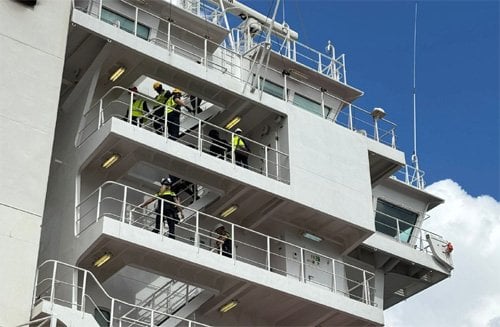
The unnamed vessel was searched and the captain has been arrested (Douane)
Several containers have been inspected, and an investigation was launched on board the ship and two unnamed companies, located in Amsterdam and Rotterdam. The containers were flagged for inspections because of their documentation, which included some goods under a transit ban and other irregularities.
Several containers were moved to a control warehouse, where customs officers opened the containers and unpacked the cargo. According to the authorities, “It quickly became clear that something was not right with the shipment.” They said labels had been removed and pieces of cardboard had been glued to the tops of the boxes. “That’s not right,” said Dutch Customs. “Then you know that the contents have been tampered with.”
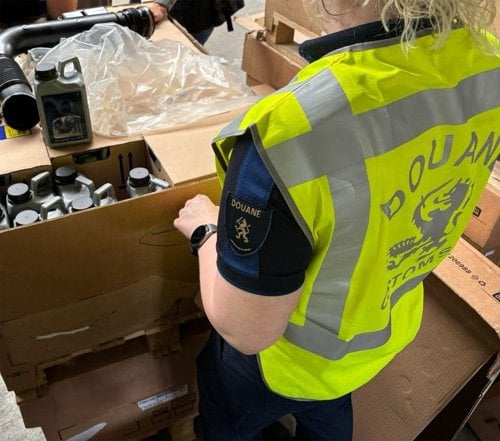
Boxes had been tampered with, and they found motor oil among other blocked goods (Douane)
The operation was specifically aimed at goods that are not permitted to be transported through Russia to other countries. The authorities said there is a risk that the goods could remain in Russia and be used to support military operations. They cited as examples aircraft parts, advanced technology, and machinery that could be used in military applications.
In one of the containers, Customs reports they found windshields, car doors, motor oil, and an entire vehicle air filter system.
“This could be used for passenger cars,” explained a customs officer. They noted, however, “It could be used for trucks headed to the battlefield.”
Dozens of containers were stopped during the inspections. Customs reports it encountered several shipments that were subject to the transit ban.
EU Calls for Sanctions on Bunker and Support Vessels in New Russian Package
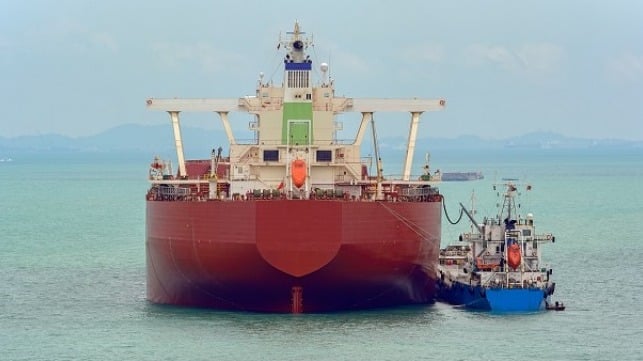
Saying that the goal is to maintain the pressure from the West on Russia, the European Commission outlined its plans for the 21st sanction package since the start of the war in Ukraine. The European Union highlights the impact of its economic sanctions while saying, “Consistency with the sanctions packages is paying off.”
President of the European Commission Ursula von der Leyen, however, also highlighted the increased Russian attacks on civilian targets in Ukraine as well as the wayward attacks that have entered European airspace and hit Romania and others, supporting the effort to further deepen the economic sanctions. She asserted that Russia is cut off from the global capital markets, is experiencing high inflation and interest rates, and has lost two-thirds of the liquid assets of its sovereign wealth fund. Energy revenues, the EU reports, fell by around 40 percent in early 2026, while saying actions are needed to address the benefits Russia has gained with the interruption of energy supplies from the Middle East.
“Today, we are putting forward the 21st sanctions package. We focus on the sectors with the highest impact: energy, financial services and crypto, trade – including fisheries, for the first time – and we are banning the entry of former Russian combatants into the European Union,” reported von der Leyen.
To maintain the pressure on the shadow fleet and the energy revenues, the EU, for the first time, is targeting vessels that assist the tankers, including those providing bunkering and other services. They are also calling for listing another 30 tankers on top of the 632 that the EU has already sanctioned. They also want to extend the restrictions on the sale of oil tankers to Russia to include LNG tankers. Another element would be a ban on Russian fisheries as well as ports and other infrastructure.
To give the oil markets time to stabilize, the EU is proposing freezing the current built-in adjustment mechanism on the oil price cap. It would maintain the $44 price until January 2027 to continue the pressure on Russia while also taking into consideration the impact of the Middle East on the oil market.
Beyond the energy market, the EU is also calling for new export restrictions on items and technology that can be used by the Russian military. This would include more metals and alloys used in aerospace and defense sectors, as well as ground support equipment and jamming and launch systems for drones.
The European Commission is also planning more direct financial sanctions targeting 31 more Russian banks with transaction bans. They also want to add 20 banks and crypto platforms, as well as oil traders in third countries, to the sanctions.
Financial aid to Ukraine also continues with the EU delivering almost €3 billion in a new loan facility to Ukraine yesterday, June 8, and expects to release the first disbursement under the previously announced €90 billion loan. By the end of the month, the EU will have provided Ukraine with €6 billion for drones and more than €3 billion of macro-financial assistance.

No comments:
Post a Comment