
“The new Gilded Age won’t end itself,” said Oxfam America. “This is a trillion-dollar alarm bell that should wake governments up to the need to take action.”
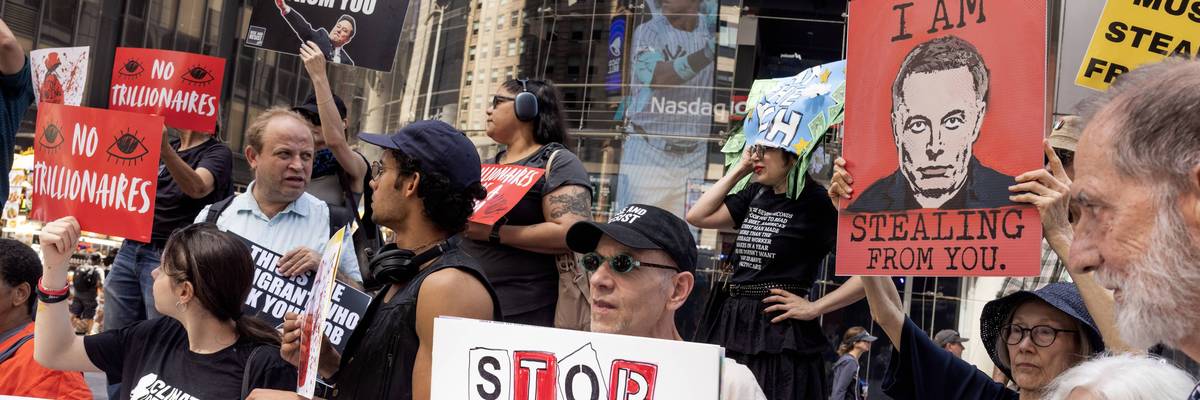
Demonstrators protest ahead of the initial public offering of Elon Musk’s SpaceX on June 5, 2026 in New York City.
(Photo by Andrew Lichtenstein/Corbis via Getty Images)
Jake Johnson
Jun 11, 2026
COMMON DREAMS
With Elon Musk’s SpaceX set to go public on Friday, the world’s richest man could soon become the first-ever trillionaire—an achievement that one leading humanitarian group called “a new pinnacle of oligarchy and a dark day for democracy.”
Whether Musk reaches trillionaire status in the coming days will depend on the success of SpaceX’s initial public offering (IPO), which critics warn is a potentially massive threat to market stability and Americans’ retirement savings. The company plans to sell 555,555,555 shares at a price of $135 each, aiming for a staggering $1.75 trillion valuation. Musk, who is the company’s board chair and owns 42% of its common stock along with options, will see his net worth skyrocket if SpaceX achieves its IPO targets.
‘The IPO Is Being Engineered’: 12-Minute Video Details Growing Fears Over Elon Musk Plot to Become World’s First Trillionaire
Oxfam America noted in an analysis released Thursday that a $1 trillion net worth would mean that it would take Musk 2,740 years to spend $1 trillion if he spent $1 million per day. The group estimated that a 10% tax on $1 trillion “could end global extreme poverty for a year, lifting over 800 million people above the extreme poverty line.”
Nabil Ahmed, senior director of economic justice at Oxfam America, said in a statement that “this moment of dramatically concentrated wealth was not inevitable.”
“Musk will be a government-backed trillionaire whose fortune was fueled by an era of regressive public policy choices—decisions rigged by a tiny few to fuel their fortunes, and overwhelmingly supported by political leaders,” said Ahmed. “A trillion dollars in the hands of one man is incompatible not only with an affordable economy, but also with a healthy democracy. Economic inequality begets political inequality, and ordinary people bear the brunt while billionaires continue to write the rules for their own benefit.”
“The new Gilded Age won’t end itself,” he added. “This is a trillion-dollar alarm bell that should wake governments up to the need to take action. Never has it been more urgent to curb the accumulation of extreme wealth—overhauling the economic policies that have created not just trillionaires, but billionaires and the obscene inequality we see today.”
Oxfam highlighted Musk’s brief but immensely destructive tenure in the US federal government at the Department of Government Efficiency, or DOGE, which took a sledgehammer to foreign aid programs and assailed the Social Security Administration, among other actions whose consequences are expected to reverberate for years to come. Oxfam has warned that the Musk-led decimation of the US Agency for International Development means that “a child under 5 could die every 40 seconds by 2030.”
Musk was given the role at DOGE after using a tiny fraction of his wealth to boost President Donald Trump and Republican candidates in the 2024 election. Musk is spending big again to boost the GOP in the 2026 midterms.
“Musk’s ability to pour money into elections allowed him to use his wealth and power in ways that embody the corrosive effects of billionaire control,” Oxfam said Thursday.
The group’s statement came amid mounting anxiety about the impact of SpaceX’s IPO, beyond potentially pushing Musk’s wealth past the trillion-dollar mark.
In a letter to the US Securities and Exchange Commission earlier this week, Sen. Elizabeth Warren (D-Mass.) raised “extreme concern” about the possibility that the IPO could flop. Major stock index providers, she observed, are “rewriting their rules to fast-track SpaceX’s entry into their indexes—and into the investment funds that power millions of Americans’ retirement savings.”
“The net result could be disastrous,” Warren wrote, “a scenario where retirees’ and families’ investment accounts take a hit if SpaceX’s valuation falters, with little recourse for any corporate misconduct, while the wealthiest man on earth becomes even wealthier due to a lack of oversight.”
AFP
June 10, 2026

SpaceX’s Starship 39 rocket launches from Starbase during the 12th test flight as seen from South Padre Island, Texas, on May 22, 2026 – Copyright AFP/File RONALDO SCHEMIDT
The stock market debut of SpaceX (Elon Musk’s rocket, satellite and company) expected Friday, could be the biggest in history. Here are the key numbers.
$75 billion
The amount SpaceX hopes to raise by selling new shares to investors. That target would be triple the all-time record, set by Saudi oil giant Saudi Aramco in 2019 ($25.6 billion).
$1.765 trillion
SpaceX’s estimated worth, or “valuation” — what the market thinks the entire company is worth if you added up all its shares.
That figure includes xAI, Musk’s AI startup and the X social network (formerly Twitter), which SpaceX absorbed in February.
It would make SpaceX the eighth most valuable company on Earth, right behind the biggest names in tech.
$18.6 billion
How much money SpaceX brought in during 2025 — its total sales before expenses. That was up a third from the year before, and most of it (61%) came from Starlink, the satellite service that beams internet to homes from orbit.
$4.9 billion
The amount SpaceX lost in 2025. Even with all that revenue, it spent far more than it earned, mostly because building AI is extremely expensive — nearly $10 billion last year alone.
A loss doesn’t mean the company is failing; it often means it is investing heavily in future growth.
$791 billion
Elon Musk’s personal fortune, according to Forbes. If the IPO goes well and SpaceX’s share price climbs, Musk could become the world’s first trillionaire — the first person in history to be worth more than $1,000,000,000,000.
82 percent
The share of SpaceX voting rights Musk will hold after the IPO. Even though new shareholders will own a slice of the company, Musk will keep almost all the decision-making power — a common setup in tech, where founders often hold special “super-voting” shares.
$28.5 trillion
SpaceX’s own estimate of the total value of all the markets it operates in — rockets, satellites, internet, AI, and more. To put that in perspective, the entire US economy produced about $30.36 trillion worth of goods and services in 2025.
The stock market debut of SpaceX (Elon Musk’s rocket, satellite and company) expected Friday, could be the biggest in history. Here are the key numbers.
$75 billion
The amount SpaceX hopes to raise by selling new shares to investors. That target would be triple the all-time record, set by Saudi oil giant Saudi Aramco in 2019 ($25.6 billion).
$1.765 trillion
SpaceX’s estimated worth, or “valuation” — what the market thinks the entire company is worth if you added up all its shares.
That figure includes xAI, Musk’s AI startup and the X social network (formerly Twitter), which SpaceX absorbed in February.
It would make SpaceX the eighth most valuable company on Earth, right behind the biggest names in tech.
$18.6 billion
How much money SpaceX brought in during 2025 — its total sales before expenses. That was up a third from the year before, and most of it (61%) came from Starlink, the satellite service that beams internet to homes from orbit.
$4.9 billion
The amount SpaceX lost in 2025. Even with all that revenue, it spent far more than it earned, mostly because building AI is extremely expensive — nearly $10 billion last year alone.
A loss doesn’t mean the company is failing; it often means it is investing heavily in future growth.
$791 billion
Elon Musk’s personal fortune, according to Forbes. If the IPO goes well and SpaceX’s share price climbs, Musk could become the world’s first trillionaire — the first person in history to be worth more than $1,000,000,000,000.
82 percent
The share of SpaceX voting rights Musk will hold after the IPO. Even though new shareholders will own a slice of the company, Musk will keep almost all the decision-making power — a common setup in tech, where founders often hold special “super-voting” shares.
$28.5 trillion
SpaceX’s own estimate of the total value of all the markets it operates in — rockets, satellites, internet, AI, and more. To put that in perspective, the entire US economy produced about $30.36 trillion worth of goods and services in 2025.
All in on Musk, SpaceX’s self-declared ‘dream weaver’
AFP
June 10, 2026

Elon Musk will control more than 82 percent of SpaceX voting shares and there is no designated successor
AFP
June 10, 2026
– Copyright US Central Command (CENTCOM)/AFP/File –
When SpaceX lists on Wall Street, expected on Friday, Elon Musk will serve simultaneously as chief executive, chief technology officer and board chairman of the rocket and AI company.
He will control more than 82 percent of its voting shares. There is no designated successor, no deputy and no key-person life insurance written into its filings.
The world’s most valuable IPO depends entirely on one man.
“He’s completely upending the conventional conduct of running a publicly traded corporation by declaring himself an irreplaceable dream weaver and master engineer of the whole undertaking,” Quinn Slobodian, co-author with Ben Tarnoff of “Muskism: A Guide for the Perplexed,” told AFP in an interview.
For Slobodian, a professor of international history at Boston University who has spent years studying Musk’s empire, that brazen concentration of personal power is not a flaw in the SpaceX offering — it is its defining feature.
SpaceX is targeting a valuation of approximately $1.8 trillion and aims to raise $75 billion when trading opens Friday under the ticker SPCX, in what will be the largest public offering in history.
– Jobs and Gates –
To understand how Musk positioned himself as literally irreplaceable, Slobodian pointed to the “prophetic founder” model exemplified by Steve Jobs and Bill Gates.
“Jobs and Gates are kind of the template,” Slobodian said, adding that Musk’s decision to give Walter Isaacson — the biographer who immortalized Jobs — access for his own biography was itself a tell.
What gave Musk’s version of that archetype genuine credibility, Slobodian argued, was a willingness to go against the grain of early 21st-century investment orthodoxy.
At a time when “design in California, assemble in China” was the way — with the iPhone as the example — Musk poured his early fortune from PayPal into a rocket company and an electric vehicle manufacturer, both requiring him to solve brutally hard engineering problems.
His distance from his tech-billionaire peers is now measurable in purely financial terms.
Musk’s fortune, expected to hit $1 trillion with the IPO, is approaching three times the size of that of the second richest person on the planet, currently Google co-founder Larry Page.
“He’s operating at a different scale, and with a scope of ambition that just makes him singular,” Slobodian said.
– Too big to fail –
Musk is often framed as a libertarian entrepreneur who built his empire outside the reach of government.
Slobodian argues that Musk has always depended on government as primary client or subsidy giver, from his earliest startup Zip2’s reliance on publicly funded GPS data to the billions SpaceX draws in federal contracts today.
He pointed in particular to what he described as SpaceX’s Golden Dome contracts, worth $4 billion, to supply satellite infrastructure for the Trump administration’s proposed national missile defense shield.
In his view, SpaceX is structurally too critical to national security interests for any administration to let it fail.
“If Trump gave a second thought to bailing out Spirit Airlines,” Slobodian said of the bankrupt low-cost carrier, “what about SpaceX?”
– After Henry Ford –
Slobodian situated Musk’s alignment with far-right movements in the United States and sovereigntist parties in Europe as serving commercial ends, not merely personal ones.
He argued that Musk sees compliant political partners both abroad and at home as essential to obtaining the regulatory approvals SpaceX needs: spectrum allocations, satellite launch rights and permission to operate Starlink in key markets.
That worldview, Slobodian and Tarnoff contend in their book, has roots in Musk’s upbringing in the suburbs of Pretoria under apartheid-era South Africa — a regime they argue deployed IBM mainframes and advanced technology to control the population through data collection and surveillance.
As for whether the Musk model outlasts the dream weaver himself, Slobodian pointed to Palantir — which, like SpaceX, first broke into government work by suing the US military for contracts — as one potential carrier of the torch.
But a true successor, he suggested, may be hard to find, “just as there was no Henry Ford after Henry Ford,” only imitations.
When SpaceX lists on Wall Street, expected on Friday, Elon Musk will serve simultaneously as chief executive, chief technology officer and board chairman of the rocket and AI company.
He will control more than 82 percent of its voting shares. There is no designated successor, no deputy and no key-person life insurance written into its filings.
The world’s most valuable IPO depends entirely on one man.
“He’s completely upending the conventional conduct of running a publicly traded corporation by declaring himself an irreplaceable dream weaver and master engineer of the whole undertaking,” Quinn Slobodian, co-author with Ben Tarnoff of “Muskism: A Guide for the Perplexed,” told AFP in an interview.
For Slobodian, a professor of international history at Boston University who has spent years studying Musk’s empire, that brazen concentration of personal power is not a flaw in the SpaceX offering — it is its defining feature.
SpaceX is targeting a valuation of approximately $1.8 trillion and aims to raise $75 billion when trading opens Friday under the ticker SPCX, in what will be the largest public offering in history.
– Jobs and Gates –
To understand how Musk positioned himself as literally irreplaceable, Slobodian pointed to the “prophetic founder” model exemplified by Steve Jobs and Bill Gates.
“Jobs and Gates are kind of the template,” Slobodian said, adding that Musk’s decision to give Walter Isaacson — the biographer who immortalized Jobs — access for his own biography was itself a tell.
What gave Musk’s version of that archetype genuine credibility, Slobodian argued, was a willingness to go against the grain of early 21st-century investment orthodoxy.
At a time when “design in California, assemble in China” was the way — with the iPhone as the example — Musk poured his early fortune from PayPal into a rocket company and an electric vehicle manufacturer, both requiring him to solve brutally hard engineering problems.
His distance from his tech-billionaire peers is now measurable in purely financial terms.
Musk’s fortune, expected to hit $1 trillion with the IPO, is approaching three times the size of that of the second richest person on the planet, currently Google co-founder Larry Page.
“He’s operating at a different scale, and with a scope of ambition that just makes him singular,” Slobodian said.
– Too big to fail –
Musk is often framed as a libertarian entrepreneur who built his empire outside the reach of government.
Slobodian argues that Musk has always depended on government as primary client or subsidy giver, from his earliest startup Zip2’s reliance on publicly funded GPS data to the billions SpaceX draws in federal contracts today.
He pointed in particular to what he described as SpaceX’s Golden Dome contracts, worth $4 billion, to supply satellite infrastructure for the Trump administration’s proposed national missile defense shield.
In his view, SpaceX is structurally too critical to national security interests for any administration to let it fail.
“If Trump gave a second thought to bailing out Spirit Airlines,” Slobodian said of the bankrupt low-cost carrier, “what about SpaceX?”
– After Henry Ford –
Slobodian situated Musk’s alignment with far-right movements in the United States and sovereigntist parties in Europe as serving commercial ends, not merely personal ones.
He argued that Musk sees compliant political partners both abroad and at home as essential to obtaining the regulatory approvals SpaceX needs: spectrum allocations, satellite launch rights and permission to operate Starlink in key markets.
That worldview, Slobodian and Tarnoff contend in their book, has roots in Musk’s upbringing in the suburbs of Pretoria under apartheid-era South Africa — a regime they argue deployed IBM mainframes and advanced technology to control the population through data collection and surveillance.
As for whether the Musk model outlasts the dream weaver himself, Slobodian pointed to Palantir — which, like SpaceX, first broke into government work by suing the US military for contracts — as one potential carrier of the torch.
But a true successor, he suggested, may be hard to find, “just as there was no Henry Ford after Henry Ford,” only imitations.
A glossary to help understand what happens in an initial public offering
Published: 6


No comments:
Post a Comment