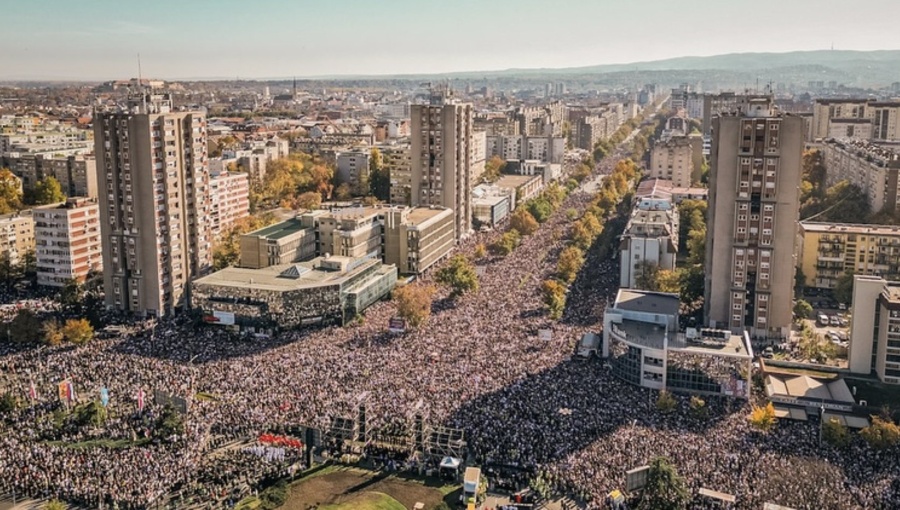
Tens of thousands of people gathered in Novi Sad on November 1 to mark one year since the collapse of the city’s railway station canopy that killed 16 people and injured one, one of Serbia’s worst infrastructure disasters.
The tragedy has become a symbol of public anger over corruption and negligence, fueling Serbia’s largest protest movement in more than a decade.
Citizens assembled at 16 locations across the city — one for each victim — before marching to the station, where they observed a minute of silence at 11:52 a.m., the time of the collapse. Wreaths were laid as church bells tolled, and in Belgrade, Patriarch Porfirije led a memorial service. Serbia and Republika Srpska declared a national day of mourning.
Participants arrived from across the country, including student and farmer convoys travelling on foot, by bicycle and by tractor. Police closed central streets as crowds filled Liberation Boulevard and traffic was diverted around the city centre.
The demonstrations began last year as an outpouring of grief but have since evolved into a broader challenge to President Aleksandar Vucic and his ruling Serbian Progressive Party (SNS), with protesters demanding early elections.
SNS offices in Novi Sad, damaged during earlier violent protests, were closed and guarded. The event remained peaceful during the day, with organisers describing it as a memorial rather than a political rally.
The large turnout underscored the persistence of the movement and its support across Serbia.
The anniversary comes amid growing economic and diplomatic pressure on Vucic’s government, including US sanctions on the country's sole oil firm NIS, factory closures, criticism from the European Union and tensions with Russia over stalled gas talks.
One year after the collapse, the scale of Saturday's gathering shows that Serbia’s protest movement retains momentum and the potential to influence the country’s political course.
Friday 31 October 2025, by Gaëlle Guehennec
For a year now, young people in Serbia have been continuing their fight for a democratic society in the face of Aleksandar Vučić’s authoritarian regime. On both sides of Serbia, student marches are criss-crossing the country in the direction of Novi Sad to commemorate the collapse of the railway station, responsible for the deaths of 16 people on 1 November 2024. This tragic event triggered a political protest on an unprecedented scale.
Throughout the last year, Serbian students have been taking to the streets. They have succeeded in organizing the largest protest movement since the fall of Slobodan Milošević in 2000. They accuse Aleksandar Vučić’s authoritarian and corrupt regime of being responsible for the tragedy in Novi Sad. Since the Serbian Progressive Party (SNS) came to power in 2012, the president has concentrated power, marginalized the opposition and stifled the independent press.
From April 2025, the mobilization turned to the international arena. Some of the students travelled to Brussels and Strasbourg to alert the European institutions to the authoritarian excesses of their government. At the same time, the movement denounced the role of the public media in relaying state propaganda. Faced with European silence and the contempt of those in power, the movement took a strategic turn: from civic to political.
In June, the creation of the Social Front marked a turning point: [1] this confederation of workers’ collectives and professional associations brought together Serbia’s five main trade unions for the first time. In a country where policy remained focused on privatization and the dismantling of labour law, this alliance opened the way to a possible reorganization of the labour movement.
But the regime’s response was brutal. Repression intensified, the police used illegal means such as sound cannons, and confrontations multiplied. On the night of 13 October, several Serbian towns became the scene of violent clashes between demonstrators and SNS supporters supported by the police and paramilitary militias. [2]
This escalation weakened the government on the international stage. Last Wednesday, the European Parliament adopted a resolution condemning the political polarization and state repression in Serbia, [3] denouncing threats to the media, anti-EU and pro-Russian propaganda, and the regime’s political responsibility for weakening democracy. However, the resolution remains non-binding, underlining Europe’s reluctance to deal with a partner considered ‘indispensable’ for regional stability.
Neither Brussels nor Moscow: for an international Balkans
By offering relative political security at Europe’s borders and privileged access to Serbian markets, Vučić has secured the complacency of Brussels and Paris. During her visit to Belgrade in early October, Ursula von der Leyen urged the president to make ‘progress on the rule of law’ [4]: a very weak reaction to a large-scale movement that was violently repressed. By betting on stabilocracy, Europe is choosing authoritarian stability rather than democracy [5], a calculation that feeds a geopolitical status quo that entrenches authoritarianism and increases regional instability.
The legacy of non-aligned Yugoslavia has left Belgrade with a tradition of the ‘third way’. Since its collapse, this position has turned into strategic ambiguity. While Serbia negotiates its entry into the EU, it maintains close ties with China and Russia.
The European Union exercises normative and economic imperialism, imposing its democratic and commercial standards while remaining the country’s main investor. This dependence is accompanied by political pressure, particularly on the issue of sanctions against Moscow. Russia, for its part, embodies symbolic and energy imperialism: Gazprom controls a large part of the sector, and the Kremlin supports Belgrade on the Kosovo issue.
For Vučić, playing on this ambivalence between Brussels and Moscow enables him to strengthen his internal legitimacy and assert his position on the international stage. Caught between two blocs, neither of which offers an emancipatory way out, the Serbian people see their sovereignty confiscated by a game of cross-dependencies.
The only progressive prospect now lies in building a social front capable of breaking away from all external control and rebuilding an autonomous democracy.
It is in this context, where internationalism is once again relevant, that a Franco-Belgian delegation made up of activists from the NPA and the Gauche anticapitaliste went to Belgrade last May. They returned there at the end of October for the Novi Sad commemoration to meet trade unions, student collectives and activists. An in-depth report on our discussions and the prospects for regional organization is forthcoming.
29 October 2025
P.S.
If you like this article or have found it useful, please consider donating towards the work of International Viewpoint. Simply follow this link: Donate then enter an amount of your choice. One-off donations are very welcome. But regular donations by standing order are also vital to our continuing functioning. See the last paragraph of this article for our bank account details and take out a standing order. Thanks.
Attached documentsthe-streets-against-the-regime-in-serbia-one-year-of_a9240.pdf (PDF - 899.3 KiB)
Extraction PDF [->article9240]
Footnotes
[1] Europe Solidaire Sans Frontières, “Serbia. Declaration of the Social Front”, 1 September 2025.
[2] Le Courrier des Balkans, “Étudiants face aux milices et à la police : la nuit où la Serbie a basculée”, 14 October 2025.
[3] European Parliament, Motion for a Resolution on the Polarisation and Increased Repression in Serbia, One Year After the Novi Sad Tragedy, B10-0459/2025, 22 October 2025.
[4] Le Courrier des Balkans, “Von der Leyen demande à Vučić « des progrès en matière d’État de droit» en Serbie”, 7 October 2025.
[5] Luka Šterić, ‘Sortir de la “stabilocratie” : repenser l’approche française des Balkans occidentaux’, Fondation Jean-Jaurès, 2 June 2022.
Gaëlle Guehennec is a member of the NPA-A in France.
International Viewpoint is published under the responsibility of the Bureau of the Fourth International. Signed articles do not necessarily reflect editorial policy. Articles can be reprinted with acknowledgement, and a live link if possible.

No comments:
Post a Comment