It’s possible that I shall make an ass of myself. But in that case one can always get out of it with a little dialectic. I have, of course, so worded my proposition as to be right either way (K.Marx, Letter to F.Engels on the Indian Mutiny)
Saturday, November 01, 2025
AI NEWZ
Universal says struck first licensing deal for AI music
Pedestrians stand outside Universal Music Group headquarters in Santa Monica, California, U.S. on Friday. June 4, 2021. (Bing Guan)
Recording industry giant Universal Music Group said Thursday it had struck a licensing deal with AI music generation startup Udio, in an industry-first tie-up aiming to launch an AI creation platform next year.
Universal and Udio said in a statement that their platform, as yet unnamed, “will be powered by new cutting-edge generative AI technology that will be trained on authorized and licensed music”.
They added that they had settled an outstanding copyright infringement case, without specifying the financial terms.
The agreement comes as artists, from authors to musicians and video game developers, fear eventual replacement by AI models trained on decades of human-produced creative output, while music streaming platforms already report a rising flood of computer-generated songs.
AI firms from industry leader OpenAI to music specialists like Udio and competitor Suno have previously been accused by major record companies of using their songs to “train” artificial intelligence models which can produce music that apes human artists.
Rightsholders have demanded stricter limits on the AI developers’ activities, including transparency on what source material they have used and guarantees for their revenue.
Startups were “engaged in the largest copyright infringement exercise that has been seen,” International Confederation of Music Publishers (ICMP) boss John Phelan told AFP last month.
And the Recording Industry Association of America, a US trade group, filed a lawsuit in June 2024 against both Udio and Suno.
By contrast, Thursday’s tie-up showed the way towards “a healthy commercial AI ecosystem in which artists, songwriters, music companies and technology companies can all flourish,” UMG chief Lucian Grainge said.
Broader talks between music companies and tech firms on how to license works for AI remain under way.
Nvidia storms past US$5 trillion valuation as AI boom powers meteoric rise
Nvidia made history on Wednesday as the first company to reach $5 trillion in market value, powered by a stunning rally that has cemented its place at the centre of the global artificial intelligence boom.
The milestone underscores the company’s swift transformation from a niche graphics-chip designer into the backbone of the global AI industry, turning CEO Jensen Huang into a Silicon Valley icon and making its advanced chips a flashpoint in the tech rivalry between the U.S. and China.
Since the launch of ChatGPT in 2022, Nvidia’s shares have climbed 12-fold as the AI frenzy propelled the S&P 500 to record highs, igniting a debate on whether frothy tech valuations could lead to the next big bubble.
The new milestone, coming just three months after Nvidia breached the $4 trillion mark, would surpass the total cryptocurrency market value and equal roughly half the size of Europe’s benchmark equities index, the Stoxx 600 index.
Shares of the Santa Clara, California-based company rose 4.6 per cent after a string of recent announcements solidified its dominance in the AI race.
Huang unveiled $500 billion in AI chip orders on Tuesday and said he plans to build seven supercomputers for the U.S. government.
Meanwhile, President Donald Trump is expected to discuss Nvidia’s Blackwell chip with Chinese President Xi Jinping on Thursday.
Sales of the high-end chip have been a key sticking point between the two sides due to Washington’s export controls.
(Production: Shung Sin Tan)
Why 81% of Maritime Companies Are Piloting AI, Only 11% Are Ready to Scale
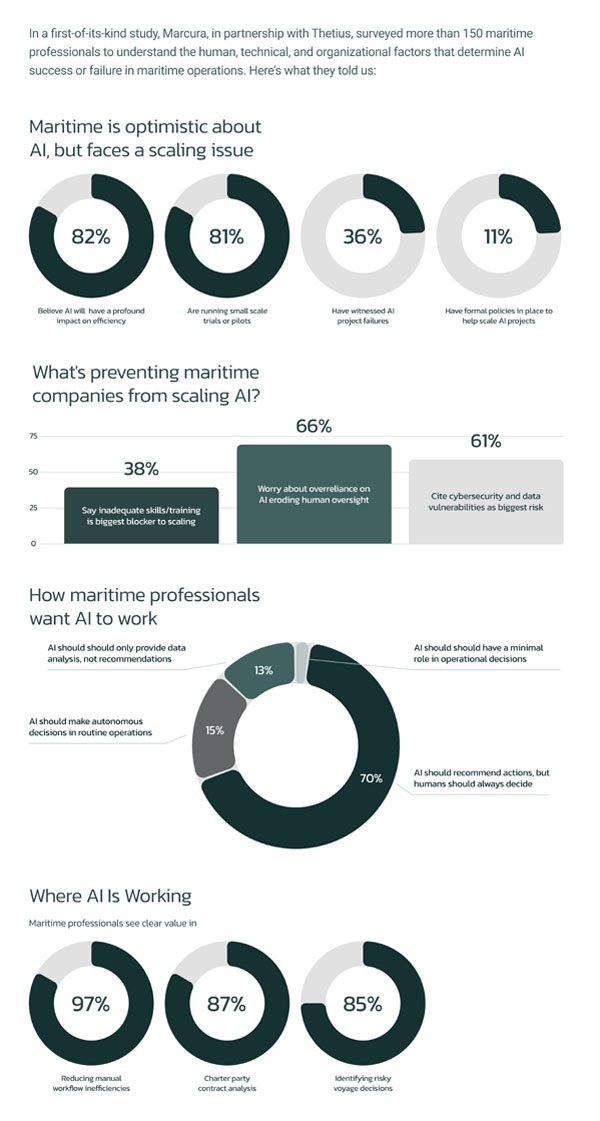
AI is now a boardroom priority in maritime, but ambition hasn’t yet turned into readiness. New industry research reveals a striking disconnect in maritime AI adoption. While 82 percent of maritime professionals believe AI can improve efficiency, only 23 percent of companies are training staff to use it. Even more telling, 81percent are running pilots, but only 11 percent have policies and guardrails needed to scale.
The gap revealed in the research is less about algorithms than execution. It reflects a mismatch between board-level ambition and the organizational readiness required to turn promising proofs-of-concept into everyday tools on the bridge and in the back office.
The vision-execution gap
Maritime leaders now see AI as strategically important, but translating vision into operating practice is hard. Pilot experiments typically start with nebulous goals. Scaling requires clarity on the problem you are looking to address, it means confronting data quality, change management, governance and training, areas many organizations have not given sufficient attention.
During the webinar launching our findings, a fellow panelist and industry veteran Christian Vinther Christensen captured this dynamic perfectly: "The C-suite and leaders expressed genuine interest in AI, but how come only 23% of companies are training their staff? It tells me that we have a challenge in bridging that gap. It's very easy to say, 'yes of course we're interested in AI,' but actually you need to set aside resources, time and energy to embrace AI in practical ways."
Why projects disappoint
Our survey shows 37% of respondents have witnessed an AI project fail or cause harm to an existing process.
Nearly a quarter of respondents believe that the vendor community is guilty of overhyping AI solutions that fail to deliver the results they promise.
The real problem stems from a fundamental mismatch between what is being sold and what maritime actually needs. Many vendors deploy generic AI models trained on broad datasets that simply do not understand maritime's contextual nuances.
Without industry-specific training, even sophisticated AI can produce plausible-sounding but dangerously incorrect answers. This is why both vertical AI and rigorous evaluation frameworks matter. Systems must be built for maritime and continuously tested against real operational scenarios.
At Marcura, we are investing in AI evaluations (evals), a process of systematically testing our AI systems against maritime-specific benchmarks. These evaluation frameworks measure accuracy across operational scenarios, catch reliability issues before deployment, and provide the transparency needed to build organizational trust in AI-driven recommendations.
The Human Factor: What's Really Holding Teams Back
Perhaps the most revealing findings in the research relate to human concerns about AI adoption. While 82% see AI as beneficial, two-thirds worry that overreliance on AI could weaken human oversight. This is not technophobia. Instead, it is a legitimate recognition that maritime decisions carry significant financial and safety consequences.
Giuseppe Oliveri, Director at d'Amico, captured an essential insight during our research interviews: "In the shipping industry there is still that feeling of the person, the face-to-face relationships and not just the computer." Maritime deals hinge on personal trust, reputation, and real-time judgment calls built over years of experience. The fear is not that AI will assist with these decisions, it is that AI might replace the relationship dynamics that make deals happen.
The research shows that 70% of respondents say AI should recommend actions while humans make final decisions.
Here’s a good example of how that balance works in practice. During the pre-fixture process a chartering manager is comparing their working charter party against their base template to ensure they haven’t missed anything important or accepted unfavorable terms.
AI scans the document in seconds and flags four critical clauses that were omitted, issues that could have led to $120,000 in losses. But the AI doesn't make the decision; it surfaces the risk. The chartering manager, equipped with this insight, negotiates the terms before signing. The expertise and judgment remain human. The administrative burden of line-by-line contract review shifts to AI.
This is the path to trust: design AI that accelerates expert judgment rather than replacing it and makes escalation easy when a case falls outside trained context.
Moving Forward: From Aspiration to Implementation
For organizations ready to move beyond the hype, the Thetius research offers clear guidance.
1. Start with a clear understanding of the problem you are looking to solve. Run curiosity discovery sessions to identify where you are losing money, nominate AI champions within teams, and create curiosity maps to guide implementation priorities.
2. Invest in AI tools built specifically for maritime. Generic solutions will consistently fall short of industry-specific needs.
3. Foster agency and trust through comprehensive training programs that help employees understand, assess, and effectively use AI tools.
4. Implement governance frameworks that cover not just compliance but transparency, auditability, and internal accountability.
5. Measure and iterate. Establish clear KPIs that track business outcomes, not just efficiency gains. Track ROI clarity from the start and continuously refine your approach based on what the data reveals rather than assumptions.
The payoff for doing this now is material. The industry is compressing typical 10-15 year technology adoption cycles into just 2-3 years for AI. That speed creates competitive separation for companies that are ready, especially where the work product is document- and judgment-heavy.
Those who remain stuck between enthusiasm and action, uncertain about how to translate strategic vision into practical outcomes, will find the gap widening. Your organization faces a clear challenge: bridge the gap between knowing AI matters and knowing how to make it work for your organization.
About the author: Janani Yagnamurthy is the Vice President of Analytics and Market Research at Marcura, where she leads cutting edge digital transformation initiatives. With a focus on building vertical AI solutions tailored to the maritime sector, she has helped uncover new opportunities for operators, traders, and charterers empowering them to make sharper commercial decisions, reduce operational friction, and proactively manage risks.
This article is sponsored by Marcura. For more information visit Marcura online.
Weathernews Inc., a global leader in weather intelligence solutions, and Toqua, a Belgian developer of physics-informed AI for ship performance modeling, today announced a strategic partnership to integrate vessel-specific performance intelligence into voyage optimization systems. The partnership enhances voyage optimization by adding vessel-specific performance intelligence to weather routing optimization. While weather routing optimizes routes based on environmental conditions, adding AI-trained performance models that account for how individual ships actually behave under varying operational conditions unlocks additional fuel savings and operational predictability.
Three Components, One Optimization "Routing optimization consists of three main components," explained Casimir Morobé, Founder of Toqua. "Weather forecast, the optimization algorithm, and the performance model. Weathernews excels at accurate weather forecasting and has a powerful optimization engine. But the third component, the performance model, is equally critical. The better the model understands how a specific vessel performs at a given speed, in given weather conditions, at a certain draft, the better the optimization algorithm can simulate different scenarios and choose the most optimal route."
By integrating Toqua's technology, physics-informed AI vessel performance models trained on actual vessel operational data, with Weathernews' weather intelligence, routing recommendations now incorporate more accurate vessel-specific performance characteristics, including hull fouling progression, vessel-specific weather factors, and unique speed-power relationships for all possible sea states.
Controlled validation programs demonstrate that this integration delivers up to 3% additional savings beyond Weathernews' routing optimization, alongside a 50% reduction in arrival time uncertainty and bunker cost estimations.
Implementation The integration requires minimal effort from customers using Weathernews’ Vessel Report or IMOS Veslink. Using operational data already stored in Weathernews systems, whether noon reports or customers' own existing high-frequency sensor data, via their API structure, Toqua creates vessel-specific models and feeds them to Weathernews via API. "From a customer point of view, it's essentially a flick of a switch," Morobé noted. "Everything remains the same. The output just becomes much more accurate and optimal."
The technology's minimal data requirements make it accessible even for single voyages. Toqua models can be activated with as little as a few days of operational data to optimize the remainder of that trip, with accuracy improving as more data accumulates.
Empowering Human Expertise Weathernews operates with 24/7 meteorological support from its global network of weather experts. Jacob Iversen, Head of Partnerships at Weathernews Europe, emphasized that this technology serves as a force multiplier rather than replacing human expertise:
'Combining our probabilistic weather forecasting with Toqua's vessel-specific models empowers our meteorologists to provide better guidance to customers. We're strengthening our human-in-the-loop approach, giving our people more accurate tools to maximize both safety and earnings for our customers’ voyage operations.'
The partnership creates a mutually reinforcing cycle: more accurate performance models mean vessels reach their expected positions more reliably, which in turn improves the utility of weather forecasting and enables safer routing decisions.. "Better weather intelligence improves model accuracy, and better models improve weather forecast utility," explained Morobé. "This synergy is what makes the integration powerful."
Proven Technology, Expanded Reach Toqua’s technology has been in use and generating these benefits for multiple years across plenty of owners and operators worldwide, including names such as Euronav (now part of CMB.TECH), Exmar, Weco, Enesel, Orion Reederei, and many more.
"Over the past five years, we've seen many successful cases where vessel-specific data-driven models inside routing systems lead to more optimal outcomes," said Morobé. "This partnership allows us to scale that impact to as many ships as possible, as quickly as possible."
The products and services herein described in this press release are not endorsed by The Maritime Executive.
Oilfield Services Expand to Data Center Services As AI Booms
Oilfield service companies are adapting to declining traditional markets by pivoting to new revenue streams in data center support and digital solutions.
Schlumberger is leveraging its experience with hyperscalers to build data centers and grow its Digital Solutions segment, which is showing rapid revenue acceleration.
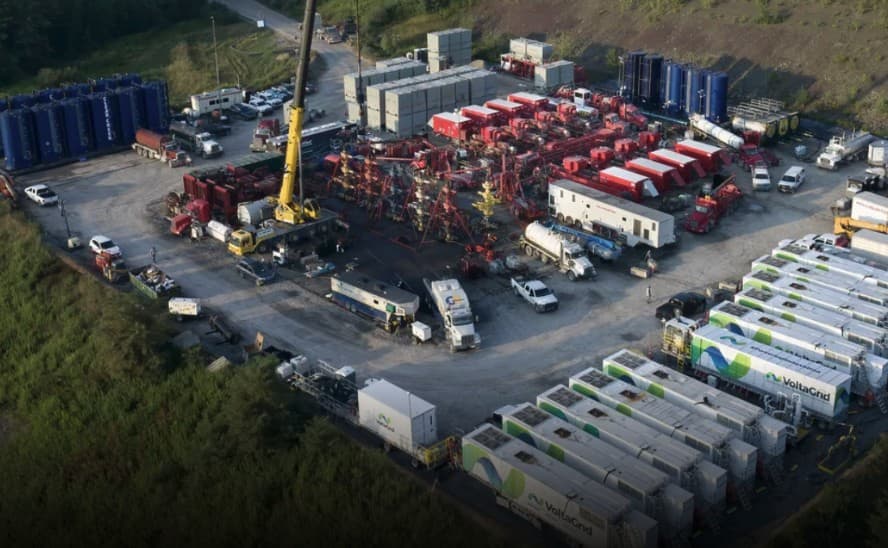
Halliburton has formed a joint venture with VoltaGrid to provide distributed power solutions for data centers, utilizing its expertise in the evolving fracking industry and microgrid technology.
Oilfield service companies have faced challenges in their core OFS business due to declining markets in the U.S. and around the world. Low prices for much of the last decade and increases in efficiency have caused rig counts to plummet, and have led some companies to look in new directions for revenue and profit. Companies like Schlumberger, (NYSE:SLB), and Halliburton are refocusing away from equipment rentals and manpower in their traditional core oil related services, to AI led digital subscription revenue sources. These companies are also leveraging their expertise in conducting remote field operations into Data Center power supply and construction.
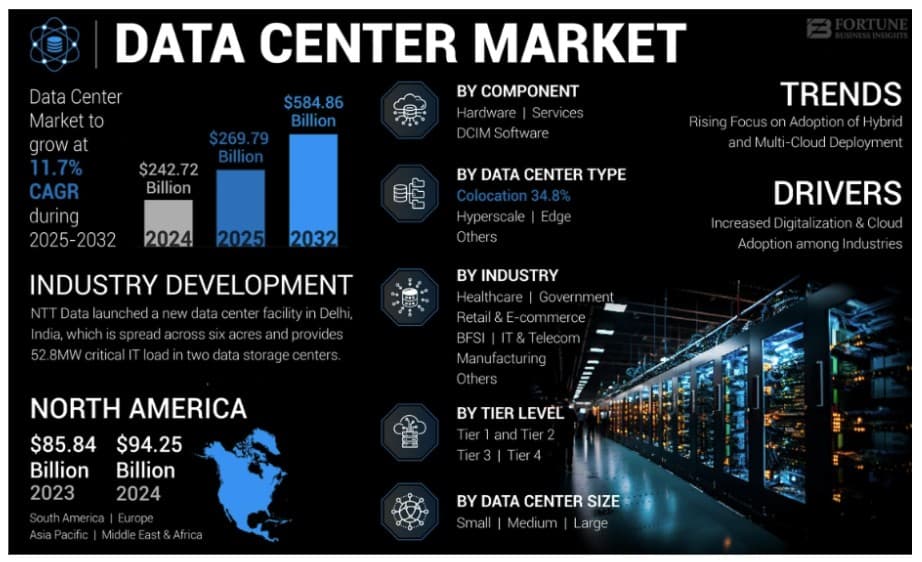
“The rapid shift toward digital transformation across industries is driving the demand for data centers. Organizations are increasingly adopting cloud services for flexibility, scalability, and cost efficiency. The growth of cloud computing, including private, public, and hybrid clouds, is significantly boosting data center investments.”
For example, SLB has chosen to leverage its extensive experience with hyperscalers in supporting their cloud based software into building out data centers. In their quarterly conference call with analysts, management disclosed that revenue from their Data Center Solutions segment had accelerated rapidly and totaled $331 mm for the quarter. SLB CEO, Olivier Le Peuch commented in this regard during the call-
“This is clearly not driven by oil and gas customers. It's driven by our hyperscalers partners that reach out to us to help them respond to this AI boom and data center growth.”
Further this represented an increase of 140% from the same period a year ago. If you are an OFS exec and you have a segment that grows at that rate, you naturally commit resources for further growth. And, placed against the backdrop of the TAM-total addressable market in this space shown in the graphic above through 2032, there is ample room for continued growth.
Still focusing on how SLB has embraced the digital transformation, the company noted their recent reorganization had made their Digital Solutions divisions a distinct reporting entity on their balance sheet. SLB Digital Solutions is comprised of Platform & Applications, Digital Operations, Digital Exploration and Professional Services. The company noted in the call that Digital was now generating revenue at a run rate of $2.4 bn annually with a present margin of 32.7% and a line of sight to 35%. It’s SLB’s plan to integrate digital and subscription services across their entire suite of service offerings. CEO Le Peuch discussed in some detail how eventually revenue from Digital will eclipse revenue from their core oilfield services-
“Digital will outperform the Core because the principle we are setting here is essentially for every service we provide, for every well site we touch, for every equipment we deliver, we'll progressively add building on our platform and connecting to our Live Performance Center, will add a set of Digital services and enhance this offering that enhance the operation, the performance and get differentiation and get the customer to create more value.”
Halliburton has taken another approach to access the Data Center market. Leveraging its position as the largest fracker in North America it has formed a joint venture-JV with VoltaGrid, a supplier of gas powered “microgrids.” Jeff Miller, CEO of Halliburton noted the synergies of the two companies in the press release-
“Through the venture, Halliburton will leverage its global operational footprint, local infrastructure, and regional regulatory expertise, while VoltaGrid will contribute its proprietary engineering design, technology innovation, and procurement capabilities. Together, the companies plan to offer turnkey distributed power generation solutions tailored to the needs of regional data centers based on a proven platform.”
Microgrids are becoming increasingly in demand as the infrastructure to support the metastatic growth of data centers, just doesn’t exist. If you go to your friendly neighborhood grid-based power purveyor and ask for a hookup, you will be told to come back in about 5-6 years. Or longer. That obviously isn’t working for the hyperscalers like Microsoft, (NYSE:MSFT), or Amazon, (NYSE:AMZN) expanding their data center footprints to meet their internal demands to provide cloud support AI storage. In that light the future looks pretty bright for companies that propose to fill the gap between total power demand and what the installed grid can provide.
If you aren’t familiar with the changes happening in the fracking industry, let me spend a few words explaining them. Up until a few years ago the Tier II diesel engine was the power source for most frac pumps. Two things drove an industry rebooting to Tier IV DBG-Dynamic Gas Blending. Diesel is expensive and produces a lot of noxious emissions. The Tier IV DGB engines provided ability to mix field gas with diesel to cut emissions and save money. When you realize a single fleet of frac pumps can use-7-10 mm gallons of diesel annually, you can see there was a big carrot to shift to the DGB engines. Now most of the Tier II fleets have been retired and the Tier IV DGB is now the standard. But the final step in the evolution of frac pumps is still underway.
If you take the thinking that emissions reduction, cost savings and more power-electric motors can deliver nearly twice the horsepower of Tier II engines, a step further, you can see all-electric equipment would be even more efficient. That’s the direction the industry is now going. Halliburton now has over half its inventory of frac fleets as all electric- “Zeus-fleets,” and has a recurring need for microgrid support.
A Halliburton Zeus fleet on location with VoltaGrid Power
The JV is fairly new between Halliburton and VoltaGrid, but with Halliburton’s 20% stake, revenue and profits should begin to hit the bottom line in coming quarters. Halliburton will also be VoltaGrid’s partner on international projects. Jeff Miller commented on their expectations for the partnership in the call-
“We have signed an agreement with VoltaGrid to be their international partner for delivering distributed power solutions for data centers outside of North America. Through this agreement, we will combine Halliburton's global reach, design, manufacturing and operating capabilities with VoltaGrid's distributed power expertise to deliver reliable power at scale. I expect this will be an important long-term growth opportunity for both VoltaGrid and Halliburton.”
Your takeaway
The major oilfield service companies have had to adapt to a changed macro environment for their services. The old paradigm of relying on rental revenue, equipment sales, and technical support is giving way to seeking new customers outside the oil and gas industry for their remote operations expertise. Additionally, their core focus on oilfield customers is on incorporating digital AI infrastructure across their platforms. Much of this is marketed through a subscription model that incentivizes clients to build long-term working relationships.
Early indications are that these moves into digital infrastructure and subscription revenue should enhance profitability. SLB noted during its recent conference call that its Digital Solutions segment was generating an EBITDA margin of 32%, with expected growth to 35% in the fourth quarter of this year. For the entire company, SLB reported an EBITDA margin of 23.1%.
Both companies trade at single-digit EV/EBITDA multiples, about half what they did five years ago. This suggests that investors have not yet recognized these companies' revenue and profit potential from their new ventures, making current stock prices an attractive entry point.
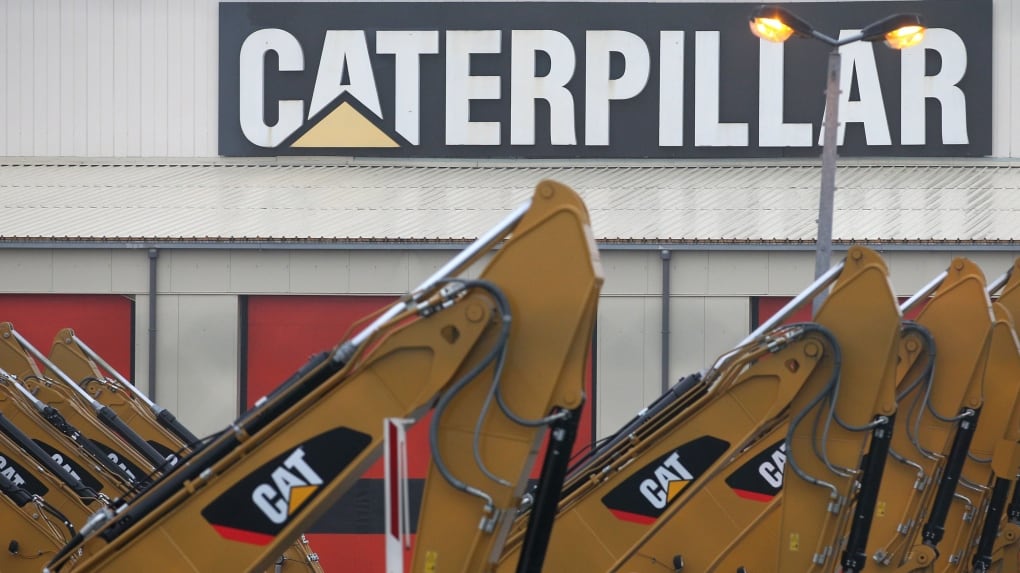
Heavy equipment parked. (AP Photo/Yves Logghe, File)
Caterpillar topped third-quarter profit and revenue estimates on Wednesday as a boom in AI technologies drove demand for its energy equipment, sending its shares up about four per cent before the bell.
The industrial equipment maker’s energy and transportation unit has fueled much of the company’s growth in recent quarters as AI-driven investments in power-hungry data centers have boosted demand for its power-generation systems.
U.S. President Donald Trump’s focus on energy projects has further aided the segment.
The unit, which also makes mining equipment such as excavators and giant shovels, contributes 40 per cent to Caterpillar’s overall revenue.
The company’s energy and transportation unit posted a 17 per cent rise in third-quarter sales to about US$7.2 billion.
Industrial machinery makers, such as Caterpillar, are now grappling with higher costs from Trump’s expansive tariffs on imports, while weak demand and elevated interest rates limit their ability to pass on the burden to customers.
The company now expects its annual tariff costs between $1.6 billion and $1.75 billion, compared with its prior expectation of $1.5 billion to $1.8 billion.
During the second quarter, companies across the globe flagged a combined annual financial hit between $16.2 billion and $17.9 billion and nearly $15 billion for 2026, according to a Reuters tariff tracker.
The company, seen as a bellwether for the global industrial economy, reported quarterly revenue of $17.6 billion, beating Wall Street’s expectation of $16.77 billion, according to data compiled by LSEG.
Its mainstay construction segment posted a 7% rise in revenue to $6.76 billion, helped by price hikes.
The company reported a quarterly adjusted per share profit of $4.95, topping the average estimate of $4.52.
(Reporting by Nandan Mandayam and Nathan Gomes in Bengaluru; Editing by Shinjini Ganguli and Saumyadeb Chakrabarty)
Data Rich NOCs Gain Edge in AI-Driven Energy Sector
Artificial intelligence is fundamentally changing how national oil companies (NOCs) utilize their extensive historical and operational data, moving beyond speculative promises to practical applications in data organization and interpretation.
NOCs possess a unique advantage due to their immense, often underutilized data reservoirs and institutional stability, allowing for the application of AI to long-term data series for more reliable insights in areas like subsurface modeling and production optimization.
To truly harness AI, NOCs must prioritize building strong data cultures and robust data governance, recognizing data as a strategic asset rather than merely a byproduct of operations, which will position them to lead the next wave of digital transformation in energy.
In the ongoing digital transformation of the energy industry, artificial intelligence (AI) has emerged as one of the most discussed — and misunderstood — tools available to operators. While the promises of AI often stretch toward the speculative, the technology’s most immediate and profound impact is already visible in how companies organize, interpret, and act upon data. For national oil companies (NOCs), this impact is potentially transformative. Unlike many private firms, NOCs sit atop immense, often underutilized data reservoirs — decades, sometimes a century, of geological, operational, and financial information that forms a foundation few other entities in the energy sector can match
Take Mexico’s National Rock Library, administered by the Ministry of Energy (SENER). It holds physical cores from wells drilled more than a hundred years ago — an extraordinary record of geological history. When digitized and paired with AI-driven analytics, such datasets can unlock patterns invisible to the human eye. Subsurface models, for example, can be refined by feeding these historical datasets into machine learning algorithms to improve facies prediction and reservoir quality estimation, and even identify underexplored analogs for new drilling campaigns. The same principle applies to seismic reprocessing or production optimization: the richer and more structured the dataset, the more powerful and reliable the AI interpretation.
This is the core advantage for NOCs — not just the data itself, but the continuity of data stewardship. Many of the Gulf Cooperation Council (GCC) NOCs, for instance, have built decades-long archives of standardized, high-quality information. Their institutional stability and continuity of purpose make it possible to apply AI to longtime series without the disruptive policy shifts that sometimes affect state-owned entities elsewhere. When models are trained on consistent, comparable data across decades, they can produce far more reliable insights on production decline trends, reservoir management, and capital efficiency.
Contrast this with some Latin American or African NOCs, where political cycles and policy shifts often reset corporate priorities. In such cases, the challenge is not the absence of data, but its fragmentation, both across time and across institutions. Here, AI’s promise lies as much in data integration and cleansing as in predictive analysis. Natural language processing tools can help standardize legacy documentation; supervised learning models can detect inconsistencies or gaps in well logs; and AI-powered metadata tagging can turn unstructured archives into queryable, connected knowledge systems.
Real-world examples of this are emerging. Saudi Aramco has developed proprietary AI systems for predictive maintenance, analyzing millions of sensor readings to anticipate equipment failure before it occurs. ADNOC’s Panorama Digital Command Center aggregates real-time data from across the company’s operations, allowing executives to visualize energy flows, costs, and emissions at a glance. These systems rely not on speculative “intelligence” but on disciplined data collection, governance, and model training — areas where NOCs, by virtue of their scope and national mandate, have a natural edge.
Schreiner Parker, Head of Emerging Markets & NOCs
The next phase for many NOCs will involve expanding these applications beyond the technical realm into strategic and commercial domains. AI can already help model fiscal sensitivity under different price and tax regimes, or identify optimal timing for licensing rounds by analyzing global exploration trends. As carbon intensity becomes a defining metric for competitiveness, AI can also play a key role in monitoring emissions, optimizing energy efficiency, and guiding investment toward low-carbon opportunities — all grounded in data the NOC already possesses.
Yet optimism must be balanced with realism. AI is not a silver bullet; it is an amplifier of organizational discipline. The sophistication of the algorithm matters less than the quality, structure, and governance of the underlying data. For NOCs to truly harness AI, they must think less about “buying AI solutions” and more about building data cultures, where engineers, geologists, and economists alike treat data not as a byproduct of operations but as a strategic asset.
If that happens, NOCs — especially those with deep archives and long institutional memory — will be uniquely positioned to lead the next wave of digital transformation in the energy sector. In the end, it is not the algorithm that determines success, but the intelligence embedded in how nations preserve, interpret, and learn from their own energy histories.
By W. Schreiner Parker, Head of Emerging Markets & NOCs at Rystad Energy.
Saudi Arabia, UAE Pour Over $130 B Into AI To Offset Oil Price Risks
Saudi Arabia and UAE are racing to dominate the Middle East’s AI landscape.
The Gulf States are pouring tens of billions into data centers, cloud infrastructure, and semiconductor ventures in partnership with U.S. tech giants like Nvidia, Oracle, and Microsoft.
The UAE’s MGX, a $100 billion AI investment vehicle formed by Mubadala and G42, is driving global partnerships through the $100 billion Global AI Infrastructure Investment Partnership.
Previously, we reported that Saudi Arabia is digging in for a "long and shallow" oil price war as it looks to regain market share from rivals like U.S. shale producers and OPEC+ members who have been exceeding their production quotas. This comes after Saudi Arabia made significant production sacrifices to support prices for over three years, which allowed competitors to increase their output. Saudi Arabia has also been hedging its oil price bets by rapidly diversifying its economy away from fossil fuels in recent years, expanding into areas such as artificial intelligence (AI), sports and tourism. Indeed, Saudi Arabia's Minister for Investment Khalid Al Falih has revealed that non-oil activities now drive more than half the country’s GDP, with that percentage growing.
And, the battle between Saudi Arabia and the United Arab Emirates for Middle East AI supremacy is quickly heating up. The two countries are not only spending heavily to beef up their AI infrastructure, including building some of the world’s largest data center clusters, but are also forming strategic alliances with U.S. tech giants. Saudi Arabia’sVision 2030 strategy has singled out AI as vital to the country’s economic transformation, with70% of its goals involving data and AI.
Saudi Arabian artificial intelligence company Humain has launched a $10 billion venture capital fund called Humain Ventures dedicated to investing in AI startups across the United States, Europe, and Asia. Owned by Saudi Arabia's sovereign wealth fund, the Public Investment Fund (PIF), Humain Ventures is a key part of Saudi Arabia's larger strategy to become a global hub for AI, and a key part of its Vision 2030 plan for economic diversification. Launched earlier in the current year, Humain has already begun deploying capital into AI infrastructure projects. In pursuit of its AI ambitions, Humain also entered into significant partnerships with major U.S. technology companies, including Nvidia (NASDAQ:NVDA), Advanced Micro Devices (NASDAQ:AMD), Oracle (NYSE:ORCL), Amazon’s (NASDAQ:AMZN) cloud service AWS, Qualcomm (NASDAQ:QCOM) and giant data center REIT Equinix (NASDAQ:EQIX).
Back in May, Oracle announced a $14 billion investment in Saudi Arabia's digital cloud and AI infrastructure over 10 years, as part of its commitment to the Kingdom's Vision 2030. This investment will expand the company's cloud and AI presence by building a comprehensive network of data centers, including existing regions in Riyadh and Jeddah and planned expansions in NEOM and Dammam. AWS and Humain haveannounced a joint $5 billion investment to build an AI zone in the Kingdom. Meanwhile, Equinix has announced plans tobuild a $1 billion data center in Saudi Arabia to meet surging demand for AI, cloud and enterprise workloads.
The UAE has also launched a slew of AI investments. Last year, the Abu Dhabi government launched MGX, a technology investment company specializing in artificial intelligence (AI) and advanced technologies. The fund was founded as a partnership between Abu Dhabi's sovereign wealth fund, Mubadala, and the AI and cloud computing company G42. MGX focuses on AI infrastructure (data centers and connectivity), Semiconductors (chip design and manufacturing)
Core AI technologies and applications (software, data, and robotics). At its launch, MGX had a target of managing over $100 billion in assets, making it one of the largest funds in the world dedicated to AI.
Since its March 2024 launch, MGX has made several high-profile moves, showcasing its ambition to become a major player in the global AI industry. In September 2024, MGX formed a partnership with Microsoft (NASDAQ:MSFT) and BlackRock (NYSE:BLK) dubbed the Global AI Infrastructure Investment Partnership (GAIIP) to invest up to $100 billion in AI data centers and energy infrastructure. Nvidia is a key partner of GAIIP, offering its expertise in AI factories and data centers. Meanwhile, Stargate UAE is a massive AI data center cluster in Abu Dhabi, developed in partnership between the Emirati AI firm G42 and US tech giants like OpenAI, Nvidia, Oracle, and Cisco (NASDAQ:CSCO). Stargate UAE is the first international deployment of OpenAI's ambitious global AI infrastructure initiative, also named "Stargate". Positioned as a "national infrastructure," Stargate UAE will provide the country with its own powerful and secure AI capabilities as part of the UAE's broader strategy to diversify its economy and reduce reliance on external technology infrastructure. The project's central feature is a 1-gigawatt AI supercomputing cluster, with an initial 200-megawatt phase planned to be operational by 2026. This facility will be equipped with advanced Nvidia hardware to meet the massive computational demands of training and running large AI models.
Further, Abu Dhabi has unveiled plans to invest AED 13 billion (equivalent to $3.54 billion) in its Digital Strategy 2025–2027, with the goal of becoming the world's first fully "AI-native" government by 2027. The strategy aims to automate 100% of all government processes and integrate AI into all digital services.




No comments:
Post a Comment