Trump's four-part strategy for a post-American world: retreat, rebel, replace and reform international institutions AND BREAK EVERYTHING
US President Donald Trump has broken with the paradigm of the rules based international order and is causing chaos with his transactional modus operandi that puts “America first”. At the same time the global emerging markets have come of age and have put on enough economic and military muscle so that they are pushing back.
It’s a clash of civilisations between the Old Western World that has dominated geopolitics and continues as neo-colonialist powers against the Global South, politely dubbing the new system “globalisation”. But that system is breaking down in the face of the rise of the BRICS bloc that prefers to dub the global order the unipolar world under a US hegemony.
Trump is not the cause of the change but he has been a catalyst that has thrown the changes into sharp relief. As IntelliNews has argued, this is the end of the Pax Americana and a new Interregnum is clearly underway. And Trump is resisting that change.
The new National Security Strategy (NSS) released in December makes it clear that the Trump administration intends to maintain America’s dominance of the western hemisphere in an updated version of the Monroe Doctrine, while at the same time ensuring that China, America’s leading geopolitical rival, doesn’t dominate the eastern hemisphere. For their part, Chinese President Xi Jinping, with his allies in the BRICS, G20 and the other Global Emerging Markets Institutions (GEMIs) are pushing for a multipolar system where all countries are treated equally.
Russia is the litmus test, as in the first two decades following the collapse of the USSR, Russian President Vladimir Putin pushed extremely hard to be taken into the Western fold, but broke decisively and permanently with the Global North following the invasion of Ukraine and has taken a big bet on the Global South Century, which appears to be paying off.
Putin and Xi’s relationship has been portrayed as a marriage of convenience, but as IntelliNews argued, it's more complicated than that as the asymmetric diplomacy of the multipolar world is a complicated patchwork world of overlapping national interests.
Trump has also been portrayed as a belligerent and isolationist wrecking ball intent on dismantling the international order that the US spent the better part of eight decades constructing. However, the Trump administration policies are also more complicated than that as political analysts Gustavo Romero and Stewart Patrick argue in a paper for the Carnegie Endowment for International Peace, Retreat, Rebel, Replace, or Reform? Making Sense of Multilateralism Under Trump 2.0.
Trump’s methods are crude. He has withdrawn from 66 international institutions' multilateral agreements and undermined confidence in Nato. He has attacked the United Nations, refused to pay the US subs causing a budget crisis there, and set up the competing Board of Peace. Diplomacy has been replaced with tariffs for friends and sanctions for enemies. And Operation Absolute Resolve in January illegally kidnapped the sitting president of Venezuela Nicolas Maduro before Trump started an unprovoked war with Iran in February.
The four Rs
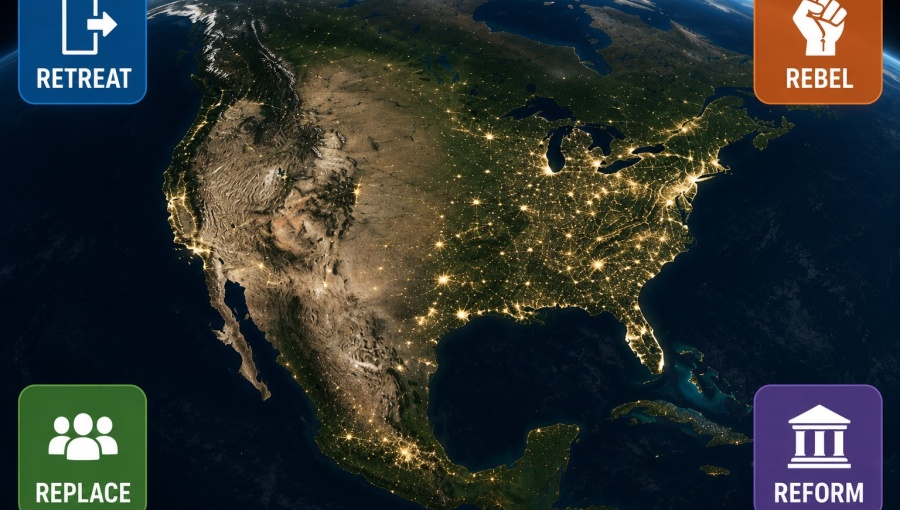
But there is some reason for the madness, according to Romero and Patrick. They break the Trump administration actions down into four categories:
Retreat: pull out of the international institutions that run the world;
Rebel: against the same institutions;
Replace: set up alternative or rival institutions that perform the same function; or
Reform: those institutions to better serve US interests.
Rather than rejecting multilateralism outright, they contend that Washington's four distinct approaches towards international institutions is a rational rear guard action to defend against America’s decline.
The US now retreats from those institutions it considers irredeemable. It rebels against those it believes constrain American interests. It attempts to replace those with alternative organisations it can control absolutely. And it attempts to reform those that continue to serve US strategic objectives.
"The conventional narrative of the second Trump administration simply repudiating multilateralism is incomplete," Romero and Patrick write. "The record is more complicated, has evolved since January 2025, and varies across issue areas and institutions."
Trump's foreign policy may be unconventional, frequently contradictory and often abrasive, but it is also the first serious attempt by an American administration to adapt US grand strategy to a world that is going through a rapid change. As IntelliNews reported, four of the five largest economies in the world on a PPP (purchasing power parity) adjusted basis are now BRICS, and the Global South countries are rapidly climbing the list while former Global North powerhouses like Germany and Japan are rapidly falling down the list. By around 2070 both China and India will have overtaken the US in nominal terms as well, as the global economic centre of gravity moves rapidly eastward to where the bulk of the earth’s population live.
World in flux
For more than three decades after the collapse of the Soviet Union, international politics rested on an a priori assumption that increasingly came to be regarded as permanent. The US possessed overwhelming military superiority, unmatched financial power and unrivalled technological leadership. It underwrote global security, guaranteed the world's reserve currency, controlled much of the international financial architecture and sat at the centre of virtually every major multilateral institution.
The institutions that dominated international affairs up until today still reflect that reality. Nato expanded eastwards under American leadership. The International Monetary Fund (IMF) and World Bank continue to operate within a framework largely designed by Washington and its allies. The United Nations, despite its many frustrations, functioned within an international system in which American power remained the ultimate guarantor of order. Even institutions where Washington did not exercise direct control nevertheless evolved within a geopolitical environment shaped overwhelmingly by US economic and military predominance.
What has been so surprising is how fast this international order is now unravelling, which is a traditional feature of the intra-empire interregna. China has emerged as the world's second-largest economy and, by most measures, the most important trading nation for more than half the countries in the world. India has become an indispensable geopolitical swing state. The Gulf monarchies now pursue foreign policies that often diverge sharply from Washington's preferences – made worse by the Gulf war. Middle powers from Turkey to Brazil increasingly refuse to align permanently with either the US or China, preferring instead to maximise their room for manoeuvre through flexible, issue-specific diplomacy, as regional alliances start to become more important than aligning with one of the mega-blocs.
Meanwhile, Russia's resilience in the face of unprecedented Western sanctions has demonstrated that even the combined economic power of the G7 can no longer isolate a major state in the way it once could. America’s defeat in the Gulf war and Russia’s inability to conquer Ukraine, despite being at least three times the size, has also demonstrated that overwhelming military might is no longer enough in the new world of asymmetric war dominated by drones, not the high-tech precision weapons that had dominated until now.
The rise of the BRICS grouping is a serious challenge to the US hegemony. Originally dismissed by many Western observers as little more than an investment bank acronym, coined by Goldman Sachs head of research Jim O’Neill, the organisation has evolved into a political vehicle through which emerging powers increasingly seek to coordinate positions on trade, finance and global governance.
For several years, IntelliNews has argued that this represents the defining geopolitical story of the twenty-first century. It is a profound redistribution of global power. The relative weight of the US is in decline —not necessarily because America itself is becoming weaker, but because others have become considerably stronger—the assumptions underpinning the post-Cold War order are eroding.
This does not mean that the US is entering terminal decline. Its economy remains the world's largest in nominal terms, its military capabilities remain unparalleled and the dollar continues to dominate international finance. But primacy and dominance are not the same thing.
The Italian Marxist Antonio Gramsci famously observed that an interregnum is the moment when "the old is dying and the new cannot be born".
The Carnegie paper explains how Washington has begun responding to this challenge.
Four-part fix
Retreat is the most visible and has attracted the greatest international attention.
Washington has withdrawn from, or substantially reduced its participation in, organisations and agreements that the administration believes constrain American sovereignty while offering limited strategic return. These include the World Health Organization, the Paris Climate Agreement, UNESCO, several United Nations bodies and the OECD's efforts to establish a global minimum corporate tax. Rather than treating multilateral engagement as an objective in itself, the administration increasingly evaluates every institution through a cost-benefit calculation.
"The administration's approach is better understood as selective disengagement than wholesale abandonment," Romero and Patrick argue, noting that Washington has become increasingly willing to accept reduced influence in institutions that it believes no longer advance core American interests.
That represents a significant departure from the philosophy that guided successive administrations after 1945. For decades, American policymakers regarded leadership of international institutions as a strategic asset in itself. Even imperfect organisations were seen as worthwhile because they reinforced an international order largely favourable to Washington.
Today's White House appears to have reached a different conclusion. If an institution cannot be reshaped to reflect American priorities, it may no longer deserve American participation.
Rebel is arguably even more significant because it demonstrates that Washington is not abandoning multilateralism altogether. Rather than leaving many institutions, it is increasingly choosing to remain inside while using its financial weight and diplomatic leverage to reshape them.
This strategy is visible across a wide range of international organisations. Rather than accepting established agendas, the US increasingly blocks initiatives it opposes, demands institutional reform, conditions funding on policy changes and presses allies to shoulder greater financial responsibilities.
In the case of the International Criminal Court (ICC), of which the US is not a member, the rebellion has taken an extreme form of sanctions on judges that have defied US interests and issued arrest warrants on Israeli Prime Minister Benjamin Netanyahu, amongst other US allies, on war crimes charges. Romero and Patrick note that Washington has increasingly used "voice rather than exit" where doing so better advances its objectives.
Disputes over Nato burden-sharing voiced at the Nato summit in the Hague last year, repeated confrontations inside United Nations agencies and pressure on international financial institutions cease to appear as isolated episodes. They become components of a broader attempt to renegotiate the terms under which American leadership is exercised.
Replace is perhaps the most innovative — and the one most clearly reflecting the structural changes taking place across the international system. Rather than relying exclusively on existing organisations, Washington has increasingly been constructing parallel institutions designed around narrower memberships and overtly under US control. Trump has appointed himself the chairman of the Board of Peace and granted himself veto powers. An organisation like that is easier to run than something like the UN made up of almost 200 sovereign states, each with equal voting rights in the General Assembly.
China and the rest of the Global South is playing a similar game with the GEMIs, the point of which is they mirror Western-dominated institutions but exclude the Global North powers.
The Asian Infrastructure Investment Bank does the same job as the World Bank but Beijing wanted an institution reflecting its growing economic influence via the Belt and Road Initiative (BRI), a like-minded development programme. The New Development Bank (NDB, formerly known as the BRICS Bank) is more or less a carbon copy of the IMF, except it is headquartered in Shanghai.
Global South regional development banks, digital payment systems and alternative financial messaging platforms increasingly coexist alongside the post-war institutions rather than replacing them outright. The emergence of competing institutional ecosystems is already one of the defining characteristics of the Interregnum.
Multiple institutions addressing similar problems may increase flexibility, but it will also reduce coherence. Competing standards emerge. Membership overlaps. Decision-making becomes increasingly dispersed. It is these tensions that will be the source of tensions in what has already become a fractured world.
Reform is the last option as the Trump administration has no intention of dismantling every international organisation. On the contrary, institutions considered strategically valuable continue to receive American support — but only on condition that they become more efficient, more accountable and more closely aligned with US priorities.
Washington increasingly differentiates between institutions worth preserving and those it believes have outlived their usefulness. And even critics of the administration cannot dispute that some of its complaints are valid.
Many international organisations are drowning in red tape and work at a snail’s pace. The World Trade Organisation (WTO) is a textbook example. Set up as part of GATT (General Agreement on Tariffs and Trade) reforms and regulation to global trade, the WTO was supposed to supervise global trade and resolve disputes. But the body is now virtually dead, bogged down in conflicting interests and lacking any international powers to enforce its decisions.
Romero and Patrick acknowledge these shortcomings directly, arguing that many multilateral institutions suffer from "bureaucratic inefficiency, collective inaction, mediocre performance, and ample hypocrisy".
America’s decline has contributed to these problems as the post-war institutional architecture was designed for an era in which the US accounted for nearly half of global economic output and Western industrial democracies overwhelmingly dominated international finance. It had the authority to smooth over the bumps, but as that power fades dispute resolution descends into mere bickering without resolution. Previously the US could rely on its military might to resolve particularly fraught arguments, but even that doesn’t work anymore.