It’s possible that I shall make an ass of myself. But in that case one can always get out of it with a little dialectic. I have, of course, so worded my proposition as to be right either way (K.Marx, Letter to F.Engels on the Indian Mutiny)
Friday, June 19, 2026
ZIONIST TERRORISM
'All of Lebanon must burn,' Israeli minister says after IDF reports four soldiers killed
Israel's military said the soldiers were killed "in combat" when their tank was hit during an operation near Kfar Tebnit.
Israel's national security minister said "all of Lebanon must burn" after the Israeli military reported that four of its soldiers had been killed in the south of the country on Thursday.
"For every tear of an Israeli mother, a thousand Lebanese mothers must weep," Itamar Ben-Gvir wrote in a post on X.
Israel's military said the soldiers were killed "in combat" when their tank was hit during an operation near Kfar Tebnit. It has named one of the victims as 32-year-old Lt. Col. Dor Gedalia Ben Simhon, the commander of the 52nd Battalion of the 401st Armored Brigade.
On Friday, the Israel Defense Forces (IDF) said an "explosive drone impact" in southern Lebanon had also severely injured a reserve officer, with four others sustaining light injuries.
The IDF carried out strikes across southern Lebanon overnight, targeting what it said were Hezbollah operatives and infrastructure. Eighteen people have reportedly been killed in the strikes as of this morning.
It comes just days after US and Iranian leaders signed an initial agreement aimed at ending the Iran war. Under the terms of the provisional deal, both sides and their allies are required to suspend all military activities, including in Lebanon.
"With all due respect to the Americans, Israel must make it clear to the entire world that the blood of our sons and the security of our citizens are not forfeit," Ben-Gvir said in his post on Friday.
Ben-Gvir sparked controversy in May after he posted video footage showing him taunting detained activists from the Global Sumud Flotilla who had been attempting to transport aid to Gaza.
The video showed the minister berating detainees and waving a large Israeli flag as the activists were forced to kneel with their hands tied behind their backs.
“Welcome to Israel, we are the landlords,” he says in the footage.
Israeli Prime Minister Benjamin Netanyahu said at the time that the manner in which Ben-Gvir had dealt with the activists was "not in line with Israel’s values and norms".
Football not covered by US-Iran framework deal, Iran's World Cup squad finds
Just two days after Washington and Tehran signed a framework deal aimed at ending their war, Iran's football federation said US travel restrictions on its World Cup squad remain unchanged, and is filing a formal complaint with FIFA.
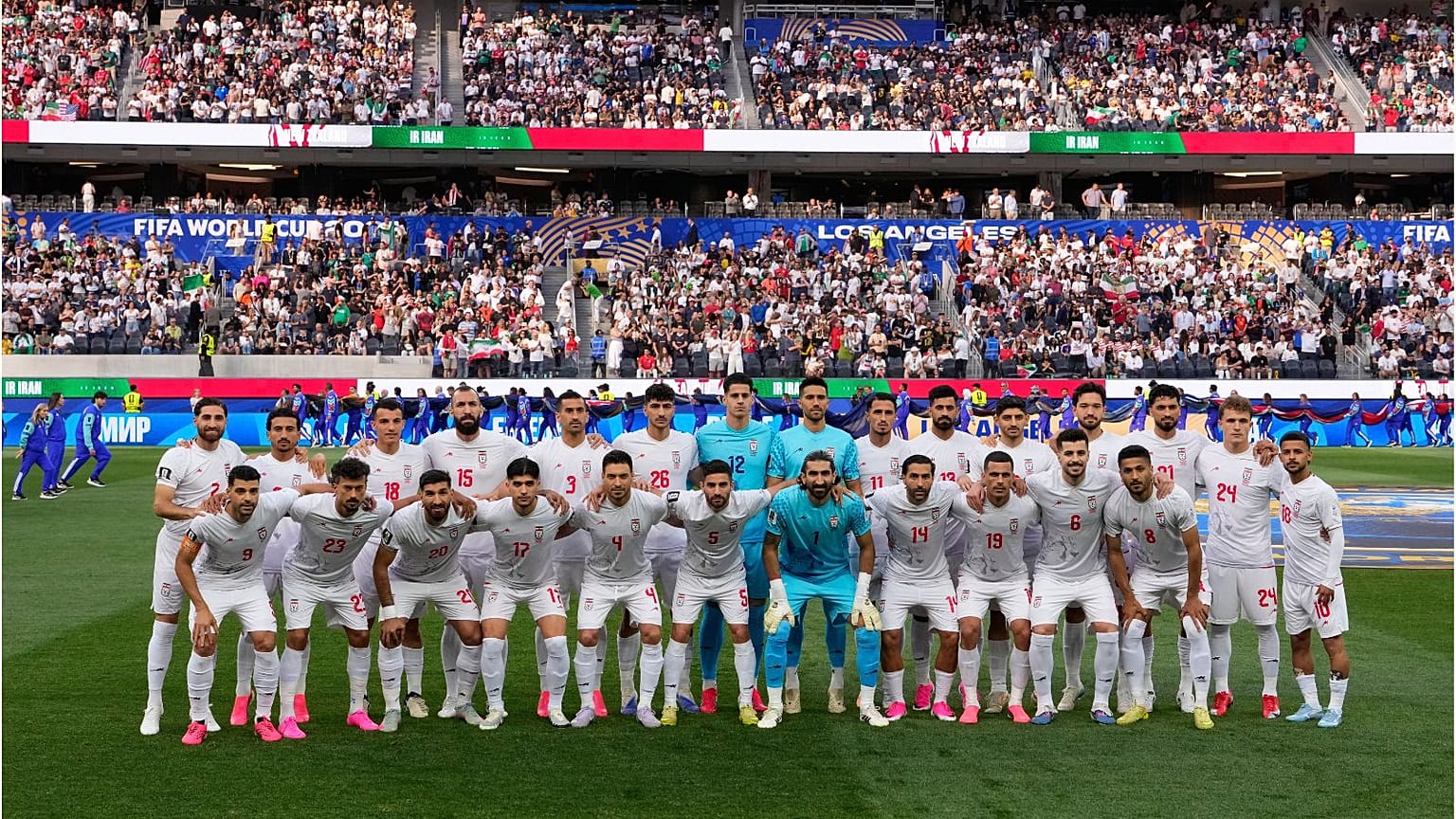
Iran's national football team is still being held to entry restrictions inside the US two days after Washington and Tehran signed a framework deal aimed at ending their war, causing further ire and threatening to put a stain on this summer's World Cup.
The 14-point deal, separately signed by US President Donald Trump in Versailles and Iranian President Masoud Pezeshkian in Tehran on Wednesday, makes no mention of eased conditions for Iranian nationals, including footballers, moving through US immigration.
Iran's football federation said on Thursday it would file a formal complaint with FIFA, arguing that US-imposed travel restrictions are stopping the team from preparing properly for the tournament.
The complaint follows confirmation from US officials that Iranian players will only be allowed into the country one day before each match and must leave immediately afterwards — rules that remain unchanged despite this week's diplomatic breakthrough.
The Iranian federation FFIRI said in a statement it would pursue the complaint through FIFA's legal channels, calling the restrictions "inconsistent with the principle of equal conditions for all participating teams."
The statement came days after head coach Amir Ghalenoei called his side "the most oppressed team in the history of international competitions" following Iran's 2-2 draw with New Zealand in their opening match.
Iran's coaching staff had planned to arrive two days before each match and leave the day after, to give players time to recover and adjust.
Instead, for the New Zealand game, the squad arrived in Los Angeles just one day before kick-off and had to leave straight after the final whistle.
Forward Mehdi Taremi said the players were told on the day of the match that they would have to leave US territory once the game ended.
White House dismisses complaints
Andrew Giuliani, head of the White House task force overseeing the tournament, dismissed the federation's complaint, saying the rules had been set out from the start. "From the beginning, we stated clearly that this procedure would apply," he said.
"The team will be allowed to enter the United States one day before the match and will be required to leave after the game. This applies to Los Angeles and Seattle," Giuliani added.
Iran had asked to arrive in Los Angeles earlier before its next match against Belgium, scheduled for Sunday at 9 pm CET, but the request was denied.
The travel restrictions add to an already strained relationship between the federation and US authorities.
Washington has also refused visas for around 15 members of Iran's backroom staff, including federation president Mehdi Taj, who has been unable to accompany the team.
What can FIFA do?
Iran is playing in the tournament hosted by the US, Mexico, and Canada against the backdrop of the recent war and the fragile ceasefire that followed, which forced the team to be based in Tijuana instead of across the border in the US, where all three of its group-round matches are to be held.
A framework deal that paves the way to long-term peace was signed on Wednesday and will be followed by another 60 days of talks, with tensions between the US and Iran still high.
FIFA had not responded to the complaint at the time of publication.
FIFA has limited authority to intervene in such disputes. The organisation has stated that immigration enforcement "remains outside its jurisdiction," even though its host city agreements require governments to guarantee a "nondiscriminatory visa environment" for players and officials as a condition of hosting matches.
FIFA has previously stripped a host of a tournament over visa-related access issues — it removed Indonesia as host of the 2023 Under-20 World Cup after the government blocked Israel's participation — but it has not signalled any willingness to take similar action against the US.
The Trump administration's own travel-ban proclamations exempt athletes and team staff travelling for the World Cup from entry suspensions, although the timing and conditions of that entry remain at the discretion of US border officials.
HUMAN RIGHTS VS RELIGIOUS RITES
U.S. Justice Department Looks Into Alleged MLB Religious Discrimination
June 20, 2026 By EWTN News By Tyler Arnold Major League Baseball (MLB) is coming under federal investigation for potentially discriminating against San Francisco Giants players who displayed Bible verses on their uniforms during the team’s gay pride celebrations.
Harmeet Dhillon, assistant attorney general for the Civil Rights Division of the Department of Justice (DOJ), sent a letter to MLB Commissioner Rob Manfred on June 18 that said the DOJ will use all available means to hold employers accountable for discrimination and referred the matter to the Equal Employment Opportunity Commission (EEOC).
The Giants held a “Pride Night” on June 12 in which most players wore caps that infused the colors of the Progress Pride Flag onto the team’s logo, which was advertised as a “celebration of Pride and the LGBTQIA+ community” during a game against the Chicago Cubs.
Starting pitcher Landen Roupp and two relief pitchers wore the caps but wrote Bible verses next to the rainbow-colored logo. Roupp wrote “Genesis 9:12-16,” in which God tells Noah the rainbow is “the sign of the covenant that I am making between me and you and every living creature with you for all ages to come” and promises to never flood the entire Earth again.
The Giants apologized in a statement to the San Francisco Standard, saying the display “caused pain and anger to many in the LGBTQ+ community.” It also prompted an official warning from the MLB to not display handwritten messages in any future games.
The DOJ letter cites an MLB explanation for why the players were warned, reported by NBC News, which said the warning is not disciplinary and “had absolutely nothing to do with the content of the message.” Rather, the MLB cited a rule that prohibits displays of writings and messages on uniforms.
However, Dhillon accused the MLB of having a “double standard” in how it enforces this rule, noting the MLB allowed players to wear “Black Lives Matter” messages in spite of the broad prohibition.
Dhillon’s letter noted that employers cannot legally use “facially neutral” policies as “a pretext for discrimination” and said the selective enforcement “calls MLB’s true motives into question” and raises questions about whether the league is complying with federal civil rights protections. She also cited Supreme Court precedent requiring employers to accommodate religious expression in uniform rules.
“The Civil Rights Act prohibits MLB and its franchises from unreasonably burdening the rights of players with religious objections to serving as the league’s vehicle for pro-Pride messages,” she wrote to the commissioner.
Neither the MLB nor the Giants responded to a request for comment. Support from archdiocese
The players got public support from the Catholic Archdiocese of San Francisco, which was first reported by the New York Post.
Peter Marlow, a spokesperson for the archdiocese, said in statements provided to EWTN News that “people of faith should not be compelled to hide or suppress their sincerely held religious convictions in public life, including in the world of professional sports.”
“In a diverse society, respect should be a two-way street,” he said. “Just as individuals with same-sex attraction deserve to be treated with dignity and free from unjust discrimination, people of faith deserve the freedom to express their beliefs peacefully and respectfully without being presumed hostile or hateful.”
While he said he understands that “some individuals may have been offended,” he added: “We do not believe that a respectful reference to sacred Scripture should be viewed as inherently hurtful or exclusionary.” Other controversies
This investigation also comes less than one month after the Nationals fired Sean Hudson, its former director of community relations, for saying the team tries to avoid the inclusion of pitcher Trevor Williams in promotional materials because of his strong Catholic faith.
Williams was outspoken against the Los Angeles Dodgers giving a Pride Night award to the Sisters of Perpetual Indulgence — a group of drag queens who dress like Catholic nuns and mock Catholic symbols and practices, which includes a blasphemous satire of the Mass.
This week, Rep. Lauren Boebert, R-Colorado, reiterated her call for a DOJ investigation into that incident and questioned a long-standing rule that exempts the league from antitrust regulations. In her June 17 letter, she demanded a response within 10 days to her concerns about alleged patterns of discriminatory behavior from the MLB.
“No private organization, even one granted special legal status, should be permitted to penalize or marginalize Americans for objecting to the public mockery of their faith,” she wrote. “MLB’s privileged antitrust position must not serve as a license for exclusionary practices.”
The Nationals did not respond to a request for comment.
Controversies about pride celebrations have also extended into the minor leagues, with the York Revolution forfeiting a game because some players refused to wear pride-themed jerseys. This team is part of the Atlantic League of Professional Baseball, which is a partner of the MLB.
The team issued a statement saying the players’ refusal to participate in pride is “completely inconsistent with our vision.” The statement said they decided to cancel the game and host a separate Pride event “out of respect for the Pride community and the York community.”
About EWTN News EWTN News is the rebranding of the Catholic News Agency (CNA), following the decision by EWTN — which was launched as a Catholic television network in 1981 by Mother Angelica, PCPA — that brings CNA and its affiliated ACI international outlets under a single, unified identity. Previous CNA articles may be foundby clicking here. View all posts by EWTN News →
NO BID CONTRACT AS USUAL
US Joint Interagency Task Force 401 Awards $500 Million Counterdrone Contract
Joint Interagency Task Force (JIATF) 401, the organization tasked with researching, testing and buying emerging counterdrone technologies for the United States Department of War (DOW), has awarded a $500 million contract to a California startup whose products have earned praise for downing thousands of Russian attack drones over the past two years in Ukraine. The three-year agreement with Perennial Autonomy will accelerate the DOW’s capacity to deploy low-cost air-to-air drone interceptors to counter uncrewed aerial systems (UAS) and protect warfighters at home and abroad.
Under the deal announced May 18, 2026, Perennial will provide a range of artificial intelligence-enabled, attritable counter-UAS, including Merops interceptors, Bumblebee quadcopters and Hornet midrange strike drones. Attritable means the drones must be inexpensive and rugged enough that they can be placed at high risk or even lost in action without busting the budget. The contract does not set a specific end date or production target.
All three systems already are being used by forces operating in U.S. Central Command. Merops interceptors have blocked or destroyed more than 4,000 Russian drones in Ukraine since mid-2024, the company says.
The Perennial systems integrate detection, tracking and engagement capabilities using computer vision, radio frequency sensing, jam-resistant communications and autonomous targeting, a DOW news release said. Soldiers retain decision-making authority over the use of lethal force.
“Drones are the defining threat of our time,” U.S. Army Brig. Gen. Matt Ross, director of JIATF 401, said in a Perennial news release. “The proliferation of inexpensive unmanned aerial systems allows nonstate actors and individuals to access intelligence, surveillance, reconnaissance and precision strike tools in ways that were previously only available to state actors.”
Low-cost Shahed drones built by both Iran and Russia have played a significant role in Russia-Ukraine and Middle East fighting. As a result, demand has soared for Perennial’s counter-UAS systems. During budget hearings in April, Army Secretary Daniel Driscoll told lawmakers that the U.S. military had bought 13,000 Merops interceptors in the early days of the Iran war at about $15,000 per unit, whereas each Shahed costs $30,000 to $50,000.
JIATF 401 announced a $5.2 million deal with Perennial in late January to buy the Bumblebee V2 counterdrone system. Manufacturing and deliveries began soon after that, and JIATF 401 began testing initial prototypes of the Bumblebee V2 at Fort Bragg, North Carolina, on April 23. The defense intelligence company Janes reported in April that tens of thousands of Bumblebee V1 quadcopters had been sent to Ukraine’s Unmanned Systems Forces over an undisclosed period.
DOW announced the Drone Dominance initiative in December 2025. Under the plan, $1 billion will be invested over the next two years to buy small, lethal drones. The funding also will accelerate growth of the nation’s UAS industrial base and rapidly arm combat units with low-cost drones.
In a video posted to the social platform X announcing the program on December 2, War Secretary Pete Hegseth said: “Drone Dominance will do two things: drive costs down and capabilities up. We will deliver tens of thousands of small drones to our force in 2026 and hundreds of thousands of them by 2027. … At the Department of War, we’re adopting new technologies with a ‘fight tonight’ philosophy, so that our warfighters have the cutting-edge tools they need to prevail.”This article was published by The Watch
About The Watch The Watch is a professional military journal published by United States Northern Command (USNORTHCOM) for foreign partners and allies. View all posts by The Watch →
REVISIONIST HISTORY
The Middle Ages, ‘Enlightenment,’ And Propaganda – OpEd
A medieval image of Peter the Hermit leading knights, soldiers, and women toward Jerusalem during the First Crusade
It’s often seemingly hopeless to try to convince people that the Middle Ages was anything other than the caricature often found in popular culture and eighteenth-century commentary. As historian Ralph Raico has noted, other than the Industrial Revolution, there is probably no historical topic in which the general public is more propagandized and more generally wrong than the topic of the Middle Ages. Raico has described how no matter how often he told his students that medieval princes and kings were subject to the law, and constrained in their powers by a variety of religious and political institutions, his students overwhelmingly stated in exams that medieval lords ruled as autocrats.
Although the general public still thinks of the Middle Ages in terms of images from popular culture, actual historians have long since moved on. This is partly why historians virtually never use the term “the Dark Ages” anymore. And if the term is used, it refers only the early Middle Ages, due to the fact that there is a dearth of documentary and textual evidence form that time period. The High Middle Ages—the time of the great cathedrals and urbanization in Europe—was hardly a Dark Age, of course, and the idea that the Middle Ages was a time of unchanging stagnation was jettisoned long ago.
In his lectures, Yale historian Paul Freedman notes that “Dark Age” is now generally used as a pejorative term. Yet, there is no agreement on when these Dark Ages supposedly occurred. Freedman comments on the how the historiography of the Middle Ages developed:
The traditional periodization concentrated on the fall of the Roman Empire. And while everybody admitted this was somewhat of an arbitrary date, and indeed its origins and consequences in Gibbon’s Decline andFall of the Roman Empire extend to the second century AD and go on to the fall of Constantinople in the fifteenth century, nevertheless, 476, the deposition of the last Roman emperor ruling from Ravenna by the barbarian chieftain Odoacer, who then proclaims Italy to be part of the Eastern Roman Empire, or at least loyal to the Eastern Roman Empire, that loyalty largely a fiction.
In the traditional periodization [the year] 476 [AD] is then followed by something called the Dark Ages. And the Dark Ages end, depending on your point of view, with the growth of the European economy in the tenth or eleventh century, with the rediscovery of Latin classical culture in the twelfth century, or with the Italian Renaissance in the fifteenth century.
Certainly, the Renaissance artists regarded everything that came before them as the Dark Ages. And it is they who call medieval architecture “Gothic,” by which they don’t mean a complimentary term. Because if there’s one thing the Cathedral of Notre Dame in Paris is not, it’s not Gothic in the literal sense. It has nothing to do with the Visigoths or the Ostrogoths. We have a few little remnants of Visigothic and Ostrogothic architecture, and it’s not like that at all.
But for [Giorgio] Vasari and people like this—Italian Renaissance writers—all this was just junk. It was just junk of the past. It’s just the Dark Ages. The sun rose in Florence sometime after Dante, is what most people continue to believe.
Freedman could have noted that the very term “Middle Ages” comes from a certain obsession among those same Renaissance writers, among them Petrarch in the fourteenth century, who viewed the history of Europe as being composed of only two periods that really mattered: the period of the Greeks and Romans in antiquity, and the new age (or soon-to-come) age of enlightened modernity. Thus, the middle age became the unimportant “dark” period in the middle of the two.
As with most modern historians of the Middle Ages, Freedman finds this “periodization” to be inadequate, but, he says: “as a medievalist I long ago gave up fighting this and embraced it.”
Of course, these time periods were not given those names through some sort of objective process. The names of historical periods did not descend to us out of the heavens. Historians, scholars, pundits, and propagandists of centuries past createdthese names for those time periods, often for political purposes.
A discussion on this can be found in a new book from Ada Palmer called Inventing the Renaissance: Myths of a Golden Age. Palmer is primarily focused on the so-called Renaissance, but how scholars and artists and other thought about the Renaissance often largely depended on a view of the Middle Ages. In a recent interview which covered her book in detail, Palmer described how one of the basic foundation of the book is the problem of developing a dark-age-golden-age narrative. Palmer asks
Where does the idea come from that there is a golden age? Where does the idea come up from that there was a dark age? Are dark ages and golden ages even real? No. But where did this myth come from? And then why has this myth been transformed over time? So [the book is] a historic story about the invention of a historical time period. [I]t looks at Petrarch, the first person to describe the Dark Ages as “dark.” [The book] looks at Renaissance figures and why in their period it was politically convenient to talk about coming from an age of ash and shadow to a more golden one. But it continues that story forward and it talks about the seventeenth century and the eighteenth century and the nineteenth century and the twentieth century and all the different reasons that we love [the idea of a golden age] in our imaginations: the idea that there was a fall, and then there was a grim dark age, and then there was a golden age, that comes after it. And this is a very satisfying and simple narrative that has been evergreen and useful for different people.
Palmer also makes reference to an important phenomena in societies that have absorbed the old English nationalism of the past. That is, in the Anglosphere, our modern views of the Middle Ages have come to us through political and cultural propaganda designed to specifically attack institutions connected to England’s main rival in the early modern period: Spain. It became important in this milieu to foster propaganda against the institutions associated with the Spaniards, mainly the Catholic Church, which was a key institution in the middle ages. A common side effect of this was to label all medieval institutions as backward and prone to despotism of a very “un-English” variety.
As Palmer put it:
If you’re coming from the Anglosphere you have to remember that there was a vast propaganda machine trying to make us dislike everything Spanish for the whole formation of our civilization over the past 200 years.” These have their origins in the old “black legends” about the Spanish—the leyendas negras—dating back to the sixteenth century. [Free PDF download.]
Palmer is certainly not coming at this as an apologist for the Catholic Church. Indeed, Palmer makes these comments on a podcast called “History for Atheists” and she notes much of her scholarship on the Renaissance began with her interest in atheism. Yet, as a historian, Palmer apparently feels compelled to separate the myth from the more nuanced reality of the Renaissance, even if this unravels some of the old accusations against the Church. Palmer notes, for example, that Galileo did not get into trouble with the Holy Inquisition for doing “too much science.” The Inquisition, she notes, was concerned with theological arguments, not scientific observations. That is, the Inquisition was not exactly troubled by Galileo’s telescope. Rather, Palmer notes Galileo got into trouble when he started fancying himself a theologian, and even then, the fact he ultimately faced house arrest was largely a political matter aggravated by Galileo’s penchant for angering his powerful patrons.
But we all know how narratives like the Galileo story become ideological weapons, portraying modern political institutions as “enlightened” and “reasonable” while the political institutions of the more distant, medieval past as somehow to be dismissed out of hand as too corrupted and backward.
After all, the popular view of the Middle Ages remains something not too far off from the images portrayed in, say, Monty Python and the Holy Grail, and is incredibly persistent. Indeed, it often seems that people are willing to believe virtuallyanything about the Middle Ages so long as it makes the people of that time look stupid, superstitious, and lazy. The common modern view of the Middle Ages is perhaps the most consistent illustration of “chronological chauvinism.”
How we view different historical periods continues to be important in terms of political ideology. Political movements are often shaped by their view of the Middle Ages or the institutions that predominated at the time. So, those who take a dark view of the idea of Christendom or of pre-democratic civil governments, will often dismiss Christianity—and especially Catholicism—and monarchy as “medieval”—a term that is itself often pejorative. This is all to be contrasted with the artifacts and institutions of more recent historical periods, all of which have wonderful and propagandistic titles which let us know how much better they are than the “Dark Ages.” The modern historical periods have names like “the Age of Reason” and “the Renaissance” and “the Enlightenment.” These are extremely effective names. Who wants be against reason and enlightenment? Clearly, when it comes to historiography and the popular imagination, the parties who claim to be the inheritors of these deliberately-named historical periods are often winning the propaganda war.
Why Does It Matter?
Moreover, the favorable press received by the Enlightenment and the Renaissance have been most unfortunate for those who support freedom and oppose state power. After all, the ideological and political thrust of both these periods tended toward strong states, political centralization, the spread of large standing armies, the expansion of conscription, and other hallmarks of growing state power. It is not a mere coincidence that the turn away from the “backward” medievals, and the turn toward “modern” thinking, also fostered the rise of absolutism and mercantilism. These latter developments, after all, were regarded as more “rational,” “enlightened,” “scientific” and necessary to leave the old “Dark Age” behind. After all, in this new age aborning, should not economies and states and culture directed and governed from the center by enlightened experts rather than by the backward provincials who cling to their localized ways of the past?
This, of course, was the thinking of the French Revolutionaries, and also of the absolutists—French and otherwise—that came before them.
In contrast, we find that the political institutions of the Middle Ages were decentralized, heavily privatized, and relatively weak compared to non-state institutions such as the Church and extended family networks. (For details see my recent review of The Medieval Constitution of Liberty and my recent lecture on taxation in the Middle Ages.)
Although the parties of renaissance and enlightenment often claim to be the parties of freedom and human rights, one can easily make the case that the turn away from the political constitutions and milieus of the Middle Ages was also a turn away from the development of pro-freedom ideology and anti-state skepticism. Rather, the embrace of “modernity” was really a turn toward absolutism, centralization, and war.
About MISES The Mises Institute, founded in 1982, teaches the scholarship of Austrian economics, freedom, and peace. The liberal intellectual tradition of Ludwig von Mises (1881-1973) and Murray N. Rothbard (1926-1995) guides us. Accordingly, the Mises Institute seeks a profound and radical shift in the intellectual climate: away from statism and toward a private property order. The Mises Institute encourages critical historical research, and stands against political correctness. View all posts by MISES →
Europe’s Climate Diplomacy In Central Asia: Energy Security Or Green Colonialism? – Analysi
In an era of climate crisis and geopolitical instability, energy security stands as one of the most critical components of state foreign policy, particularly for the European Union. Following the onset of the Ukraine war and the subsequent reduction or cessation of Russian gas exports to Europe, European authorities are not only seeking to diversify their energy import routes but are also striving to accelerate the transition to renewable energy sources (Pivariu,2025). Beyond the climate and energy dimensions, this engagement is also shaped by the broader context of great power rivalry, as major global actors including China, Russia, and the West compete for influence and investment opportunities across Eurasia, with Central Asia emerging as a key geopolitical arena(IFIMES,2025). In this context, Central Asia, a region with immense potential for producing clean energy (solar, wind, hydro, and even green hydrogen), has garnered particular attention. The question that arises is whether these collaborations are genuinely founded on equal partnership and sustainable development, or whether behind the green façade of this diplomacy lay a new form of energy-driven, exploitative colonialism. To better understand the issue, we first turn to Europe’s climate diplomacy.
Europe’s Climate Diplomacy: Objectives and Tools
With the adoption of the European Green Deal in 2019, the European Union charted its strategic course towards achieving a carbon-neutral or zero-carbon economy by 2050. This deal serves as the cornerstone of European environmental policy, emphasizing the reduction of greenhouse gas emissions and increasing the share of renewables in the EU’s energy mix. Figure 1 illustrates the future of global cooperation for carbon neutrality under two distinct scenarios: maximum cooperation and minimal cooperation. This figure clearly demonstrates that carbon neutrality is a global concern, and the inclination toward renewable energy aligns with this objective.
Source: IEA
This agenda not only seeks internal transformations within the EU but has also influenced the Union’s relations with other countries, especially those in Central Asia. Since its adoption, various tools have been developed to support this green transition in European foreign policy, including the Global Gateway initiative. Presented as an alternative to China’s Belt and Road Initiative, the Global Gateway aims to develop sustainable infrastructure in developing nations. In this context, Central Asian countries, owing to their vast renewable energy capacities, have attracted particular attention from across the globe, especially Europe. This cooperation primarily involves renewable energy production projects, such as solar and wind farms, notably in Kazakhstan, Uzbekistan, and Turkmenistan. Furthermore, the development of green hydrogen in these countries is a key objective for the EU, a pursuit that has gained special significance as Europe seeks to reduce its dependence on fossil fuels and rely on clean sources. The Samarkand meeting can also be considered a significant step by EU countries towards expanding renewable energy and investing in Central Asia (Popławski, 2025).
Under the new EU strategy to be implemented for Central Asia, this initiative will foster regional cooperation through projects related to environmental protection, biodiversity, renewable energy sources, sustainable land management and agriculture, and scientific collaboration at various levels (European Research Institute, 2023). Within the framework of these policies, instruments such as the European Investment Fund, the European Bank for Reconstruction and Development, and partnerships with major European companies like Siemens and Total Energies are among the active mechanisms in this endeavor.
Central Asia’s Capacities in the Green Transition
Despite having economies historically reliant on fossil fuels (oil and gas) for decades, Central Asian countries now have the opportunity to become a regional hub for clean energy. Kazakhstan alone enjoys approximately 300 sunny days per year. Turkmenistan possesses significant water resources along the Caspian Sea, and Uzbekistan has recently initiated plans to develop wind turbines in its desert regions. These characteristics make the region one of the most important geographic areas for renewable energy production.
Figure 2 shows the number of sunshine hours in Astana, Kazakhstan, indicating the country’s high potential for solar energy generation. Moreover, the region’s deposits of critical metals such as lithium and rare earth elements can contribute to the global supply chain for clean energy equipment (e.g., lithium batteries and solar panels). The strategic agreement between the EU and Kazakhstan on green hydrogen and critical raw materials underscores the country’s importance in EU policymaking (Zabanova, 2023). Kazakhstan has also signed energy and transport agreements with the EU (NE Global, 2024). If managed properly, Central Asia could become not only an exporter of clean energy but also a technological partner for Europe. However, to become a clean energy hub, the region requires adequate infrastructure, substantial investment, and the transfer of modern technologies—capabilities the EU, as a major international actor, can provide, positioning itself as a major energy investor in the region. The €12 billion investment in renewable energy in Central Asia should be viewed in this light (Ellis, 2025). This becomes even more comprehensible when considering the investment needs of Central Asia across various sectors, including renewables, as depicted in Image 1
Furthermore, Image 2 illustrates how each country in Central Asia and the Caucasus meets its energy needs. It is evident that despite the region’s high potential, Central Asian countries currently rely on oil, natural gas, and coal. Although some countries, like Tajikistan, may have turned to renewables due to a lack of access to fossil fuels.
Source: EMBER
Image 3 shows the combined renewable energy potential of Central Asia and the Caucasus, which could form a green corridor for energy transmission to Europe.
Source: EMBER
Green Colonialism?
So far, on the surface, everything appears positive: foreign investment, job creation, and technology transfer. However, from a critical perspective, there are fundamental concerns regarding the structure of these collaborations. The concept of ‘green colonialism’ refers to situations where developed countries, leveraging climate tools and clean energy projects, effectively mobilize the natural resources and capacities of developing nations to serve their own interests, without a significant share of the benefits accruing to the host countries. These concerns intensify when large-scale solar or green hydrogen projects are planned in deprived areas without the involvement of local communities (Schaik and Cretti, 2023).
In some instances, decision-making processes at the national level in Central Asian countries occur without the participation of local communities or even civil society institutions. This prevents Central Asian countries from directly benefiting from the projects, leaving them merely as energy suppliers. In this context, examples exist of large solar projects in Kazakhstan where the social and environmental impacts on local communities were not adequately assessed. For instance, in some areas of Uzbekistan and Kazakhstan, lands selected for wind turbines and solar panels may be essential for local agriculture or settlement, but state authorities overlook these issues. The lack of attention to local conditions and the neglect of people’s demands are significant challenges. This situation is reminiscent of the era of colonial exploitation of oil resources in the 20th century, with the difference being that now this exploitation is presented under a green guise and the cover of sustainable development.
A Different European Approach or History Repeating Itself?
Some proponents of European climate diplomacy argue that these collaborations are fundamentally different from previous colonial models. First, they note that transparent European legal and environmental frameworks are observed. Second, their ultimate goal is to reduce global emissions. Thus, Europe, as a global actor, seeks to ensure long-term interests by supporting green projects. Indeed, given the climate change crisis and the need to reduce greenhouse gases, the EU’s green initiatives can be presented as solutions to global problems like climate change and energy security. Yet questions remain unanswered regarding the enforceability of these frameworks and the actual role of Central Asian countries in shaping projects. There are considerable concerns and doubts, particularly concerning guarantees for the interests of Central Asian states. If the countries of the region remain merely energy suppliers for Europe, rather than technological and innovation partners, it is impossible to speak of an equitable interaction.
Paths for Improvement and Key Recommendations
To steer EU-Central Asia energy relations away from a pattern of green colonialism, a fundamental reassessment of project design and implementation is required. Key recommendations for reforming this process include:Establishing mechanisms for active local community participation in renewable projects: This can enhance transparency and social synergy, involving local communities in decision-making processes.
Genuine transfer of modern technologies to host countries, not merely the exploitation of their resources: This would enable Central Asian countries to develop independently in the field of clean energy, becoming true partners of the EU.
Strengthening local oversight institutions to assess environmental and social impacts: This can help protect natural resources and ensure the well-being of local communities. Defining mechanisms to guarantee long-term economic benefits for Central Asian countries: Economic and trade mechanisms should be designed so that Central Asian countries reap the long-term benefits of these projects.
Developing multilateral regional institutions for collective bargaining in climate and energy negotiations: This would empower Central Asian countries to play an effective role in global climate and energy discussions.
Conclusion
The transition to clean energy and the reduction of dependence on fossil fuels are global imperatives that must be addressed by all countries in combating the climate crisis and reducing environmental pollution. In this regard, the European Union, as a global actor, seeks to lead and advance green and sustainable policies, particularly leveraging Central Asia’s vast potential as a major source of renewable energy. With their specific geographical features and rich natural resources, Central Asian countries can play a vital role in the global transition to a green economy. However, the manner in which these collaborations are managed and structured is of paramount importance.
If EU energy cooperation with Central Asia is designed solely based on short-term interests and the exploitation of the region’s natural resources, it may lead to a repetition of a new model of economic colonialism, where Central Asian countries remain in the role of energy and raw material suppliers without benefiting from the real advantages of these projects. This situation contradicts the principles of sustainable development and social justice and could lead to social discontent and environmental degradation in these countries.
Conversely, if Central Asian countries genuinely become partners in decision-making and project design, benefit from modern technologies, and establish robust and transparent oversight institutions to evaluate the environmental and social impacts of these projects, then this cooperation can be viewed as a successful model of green diplomacy and sustainable development. Therefore, the path forward requires greater synergy, transparency in decision-making processes, and enhanced participation of local communities in major energy projects.
UNEC, (2023). Central Asia would need a massive shift rather than a massive increase in investment to reach net zero by 2050, according to the UN. https://unece.org/media/press/377754.
Ebrahim Rezaei Rad is a PhD candidate in International Relations and a university lecturer. He is also a university lecturer and guest researcher at the Middle East Strategic Studies and Research Center, within the Energy Diplomacy Studies Group. His primary research interests focus on energy studies, energy security, and the geopolitics of energy. He has authored several academic articles in these fields and has presented his research at international conferences addressing energy, security, and geopolitical issues. In addition, he has co-authored several books on related topics in collaboration with other scholars. His research examines the intersection of energy, international relations, and strategic studies, with particular emphasis on the role of energy resources in shaping regional and global geopolitical dynamics.
About IFIMES
IFIMES – International Institute for Middle-East and Balkan studies, based in Ljubljana, Slovenia, has special consultative status with the Economic and Social Council ECOSOC/UN since 2018. IFIMES is also the publisher of the biannual international scientific journal European Perspectives. IFIMES gathers and selects various information and sources on key conflict areas in the world. The Institute analyses mutual relations among parties with an aim to promote the importance of reconciliation, early prevention/preventive diplomacy and disarmament/ confidence building measures in the regional or global conflict resolution of the existing conflicts and the role of preventive actions against new global disputes. View all posts by IFIMES →
China’s New Intelligence Posture: Spying By Openness – Analysis
In early June, the Five Eyes – an intelligence alliance comprising the security and intelligence services of the US, UK, Canada, Australia, and New Zealand – published a bulletin titled ‘Safeguarding Our Secrets’. The bulletin warned that China’s Ministry of State Security (MSS) was increasingly using professional networking sites and job portals such as LinkedIn, Indeed, and Upwork to recruit unwitting government and civil service staff in their countries.
While the allegations have, predictably, been denounced by China’s Ministry of Foreign Affairs, they speak to a larger shift in China’s intelligence posture: one focused on exploiting the openness of digital spaces and torrential flows of public data to make rich intelligence pickings. This is a theme that materialises in various forms, from the extensive use of LinkedIn for recruitment to the exploitation of open-source large-language models (LLMs) for intelligence collection, and the synthesis of publicly validated and voluntarily provided data, such as biometric information and travel documentation, for predictive policing and surveillance. What then do these trends say about China’s role as a key global intelligence actor in 2026? And how are the counterintelligence services of targeted countries adapting to this new landscape?
Social Media Recruitment
China’s use of social media for intelligence-related purposes, mainly recruitment, is not new. As early as 2017, an MSS officer operating under the pseudonym of ‘Michael Yang’ contacted former Central Intelligence Agency (CIA) officer Kevin Mallory, developing a friendship with the American that would later be converted into a recruitment offer until the latter’s exposure and conviction in 2018. Mallory’s case was subsequently adapted into a short film produced by the Federal Bureau of Investigation (FBI) in 2020, aimed at increasing awareness of hostile recruitment on social media by China’s intelligence services. By 2023, such activity had intensified. At a Five Eyes summit meeting in Palo Alto, California, that year, Sir Ken McCallum, Director-General of Britain’s Security Service MI5, warned that China had not only stepped up its approaches to individuals and personnel attached to critical infrastructure, the security and diplomatic establishment, and civilian science and frontier technology, but was increasingly relying on social media to do so, having made nearly 20,000 recruitment attempts in the UK alone through LinkedIn.
Technological advancements, particularly in the field of digital forensics, have made efforts to counteract these challenges more feasible. In late 2025, MI5 rolled out its ‘Think Before You Link’ campaign and associated app to British parliamentarians targeted by Chinese intelligence, with the app’s integrated AI system helping to identify doctored profiles and messaging histories.
‘Safeguarding Our Secrets’, the most recent Five Eyes pronouncement, is hence only the latest iteration of a longstanding concern among Western counterintelligence services about the capabilities of their Chinese counterparts and their exploitation of the ‘open’ nature of social media. What is clear, however, is the enduring importance of technology in combatting this problem. The MSS has proven adept at using sentiment analysis in its messaging operations, both internally and, on occasion, in its external activities, to shape its communication so as to align with the beliefs of its targets. As intelligence services worldwide come to contend with the language and communication styles used in the MSS’s social media strategy to maximise effect, the use of increasingly advanced digital forensics to identify and pre-empt such messaging will become ever more important from a counterintelligence standpoint.
Distillation Attacks: Exploiting Open Source Code
Another illustration of the MSS’s effectiveness in exploiting open architectures is the increasing frequency of distillation attacks. Most commercial AI can be ‘flooded’ with automated prompts aimed at eliciting information from a system. The harvested data can then be used to explore further vulnerabilities within an adversary’s model, plug one’s own gaps, or outcompete other commercial models.
In recent months, Chinese intelligence has increasingly come to leverage the openness of commercial AI to harvest data through distillation attacks. Spurred to outcompete the US in the sphere of AI, the MSS has supported distillation attacks led by Chinese AI giants such as DeepSeek, MoonShot, and MiniMax against US models, with Anthropic, Google, and OpenAI coming under focused attack. Such distillation attacks act, in effect, as a form of advanced intelligence collection. As commercial AI becomes increasingly embedded within national security architectures, distillation, powered by quicker iteration, can provide an attacker from China with unique insight into US cyber and physical vulnerabilities to exploit.
As AI grows increasingly advanced, national counterintelligence services — particularly those faced with as powerful a rival as China — will take steps, as some already are, to limit the openness of AI architecture that enables such attacks to take place. While most commercial AI firms such as OpenAI and Anthropic operate as proprietary endeavours, limiting deep access to internal functioning by an adversary, distillation attacks place new demands for vetting and verification in how AI is used. Indeed, pressures from national security architectures will likely catalyse such a push. This, in turn, precipitates an accelerated collapse of the boundaries between industrial and national security intelligence — a shift which, while underway for some years, may have significant ramifications for the future of intelligence and geopolitics.
The Dynamic Control Platform and China’s New Intelligence Stack
Finally, recent reports about China’s ‘Dynamic Management and Control Platform for Foreigners‘ have brought into sharp focus the sophistication and near-omniscience the MSS enjoys vis-à-vis its adversaries through its harvesting and deployment of personal data. Similar to the Maven Smart System operated by Palantir and used by US intelligence during the Iran war, the Dynamic Control Platform (DCP) synthesises a multiplicity of data and intelligence inputs within a single visual dashboard. It fuses biometric information, sensor data, and vast streams of intelligence on specific targets to psychologically profile and pre-empt the actions of targeted individuals. Since its discovery, the platform has raised concerns that it could be used as a tool of intimidation and repression, both within and beyond China’s borders.
Much of the DCP’s success hinges on the use of open systems and databases holding voluntarily provided data. Simple inputs such as biometric data and travel details — often collected from foreign visitors through their visa applications — can be aggregated, organised, and weaponised through the platform. Its use therefore points to a larger conclusion: China’s intelligence services no longer require secret intelligence to target adversaries and competitors with the desired level of precision. Voluntarily submitted personal data, and even open-source intelligence (OSINT), can equally suffice in the hands of an intelligence power with the technological capacity to make sense of it. It is the capacity to understand data, not simply the quantity of it, that makes Chinese intelligence systems such as the DCP particularly effective, and even lethal.
Yet China’s omniscience by way of open-source data does not necessarily translate into omnipotence. Its counterintelligence adversaries in the West have already begun to explore steps to counteract, and even weaponise, the advantage the MSS enjoys through its unfettered access to personal data. Just as AI enables the MSS to generate fake social media profiles to suborn targets, or to synthesise, triangulate, and target specific individuals and their connections, it also provides those on the receiving end with the means to feed false data into the systems on which such technologies rely. AI is proving increasingly capable of circumventing traditional biometric sensors, undermining the integrity of the data on which systems such as the DCP depend. As technology facilitates further development, the inputs fed into such systems may grow increasingly suspect — exposing a key vulnerability of modern Chinese counterintelligence.
Intelligence is no longer restricted to the cloak-and-dagger world of secrecy alone, but is increasingly shaped by the publicly available torrents of data made accessible through cyberspace. China’s growing adeptness in managing these twin streams speaks to both the changing character of intelligence and to Beijing’s geopolitical heft on the world stage today. The rest of the world must rise to the challenge this poses — or risk being left behind in this dangerous new world.
About the author: Archishman Ray Goswami is a Non-Resident Associate Fellow at the Observer Research Foundation and a DPhil candidate in International Relations at the University of Oxford.
About Observer Research Foundation ORF was established on 5 September 1990 as a private, not for profit, ’think tank’ to influence public policy formulation. The Foundation brought together, for the first time, leading Indian economists and policymakers to present An Agenda for Economic Reforms in India. The idea was to help develop a consensus in favour of economic reforms. View all posts by Observer Research Foundation
Cuba approves sweeping market reforms as economic crisis and US pressure mount
Beyond the tourism sector, the legislative package introduces crucial updates for state enterprises, agricultural production and the national financial system.Facebook
Cuba's National Assembly has approved the country's most far-reaching economic overhaul since the 1959 revolution, ratifying a package of reforms designed to pull the island back from the brink of collapse after the measures cleared the Communist Party's Central Committee.
The package, voted on by lawmakers on June 18 and backed by President Miguel Díaz-Canel and former president Raúl Castro, comprises 176 measures grouped into 23 strategic areas of economic and social policy, according to the Communist Party newspaper Granma. The proposals emerged from a review process in which 390 suggestions were submitted to the National Assembly, of which roughly two-thirds were accepted in some form, with the remainder folded into implementation guidance or judged not to constitute substantive change.
Prime Minister Manuel Marrero unveiled the measures in a landmark address to the National Assembly, framing them as an effort to modernise the economy and improve productivity while preserving Cuba's socialist system.
The vote passed unanimously, and Díaz-Canel closed the session by reciting Fidel Castro's revolutionary slogan, "Socialism or death!"
"When the daily life of the people becomes extremely difficult, the primary duty of the Communist Party and the Revolutionary Government is not simply to explain the crisis, but to actively change whatever is necessary to overcome it," he said.
The reforms will, for the first time, permit private companies employing more than 100 workers and allow Cubans to own multiple businesses. Foreign investors will no longer be required to enter joint ventures with the state, and both domestic and foreign investors will be allowed to acquire equity stakes in state enterprises. The package also opens the door to private banks, paves the way for private real estate development and encourages direct foreign investment, including from Cubans living abroad. The state business sector itself will be restructured, with expanded autonomy, decentralised decision-making and revised rules governing profit allocation and executive pay.
Among the more granular provisions, the package will permit property leasing, free-of-charge usufruct arrangements and the selective sale of real estate, available to both resident Cubans and those living abroad on a case-by-case basis. In tourism specifically, the reforms introduce new categories of operators and updated business models, with a particular focus on drawing foreign direct investment from the Cuban diaspora while widening the scope of activity permitted to private domestic businesses.
The ruling party insisted the changes "do not constitute a deviation from the socialist project." Castro voiced full support for the package and called for broad public participation in its implementation. Díaz-Canel acknowledged that hardliners within the Communist party — which has held power on the island since 1965 — would likely resist parts of the package. "Some of the changes will not have absolute consensus, but cannot be postponed," he said.
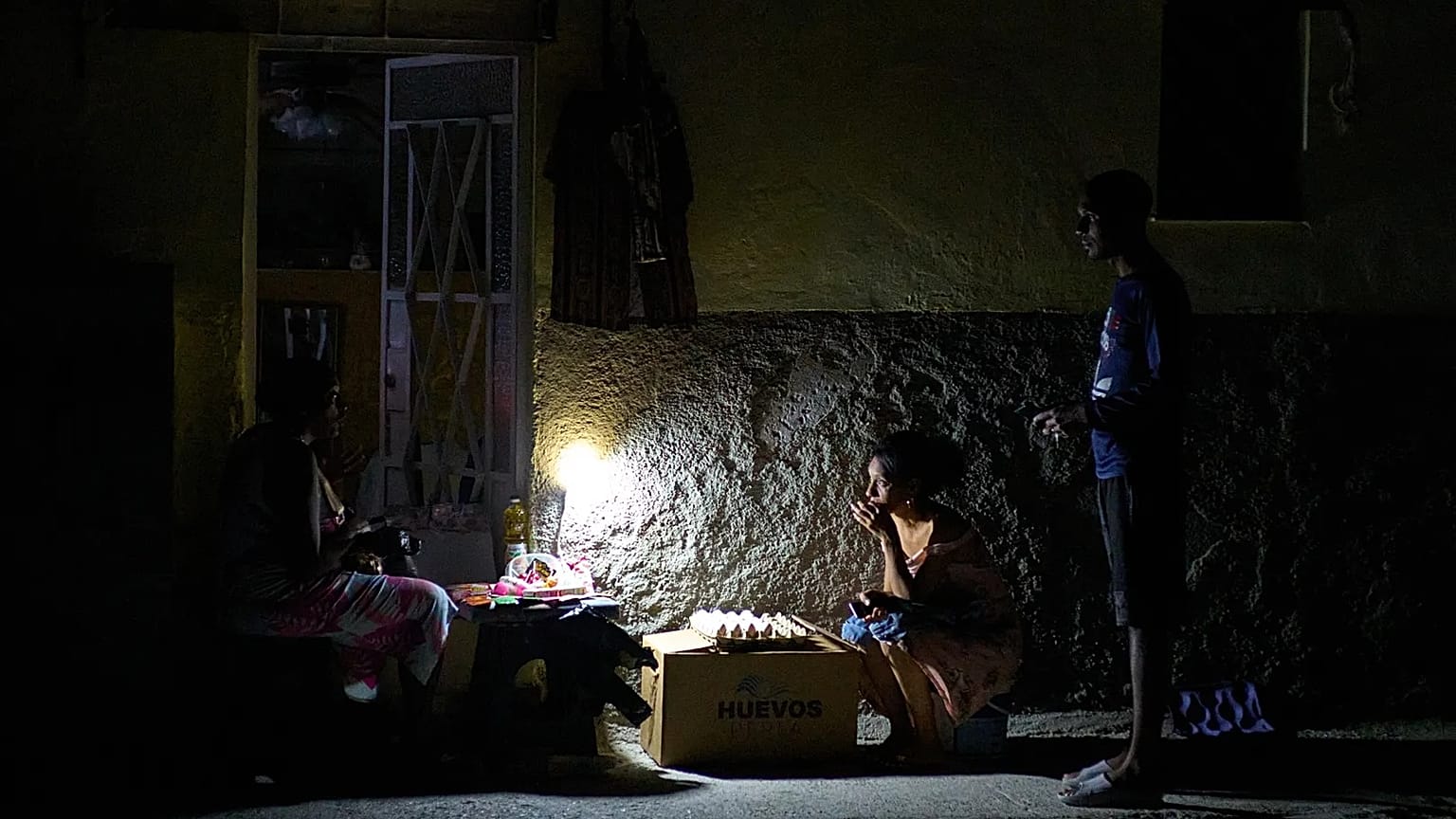
The reforms arrive as Cuba endures one of the deepest economic crises in its history, the latest chapter in a confrontation with Washington that has escalated steadily since January. Blackouts now regularly stretch beyond 30 hours, and the island is contending with acute shortages of food, fuel, water and medicine. Volker Türk, the United Nations High Commissioner for Human Rights, has warned that children are dying on the island for want of medical supplies. Only a single tanker, the Russian-owned Anatoly Kolodkin, has delivered crude oil to Cuba since the start of the year, arriving at the port of Matanzas in late March with a cargo that analysts said would cover little more than a week of the island's diesel needs.
Much of that hardship traces directly to Washington's pressure campaign. The Trump administration imposed a de facto fuel blockade on Cuba in January, in the aftermath of the US-led operation that removed Venezuelan president Nicolás Maduro and severed Cuba's access to subsidised Venezuelan oil. An executive order threatening tariffs on any country supplying fuel to the island successfully deterred Mexico and other potential suppliers from maintaining shipments. The blockade has since triggered repeated nationwide blackouts, and pushed Cuba to declare in May that its fuel reserves were entirely exhausted, a crisis that sparked the largest street protests in Havana since the embargo began.
The pressure has not been limited to economic measures. Last month, the US indicted Castro, Fidel's brother, over Cuba's 1996 downing of two civilian aircraft operated by a Miami-based exile group, in charges that carry the death penalty and that Havana has no obligation, and no apparent intention, to honour given the absence of an extradition treaty. The indictment was announced alongside the deployment of the USS Nimitz carrier strike group to the Caribbean, echoing the build-up that preceded the Maduro operation, when the USS Gerald R. Ford was stationed off Venezuela's coast in the months before his capture. Classified intelligence cited by Axios has separately disclosed that Cuba acquired more than 300 military drones from Russia and Iran since 2023 and held internal discussions about potential strikes on the US naval base at Guantánamo Bay, a revelation that added an unpredictable security dimension to what had largely been an economic and diplomatic standoff. Trump has repeatedly said Cuba would be "next" after his administration's campaigns against Venezuela and Iran, while CIA director John Ratcliffe travelled to Havana in May for talks that signalled some openness to dialogue.
In unusually candid remarks, Díaz-Canel broke from Havana's longstanding habit of attributing the country's troubles solely to the six-decade US trade embargo. He pointed instead to domestic failings, citing "slowness, bureaucracy and norms that impede those who want to produce," along with "decisions that we have put off." Even so, he was careful to frame the reforms as a defensive measure rather than a capitulation. "We are not doing this because of pressure from the Yankees," he said, but to "preserve" socialism.
Analysts were sceptical that the reforms were driven purely by internal conviction. "Their backs are up against the wall as never before," said Michael Bustamante, chair of Cuban studies at the University of Miami, according to AFP. "They're in the uncomfortable position of making changes to their economic model, seemingly because of the pressure that's being exerted on them by the United States."
The European Union piled on further pressure the same day, with a resolution urging sanctions against Díaz-Canel and Grupo de Administración Empresarial, the military-controlled business conglomerate that dominates large parts of the Cuban economy. The resolution condemned what it described as "the systematic repression" by the Cuban government, while calling for "profound economic and political change." The bloc has separately stepped up humanitarian assistance to the island in recent months, mobilising several million euros in aid to address shortages of food and drinking water.
Whether the reforms will satisfy the White House remains uncertain. Senior figures in the Trump administration, Rubio among them, have signalled that economic opening on Cuba's part could translate into reduced pressure from Washington, but the US gave no immediate response to the Cuban announcement. Vice-president JD Vance, asked on June 18 whether the administration would now turn its focus to Cuba following a memorandum of understanding ending the war with Iran, said Washington wanted Cubans to be "happy and successful." "We're actually talking to the Cuban government right now about how they could change their ways to change that," he said. "If they make smart decisions, we're going to have a much better relationship with that island." Trump has made clear his ambitions extend beyond economic policy to the makeup of Cuba's government itself, having repeatedly floated both military action and what he has called a "friendly takeover" of the island.
The government has yet to set out a timetable for implementing the reforms. Economists said the package could meaningfully improve investment flows and productivity if carried through, but cautioned that its ultimate impact would depend on execution Havana has not yet detailed — and on a Washington that has shown no sign, so far, of relenting.
Cuba's President Miguel Díaz-Canel admits 'urgent changes' needed to overcome crisis
The oil blockade imposed by President Donald Trump in January has brought the island's already moribund economy to the brink of collapse, marked by power cuts sometimes lasting over 30 hours.
Cuba's communist model needs "urgent changes" to overcome a major crisis which cannot be blamed solely on a crippling US oil blockade, President Miguel Díaz-Canel said in his frankest admission yet of the need for radical reforms.
While Havana's impulse has been to blame its problems on a more-than-six-decade US trade embargo and more recent blockade, Díaz-Canel admitted in remarks broadcast on Thursday there were "obstacles that don't come from outside, nor the blockade."
He called out "slowness, bureaucracy and norms that impede those who want to produce" as well as "decisions that we have put off" for contributing to the worst crisis in living memory.
"The situation calls for urgent and necessary changes," he told the Communist Party Central Committee.
Díaz-Canel was speaking at a party meeting convened hastily to fast-track reforms aimed at boosting the private sector and attracting investment from millions of Cubans who have fled abroad.
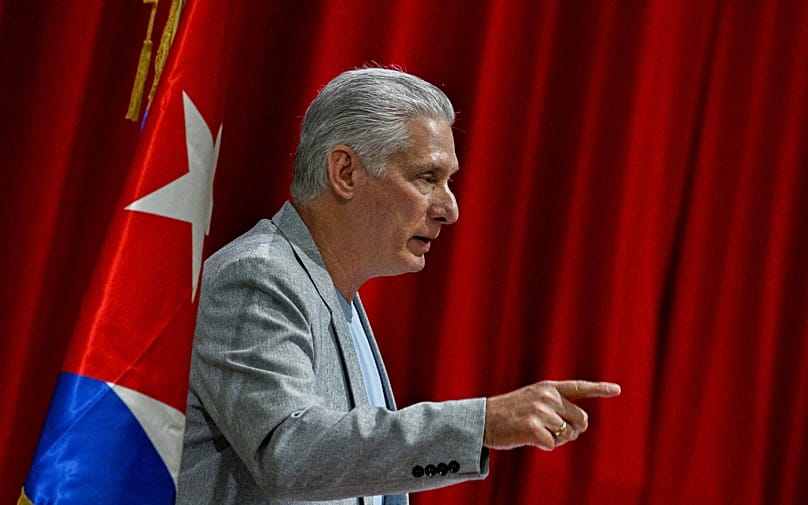
Cuban President Miguel Díaz -Canel delivers a speech at the Convention Palace in Havana, 20 March, 2026 AP Photo
The measures are part of an eleventh-hour bid to stave off economic collapse in the face of unprecedented US pressure.
They are expected to be approved by the National Assembly, which rubber-stamps legislation, later Thursday after being endorsed by the Communist Party.
'Backs against the wall'
Few details of the changes have been forthcoming but Díaz-Canel cited China and Vietnam as possible models for opening Cuba's economy to the world six decades after the overthrow of a US-backed dictator and embrace of communism.
"Their backs are up against the wall as never before," Michael Bustamante, Cuban Studies Chair at the University of Miami, told the AFP news agency.
"They're in the uncomfortable position of making changes to their economic model, seemingly because of the pressure that's being exerted on them by the United States."
The oil blockade imposed by President Donald Trump in January has brought the island's already moribund economy to the brink of collapse, marked by power cuts sometimes lasting over 30 hours and shortages of food, fuel, drinking water and medicine.
Díaz-Canel appeared to anticipate resistance from Communist hardliners.
Some of the reforms "will not have absolute consensus but cannot be postponed," he said.
But "when people's lives become this hard," the government has a responsibility to "change what needs to be changed" rather than try to explain away the crisis, he argued.
It is unclear, however, whether the changes will satisfy Trump, who is pushing for a change in Cuba's leaders as well as its economic model.
The Republican leader has floated a "friendly takeover" of Cuba and joked about making a "stop over" there after ending his war with Iran.
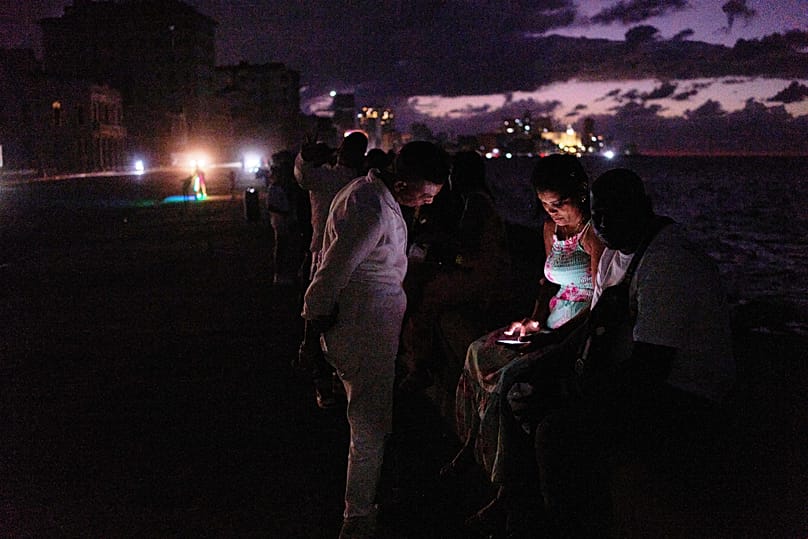
People spend the night in the dark on the Malecon during a blackout in Havana, 21 March, 2026 AP Photo
Asked on Thursday if Cuba was now in Trump's sights after he signed a deal to end the Iran war, Vice-President JD Vance said Washington wanted Cubans to be "happy and successful."
"We're actually talking to the Cuban government right now about how they could change their ways to change that."
"If they make smart decisions, we're going to have a much better relationship with that island," he said.
Widespread scepticism
Some of the reforms announced by Cuba were a rehash of earlier proposals, such as granting greater autonomy to state-owned enterprises, which account for roughly 80% of economic activity.
Many disillusioned locals shrugged off the announcements as too little too late, or more state "lies."
"It's a lie, we've been doing this for 67 years and it gets worse every day," Iris, a 58-year-old cleaner, who had been without power at home for 12 hours, seethed.
Related
The country's small but growing business class welcomed the changes, however, while making clear they did not see them as a quick fix.
The reforms "offer hope, a chance that may or may not materialise," said Mario Gonzales, the 32-year-old manager of a restaurant in Havana's historic old town which was thronged with tourists a decade ago and now fills only a handful of tables for dinner.



.jpg)


.jpeg)


.jpeg)