Wednesday, July 01, 2026

DARK SKIES NO  MORE

Astronomers Denounce Elon Musk-Led Plan to Pollute Earth’s Orbit With 1.7 Million Satellites

Some of the satellites “would be the brightest ever in orbit, with damaging consequences for dark skies on Earth,” said the European Southern Observatory.


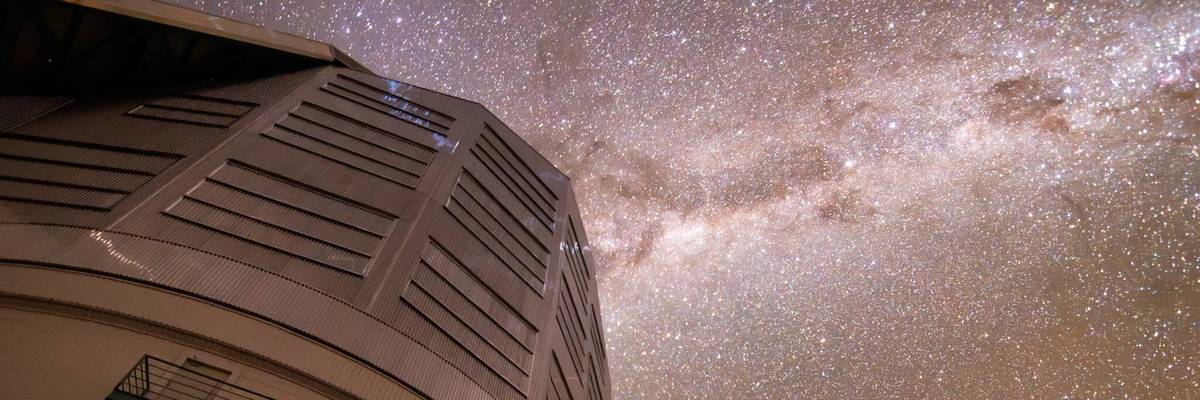
The night sky is seen above Rubin Observatory in Cerro Pachon, Chile on June 8, 2025.
(Photo by Observatorio Vera C. Rubin/handout/Anadolu via Getty Images)


Julia Conley
Jul 01, 2026
COMMON DREAMS

European astronomers on Wednesday urged the US Federal Communications Commission to block a plan led by SpaceX CEO Elon Musk to launch a total of 1.7 million satellites into the Earth’s orbit, warning that the use of so many extremely bright satellites—partially to support artificial intelligence data centers—would have “devastating consequences for astronomy.”

SpaceX’s Starlink telecommunications program has already rapidly increased the number of satellites orbiting the Earth, with the total now exceeding 14,000 since 2019.


Now the space exploration company led by Musk—a former special government employee under the Trump administration—has plans to send 1 million more satellites into space, which would “significantly alter the appearance of the sky,” according to a new study by the European Southern Observatory (ESO).

Scientists found that 100,000 is the maximum number of satellites—ones that are faint enough to be invisible to the naked eye—that can orbit the Earth in order to allow astronomers to continue observing the sky with modern telescopes.

In addition to Musk’s launches, the US startup Reflect Orbital has proposed launching a constellation of 50,000 “very large mirror-like satellites to provide sunlight at night,” said ESO.

“These satellites would be the brightest ever in orbit, with damaging consequences for dark skies on Earth,” said the observatory. “Seen from within a reflected beam, the satellite delivering sunlight would appear four times brighter than the full Moon. Even if no satellite points its beam directly at an observer, each would be as bright as the planet Venus, the ‘morning star.’ From a light-polluted city, like Munich, Germany, these hundreds of satellites would be the only ‘stars’ visible in the night sky.”


The startup E-Space and two Chinese constellations, CTC-1 and 2, would also add hundreds of thousands of satellites into orbit.

The companies’ satellite project could hinder scientists’ ability to observe far-away galaxies, Earth-like planets near other stars, and asteroids that could potentially endanger the planet.

“Satellites, illuminated by the sun, are much brighter than distant galaxies. When a satellite crosses what we observe, it makes a bright streak on our image, zapping whatever is behind it,” said ESO astronomer Olivier Hainaut, who led the study.

Hainaut noted that the planned launches could have economic and ecological impacts on the planet and humankind as well as harming astronomy.

Extreme light pollution from the bright satellites could disrupt people’s biological clocks and ecosystems across the planet, and the satellites could also directly impact air quality due to the numerous launches required to send them into space and the “atmospheric pollution caused as they burn up on reentry at the end of life.”

ESO conducted the research as the FCC considers applications from SpaceX and Reflect Orbital regarding the satellite launches

“The FCC received over 1800 comments regarding Reflect Orbital and nearly 1,500 comments on the application by SpaceX,” said ESO institutional affairs officer Betty Kioko. “The ball is now in the FCC’s court, and we wait to see the determinations they make on both filings. For optical astronomy, this is an existential threat, and we hope that the regulators will share that view.”
$1.1 Trillion Big Oil Subsidies Spark Fresh Calls for Windfall Tax on Profits From Trump’s Iran War

“The $1.1 trillion that governments are pouring into fossil fuel subsidies this year is not a safety net, it is a ransom payment.”

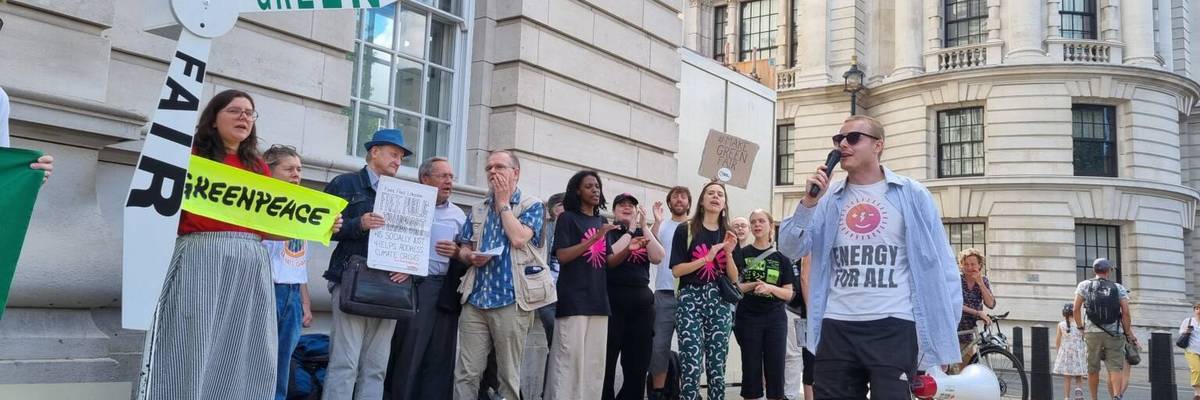
Activists with groups including 350.org and Fuel Poverty Action protested outside of the UK Department for Energy Security and Net Zero in London on July 1, 2026.

(Photo by 350.org

Jessica Corbett
Jul 01, 2026
COMMON DREAMS


With the US and Iranian governments engaged in 60 days of peace talks, the United Nations’ latest projections about the illegal war’s impact on fossil fuel subsidies this week triggered new demands for taxing the windfall profits of climate-wrecking Big Oil.

The United Nations Development Program (UNDP) on Monday released “Military Escalation in the Middle East: Cushioning the Global Shock,” a report detailing how governments have navigated the “most severe oil supply shock in history,” caused by Iran limiting traffic through the Strait of Hormuz in response to the Trump administration and Israel’s unlawful assault.

As fossil fuel prices have soared worldwide, the report states, “governments have moved quickly to cushion households and firms from higher energy prices through fuel subsidies, tax cuts, price caps, strategic stock releases, emergency procurement, export restrictions, demand-management measures, and fuel switching.”

“While energy subsidies had fallen by roughly half in 2024 as energy markets stabilized, the downward trajectory has sharply reversed,” the document notes. “We estimate that global fossil fuel subsidies are currently on track to reach $1.1 trillion in 2026 and could reach as high as $1.43 trillion in a severe scenario where the average oil price reaches $110/barrel... This represents an estimated $410-$740 billion increase from 2025.”

UNDP Administrator Alexander De Croo said in a statement that “the global spillover of the Middle East conflict is profound and potentially long-lasting. Developing countries, many already struggling with debt, have temporarily managed to protect people from the worst of the energy shock.”

“These countries are doing everything they can, but there is a hidden cost,” he stressed. “To deal with today’s crisis, governments are postponing tomorrow’s investments. Money that should be building schools, hospitals, and clean energy systems is being used simply to keep economies afloat. Without international support, these countries won’t escape the shock. They are absorbing it at the expense of future growth.”

“No country should have to sacrifice its future development to manage a crisis it did not create,” De Croo argued. “First, we must unlock multilateral liquidity in ways that are easy to access for low- and middle-income countries. Second, we must accelerate investment in renewable energy. Every clean energy investment reduces exposure to future shocks. The crisis has made one thing clear: Energy security and the energy transition are no longer separate agendas. They are one and the same.”


In addition to reiterating calls for a just transition to clean energy, the advocacy group 350.org has repeatedly advocated for a windfall profits tax targeting oil and gas giants cashing in on the conflict in the Middle East. Executive director Anne Jellema pushed for such policies again on Wednesday, noting the new UNDP numbers.

“The $1.1 trillion that governments are pouring into fossil fuel subsidies this year is not a safety net, it is a ransom payment,” Jellema declared. “Every dollar spent shielding the fossil fuel industry from the consequences of its own price volatility is a dollar not spent on the clean energy systems that can bring costs down for good.”

“We need a phaseout to end public subsidies for fossil fuel companies, and a permanent windfall tax on fossil fuel profits,” she continued. “Not a one-off levy, but a permanent, legislated mechanism that redirects the extraordinary profits of an industry driving this crisis into the just transition every country needs. That means affordable clean energy, retrofitted homes, and funding to protect people from the extreme weather unleashed by fossil pollution.”


In the United States, where President Donald Trump’s war has cost Americans tens of billions of dollars at the pump, Sen. Sheldon Whitehouse (D-RI) and Rep. Ro Khanna (D-Calif.) reintroduced the Big Oil Windfall Profits Tax Act in March, just weeks into the war.

Backing the bill, Food & Water Watch managing director of policy and litigation Mitch Jones said at the time that “historical evidence could not be any clearer: Big Oil will undoubtedly leverage the current crisis in the Middle East to maximize profit margins, pinching American families and enriching their executives and Wall Street speculators.”

“This demands a policy response—namely, a windfall profits tax... which would recover much of these egregious, opportunistic gains and return them to everyday Americans,” Jones added. “Fossil fuel companies must be held accountable for the profiteering they are orchestrating as we speak.”

Rep. Joaquin Castro Says ICE Tried to Deport Families to Venezuela After Massive Quakes

“I am calling on the Trump administration to halt all deportations to Venezuela and to shut down the Dilley trailer prison,” the Texas Democrat said.


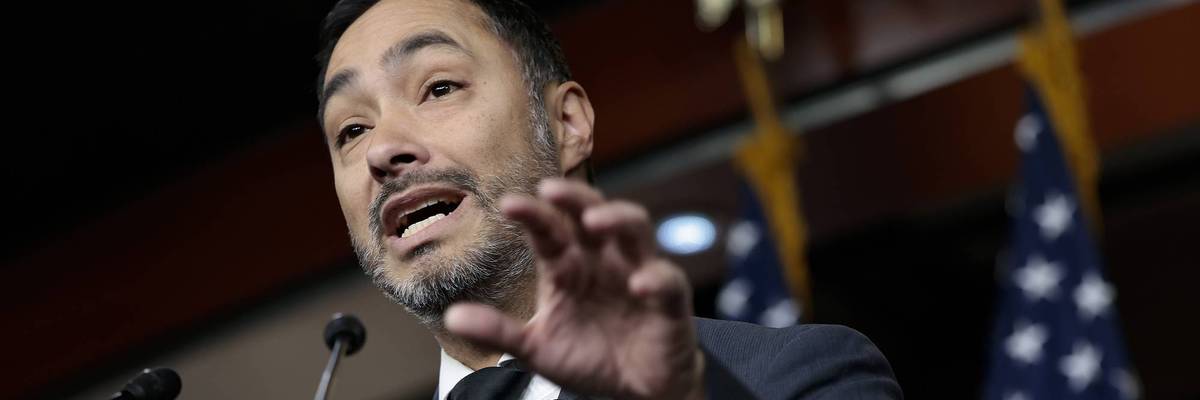
US Rep. Joaquin Castro (D-Texas) speaks to reporters in the US Capitol in Washington, DC on January 9, 2026.
(Photo by Heather Diehl/Getty Images)


Brett Wilkins
Jul 01, 2026
COMMON DREAMS

Congressman Joaquin Castro on Wednesday accused US Immigration and Customs Enforcement officials of moving to deport families to Venezuela immediately after last week’s devastating earthquakes that rocked the country, killing nearly 2,000 people and wounding more than 10,000 others.

“Just hours after the devastating earthquakes in Venezuela that killed over 1,900 people, ICE attempted to deport children and families from the Dilley trailer prison to Venezuela,” Castro (D-Texas) said on social media, referring to the Camp East Montana detention center at Fortb Bliss in El Paso, Texas.

“They were woken up in the middle of the night and sent to Arizona on their way to Venezuela,” the congressman continued. “The families were ultimately sent back to Dilley, but worry that they could be deported at any time. It is unthinkable to send children and families, who have committed no crimes, into a country plunged into chaos by natural disaster.”

Castro noted that “last week, 146 men, women, and children were deported back home to Venezuela hours before the earthquakes—many are suspected to have been killed.”

On June 24, a 7.2-magnitude earthquake centered in San Felipe, Yaracuy—about 100 miles west of Caracas—was followed less than a minute later by a 7.5-magnitude temblor, whose epicenter was also in Yaracuy. Tens of thousands of people are still missing, an estimated 1,000 buildings are destroyed, and basic essential services like water and electricity remain offline in many affected areas.

“These actions are cruel and un-American,” Castro said of the post-quake deportations. “I am calling on the Trump administration to halt all deportations to Venezuela and to shut down the Dilley trailer prison.”

Camp East Montana, the nation’s largest immigrant detention center, is operated by private prison profiteer Amentum Services Inc., which “has a history of health, safety, and other violations of federal law,” according to the consumer advocacy watchdog Public Citizen.

Kyle Virgien, senior staff attorney at the ACLU’s National Prison Project, called Camp East Montana “nothing short of a civil rights catastrophe.”

The ACLU and other groups are suing ICE and other federal agencies and officials over what the plaintiffs call “inhumane” conditions at the camp.

“Since the day it opened, the facility has repeatedly made headlines for horrific rights violations and even the deaths of three detained people, yet ICE has still evaded accountability for its conduct,” Virgien said.

Castro, who has visited Camp East Montana several times, said after touring the facility in May that “when we look back at this era in American history, we will look back in shame… of the human rights abuses, most particularly against children.”

Activists, including Japanese Americans interned by the US during World War II—one of which was located at Fort Bliss—have called for the closure of Camp East Montana and other ICE facilities, which many have compared with the concentration camps in which they were imprisoned in the 1940s.

After the earthquakes, advocates have also renewed demands for the US to end its economic sanctions, which have devastated Venezuela’s economy and have been blamed for the deaths of tens of thousands of Venezuelans.

Earlier this year, President Donald Trump ordered an illegal invasion of Venezuela and the abduction of President Nicolás Maduro, who the US administration accuses of dubious narcoterrorism-related crimes.

While the Trump administration has issued narrow exemptions from sanctions to companies seeking to profit from Venezuela’s political crisis and copious natural resources—primarily oil—these waivers have not delivered broad relief to the people who need it most.


As Post-Quake Misery Mounts in Venezuela, Demand Grows for Total End to US Sanctions

“Anything short of a full lifting of sanctions will hobble the overall response before it gets off the ground,” said a letter sent to Trump and Rubio by a coalition of advocacy groups.


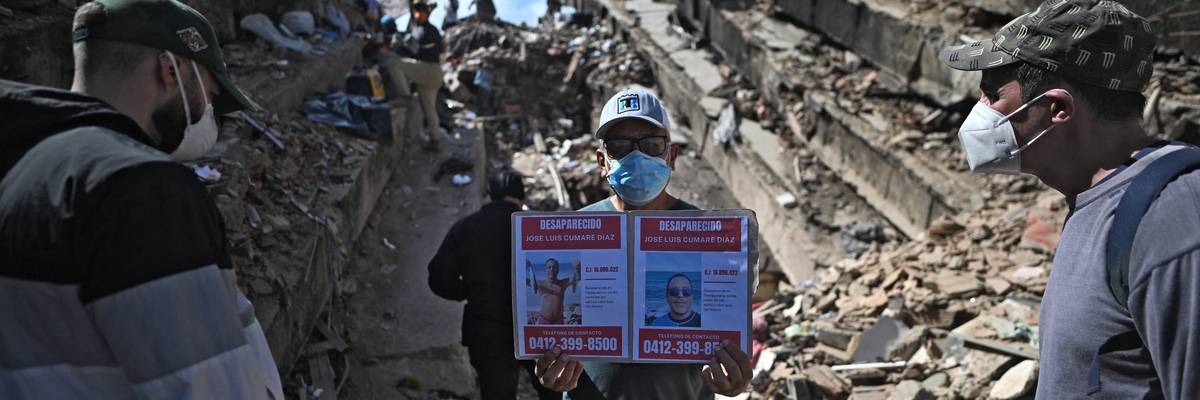
A man shows pictures of missing people amid the rubble at Los Cocos beach, in Caraballeda, La Guaira state, Venezuela, on July 1, 2026, following the June 24 twin earthquakes.
(Photo by Juan Barreto/AFP via Getty Images)


Stephen Prager
Jul 01, 2026
COMMON DREAMS

As death and injury tolls from Venezuela’s pair of devastating earthquakes last week continue to rise, a coalition of human rights and anti-war groups called on President Donald Trump and Secretary of State Marco Rubio on Wednesday to lift the US sanctions that have crippled the nation’s economy.

“As long as sweeping economic sanctions remain in place and Venezuelan assets remain frozen abroad, reconstruction will be unnecessarily delayed, and millions of people will continue to suffer,” said the letter, which was written by Just Foreign Policy, the Latin American Working Group, and Venezuelan American Community Action and shared exclusively with Common Dreams.

It has been signed by more than a dozen other groups, including the Center for Economic and Policy Research (CEPR), the Quincy Institute for Responsible Statecraft, Peace Action, and the Presbyterian Church’s Office of Public Witness.

The earthquakes have killed nearly 2,300 people as of Wednesday, a death toll that is expected to rise, with the number of missing people greater than 40,000, according to an unofficial estimate. The United Nations’ resident coordinator said the UN was preparing more than 10,000 body bags for the country “in anticipation of the death toll rising further.”

The quakes caused $6.7 billion in damage, the equivalent of 6% of the country’s gross domestic product, the UN Development Program estimated last week.


In the letter sent Wednesday, the groups welcomed the State Department’s mobilization of support for Venezuela, which has included search and rescue teams, military personnel for disaster relief, and at least $150 million in humanitarian assistance through aid partners and the UN.

But they said, “It is clear that emergency relief alone will not be enough.”

“Venezuela’s recovery will require access to its own financial resources and the ability to import the equipment, construction materials, medicine, fuel, spare parts, and other goods needed to rebuild homes, hospitals, schools, roads, ports, and critical infrastructure,” they said.

They said acquiring these needs has been made vastly more difficult by US sanctions that have “deliberately crushed Venezuela’s economy, restricting the government’s ability to import goods, maintain infrastructure, and deliver basic services to its population.”

Even before the earthquakes, they pointed out, nearly a third of Venezuela’s population was in need of humanitarian assistance in May, according to the UN Office for the Coordination of Humanitarian Affairs.

They said US “responsibility” for the state of Venezuela’s economy has only grown since Trump’s operation in January to topple and abduct President Nicolás Maduro.

Despite Venezuela’s oil exports rising 25%, its economic growth plummeted to an annual rate of just 2.5% in the first quarter of 2026, according to an analysis of bank data by Francisco Rodríguez, a senior research fellow at CEPR, who said it was “the lowest rate of growth observed since the second quarter of 2021.”

“The data suggests the US may be holding Venezuelan oil revenues in deposit accounts and not disbursing them to the Venezuelan government,” the letter said, “currently leaving ordinary Venezuelans with too little of the promised economic improvement and directly contradicting the Trump administration’s claim that Venezuelans are doing better than ever.”


Given the US role in creating these conditions, as well as the role of US sanctions in turning Venezuela’s economic crisis in the 2010s into one of the worst depressions of the last 50 years, the coalition said the Trump administration must not continue using economic warfare to force political concessions.

They also condemned calls from Democrats, including Senate Foreign Relations Committee Ranking Member Jeanne Shaheen (NH) and House Foreign Affairs Committee Ranking Member Gregory Meeks (NY) earlier this month, for the Trump administration to “exercise its leverage” on Venezuela’s current government, led by President Delcy Rodriguez, to push for democratic elections.

“The primary leverage the US has long held over Venezuela includes indiscriminate economic sanctions, alongside threats of military action that are illegal under US and international law,” the coalition said.

“Using economic pressure against a civilian population as a political tool was unconscionable before this earthquake,” they continued. “In its aftermath, any call to tighten that leverage, or to attach political conditions to aid or in exchange for a lifting of economic sanctions must be recognized for what it is—an act of collective punishment against long-suffering civilians who should not face further indiscriminate harm due to US policy.”

The coalition said that the Trump administration’s limited, temporary unfreezing of some sanctions to allow humanitarian relief transactions was “wildly insufficient,” as it did not unfreeze other sanctions that have hamstrung Venezuela’s economy.

“The Venezuelan government must be free to receive and allocate earthquake relief and to direct humanitarian support to those who need it most,” the letter said. “Anything short of a full lifting of sanctions will hobble the overall response before it gets off the ground.”

They called for the US to provide “massive humanitarian assistance” without political strings attached.

They also said the US must release Venezuelan oil revenues held in US accounts and pressure other countries like the UK and Portugal to do so as well.

“This is Venezuela’s money, and it is now urgently needed,” the groups said. “Withholding it during a national catastrophe of this magnitude is indefensible.”

They also called on the US to lift all sanctions on Venezuela, which they said “impede the delivery of humanitarian goods, reconstruction materials, and financial transfers needed for disaster response and economic recovery.”

“The United States has a short window to demonstrate that its relationship with the Venezuelan people is not merely transactional,” the letter concluded. “The scale of aid must match the scale of the harm the United States has played a role in creating. Anything less would confirm what many Venezuelans already fear: that American concern for their welfare begins and ends where American geopolitical and economic interests do.”

Imperialist-Induced Fault Lines: The Venezuelan Earthquake


 June 30, 2026


MR Online

Collection drives for food, clothing, medicine, and other essential goods have sprung up across Venezuela. Here, members of Provincial Trujillo Commune organize donations for families displaced by the earthquake. (Gobernación de Trujillo)

There is no such thing as a purely natural disaster, especially in a country under siege. Likewise, the response to any disaster is always mediated by social, political, and even geopolitical factors. Following the devastating 1812 earthquake that occurred during the independence struggle, Simón Bolívar said: “If nature opposes us, we will fight against it and make it obey us.” Today, this remark can sound jarring—like a strange anti-ecological outburst—but what Bolívar meant was that the strategic project of emancipation must remain in the forefront and guide our actions, even when confronting a natural challenge.

This should be kept in mind when we think about the earthquakes that recently struck Venezuela. The natural fact is straightforward: there was a double movement of the earth, first a magnitude 7.2 tremor followed seconds later by another measuring 7.5. In its wake, the destruction followed along natural fault lines, such as the San Sebastián Fault that runs along the La Guaira coast, but it also spread along imperialist-made ones. Foremost among these were the fractures in the country’s infrastructure, emergency rescue capacity, and health system caused by more than a decade of crippling sanctions.

These sanctions, which still number more than 1000, are not merely words and hostile intentions. Mark Weisbrot’s research at CEPR in Washington estimated that they contributed to some 40,000 excess deaths in just one year. For those unacquainted with the international finance system, the impact of a sanctions regime of this kind may be hard to understand. However, the net result is that every international transaction becomes difficult. Ordinary trade and credit lines collapse, while companies, banks and governments avoid transactions, even when they may be technically legal under the sanctions regime, because they lack certainty and fear future reprisals.

The consequences affect every aspect of disaster preparedness and response. In Venezuela, millions of people began to migrate shortly after the Obama Executive Order was published in 2015, including doctors, medics, civil engineers, and other trained professionals. Heavy rescue equipment became harder to repair because spare parts cannot be imported. Hospitals struggled to replace specialized medical equipment. Public utilities postponed maintenance because financing dried up and suppliers fear secondary sanctions. Even when transactions are technically legal, banks and manufacturers frequently overcomply, refusing to participate and leaving institutions to improvise under conditions of permanent scarcity.

A second set of fault lines was opened by the January 3 imperialist attacks on Venezuela, in which democratically-elected President Nicolás Maduro was kidnapped in a military operation that killed more than one hundred people, and left many more injured and traumatized. Although the Bolivarian Revolution succeeded in retaining political power—essential to any revolutionary process—it lost control over Venezuela’s oil sales and was forced to introduce “reforms” to the country’s highly advanced legislation governing its natural resources, especially oil.

All of this means that the earthquake in Venezuela, heartbreaking by every measure, has been made far more lethal—both in its immediate impact and long-term consequences—by factors directly attributable to U.S. imperialism’s ongoing, multi-level assault on the country and its people. Nearly 1500 deaths have now been officially recorded, and that tragic toll will continue to rise in the days ahead. The overall number of casualties will be felt on many levels, and the struggle to mitigate them through an effective, sovereign, and coordinated response is now a battleground, in which the contradiction with U.S. imperialism is at the center.

Radically Different Responses

When the double earthquake struck, it was experienced as an eerie combination of thunderous sound, prolonged and severe movement of the earth, and an oddly colored sky. One observer described it as “wind without wind.” People screamed and dogs went mad with fear. Entire buildings collapsed into rubble, while cracks opened up in the beach where many had gone to spend the national holiday. Days later people remain trapped beneath the debris. The situation is especially grave in the cities and towns that line the La Guaira coast. On social networks, hundreds of photographs and names circulate as families desperately search for missing loved ones.

In such a situation, it is natural to offer aid without first thinking of one’s own interests. This is precisely what people throughout Venezuela and neighboring countries have done. Acting president Delcy Rodríguez’s government has also responded swiftly and forcefully, deploying the means at its disposal in the people-centered manner that has characterized the Bolivarian Revolution over the last three decades. Alongside this official response, there have been massive spontaneous contributions: motorcycles piled high with supplies streamed toward the affected areas, while volunteers joined the huge, state-led rescue effort, and aid teams from Mexico, Cuba, and Brazil arrived quickly with concrete assistance.

If compassion drives the Venezuelan government’s and the Latin American peoples’ response, the same cannot be said of U.S. imperialism, for which concern for humanity has been displaced by the motives of profit, expropriation, and domination, and which has so often sought to turn the misfortune of others to its own advantage. The day following the earthquake, Secretary of State Marco Rubio coolly announced that the Department of War, SOUTHCOM, and the marines would be central to the U.S. “aid” effort.

We have seen this playbook before. Following Haiti’s devastating 2010 earthquake, the barely disguised Trojan horse of U.S. “humanitarian assistance” arrived in the form of an aircraft carrier and some 20,000 troops on the ground. The consequences of that de facto occupation in the Haitian case included an obvious loss of sovereignty, documented cases of sexual assault and exploitation, and the cholera epidemic brought by the occupying forces.

In the face of imperialism’s designs, the voice of the Venezuelan revolutionary people is united around three demands: the U.S. must lift the sanctions completely, unfreeze all Venezuelan assets, and return President Maduro and Cilia Flores to Venezuela. If these steps are not taken, the U.S. presence looks quite a bit like a simple military occupation—an integral part of the recolonizing ambitions expressed by Donald Trump’s MAGA imperialism, with its grotesque revival of the Monroe Doctrine.

MR Online

In Caracas, while people wait for their homes to be assessed, people are either going to shelters or camping in the streets. Photo: Andrew Drum.

The Battle over the Narrative

The struggle to defend the Venezuelan people, their future, and their projects in an integral manner is also unfolding as a struggle in the media and the social networks. False and malicious claims are circulating alleging that the government is not responding or that it is blocking relief. At the same time, videos from unrelated disasters, including earthquakes in Turkey, have been passed off as footage from Venezuela, alongside a flood of AI slop. Much of this comes from Maria Corina Machado’s disgruntled opposition that feels left out of the post-January 3 deal-making.

What is true is that the large number of well-meaning drivers attempting to reach La Guaira caused the main highway from Caracas to become congested, temporarily preventing heavy machinery and ambulances from arriving. Likewise, so many people, cars, and motorcycles converged around the rescue sites that the voices of those trapped under the rubble were difficult to hear, hampering rescue efforts. National and international rescue teams asked for space to work. The government responded by setting up a coordination center in the sports complex called Poliedro de Caracas, where civilian aid is collected and sent in trucks to where it may be needed. In the center, people who volunteer are evaluated to determine where they can be most useful.

If the COVID pandemic taught us anything it is that only a state-directed response can be effective. Nongovernment operators and individuals are welcome but need to be part of a coordinated effort that only a sovereign state can lead. The most common Big Lie being deployed now by foreign media is essentially the same one which has always been employed against the Bolivarian Revolution: that a level of state authority comparable to—and likely weaker than—that exercised by governments in the Global North is “authoritarian” whenever it is exercised in a Global South country. Meantime, some argue that there is no government response, opening the path for forceful external intervention.

Revolutionary Preparation

The double earthquake hit a country weakened by sanctions but strengthened by the 27-year-old Bolivarian Revolution that has profoundly shaped all aspects of Venezuelan society. If sanctions have systematically weakened Venezuela’s material infrastructure, the Bolivarian Revolution spent more than two decades cultivating a new social metabolism. Though still in formation, it has already become the country’s greatest source of resilience. Communal councils, communes, the civic-military union, and public housing programs all became part of the country’s capacity to respond collectively to the crisis.

The revolution has consistently strengthened the country’s housing stock. Gran Misión Vivienda Venezuela, Hugo Chávez’s housing project initiated in 2011, has produced millions of “dignified homes” all across the country. Most of these buildings, built by a range of Chinese, Brazilian, Belarussian, and Venezuelan firms, have fared well in the earthquake. In the cases where a building was made unliveable—which happened mostly along the coastal fault line—they tended to tilt rather than collapse. Concentrating people in apartment blocks rather than having them dispersed in precarious hillside settlements is also safer, both because of higher construction standards and because it facilitates collective action and the delivery of state assistance.

A second factor is the civilian-military alliance that Chávez promoted. This model, now internalized by the whole population, became the framework for the government’s combined state-and-volunteer response. The civilian-military alliance, which Maduro wisely expanded to include the police, has always been both an institutional arrangement—expressed in the six-million-member militia—and a more widespread political attitude rooted in the class consciousness of civilians and military personnel alike. Its first testing ground was the Vargas tragedy of 1999, precisely where the current hit harder. The civilian-military alliance rose to the occasion then, just as it is doing now.

Finally, it is in the country’s socialist communes that the most far-sighted response is taking shape. Teams from the network called Unión Comunera went to help with rescue efforts in La Guaira. In Caracas’ El Panal Commune, in addition to assessing the condition of the barrio’s buildings, communards set up several collection centers and are creating a shelter for those who have been left houseless by the earthquake.

As in the challenges faced by the food shortages of the mid-2010s, people around the country are turning to communes to collectively solve the medical and existential problems they face and to find a way forward. Given the power of the country’s communal movement and its solid ideological formation, it is possible that the communes could once again become a catalyst for renewed political consciousness. In these difficult times, they may prove decisive in rallying the Venezuelan people around the socialist project, temporarily under the shadow of the January 3 attack.

Years of blockade and imperialist aggression have no doubt left Venezuela materially weaker. Yet the Bolivarian Revolution has produced a new social metabolism that cannot easily be undone: an organized people and a set of institutions capable of responding to crises. If the earthquake has  exposed the country’s vulnerabilities, it also revealed where its real strength lies: in the revolutionary people and in deep-rooted social and institutional transformations.

MR Online

Unión Comunera Brigade in La Guaira. Photo: Brigada Argentina Permanente.

This first appeared in Monthly Review.

The political, social and economic impact of Venezuela’s twin earthquakes (plus: Despite quakes, US still withholds 70% of Venezuela’s oil revenues)


Translation by Federico Fuentes for LINKS International Journal of Socialist Renewal. See also further below, “Despite earthquakes, US still withholds 70% of Venezuela’s oil revenues”.

Natural disasters have the uncomfortable ability to reveal the harsh truth of a situation. They do not cause crises on their own; they simply strip away the facades concealing them. The two major earthquakes that recently struck Venezuela, with epicentres in Caracas and La Guaira, not only shifted the tectonic plates of the Caribbean and South America, but also completely shattered the political, social and economic normality in a country already struggling, with great effort, to get back on its feet. This tragedy also unfolds against an already complex backdrop marked by the January 3 military aggression and imposition of US tutelage over the nation.

US sends troops and equipment: Aid as a control mechanism

Forty-eight hours after the most powerful earthquakes to hit the country in 125 years, the US has exploited the humanitarian catastrophe to accelerate its military control over a country it invaded just six months ago.

US Southern Command announced the deployment of about 100 airforce personnel to take over managing Venezuela’s Simón Bolívar International Airport, now operating at reduced capacity due to structural damage. About 130 marines arrived at La Guaira port to assist authorities in the terminal’s reopening, helping deliver humanitarian aid and heavy equipment.

Several US military helicopters have already transported State Department personnel tasked with leading the aid mission. Meanwhile, US Southern Command has confirmed that the US Space Force is providing satellite imagery to assess damaged infrastructure.

To date, Venezuela has welcomed more than 1600 international rescue workers. As for on-the-ground coordination, US General Kevin J Jarrard arrived in Caracas on June 25 to lead the humanitarian response. On behalf of the Venezuelan government, Acting President Delcy Rodríguez appointed General Juan Ernesto Sulbarán as the sole authority for the emergency, placing the La Guaira region under strict military administration.

Economic impact: Reconstruction figures

The United Nations Development Programme (UNDP) preliminarily estimates damage caused by the two earthquakes at US$6.7 billion (about 6% of GDP), concentrated mainly on homes and property in La Guaira and Caracas, and not counting the enormous long-term reconstruction costs.

The president of Fedecámaras [Venezuela’s big business chamber] ruled out widespread shortages and said the economic impact would be limited because the private sector continues to function. But the tragedy threatens to bring Venezuela’s fragile economic recovery to a sudden halt, following a decade of deep recession. In response, the government announced an initial reconstruction fund of US$200 million drawn from IMF reserves, a figure analysts consider wholly insufficient given the scale of the disaster.

Compounding this crisis is a sovereign debt which various estimates put at $240 billion. This staggering figure greatly complicates the state’s ability to finance a huge reconstruction effort without relying on external support.

Government under the microscope

The double earthquake has placed the executive’s operational capacity and nature of its institutional control under intense public scrutiny. Far from being a simple logistical challenge, the emergency exposes the state’s weaknesses: the constant friction between military control of security and the free flow of aid, the pre-existing collapse of healthcare infrastructure, and an information blackout that breeds mistrust through inconsistent casualty figures.

The interim Delcy Rodríguez government is staking its survival and political capital on its handling of the crisis. This will determine whether it can consolidate power or whether a misstep, corruption scandal or perceived neglect will catalyse mass protests by a society unwilling to tolerate further mistakes.

Elections on hold and the centrality of power

Disasters of this magnitude redefine national priorities, altering the relationship between social classes and those in power. In the current climate, the crisis caused by the earthquakes provides the perfect pretext to postpone any electoral process or discussion of political transition until the end of 2026. It also puts wage demands on hold under the unifying banner of national reconstruction.

However, amid disasters, social solidarity often flourishes outside of the government’s political apparatus: neighbours clear rubble with their own hands, students transform into rescue workers, doctors improvise field hospitals, and churches, universities and community organisations coordinate relief centres.

In just a few days, a social force has emerged whose significance will far transcend the current emergency. This phenomenon not only reveals the strengths and weaknesses of official institutions, but also the enormous capacity of a society to organise itself, care for the most vulnerable and build responses from the grassroots up — a popular energy that will undoubtedly shape the country’s political future.

Sanctions and confiscated oil revenue

The double earthquake has forced the international community to adopt a pragmatic shift. The US announced a $150 million humanitarian aid package and temporarily suspended some economic sanctions to facilitate the flow of emergency funds. Meanwhile, the European Union increased its aid to victims but refused to amend its restrictive measures.

Washington’s move reveals a stark paradox: the nations now providing temporary support are the same ones imposing the sanctions that have strangled Venezuela’s economy and hampered its independent capacity to respond to disasters.

Estimates of the value of Venezuelan assets frozen abroad vary, but are calculated to run into billions of dollars. Economist Asdrúbal Oliveros estimates the total as about $22 billion, although a formal audit has not been conducted. Of these assets, about $8 billion from oil sales are under the US Treasury Department’s direct control.

A workers’ emergency plan

Venezuela’s reconstruction must not follow free-market logic nor become a source of profits for financial elites or the traditional bourgeoisie. It is crucial that the people and the working class develop a national emergency plan based on active solidarity, sovereignty and popular control. To prevent resources being misappropriated and the crisis worsening, we raise three urgent demands:

  • IMF emergency funds, international aid and resources from sanctions exemptions must be allocated exclusively to repair homes and schools, ensuring they are not lost to bureaucracy, corruption or the Central Bank of Venezuela’s (BCV) foreign exchange auctions.
  • Housing and logistical solutions must come from organised communities. The state must facilitate aid without imposing bureaucratic hurdles, military cordons or accepting foreign interventions that compromise national sovereignty.
  • Repatriating frozen funds is vital. We must demand the immediate return of Venezuelan assets held in foreign banks due to oil sanctions. It is unacceptable that, while the country faces a severe shortage of funds for machinery and medicines, its own resources remain frozen. Likewise, the suspension of debt renegotiation is unacceptable.

The working class must not allow itself to be distracted amid the crisis. The traditional right and conservative sectors will try to divert public debate towards artificial and self-serving discussions, but today the absolute priority is addressing people’s material needs, who demand a dignified life and have taken to the streets not only to save lives, but to demonstrate that they constitute the country’s true social majority.


Despite earthquakes, US still withholds 70% of Venezuela’s oil revenues

By Autonomous and Independent Workers’ Committee. Translation by Federico Fuentes for LINKS International Journal of Socialist Renewal.

While La Guaira state struggles to rebuild out of the ruins of the double earthquake, one financial factor is worsening the humanitarian crisis. Technical reports and expert statements say the US administration’s sanctions policy ensures most of the foreign currency Venezuela generates from oil sales remains under US control, drastically limiting the funds available for reconstruction.

Oil engineer, Einstein Millán Arcia, who is also a former manager at Venezuela state oil company, PDVSA, says since January Washington’s control over Venezuela’s trade decisions has been “growing and sustained.” International buyers, via a network of Treasury Department licenses, are having to deposit oil payments into US-supervised accounts.

The figures to May reflect the magnitude of this discretionary control:

  • Total production: Between January–May, Venezuela exported about 152.38 million barrels of oil.
  • Frozen cash: This generated a gross value of $11.673 billion. However, 70% of this remains frozen in US Treasury-managed accounts.
  • Authorised trickle: Washington only allowed a small fraction of these funds to flow into Venezuela. The US State Department reported to Congress that it had authorised the disbursement of some $3.5 billion (via intermediaries such as Qatar), primarily for the public payroll and foreign exchange market. The Central Bank of Venezuela (BCV) has not formally confirmed this figure.

Impacts: Fewer cranes, more inflation

This has direct consequences on the state’s ability to respond to the natural disaster, which has caused damages totalling $6.7 billion (about 6% of Venezuela’s GDP) according to preliminary United Nations Development Programme (UNDP) estimates.

Economist Francisco Rodríguez, author of The Collapse of Venezuela, warns the structural impact of this policy is severe, especially in the area of ​​infrastructure:

During Venezuela's long economic implosion, the sector that most contracted was construction — with its GDP falling by a whopping 95.9% between 2013 and 2020…

We should not forget that for more than 7 years, US sanctions barred the Venezuelan government from purchasing the heavy machinery that is needed to dig people out of the rubble today.

Added to this is the problem of macroeconomic instability. As most oil revenue does not enter the country in a sovereign and regular manner, the BCV has fewer tools to stabilise the exchange market, driving up prices and devaluing ​​budgets allocated to humanitarian aid. Even the US Treasury Department admits that, prior to the earthquake, there were operational obstacles to coordinating international assistance and acquiring disaster relief equipment.

Financial crossroads

The scale of the destruction, which has left more than a hundred buildings collapsed along the country’s central coast, exceeds the country’s current liquidity. Analysts agree the lack of transparency and discretionary management of Venezuela’s funds abroad adds a layer of uncertainty to the tragedy. According to UN experts, the financial urgency is so profound that addressing the housing and infrastructure crisis could require immediate relief, and even the complete lifting, of financial restrictions on Venezuela’s energy industry.

In response to the crisis caused by the recent earthquakes, the Autonomous and Independent Workers’ Committee takes a clear stance: we join the national and international demand for the US Treasury Department to give back Venezuela’s financial resources.