Festivals are more than just occasions for celebration; they are potent social texts that show how societies construct their identities, reconcile moral dilemmas, and preserve myths for contemporary society.
One of the most notable instances of this continuity in India is Vijaya Dashami, also referred to as Dussehra. The celebration, which has its roots in the legendary victories of Goddess Durga over Mahishasura and Lord Ram over Ravana reflects ageless tales of good triumphing over evil. But in the process of evolving from myth to modernity, Vijaya Dashami has evolved into a cultural performance that unites disparate identities, upholds moral principles, and adjusts to shifting social circumstances.
Vijaya Dashami offers a living lens to examine collective identity in the modern world, where fast urbanisation, digital communication, and changing societal norms are reshaping how traditions are conducted. In addition to reciting epics, the effigy burning, community meetings, and stage plays (Ramlila) serve as a forum for social criticism, gender discussions, and even political symbolism. They also serve to uphold society’s common moral standards. Therefore, Vijaya Dashami’s sociology resides in the way it connects legendary imagination with contemporary forms of solidarity, serving as a reminder that festivals are as much about the present as they are about the past.
Myth and Morality in Modern Times
The ageless notion of good triumphing over evil has always been represented by the tales of Durga’s victory over Mahishasura and Ram’s victory over Ravana. These myths continue to motivate people to address the injustices of the present rather than merely serving as a remembrance of the past. These days, Ravana and Mahishasura are viewed as symbols for the ills that individuals faces in their personalities such as jealousy, arrogance and carelessness about others and also society faces, such as differences, violence, injustice, and corruption, rather than merely as mythological villains.
For instance, protesters in Delhi and other cities burned effigies of “modern-day Ravanas” to symbolise dishonest politicians and officials during the 2011 anti-corruption campaign in India (Chakrabarty & Roy, 2013). The image of Goddess Durga was also used in numerous demonstrations following the 2012 Delhi gang rape (Nirbhaya case), where participants said that “every woman is Durga” and demanded the defeat of contemporary “Mahishasuras” who engage in gender violence (Kumar, 2016).
Collective Identity and Social Solidarity
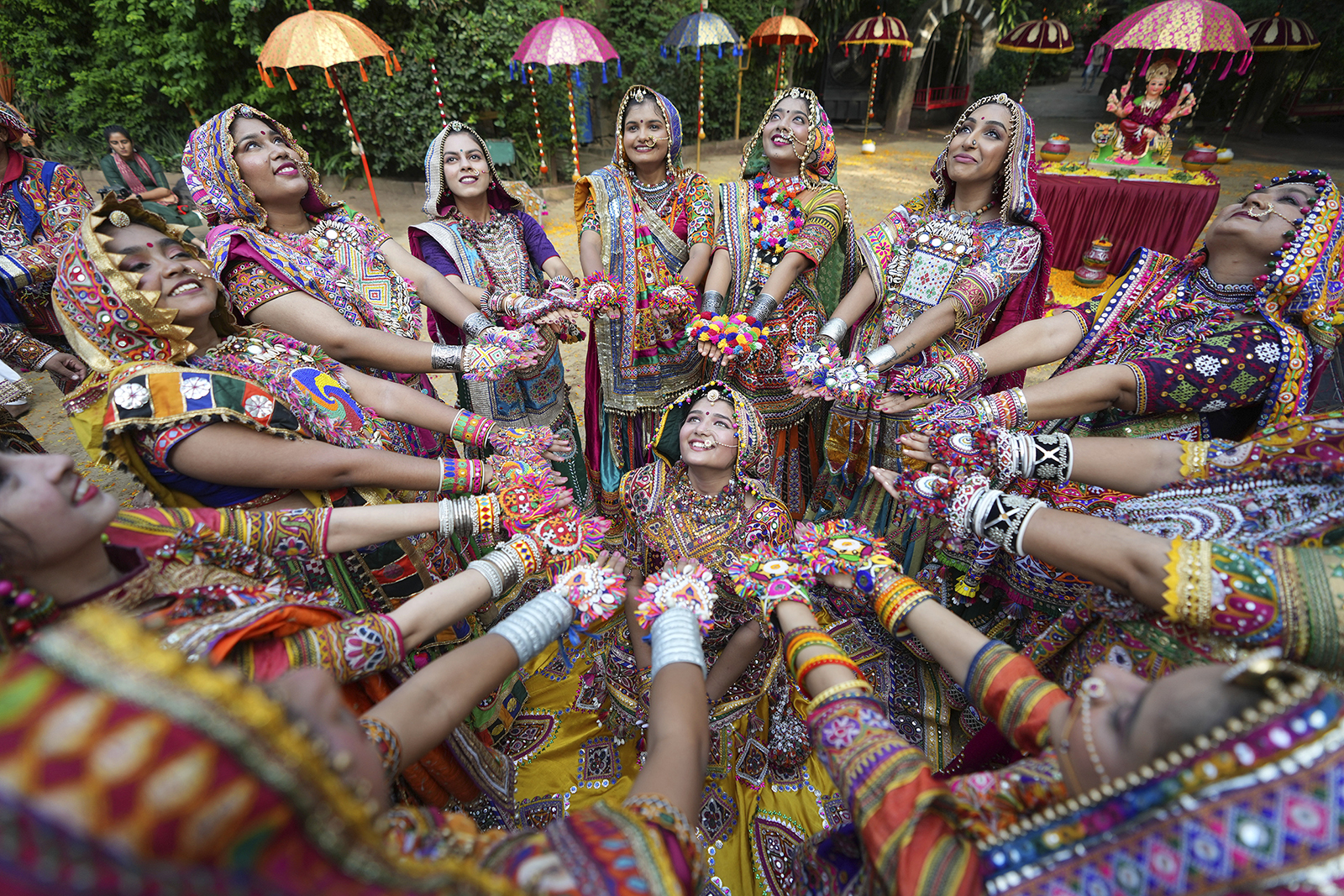
For many years, Vijaya Dashami has been a potent hub for social cohesion and collective identity. Through shared rituals, effigy burnings, and Ramlila performances, the festival has historically united communities and provided a forum for participation in a shared cultural narrative among members of all castes, social groups, and localities.
\
Such rituals reinforce collective consciousness by reminding people of their common ideals, as Durkheim (1995) contended, and Anderson’s (1983) concept of “imagined communities” explains how these meetings promoted a more comprehensive sense of belonging. This solidarity has grown across regional borders in the modern era.
Grand festivities like the Ramlila in Delhi’s Ramlila Maidan, which is televised and watched by millions of people, in India turn a local performance into a National occasion that brings together many regional and linguistic groups (Lutgendorf, 1991).
In a similar vein, Indian groups in the diaspora host major Vijaya Dashami processions and cultural events in places like Singapore, Toronto, and London. In multicultural contexts, these gatherings foster a feeling of shared identity in addition to reinforcing ties to Indian history (Vertovec, 2000). Vijaya Dashami demonstrates how festivals serve as both global identity markers and local bonding mechanisms, maintaining solidarity in a society that is becoming more divided and interconnected by the day.
Honouring Weapons as a Symbols of Duty, Discipline and Divine Power
One of the lesser-discussed yet significant aspects of Vijaya Dashami is the tradition of Ayudha Puja, or weapon worship, which is deeply connected to the idea of honouring tools of duty, discipline, and divine power. In Indian epics, both Ram and Durga invoked divine blessings before going to battle, and this symbolic act continues today in the rituals of the Indian Armed Forces.
On Vijaya Dashami, regiments across the Army, Navy, and Air Force perform Shastra Puja (weapon worship), offering prayers to rifles, tanks, aircraft, and other instruments of defence. This ritual underlines the ethical principle that weapons are not instruments of aggression but of duty and protection, to be wielded with discipline and responsibility. In modern times, the meaning of this practice extends beyond the military: it reflects a broader societal respect for the tools that sustain human life whether technology, machinery, or even digital devices. Just as soldiers seek divine blessing to use their weapons only in the service of justice and security, today’s professionals symbolically honour their tools of work, reminding us that technology and power, when guided by ethics, can also serve the greater good.
Gender and Power Narratives
The tale of Goddess Durga defeating Mahishasura has long represented the victory of feminine power against patriarchal powers of oppression. In the medieval period, patriarchal norms led men to dominate the organization and conduct of festivals like Vijaya Dashami, taking charge of leadership roles, performances, and ritual practices. Women were frequently restricted to being spectators or participants rather than decision-makers. The larger patriarchal framework of Indian society was mirrored in this imbalance (Chakravarti, 1993).
However, in recent decades, contemporary Vijaya Dashami festivities have placed a greater emphasis on women’s agency and involvement, reflecting changing gender norms. Goddess Durga embodies shakti, the eternal feminine energy, and today’s woman stands as a living symbol of that power resilient, assertive, and transformative in society.
From the recent instance where Colonel Sofiya Qureshi of the Army’s Corps of Signals and Wing Commander Vyomika Singh of the Indian Air Force performed weapon worship during Vijaya Dashami, to women’s committees in Kolkata taking charge of pandal planning and finances, and feminist reimagining of Durga in media campaigns, contemporary practices show how women across diverse sectors are reclaiming spaces once dominated by men and redefining the power of feminine energy in society.
Politics, Media, and Public Life
Once grounded in local cultural expression and religious symbolism, effigy burnings and Ramlila performances have become more and more politicised and media-driven spectacles. Rituals, according to sociology Clifford Geertz (1973), are “cultural performances” that civilisations use to dramatize their values. What was once a revered statement of the victory of virtue over evil has been transformed into a public platform for socio-political symbolism and Nation-building in the instance of Vijaya Dashami. In an effort to associate themselves with the moral authority of Ram’s victory over Ravana, political officials regularly attend effigy burnings.
For instance, Indian prime ministers and chief ministers frequently open Ramlila celebrations in Delhi’s Ramlila Maidan, turning a religious rite into a platform for socio-cultural and political prominence (Lutgendorf, 1991). At the same time, these performances have been magnified into national spectacles by mass media, initially via television and currently through internet channels. For example, Ramanand Sagar’s Ramlila television series in the late 1980s not only attracted record audiences but also had an impact on political mobilisation, particularly the Ram Janmabhoomi campaign (Rajagopal, 2001).
More contemporary examples of how media transforms ritual into consumable cultural content that is available to both local and international audiences include Instagram loops of Durga Puja pandals and live-streamed effigy burnings. As a result, Vijaya Dashami blurs the boundaries between faith, spectacle, and public life by serving as both a religious tradition and a mediated performance of governing authority.
Continuity and Change in Cultural Practice
Vijaya Dashami provides examples of how customs can uphold their essential principles while adjusting to contemporary situations. Fundamentally, the event upholds the moral and cultural teachings found in the stories of Ram and Durga by celebrating the ageless notion of “good triumphing over evil.” However, there have been substantial changes in the ways that these stories are executed. The impact of modernisation and globalisation on cultural practices is seen in the way that elaborate pandals, Instagram reels, broadcast Ramlila serials, and urban mega-events now either supplement or even replace traditional rural performances (Lutgendorf, 1991; Vertovec, 2000). For instance, Kolkata’s Durga Puja has developed into a global event that draws tourists, media attention, and corporate sponsorships while maintaining the idol immersion ceremony that marks Durga’s triumph (Banerjee, 2004).
Even far from the homeland, Indian identity and moral narratives are maintained through the elaborate Vijaya Dashami festivities held by diaspora populations in places like New York and London, which combine traditional rites with regional cultural elements (Vertovec, 2000). These instances indicate how cultural traditions can change without losing their symbolic meaning, despite the festival’s dynamic forms and unchanging essence.
Conclusion
Despite having its roots in ancient mythology, Vijaya Dashami is still relevant in the quickly evolving world of today. The festival’s lasting importance is demonstrated by its tales of virtue triumphing over evil, the celebration of collective identity, the assertion of female strength, and the interaction between ritual and public life. However, the way it is experienced has changed because to modernisation, media, and globalisation; diaspora communities can now celebrate their history far from home, women can now play active roles, and hamlet Ramlilas have become national spectacles.
Vijaya Dashami is essentially a prime example of the dynamic continuity of culture, demonstrating how customs can change in shape while maintaining their moral and social foundation. In methods that bring communities together across time and distance, festivals serve as a living reminder that they are not only celebrations of the past but also mirrors of current society.
Reference
- Anderson, B. (1983). Imagined communities: Reflections on the origin and spread of nationalism. Verso.
- Banerjee, S. (2004). Rituals of power and power of rituals: Public celebrations and women’s participation in Bengal. Economic and Political Weekly, 39(17), 1685–1692.
- Chakrabarty, B., & Roy, S. (2013). Public policy and politics in India: How institutions matter. Routledge.
- Chakravarti, U. (1993). Conceptualising brahmanical patriarchy in early India: Gender, caste, class and state. Economic and Political Weekly, 28(14), 579–585.
- Durkheim, E. (1995). The elementary forms of religious life (K. E. Fields, Trans.). Free Press. (Original work published 1912)
- Geertz, C. (1973). The interpretation of cultures. Basic Books.
- Kumar, R. (2016). Violence, resistance, and identity: The politics of rape in India. Economic and Political Weekly, 51(9), 15–17.
- Lutgendorf, P. (1991). The life of a text: Performing the Ramcaritmanas of Tulsidas. University of California Press.
- Rajagopal, A. (2001). Politics after television: Religious nationalism and the reshaping of the Indian public. Cambridge University Press.
- Vertovec, S. (2000). The Hindu diaspora: Comparative patterns. Routledge.
Dr. Neelu Rawat
Dr. Neelu Rawat, Associate Professor, Department of Sociology, Central University of Punjab, Bathinda, Punjab, India.