Tuesday, November 11, 2025

'Slimebag': Critics in awe as ethics office purged after Trump's 'attack dog' probed

Nicole Charky-Chami
November 11, 2025 
RAW STORY


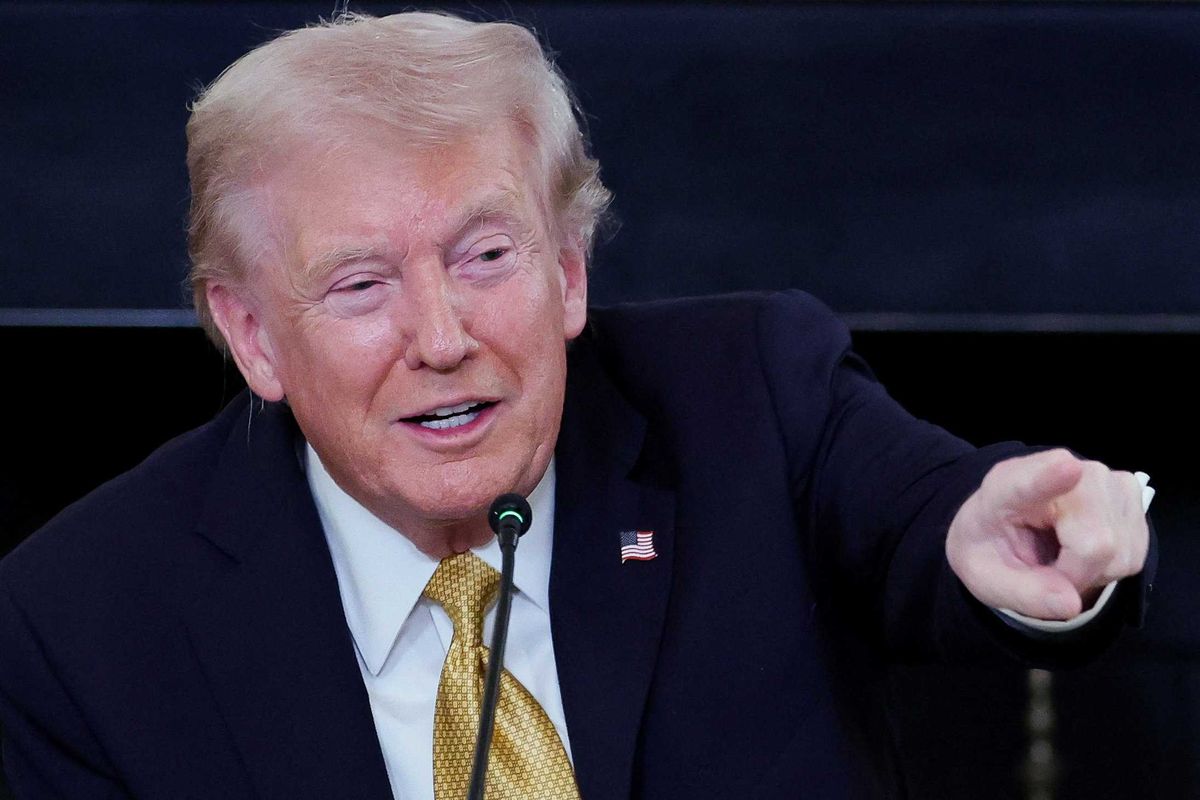
U.S. President Donald Trump gestures during an announcement regarding his administration's policies against cartels and human trafficking, from the State Dining Room at the White House in Washington, D.C., U.S., October 23, 2025. REUTERS/Jonathan Ernst

Reactions started rolling in Tuesday after a Wall Street Journal report revealed that Bill Pulte, the director of President Donald Trump's Federal Housing Finance Agency, was under investigation by ethics watchdogs shortly before the ethics office overseeing the agency was purged.

Pulte oversees the U.S. mortgage market and also runs Fannie Mae and its brother firm Freddie Mac. He has taken over both the company boards and made himself the chairman of both organizations and most recently suggested a 50-year mortgage could make homes more affordable.

The Federal Housing Finance Agency watchdog role was removed earlier this month and the ethics office for Fannie Mae "had received internal complaints alleging senior officials had improperly directed staff to access ... mortgage documents" for officials who have criticized or legally fought Trump, including New York Attorney General Letitia James.

Social media users responded to the report:

"You can’t just waltz in & start [going] thru the president’s 'enemies' gov’t documentation at will. I’ve been waiting for this to surface," former federal prosecutor Joyce Vance wrote on X.

"Bill Pulte's company (Pulte Homes) best years selling homes were from 1998 to 2008. He is a slimebag builder," a software developer wrote on X.

"Trump next time he is asked about Pulte," loan officer and former talk radio host Tyler Cralle wrote on X, paired with Mariah Carey's "I don't know her" meme.

"Shocked, well not shocked," attorney Kevin Baum shared with a Simpsons meme on X.

"Hate how obviously clear this was. And simply zero way of doing anything about it for 3+ years," film archivist and copy editor David Neary wrote on X.

"Big surprise... Not," writer and editor C. John Schoonejongen wrote on X.

"Bill Pulte is covering up a crime he committed," TV/film editor Molotovsky wrote on Bluesky.
HEGSETH'S MISOGYNIST MILITARY

SEALs flatten 'weak' Hegseth as elite captain's career ruined because she's female: report


Travis Gettys
November 11, 2025
COMMON DREAMS


Pete Hegseth speaks to senior military leaders at Marine Corps Base Quantico, Virginia. Andrew Harnik/REUTERS

The first woman nominated to lead the Naval Special Warfare command overseeing Navy SEALs had her promotion abruptly canceled — and military sources blame Defense Secretary Pete Hegseth's hostility to women in combat roles.

CNN reported the Navy captain, a troop commander with Navy SEAL Team Six and a Purple Heart recipient, had been ranked the top officer for promotion in her cohort and was in line to take charge over the elite unit until the plans were scrapped just two weeks before a formal ceremony was scheduled, and thanks to the Navy's “up or out” policy, her military career was effectively ended.

“They want to keep it the brotherhood and don’t like that she’s coming in and challenging the status quo,” a Navy special operations source familiar with the situation told CNN.

One defense official familiar with the matter said there had been discussions about whether the role was necessary, and a Pentagon source said Hegseth was not involved and the captain's nomination was pulled because she was not a SEAL, but multiple sources told CNN they didn't buy those explanations.

“They can justify it by saying she’s not qualified because she’s not a SEAL,” said one retired SEAL. “But the SEALs thought she was qualified.”

CNN is not naming the captain, who did not respond to requests for comment, but the retired SEAL said the move clearly reflected Hegseth's views about women serving in the military and stated the Pentagon chief was a misogynist.

“I’m sure they would repeal the whole women in combat thing [if they could], but this is what they can do,” the retired SEAL said.

Hegseth has already removed several women from top leadership roles, and active-duty women – who make up about 18 percent of the U.S. military – and military veterans told CNN the self-styled "secretary of war" had made service less safe and more difficult for them.

“To be quite honest, I am fearful for women in uniform right now,” said Patti J. Tutalo, a retired Coast Guard commander who served on an advisory group for women in the military before it was shut down this year.

“I definitely think there will be a retention issue for women,” Tutalo added. “I also think that you’re going to see an increase in assaults, increase in harassment, increase in bullying, hazing, and I think there’ll be a lack of accountability for those things.”

The Navy captain's former SEAL Team Six comrades are furious about her command getting yanked.

“That’s horse s--t,” the former senior enlisted SEAL said.

The former SEAL voted for Trump and still supports him, but he said Hegseth's personal views were interfering with his ability to lead the military.

“I think my job is to protect women and children but occasionally there’s bada-- [women] out there, and we should capitalize and not limit ourselves,” he said.

The Navy special operations source pointed out the captain had been effective at recruiting women to special operations roles, and that person offered withering criticism of Hegseth.

“It p---es me off because it is clearly someone who is capable and has done extraordinary things and is being punished because of — and I hate that I have to say it this way — weak-a-- men,” that source said.
Red state county agrees to pay out $3M for newspaper raid


Anna Kaminski,
 Kansas Reflector
November 11, 2025 


The Kansas state flag waving along with the national flag of the United States of America. (Photo credit: rarrarorro / Shutterstock)

Marion County agrees to pay out $3M for newspaper raid, expresses regret


by Anna Kaminski,
Kansas Reflector
November 11, 2025

TOPEKA — The county involved in a small-town Kansas newspaper raid in 2023 will pay a cumulative $3 million to three journalists and a city councilor.

In two of the four agreements, the Marion County Sheriff’s Office also crafted a statement admitting regret.

“The Sheriff’s Office wishes to express its sincere regrets to Eric and Joan Meyer and Ruth and Ronald Herbel for its participation in the drafting and execution of the Marion Police Department’s search warrants on their homes and the Marion County Record. This likely would not have happened if established law had been reviewed and applied prior to the execution of the warrants,” the statement reads.

Marion County’s board of commissioners approved agreements Monday with Eric Meyer, the owner and editor of the Marion County Record, and Ruth Herbel, the Marion city councilor whose home was raided in tandem with the newspaper office, and two other journalists. The agreements coincide with consent judgments expected to be submitted in their federal cases against the county.

The county was a secondary player in the raids, in Meyer’s eyes, but the agreements could play a part in the paper’s ongoing cases against the city.

“Everybody involved in this is 100% convinced we are going to go to trial with the city,” Meyer said. “This will make that easier in some regard.”

The county’s agreements with Deb Gruver and Phyllis Zorn, local journalists whose lives were upended by the raids, are more akin to settlements and don’t include admissions of regret.

The county agreed to pay Meyer $1.5 million, Herbel $650,000, Zorn $600,000, and Gruver $250,000, according to copies of the agreements obtained by Kansas Reflector.

Insurance covers most of those funds, but the county must pay Meyer $50,000.

In another lawsuit against former Marion police chief Gideon Cody, who is also facing criminal charges, Gruver settled earlier this year for $235,000.

According to Meyer, Zorn has retired from her position at the Marion County Record, effective immediately.

Monday’s deals settle the county’s obligations within four federal lawsuits against the city of Marion and Marion County governments and officials in the wake of the raids. Five cases were consolidated into a single federal lawsuit, and the four agreements give the county and the sheriff’s office immunity from any future legal action related to the Aug. 11, 2023, searches and seizures at the Marion County Record, Meyer’s home and Herbel’s home.

The county agreed to make available Marion County Sheriff Jeff Soyez, Detective Aaron Christner, and Undersheriff Larry Starkey for official interviews, which could be used in other legal disputes. Previously, the cases were stalled, preventing interviews from taking place.

Claims against the city of Marion, its police department and other officials, including former Mayor David Mayfield and former police chief Gideon Cody, are not involved in the agreements.

Kansas Reflector is part of States Newsroom, a nonprofit news network supported by grants and a coalition of donors as a 501c(3) public charity. Kansas Reflector maintains editorial independence. Contact Editor Sherman Smith for questions: info@kansasreflector.com.
THE CRUEL STATE
The GOP is keeping Americans on the hook — even if the shutdown ends
, Source Nm
November 11, 2025


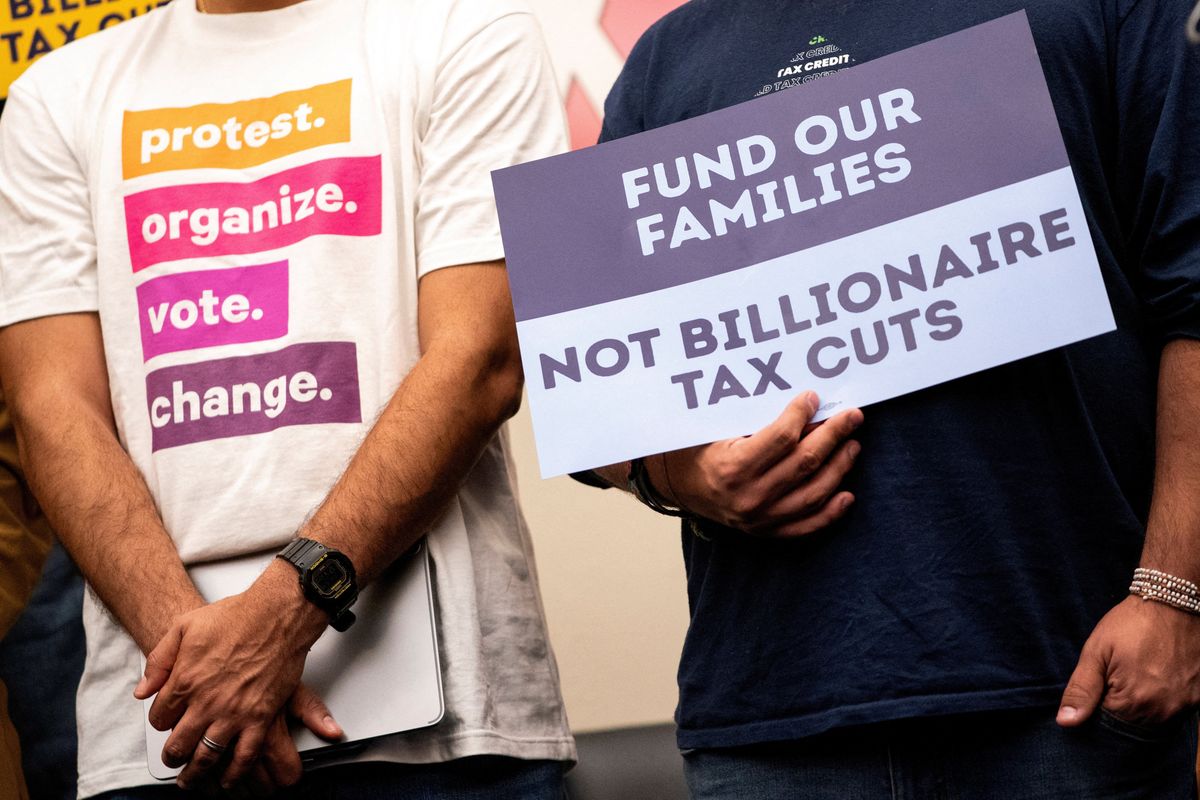
Demonstrators hold signs during a press conference on Capitol Hill. 
REUTERS/Nathan Howard

As New Mexicans, we know what it means to take care of each other. When our neighbors are struggling, we help them.

That’s why our state leaders stepped in to make sure families could still get food during the appalling and unprecedented suspension of SNAP food benefits. And that’s why the Trump administration’s choice to block SNAP during a government shutdown, despite having the emergency funds, struck such a deep nerve — it’s not just cruel, it’s unnecessary.

When the shutdown ends, many federal workers and families will finally get some relief. But that relief won’t last long. The truth is: even after the government reopens, the cuts to food and healthcare programs will keep coming, and they are about to get worse

Buried in the details of H.R. 1 — the federal budget bill pushed by House Republicans — are huge cuts to SNAP, Medicaid, and marketplace health insurance. These cuts will hurt hundreds of thousands of New Mexicans, ripping away support that keeps our families stable and healthy. These are not temporary disruptions caused by a funding gap — these are long-term structural changes designed to take away food and healthcare from our families.

New Mexico’s federal lawmakers aren’t staying quiet. Senators Martin Heinrich and Ben Ray Luján, along with Representatives Melanie Stansbury, Teresa Leger Fernández, and Gabe Vasquez, are fighting to protect food assistance and healthcare, and rural clinics that are lifelines in our communities.

In New Mexico, we’ve seen what works. When families have access to healthy food, health care, and stable housing, our whole state is stronger. We’ve made progress in recent years: expanding child hunger programs, improving access to affordable healthcare, and creating state initiatives that keep working parents on their feet. That progress is now under direct threat from Washington DC.

As our lawmakers prepare for the upcoming 30 day legislative session, protecting that progress must come first. Lawmakers must continue the important work that began in October’s special session: building state-level solutions to shield New Mexico families from the harshest effects of H.R. 1’s cuts. That means investing in our state food assistance programs, protecting healthcare coverage, making sure rural hospitals and clinics are funded, and ensuring no child in New Mexico goes hungry.

We don’t have to accept a future where federal politics decide who in our communities eats, who gets medical care, or who is left behind. The values that define New Mexico — community, resilience, and compassion — are stronger than any budget cut.

The shutdown will end. But our responsibility to one another will not.

Sovereign Hager is from Albuquerque, NM 
and is the Public Benefits director at New Mexico Center on Law and Poverty.

Source NM is part of the States Newsroom network


Supreme Court extends SNAP freeze as millions go hungry and shutdown drags on


Robert Davis
November 11, 2025 
RAW STORY


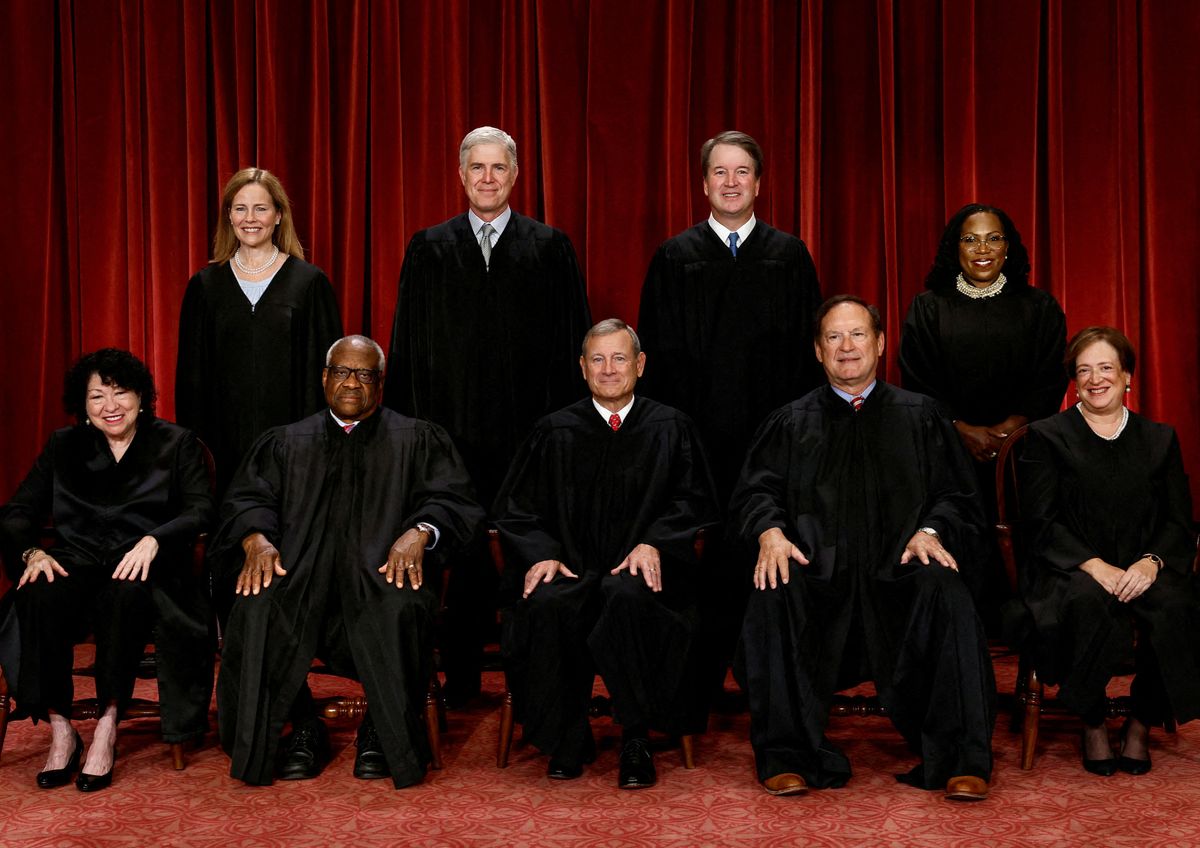
FILE PHOTO: U.S. Supreme Court justices pose for their group portrait at the Supreme Court in Washington, U.S., October 7, 2022. Seated (L-R): Justices Sonia Sotomayor, Clarence Thomas, Chief Justice John G. Roberts, Jr., Samuel A. Alito, Jr. and Elena Kagan. Standing (L-R): Justices Amy Coney Barrett, Neil M. Gorsuch, Brett M. Kavanaugh and Ketanji Brown Jackson. REUTERS/Evelyn Hockstein/File Photo


The Supreme Court extended its order blocking Supplemental Nutrition Assistance Program, or SNAP, food assistance payments until at least Thursday as lawmakers in Congress debate a bill that could reopen the government, according to a new report.

The order was not unanimous, with liberal Justice Ketanji Brown Jackson filing a dissent, according to a report by Kate Buehler, Supreme Court reporter for Law360. It comes at a time when Democrats have agreed to vote for a series of short-term spending bills in exchange for a vote on the expiring Affordable Care Act subsidies in December.

"The administrative stay entered on November 7, 2023 is hereby extended until 11:59 p.m. (EST) on November 13, 2025," the order reads in part. "Justice Jackson would deny the request for the extension of the administrative stay and the application."


The BBC’s Foolish Gift to Donald Trump

Dangerous Edits


It began with a revelation in The Telegraph on November 3. The paper had seen an internal memo in the BBC pointing to editing on its October 2024 Panorama programme of two parts of US President Donald Trump’s speech in January 2021. The sin was not in the editing but its liberal manner, suggesting that Trump had explicitly incited the Capitol Hill riots of January 6. Through spliced footage, Trump is initially shown promising to walk with his supporters to the Capitol where he would “fight like hell” when he had said he would walk with them “to peacefully and patriotically make your voices heard”.

The Panorama special, titled “Trump: A Second Chance?”, goes on to give the impression that flag-waving men had also converged with menacing intent after the speech. In the words of the dossier, this “created the impression Trump’s supporters had taken up his ‘call to arms,’” when the footage had, in fact, been shot before the address.

The internal leaked memo, running into 19 pages, was all the more stinging in coming from a former external advisor to the BBC’s Editorial Guidelines and Standards Committee (EGSC), Michael Prescott. The document also alleged that senior executives, including the BBC chairman Samir Shah, had given the cold shoulder to various serious complaints submitted by an advisor to the EGSC. There was a general refusal “to accept there had been a breach of standards”. Indeed, at the EGSC meeting on May 12, 2025, the corporation’s deputy director of news, Jonathan Munro, blandly asserts it as “normal practice to edit speeches into short form clips.” Nor did he see any need to balance the Trump Panorama special “with an equally aggressive look at [Democratic candidate Kamala] Harris”. In Munro’s words, there was no need “for due impartiality to have companion programmes”.

The Conservatives, scrounging for every morsel to claw back some electoral appeal, saw a gaming chance in barking at the corporation. Former Tory prime minister Boris Johnson was seething in calling the revelations a “total disgrace”. Current Tory leader Kemi Badenoch was all in favour of seeing heads roll. “The BBC license fee,” stated shadow culture secretary Nigel Huddleston, “is justified on the basis of impartiality and trust.” There could be “no justification for this kind of deliberate manipulation and the spreading of misinformation.” And, he argued, the corporation had form. “This is not the first time that evidence of bias at the BBC has emerged, but it is one of the most stark and alarming examples to date.”

Heads did roll, and not merely because of the Panorama program. The corporation has also been assailed regarding its coverage of Gaza and such topics as transgender rights. Tim Davie, the Director-General of the BBC, along with Deborah Turness, CEO of news, stepped up to the chopping block. In his statement, Davie had “been reflecting on the very intense personal and professional demands of managing this role over many years in these febrile times” allied to “the fact that I want to give a successor time to help the Charter plans they will be delivering.” Admitting merely “some mistakes” in the organisation, the BBC remained “the most trusted news brand globally.”

Turness was more explicit. “The ongoing controversy around the Panorama on President Trump has reached a stage where it is causing damage to the BBC – an institution that I love.” While taking her share of responsibility for the debacle, she remained “absolutely clear recent allegations that BBC News is institutionally biased are wrong.”

For his part, Shah preferred a letter of tardy contrition to the House of Commons Culture, Media and Sports Committee. He conceded that “the way the speech was edited did give the impression of a direct call for violent action. The BBC would like to apologise for that error of judgment.”

It had been a foolish thing to do. The Panorama mangle gift wrapped the claims of bias to British politicians and figures best exposed. It also gave the White House more grist to the mill in arguing that the Fourth Estate was not to be trusted and worthy of being hounded. Trump has already made something of a habit of raging against the American networks and successfully settling claims. In December last year, ABC News settled a lawsuit with Trump in which it agreed to give $15 million to Trump’s presidential library. Trump claimed that anchor George Stephanopoulos had inaccurately asserted on-air that he had been liable for raping E. Jean Carroll.

In July, Paramount settled with Trump’s legal team to the sum of $16 million also intended for the future Donald Trump Library. CBS’s parent company had folded under pressure, despite frivolous claims regarding editorial decisions on a CBS interview with Democratic presidential nominee Kamala Harris in 2024. The settlement was undoubtedly helped along by the presence of Trump’s Federal Communications Commission appointee Brendan Carr.

Such settlements can only sully the networks and their news divisions. CBS news anchor John Dickerson is hard to fault in points made in his Reporter’s Notebook segment: “Can you hold power to account when you’ve paid it millions? Can an audience trust you when you’ve traded away that trust?”

With the BBC admitting to error, and a few high-level resignations, Trump’s desire to extend his bullying approach to a foreign broadcaster has been stirred. His lawyers seek three actions from the corporation: a retraction of the documentary, an apology, and compensation. Failing to do this, legal action for $1 billion in damages will be sought.

The chastening question in all of this was why the Panorama crew even felt the need to splice and adjust footage, despite being aware that news coverage, at least of the BBC brand, must be above reproach. The corporation’s former North America editor Jon Sopel, aware of Trump’s snarling disposition to the press, summed it up: “You do not leave any room for error; you just have to be scrupulous.” Trump is more than able to do the work for documentary makers without elaborate abridgments or forced edits, very much a man capable of being hoisted by his own petard. Unfortunately, those in the news business just can’t help themselves.

Binoy Kampmark was a Commonwealth Scholar at Selwyn College, Cambridge. He lectures at RMIT University, Melbourne. Email: bkampmark@gmail.comRead other articles by Binoy.\
BBC grapples with response to Trump legal threat

By AFP
November 11, 2025


Donald Trump's lawyers have threatened to sue the BBC for $1 billion over the misleading edit - Copyright AFP HENRY NICHOLLS

Akshata KAPOOR

The BBC’s outgoing boss on Tuesday defended its journalists as the broadcaster grappled with how to respond to US President Donald Trump’s threat of a lawsuit over a misleading speech edit.

Trump’s lawyers on Monday gave the BBC until Friday to “appropriately compensate” the president for “harm caused” by a documentary containing the edit, or face a $1 billion lawsuit for damages.

The controversy has already seen the under-fire broadcaster apologise for giving the impression that Trump directly urged “violent action” just before the assault on the US Capitol by his supporters in 2021.

It has also claimed the jobs of two senior executives and lifted the lid on tensions at the top of the renowned institution over the coverage of hot-button issues, including the war in Gaza.

Director general Tim Davie, who resigned on Sunday, admitted the broadcaster had made “some mistakes that have cost us” but said “we’ve got to fight for our journalism”.

“These times are difficult for the BBC, but we will get through it,” Davie said, according to BBC News.

The BBC reported that Davie did not directly address Trump’s legal threat in the meeting.

Meanwhile, Prime Minister Keir Starmer’s spokesman on Tuesday said it was “not for the government to comment on any ongoing legal matters” related to the BBC.

Starmer had previously defended the BBC as having a “vital role in an age of disinformation”. Culture Secretary Lisa Nandy is also set to make a statement in parliament about the row.

– Board divisions –

The BBC, which is funded by the British public, has faced growing accusations of bias from different ideological camps.

The latest crisis, which spiralled after the Daily Telegraph last week leaked a memo by former BBC advisor Michael Prescott, has also laid bare some of the divisions within the BBC and its board.

In his report, Prescott raised concerns about anti-Israel bias in the BBC’s Arabic service, the coverage of the Gaza war, and the BBC’s reporting on trans issues, among others.

In a public apology for the Trump speech edit, BBC chair Samir Shah on Monday said the broadcaster had taken steps to address other issues in Prescott’s memo, vowing to reform oversight within the organisation.

Some current and former BBC journalists have blamed right-wing board members for leading the charge that the BBC is “institutionally biased” — which outgoing BBC News CEO Deborah Turness denied.

However, Mark Urban, a former BBC editor and presenter, suggested in a blog that “culture wars” and liberal voices were also at fault for the lapses.

The BBC is due to renegotiate its Royal Charter, which outlines the corporation’s governance and will end in 2027.

Davie said despite recent controversies — which have sparked calls for changing the licence-fee funding model that the BBC depends on — the broadcaster was in a “really good position to get a good charter”.

– ‘Prepared for all outcomes’ –

Public callers told BBC Radio 5 on Tuesday they would refuse to pay the licence fee if “we have to pay a penny to Trump”.

Trump has been accused of a hostile campaign to stifle US news and media organisations since returning to power in January.

The letter from his legal team said the edit in the BBC’s flagship Panorama documentary programme gave a “false, defamatory, malicious, disparaging, and inflammatory” impression of what he said in his speech outside the White House.

A federal criminal case accusing Trump of seeking to overturn the results of the 2020 election that he lost to Joe Biden was dropped because of his November 2024 White House victory.

Trump’s lawyers are threatening to sue the BBC in Florida. They would be too late to file a lawsuit in the UK, where there is generally a one-year time limit for bringing libel claims, given that the documentary was aired in the UK in October 2024.

But Trump would face other challenges. Media and defamation lawyer Matthew Gill told AFP the Panorama documentary would likely have had a “very small audience” in the United States, making it harder to prove harm caused to Trump.

BBC chair Shah told BBC News on Monday that the organisation was “considering how to reply” to Trump.

When asked about whether the legal threat could be real, Shah replied: “I do not know that yet, but he’s a litigious fellow, so we should be prepared for all outcomes.”


'Should worry us all': UK outrage as BBC bosses culled after Trump fury

Ewan Gleadow
November 10, 2025 
RAW STORY


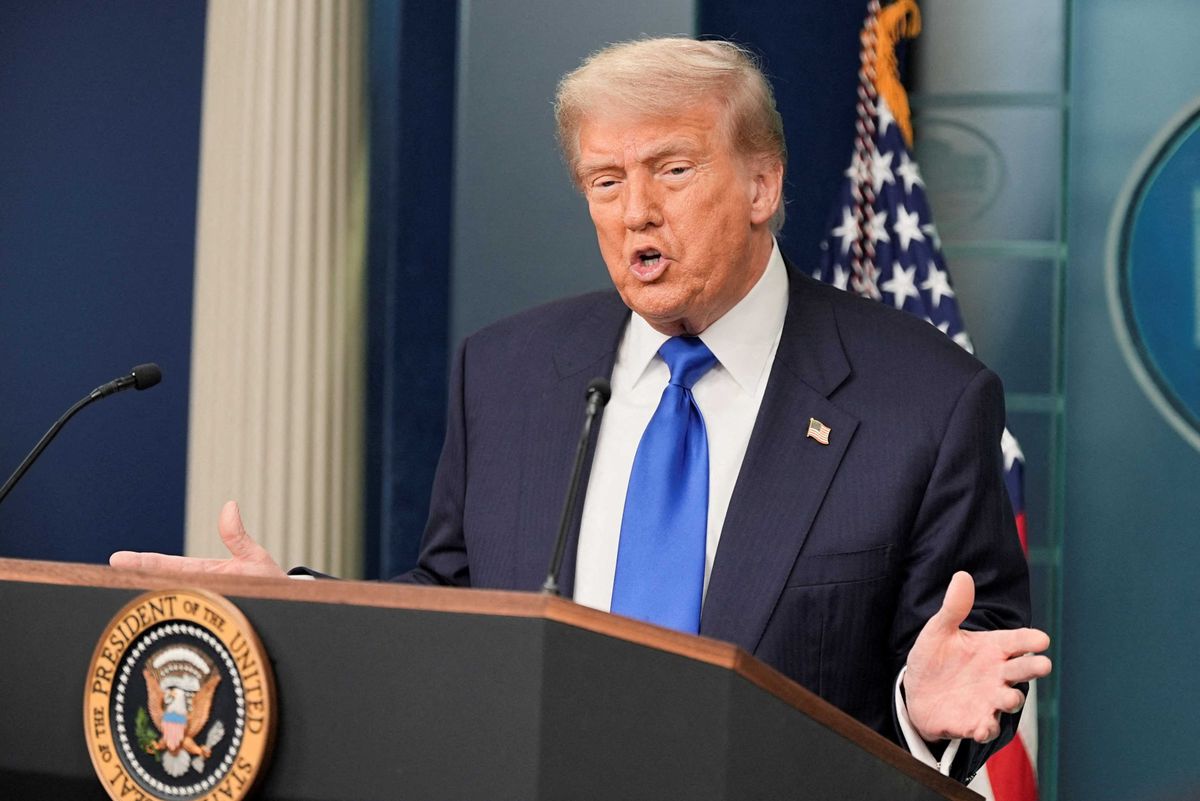
Donald Trump speaks to the media. REUTERS/Ken Cedeno

UK politician has warned Donald Trump could "destroy" the BBC.

The British Broadcasting Company director general, Tim Davie, as well as head of news Deborah Turness, resigned Monday following criticism of a documentary aired about Trump. An internal memo at the BBC suggested two parts of Trump's speech in the Panorama show had been edited together to make it look as though he explicitly encouraged the Capitol Hill riot of January 2021.

Trump has since responded to the documentary and the resignations of Davie and Turness in a post to Truth Social. He wrote: "The TOP people in the BBC, including TIM DAVIE, the BOSS, are all quitting/FIRED, because they were caught 'doctoring' my very good (PERFECT!) speech of January 6th.

"Thank you to The Telegraph for exposing these Corrupt 'Journalists.' These are very dishonest people who tried to step on the scales of a Presidential Election. On top of everything else, they are from a Foreign Country, one that many consider our Number One Ally. What a terrible thing for Democracy!"

But Ed Davey, a member of the UK parliament and leader of the Liberal Democrats party, warned that Trump has the power to "destroy" the BBC following the Panorama documentary. Responding to Trump's Truth Social post, Davey wrote: "It's easy to see why Trump wants to destroy the world's number one news source. We can't let him.

"The BBC belongs to all of us here in the UK. The Prime Minister and leaders from across the political spectrum should be united in telling Trump to keep his hands off it." Outraged members of the public agreed with Davey, with one person calling on Prime Minister Keir Starmer to "make it abundantly clear to the fool Trump" that the president's opinion of the BBC was of no interest.

Davey also called the former director general a "decent man doing a difficult job" and warned the White House and Trump's statements on the BBC are worrying.

He wrote: "I had my disagreements with the BBC under Tim Davie but he was a decent man doing a difficult job. To see Trump's White House claiming credit for his downfall and attacking the BBC should worry us all."

In Trump's speech in Washington D.C. on January 6, 2021, he said: "We're going to walk down to the Capitol, and we're going to cheer on our brave senators and congressmen and women."

However, in the Panorama edit he was shown saying, "We're going to walk down to the Capitol... and I'll be there with you. And we fight. We fight like hell." Trump's press secretary, Karoline Leavitt, has since described the BBC as "100% fake news."

Deadly measles surge sees Canada lose eradicated status

THANK THE 'FREEDOM CONVOY'


By AFP
November 10, 2025


A child receives an MMR vaccine - Copyright AFP/File AIZAR RALDES


Ben Simon

Canada has lost its measles elimination status, health officials said Monday, a major setback caused by a year-long resurgence of the disease largely among unvaccinated groups.

Canada was formally declared measles-free in 1998, an achievement credited to years of consistently high childhood vaccination rates.


But an outbreak that began in the eastern part of the country in October 2024 has since spread nationwide, notably among certain groups of Mennonite Christians who have refused to vaccinate their children on religious grounds.

Canada has recorded 5,138 measles cases so far in 2025, with the provinces of Ontario and Alberta the hardest hit.

Two newborns, born to unvaccinated mothers, have died from the virus.

Health Canada, a government agency, said in a statement that it has officially been informed by the Pan American Health Organization (PAHO) “that Canada no longer holds measles elimination status.”

The update came after PAHO, the UN’s regional health office, confirmed “sustained transmission of the same measles virus strain in Canada for a period of more than one year.”

Provincial health ministers are “discussing coordinated actions, including strategies to build trust (in vaccines) through community engagement,” Health Canada said.

The agency noted that while measles transmission “has slowed recently,” the outbreak has persisted “primarily within under-vaccinated communities.”

Samira Jeimy, from Western University’s Schulich School of Medicine, told AFP that Canada lost its status “because two-dose vaccine coverage dropped below the 95 percent threshold required to stop sustained transmission.”

The spread of the virus in under-vaccinated communities was, for experts, “easily visible as a signal of system fragility,” Jeimy said.

Pediatric doctors in Ontario have stressed that the outbreak is not confined to Mennonite groups.

Infections have also occurred among new immigrants from the developing world who, for various reasons, did not keep up with immunizations after settling in Canada — including due to an acute shortage of family doctors.

– Regional spread –

Measles is a highly contagious respiratory virus spread through droplets when an infected person coughs, sneezes, or simply breathes.

It causes fever, respiratory symptoms, and a rash, but can also lead to serious complications, including pneumonia, brain inflammation, and death.

In a regional update Monday, PAHO confirmed Canada was the only country in the Americas to lose its elimination status, but said several others were facing active measles transmission, including the United States.

In 2025, the United States experienced its worst measles outbreak in more than 30 years, with over 1,600 confirmed cases.

A September Washington Post poll found that one in six American parents has delayed or skipped some or all of the standard childhood vaccines.


Some nine percent have opted out of administering polio or MMR (measles, mumps, rubella) shots to their children, the poll found.

Vaccine resistance has mushroomed in the United States in recent years, stoked in large part by debunked claims linking vaccines to autism.

The US health secretary, Robert F. Kennedy Jr., has played a significant role in fueling those fears by repeating the false claims.


New toothpaste? Keratin regenerates enamel to stop tooth decay


By Dr. Tim Sandle
SCIENCE EDITOR
DIGITAL JOURNAL
November 11, 2025

 
Dental x-ray. Image by Tim Sandle.

Your next toothpaste might be made from your hair, and it could regrow your enamel, according to researchers based at King’s College London.

The scientists have found that keratin, the protein in hair and skin, can repair and protect tooth enamel. The material forms a mineralised layer that halts decay and restores strength, outperforming traditional fluoride. Specifically, when keratin interacts with the minerals found in saliva, it forms a coating that closely replicates the composition and protective function of natural enamel.

The product is made from sustainable sources like hair, it could soon be available in toothpaste or gels. The discovery could transform dentistry by turning waste into a powerful tool for regeneration.

Tooth decay

Dental caries (tooth decay) is one of the most prevalent diseases globally, presenting the largest impact on advanced deterioration in oral health.

Everyday habits, from drinking acidic beverages to poor brushing routines, wear away enamel over time. This erosion can lead to sensitivity, discomfort, and eventually tooth loss. While fluoride toothpaste helps slow this process, the keratin-based formulation in the new study went further, completely preventing it in laboratory tests.

Keratin

Keratin creates a dense, mineralised barrier over the tooth’s surface, blocking the nerve channels responsible for sensitivity (a form of biomimetic protein-based platform). This not only protects against further damage but also provides immediate relief from discomfort, addressing both cause and symptom.

In the study, the research team extracted keratin from wool and applied it to tooth surfaces. When exposed to the natural minerals present in saliva, the protein organised itself into a crystal-like structure that mimicked real enamel.

Over time, this microscopic framework continued to attract calcium and phosphate ions, gradually forming a durable, enamel-like layer. The finding marks an important milestone in regenerative dentistry and brings researchers closer to treatments that can rebuild the tooth’s protective shell rather than just patching damage.

New teeth cleaning products


The researchers envision the treatment being available in two forms: a daily-use toothpaste or a professional gel applied by dentists, similar to nail varnish. According to the team, keratin-based enamel repair products could be accessible to the public within two to three years.

Other advantages

The research addresses growing concerns about the environmental impact of dental materials and the long-term use of fluoride.

Keratin is sustainably sourced from biological waste materials like hair and skin. In addition, the substance eliminates the need for traditional plastic resins, commonly used in restorative dentistry, which are toxic and less durable.

The research appears in the journal Advanced Healthcare Materials, with the research paper headed: “Biomimetic Mineralization of Keratin Scaffolds for Enamel Regeneration.”
New data reveals the world’s leading economies by ‘real GDP’ in 2025


By Dr. Tim Sandle
SCIENCE EDITOR
DIGITAL JOUNAL
November 11, 2025


Image: — © AFP WANG Zhao

The International Monetary Fund has just warned of slowing global economic growth in its latest analysis. Similar to this finding, a newly issued report reveals the world’s wealthiest countries by real gross domestic product in 2025.

To evaluate how countries rank in real economic terms, researchers at BestBrokers calculated Real GDP figures for 135 countries, based on IMF data covering the 10 years between 2016 and 2025. GDP, or Gross Domestic Product, is the total monetary value of all final goods and services produced within a country’s borders in a specific time period. It is the main measure of a country’s economic size and health.

Analysing real GDP is important since it strips out the effects of inflation and temporary price changes, offering a true picture of economic performance and living standards. While nominal figures often highlight the largest economies, real GDP reveals the relative strength and resilience of countries, showing where growth is genuine and where it is eroded by rising prices.

Countries with the highest Real GDP in 2025:

  1. United States: $23.83 trillion (nominal $30.62 trillion)
  2. China: $16.77 trillion (nominal $19.40 trillion)
  3. Germany: $4.07 trillion (nominal $5.01 trillion)
  4. Japan: $3.81 trillion (nominal $4.28 trillion)
  5. United Kingdom: $3.44 trillion (nominal $3.96 trillion)
  6. France: $2.97 trillion (nominal $3.36 trillion)
  7. India: $2.30 trillion (nominal $4.13 trillion)
  8. Italy: $2.20 trillion (nominal $2.54 trillion)
  9. Canada: $1.76 trillion (nominal $2.28 trillion)
  10. Russia: $1.73 trillion (nominal $2.54 trillion)

The U.S., China, and Germany lead in real GDP figures just as they do in nominal terms in 2025; however, the values are significantly reduced once the GDP deflator is applied and inflation is taken out of the equation, resulting in a ‘real figure’ that is between 16% (China) and 23% (the U.S.) lower than the nominal one.

In 2025, the U.S. leads in real GDP with $23.83 trillion, approximately 23% lower than its nominal GDP of $30 trillion. Since 2024, its real GDP has grown modestly by 2.02%, up from $23.36 trillion.

China and Germany round out the top three in the 2025 real GDP ranking. China’s real GDP stands at $16 trillion, about 16% below its nominal $19 trillion, while Germany’s real GDP is $4.07 trillion, roughly 20% lower than its nominal $5.01 trillion. Both countries show similar year-on-year growth, increasing by 4.61% and 4.59%, respectively.

In terms of real GDP per capita, Liechtenstein tops the list at $231,478, followed by Ireland with $125,005 and Luxembourg at $106,732. At the opposite end, Argentina ranks lowest with just $12.88 in real GDP per person, with Moldova not far ahead at $253.61 per citizen.

Ghana recorded the largest year-over-year increase in real GDP, rising 17.35% from $13.91 billion to $16.32 billion in 2025. It was followed by Ireland with a 13.90% annual increase and Morocco at 11.62%. In contrast, Ethiopia and Egypt saw significant declines, with real GDP falling by 34.63% and 23.89%, respectively.

Looking at changes over the past decade, Armenia has seen its real GDP nearly double, rising 97.7% from $7.01 billion to $13.86 billion between 2016 and 2025. Albania also saw a significant increase of 88.5%, from $12.63 billion to $23.80 billion. In contrast, Argentina and Türkiye experienced dramatic declines, with real GDP falling 98.8% ($47.81 billion vs $590.54 million) in Argentina, and 88.4% ($525.32 billion vs $60.90 billion) in Türkiye.

The disparities across regions, rapid expansions in some emerging markets, contrast with sharp contractions in others.
German court rules against OpenAI in copyright case


By AFP
November 11, 2025


The case could have implications for European artists - Copyright AFP MARCO BERTORELLO


Jan Mueller with Femke Colborne in Berlin

A German court ruled Tuesday that OpenAI has infringed copyright law by using song lyrics to feed its chat models in a case that could have wide implications for European artists.

The Munich court found that the maker of ChatGPT was not entitled to use song lyrics to train its artificial intelligence without licences, and that the artists who wrote them are entitled to compensation.

“Both the memorisation in the language models and the reproduction of the song lyrics in the chatbot’s outputs constitute infringements of copyright law,” the court ruled.

The case was filed in November 2024 by German music rights body GEMA on behalf of the artists behind nine German songs.

GEMA, which represents more than 100,000 composers, songwriters and publishers, accused OpenAI of reproducing protected song lyrics without having purchased licences or paid the creators.

San Francisco-based OpenAI argued it had not broken the law because its language models do not store or copy specific data but rather reflect in their settings what they have learnt, according to the court.

With regard to the AI chatbot, it is users who are the producers of its output and are responsible for it, OpenAI argued.

But the court on Tuesday ruled that the plaintiffs were entitled to compensation “both on the basis of the reproduction of the texts in the language models and their reproduction in the outputs”.

In a statement on Tuesday, OpenAI said that “we disagree” with the ruling and that the company was “considering next steps”.

“The decision is for a limited set of lyrics and does not impact the millions of people, businesses and developers in Germany that use our technology every day,” it said.

“We respect the rights of creators and content owners and are having productive conversations with many organisations around the world, so that they can also benefit from the opportunities of this technology.”

– ‘Milestone victory’ –

OpenAI has faced several court cases in the United States, with media groups and authors among those claiming that the company’s ChatGPT chatbot has been trained on their work without permission.

But GEMA’s challenge is the first major case of its kind in Europe, the music rights group said.

Law firm Raue, which represented GEMA in the case, said the ruling “sets an important precedent for the protection of creative works and sends a clear signal to the global tech industry”.

The ruling has provided “legal certainty for creative artists, music publishers and platforms throughout Europe and is likely to have an impact far beyond Germany”, it said in a statement.

Kai Welp, the head of GEMA’s legal department, said it was “crucial for authors receive remuneration for the commercial exploitation of their works so that they can make a living”.

“It is to be hoped that today’s decision will increase the willingness of AI companies to negotiate and that, in this way, fair remuneration for our members can be agreed,” Welp said.

The verdict could also have implications for other types of creative content, according to GEMA.

The German Journalists’ Association also welcomed the ruling, hailing it as “a milestone victory for copyright law”.
‘Western tech dominance fading’ at Lisbon’s Web Summit


By AFP
November 11, 2025


This year's Web Summit spotlights a kaleidoscope of startups from around the world - Copyright GETTY IMAGES NORTH AMERICA/AFP Tom Brenner


Daxia ROJAS and Tom Barfield

Global tech leaders will pack Lisbon’s annual Web Summit from Tuesday to talk Artificial Intelligence, robots and startups — all under the shadow of tensions over cutting-edge tech and the natural resources needed to build it.

Over four days, the “Davos for geeks” is set to welcome over 70,000 visitors including 2,500 startups and 1,000 investors, according to organisers.

Tech leaders gathered at Monday’s opening night, starring Swedish startup founder Anton Osika, whose Lovable software company is touted as the fastest growing in history.

The audience also cheered TikTok star Khaby Lame, tennis great Maria Sharapova and an Olympics-style parade of tech founders bearing their nations’ flags.

Here are some of the key themes at the show:

– Shifting sands –

“This year, more than any year before, it’s clear that the era of Western tech dominance is fading,” Web Summit founder Paddy Cosgrave said Monday.

He cited Chinese manufacturers leading in fields like AI and humanoid robots, as well as Brazilian digital payments service PIX and a record number of Polish startups, as evidence of a more multipolar tech world.

Beyond the glossy tech products, global tensions over hi-tech trade, competition and sovereignty will weigh on discussions.

– Robots and autonomous cars –

The “most advanced humanoid robots in the world” on display are “not European, they’re not American. Instead, they are Chinese,” Cosgrave said.

Nevertheless, US speakers will include Amazon Robotics boss Tye Brady and Robert Playter of Boston Dynamics.

Uber president Andrew Macdonald and rival Lyft’s chief David Risher will talk up schemes to fill the streets with robotaxis.

Uber has partnered with Nvidia to upgrade tens of thousands of vehicles with automation tech from 2027.

Waymo, a subsidiary of Google parent company Alphabet, has said its driverless vehicles will arrive in London next year. And several Chinese manufacturers including Baidu and Pony.ai have Europe in their sights for an automated car rollout.

– AI and chips –

The struggle for dominance may be fiercest in generative artificial intelligence, spotlighting Tuesday’s planned appearance by Cristiano Amon, boss of American chip developer Qualcomm.

His company has announced AI chips squaring up to sector heavyweight Nvidia and challenger AMD. The rival high-end processors are subject to US export restrictions on national security grounds.

Several leaders of other top AI firms will also appear, including Microsoft president Brad Smith.

Osika’s Lovable is one of several firms allowing users to create apps and websites via a chatbot without coding experience. “We’re seeing 100,000 new products built on Lovable every single day,” he said.

British dictionary publisher Collins dubbed this “vibe coding” approach its word of the year for 2025.

– Health and sports –


Almost 30 percent of investment in new sports technology went into AI firms in the first half of this year, investment bank Drake Star said in a study.

On stage, Sharapova praised AI tools’ value to sports — from preparing athletes for competition to speeding up recovery time or stoking fans’ engagement.

And wearables, such as watches and rings able to monitor sleep, heart rate or body temperature, mean that tech’s ability to detect initial signs of illness will be another hot topic.

– Tech sovereignty –


Brussels will send Henna Virkkunen, the European Commission’s digital chief, as the 27-nation EU is increasingly fearful for its technological sovereignty amid rising trade and political tensions.

“We’re more and more dependent, especially on the American hyperscalers” or major data centre operators, said Maya Noel, director general of the France Digitale network of tech companies and investment firms, who will urge European alternatives.

As the Commission pressures American and Chinese platforms to tighten measures for underage internet users, American games publisher Roblox — whose game is popular with minors — will outline how it plans to verify players’ ages.


Global tech tensions overshadow Web Summit’s AI and robots


By AFP
November 10, 2025


AI will be taking centre stage at this year's Web Summit as major global players are racing to control the supply chain for chips needed to drive generative artificial intelligence - Copyright AFP ANTHONY WALLACE


Daxia ROJAS

Flashy AI, robotics and self-driving cars will be on show at the annual Web Summit in Lisbon from Monday, but global tensions over high-tech trade, competition and sovereignty will be weighing on the minds of entrepreneurs, investors and policymakers.

Known as the “Davos for geeks,” the four-day event in the Portuguese capital is set to welcome over 70,000 visitors, including 2,500 startups and 1,000 investors.

– AI and chips –

With major global players racing to control the supply chains behind generative artificial intelligence, an appearance by chief executive of American chip developer Qualcomm Cristiano Amon will be a hot ticket.

His company recently announced a new range of AI chips designed to compete with sector heavyweight Nvidia and challenger AMD.

Both firms’ high-end processors are subject to restrictions from Washington on their export to China on national security grounds.

Several leaders of other top AI players will also appear in Lisbon, including Microsoft President Brad Smith and Joleen Liang, co-founder of Chinese startup Squirrel AI, which is bringing the technology into classrooms.

One of Europe’s hottest tickets, Swedish startup Lovable, is sending boss Anton Osika to vaunt its technology that allows users to create apps and websites via a chatbot without coding experience.

British dictionary publisher Collins dubbed this “vibe coding” approach its word of the year for 2025.

– Health and sports –

Almost 30 percent of investment in new sports technology went into AI firms in the first half of this year, investment bank Drake Star found in a study.

In Lisbon, Russian tennis star Maria Sharapova and France’s Caroline Garcia will be on stage talking about how AI can improve athletes’ performance in their discipline.

Increasingly capable devices ranging from watches and rings able to monitor sleep, heart rate or body temperature mean that tech’s ability to detect initial signs of illness will be another hot topic.

– Robots and autonomous cars –

American robotics chiefs in Lisbon will include Amazon Robotics boss Tye Brady and Robert Playter, head of the Boston Dynamics company known from viral videos of its dog-like quadrupeds.

Uber president Andrew Macdonald and Lyft’s chief David Risher will for their part talk up schemes to fill the world’s streets with robotaxis.

Fired in part by the generative AI surge, competition is heating up to dominate automated driving.

Uber has signed a partnership with chip developer Nvidia to upgrade tens of thousands of cars from different manufacturers with automation tech from 2027.

Waymo, a subsidiary of Google parent company Alphabet, has said its driverless vehicles will arrive in London from next year.

And several Chinese manufacturers including Baidu and Pony.ai have Europe in their sights for an automated car rollout.

– Tech sovereignty –

Brussels will make its presence felt at Web Summit by the presence of Henna Virkkunen, the European Commission’s digital chief.

The 27-nation EU is increasingly fearful for its technological sovereignty as transatlantic trade and political tensions mount.

“We’re more and more dependent, especially from the American hyperscalers” or major data centre operators, said Maya Noel, director general of the France Digitale network of tech companies and investment firms.

She will tell attendees that European options are needed if the continent is to remain in control of its economy.

As the Commission pressures American and Chinese platforms to tighten protections for underage internet users, American games publisher Roblox — whose eponymous game is vastly popular with minors — will outline how it plans to verify players’ ages.

AI Concentration of corporate power a ‘huge’ concern: UN rights chief

By AFP
November 11, 2025


Image: — © AFP Kirill KUDRYAVTSEV

Nina LARSON

A few tech giants accumulating massive power coupled with artificial intelligence is posing huge global rights challenges and needs regulation, the UN human rights chief told AFP in an interview.

Amid increasing worries over threats to democracy and with a growing number of countries at risk of sliding towards autocracy, Volker Turk said a key concern was the seeming unbridled power of a small number of technology companies.

In an interview this week at the UN rights office overlooking Lake Geneva, he pointed to how seven or eight big tech companies now boast more wealth than the entire economies of even industrialised nations.

“They have amassed an immense amount of power,” he said.

“And power, we all know, if it is not circumscribed by rule of law, by international rights law, can lead to abuse.

“It can lead to an exercise of powers to subjugate others.”

The United Nations High Commissioner for Human Rights said he was deeply “worried that corporate power, if it’s not constrained by the law and by international rights standards, is going to be a huge issue for us”.

“It’s an area where I think we as the human rights community will have to focus much more.”

– ‘Extremely manipulative’ –

Turk did not mention any company by name.

But he spoke just days after Tesla shareholders endorsed a pay package that could reach $1 trillion for its chief executive Elon Musk — already the world’s richest person and owner of social media platform X.

Other high-profile tech figures like Meta chief Mark Zuckerberg and Amazon founder Jeff Bezos also figure among the world’s wealthiest people.


UN High Commissioner for Human Rights Volker Turk said a few tech giants had amassed ‘an immense amount of power’ – Copyright GETTY IMAGES NORTH AMERICA/AFP Tom Brenner

Turk this year voiced alarm to the UN Human Rights Council over the influence wielded by “unelected tech oligarchs”.

They “have our data: they know where we live, what we do, our genes and our health conditions, our thoughts, our habits, our desires and our fears”, he told the UN’s top rights body.

“They know how to manipulate us.”

The fact that tech titans are racing to roll out generative artificial intelligence tools adds to the concern of many experts.

“Generative AI can have huge potential to resolve some of the biggest problems that we face, but we also can see the shadow side,” Turk said.

He highlighted the impact AI-enhanced social media could have on election campaigns and other democratic processes.

It can be “extremely manipulative”, he warned, and “can distort views, distract people from real life… the real issues”.

– ‘Climate denial’ –

Turk cautioned that “AI that is unregulated can be a huge source of distraction, which then takes away the political energy that we need in order to actually fight autocratic tendencies, to push back on lack of control”.

At the same time, AI is being used for “distorting reality”, he said, adding he did not want to say it was creating alternative realities, “because they are not realities. It is fake”.

And they are not harmless, he warned.

“The right to truth, the right to science are fundamental issues,” Turk said.

With the UN climate conference under way in Brazil, he also decried the harm from climate change disinformation.

“I’m shocked to hear leaders talk about climate denial again, when we all know that we are already overshooting the goal that was set 10 years ago with the Paris Agreement,” he said.

“What are we thinking? What are we doing to our children, our grandchildren, future generations?” he asked.

“There will be questions asked about accountability in the future, but then it’s too late.”


Leaked data: Minor details create a damaging big picture


By Dr. Tim Sandle
SCIENCE EDITOR
DIGITAL JOURNAL
November 10, 2025


How much of your data is going missing? Image by Tim Sandle.

Since 2004, over 23 billion accounts have been compromised, exposing nearly 58 billion data points, including sensitive personal details like eye colour, shoe size and more. This translates to 28.8 million individual pieces of information. To put that into perspective, this is nearly equivalent to the entire population of Australia having their physical traits leaked online.

The company Surfshark has recently analysed data from 160 countries, grouped 100 different types of leaked data points into nine distinct categories, and provided an overview shared with Digital Journal.


The danger surrounding this is not simply a stolen password; it is the aggregation of seemingly minor details. When physical features like height, shoe size, or even eye colour are added to the mix, it provides personally identifiable information that enables account takeovers, very personalised and sophisticated identity theft, financial loss, and fraud schemes.

Overview of different leaked data points


In the report, Surfshark looked at countries with populations over one million and grouped types of leaked data points into nine distinct categories: personal information, passwords, education, finance, location, social media, physical characteristics data, vehicle data, and other.

Overall, the password category (containing information about exact passwords, their hints, security questions, and their answers) accounts for 30% of all leaks, with the actual password field being the most frequently exposed single data point. This data point alone has been leaked 10.4 billion times, accounting for nearly a quarter (23%) of all data points.

Personal information (29%) and location data (23%) categories follow closely. When analysing the most leaked data types by country, the US stands out by ranking in the top three for 18 of the 20 most leaked data types. These include first name, last name, full name, phone, address, and location.

More than just usernames and passwords

While login credentials and contact details are the most commonly compromised in data leaks, the scope of exposed information often extends to highly personal, physical attributes of an individual’s life. Although these data categories are less frequently leaked, they are crucial in augmenting a digital profile with real-world characteristics, making the concept of “digital doppelgänger” chillingly plausible.

Israel leads the world in the exposure of physical features data, followed by France, Australia, and the US.

The leaks are so detailed that security researchers can identify which countries lead in particular attributes:Israel has the most leaks related to height;
France leads in exposed data on eye colour, hair colour, and weight;
The U.S. ranks first for leaked shoe size data.

According to Sereika, the real danger arises when various data points are combined. The more personalized the information criminals have, the easier and more dangerous an attack becomes. While you can reset a leaked password, your eye colour, once exposed, is lost forever. People have to pay more attention to what information they share online.

To protect your digital footprint the report advises reviewing your online presence, limiting the amount of personal information you share, and demanding greater data security from the companies people entrust with their data.

‘Splinternets’ threat to be avoided, says web address controller


By AFP
November 11, 2025


ICANN, a US-based non-profit, manages all internet addresses
 - Copyright AFP Adek BERRY

Tom BARFIELD

The risk of the internet fragmenting into national “splinternets” will likely be averted in a UN vote next month, the head of the authority that manages web addresses told AFP on Tuesday.

“The vast majority of the countries that we have met with, including countries who in the past have been very sceptical… believe the current model of governing the internet has worked,” Kurtis Lindqvist, head of ICANN, said at the Web Summit tech gathering in Lisbon.

Officials from UN member countries are to meet December 15-16 to review the rules that have applied to internet over the past two decades.

Some proposals circulating call for control of managing internet addresses being taken away from the US-based non-profit Internet Corporation for Assigned Names and Numbers (ICANN) that Lindqvist runs.

Pressure has built in recent years to give that power to governments and trade groups.

But ICANN has warned that any such move could lead to a fragmented “splinternet” in which it could prove expensive or impossible for people to connect across separate address systems.

Lindqvist said “there’s some careful optimism” that the existing system will remain in place. “But let’s see what happens in December.”

He added that “negotiations really start now” on the text that will be adopted at the meeting at the United Nations headquarters in New York.

– ‘Phenomenally successful’ –

ICANN is best known for coordinating global allocation of internet addresses — whether the easily-remembered versions people type into web browsers, or the strings of numbers used by computers known as IP addresses.

Having a single agreed-upon address system worldwide means that anyone in any country can easily reach people elsewhere on the globe by visiting their website or sending an email.

The internet’s social and business benefits are “only possible because we have a uniform technical standard, we have uniform identifiers that are reachable throughout the entire internet,” Lindqvist said.

“If we start fragmenting this by raising barriers or through policy actions, then we start diminishing this value creation”.

Over the decades the internet has existed, “we have unfortunately been so phenomenally successful with this that people are starting to take the internet for granted, and that’s the real risk,” Lindqvist added.

The ICANN chief further called for the UN to end the practice of reviewing internet governance every 10 years.

“The model of governing the internet has been successful… We know it works,” he said, adding that “that seems to be agreed to by most member states”.

By contrast, in terms of regulation of AI — this decade’s erupting technology — “everything literally is on the table” in talks among governments, Lindqvist said.

From proposals for independent governance along ICANN lines to a dedicated UN AI agency, “It’s the same as the late ’90s, literally it’s the same spectrum,” he said.

AI adoption in the US adds ~900,000 tons of CO₂ annually, equal to 0.02% of national emissions


IOP Publishing

AI Adoption in the U.S. Adds ~900,000 Tonnes of CO₂ Annually, Equal to 0.02% of National Emissions 

image: 

AI Adoption in the U.S. Adds ~900,000 Tonnes of CO₂ Annually, Equal to 0.02% of National Emissions

view more 

Credit: IOP Publishing


new study published in Environmental Research Letters finds that continued growth in artificial intelligence (AI) use across the United States could add approximately 900,000 tonnes of CO₂ annually. This is not a small amount but equates to a relatively minor increase when viewed in the context of nationwide emissions.

While AI adoption is expected to boost productivity and economic output, researchers note that its environmental footprint can be seen as relatively modest compared to other industrial activities. The study examined potential AI integration across various sectors, estimating the associated rise in energy use and carbon emissions.

Key findings include:

  • AI adoption across the U.S. economy may result in an additional 896,000 tonnes of CO₂ emissions per year, which represents just 0.02% of total U.S. emissions.
  • Energy use in individual industries could increase by up to 12 petajoules annually, comparable to the electricity consumption of around 300,000 U.S. homes.

Co-author Anthony R. Harding explains: “While the projected emissions from AI adoption are modest compared to other sectors, they still represent a meaningful increase. This underscores the importance of integrating energy efficiency and sustainability into AI development and deployment, especially as adoption accelerates across industries.”

As AI technologies become more integrated into daily operations, researchers encourage industry leaders to incorporate energy efficiency and sustainability into their AI strategies to ensure responsible growth as adoption scales.

ENDS 


About IOPP

IOP Publishing is a society-owned scientific publisher, delivering impact, recognition and value to the scientific community. Its purpose is to expand the world of physics, offering a portfolio of journals, ebooks, conference proceedings and science news resources globally. IOPP is a member of Purpose-Led Publishing, a coalition of society publishers who pledge to put purpose above profit.   

As a wholly owned subsidiary of the Institute of Physics, a not-for-profit society, IOP Publishing supports the Institute’s work to inspire people to develop their knowledge, understanding and enjoyment of physics. Visit ioppublishing.org to learn more.  


Lehigh University–Siemens partnership advances microgrid research for AI data centers


PhD student Saskia Putri explores real-time monitoring and control tools to help data centers manage growing power demands from artificial intelligence


Lehigh University

Lehigh University-Siemens partnership team 

image: 

Lehigh University PhD student Saskia Putri (civil and environmental engineering), Farrah Moazeni, assistant professor of civil and environmental engineering, and Javad Khazaei, assistant professor of electrical and computer engineering, P.C. Rossin College of Engineering and Applied Science. The team is collaborating with Siemens to advance microgrid technology for data centers.

view more 

Credit: Lehigh University


Hyperscale data centers are behemoths of computing power. Spanning over a million square feet in a single facility alone, they house thousands of servers that process, store, and analyze massive datasets that drive artificial intelligence. 

Not surprisingly, such infrastructure also requires an enormous amount of power. 

“Data centers have distinctive load profiles,” says Saskia Putri, a fourth-year Lehigh University PhD student advised by Farrah Moazeni, an assistant professor of civil and environmental engineering in the P.C. Rossin College of Engineering and Applied Science. “When they’re training AI models, their power requirements can jump suddenly and significantly. That kind of rapid change can create instability in the electrical grid.”

To tackle this problem, Siemens sponsored a one-year research project led by Farrah Moazeni and co-led by Javad Khazaei, an assistant professor of electrical and computer engineering. As part of this agreement, Putri was awarded a year-long fellowship to work with researchers at Siemens on advancing microgrid technology for more resilient and reliable energy systems. The agreement stems from a new research collaboration between Siemens—a global leader in automation and energy systems—and Lehigh’s Center for Advancing Community Electrification Solutions (ACES).

Under the Siemens-Lehigh research agreement, one of Putri’s tasks is to develop a data center microgrid—a localized power network capable of operating independently of the main grid. Her work will focus on modeling, simulating, and embedding real-time control systems to enhance the microgrid’s stability and reliability in powering energy-intensive operations such as AI training.

“In addition to real-time control, we also aim to build a real-time monitoring tool that lets users know when a disturbance or maintenance issue is likely to occur,” she says. “The idea is to design a system that is reliable and efficient and can predict and respond to changes instantly, ensuring rapid voltage stabilization under dynamic conditions.”

Throughout the fellowship, Putri will make several visits to Siemens’ research and development department to refine her designs. She will also use resources from Moazeni’s Interconnected Critical Infrastructure Systems Engineering (CONCISE) Laboratory and the Integrated, Resilient, and Intelligent Energy Systems (INTEGRITY) Laboratory, led by Javad Khazaei. Lehigh’s own data center will serve as a testing ground for Putri’s models, allowing her to validate simulations using real operational data. 

The collaboration underscores the value of mutually beneficial university-industry partnerships, a theme highlighted during a recent national workshop on industry-academia collaboration hosted by Lehigh in Washington, D.C.

For Siemens, which aims to incorporate new control and optimization algorithms into its software and hardware platforms, partnering with Lehigh bridges academic innovation and industrial application, and promises access to promising technologies. 

“They focused on continuously improving their monitoring and automation tools across diverse industrial applications,” says Putri. “By collaborating with universities like Lehigh, they can bring in new ideas and research that haven’t yet been implemented in the real world.”

Such advances could translate to significant energy savings. According to the International Energy Agency, data centers already account for about 1.5 percent of global energy consumption—a figure expected to climb as AI demand grows. 

“That's why we want to use a microgrid instead of relying solely on the main grid,” says Putri. “We plan to incorporate solar panels, wind turbines, and energy storage systems. By combining renewable generation with storage, we can save energy and reduce emissions.”

For Putri, the partnership offers an opportunity to address the unique challenges of modeling hyperscale data center microgrids at a time when the world is increasingly reliant on artificial intelligence. 

“The design of these microgrids is not typical,” she says. “The load profile is different, the scale is massive. How can I automate that? How can I combine AI with microgrid design? These things have never been done before in the industry. I’m fascinated by how algorithms can control and optimize infrastructure to make it more resilient and sustainable—and that’s what makes this partnership so exciting.”

The experience will also give her a glimpse into her potential future. Still weighing a career in academia versus industry, Putri sees the fellowship as a chance to explore what it’s like to pursue her passion within a global company.

“When I think about going into industry, I think about companies like Siemens that prioritize research and development,” she says. “My passion is research—and if we can use what we’re learning here to make data centers greener and grids more stable, that would be amazing.”

Related Links: