It’s possible that I shall make an ass of myself. But in that case one can always get out of it with a little dialectic. I have, of course, so worded my proposition as to be right either way (K.Marx, Letter to F.Engels on the Indian Mutiny)
Gee someone should tell all these cops and governments that unions are irrelevant.......
May Day Demonstrators Rally Across Asia Workers across Asia rallied Monday to press for better conditions, often encountering a heavy police presence and, in some places, outright resistance.
- A leading trade union leader was arrested Monday as thousands of police brought the capital to a virtual standstill during a government clampdown on unauthorized May Day demonstrations, an opposition leader said. Chea Mony, leader of the Free Trade Union, was arrested by police and detained for two hours on grounds that he was organizing unauthorized demonstrations, said Sam Rainsy, leader of the opposition.
Demonstrations were planned in major cities across Indonesia, with up to 50,000 people expected in the capital alone to protest government plans to revise a labor law -- cutting severance packages and introducing more flexible contracts that would chip away at worker security. "Don't change the law," thousands of laborers chanted at Jakarta's main downtown roundabout, as others arrived in buses and trucks, waiving green, yellow and red flags and banners expressing their demands. High alert for Philippine May Day Strikes to follow May Day: CosatuSABC News
And this is why MayDay is still relevant and important even today.
'Preserve May Day significance' Labour Minister Membathisi Mdladlana urges workers and employers to preserve the significance of the world May Day celebrations to be observed on Monday. In a statement ahead of the celebrations, the minister said it was important for everyone to think of those who were still denied basic worker rights. "On Monday South African workers, as part of the global community, will be joining their counterparts around the world in celebrating the achievements and fruits of the struggles that were waged by their forefathers more than 100 years ago." As we will be celebrating, it is important to note that this year's celebration coincides with the 60th anniversary of the historic mineworkers' strike of 1946. It is the struggles of this nature that led to the current improvements in our working conditions," he said. It was important for people not to treat the May Day holiday as an ordinary public holiday, the minister said. "The freedoms that we enjoy today resulted from attempts by the government and its social partners to ensure the realisation of those struggles and I would therefore like to remind our fellow countrymen and women that as we celebrate, we should pause to spare a thought for those who are yet to enjoy these basic conditions."
Bangalore: It's May Day on Monday. But as workers around the world are celebrating their special day, 350 government employees in Bangalore have little to rejoice. They have been working on contract for more than a decade, and now, the Supreme Court has said that they have no right to regularisation. A case in point is B C Karunakar, who has been working as a typist at the Commercial Taxes department for over 20 years. But despite working here for two decades, he isn’t a permanent employee just like his colleague, T Govindaiah who has put in 22 years of work in the organisation.They've worked for 20 years without increments, medical facilities, and privileged leave. And now they will now retire without pension.
And in Montreal workers kicked off May Day early with a protest against the Charest Neo0Liberal agenda. May Day comes early to Montreal
And check out these sites.
LabourStart for up to the minute May Day headlines.
Workers across the world march for peace and better pay in May Day rallies
May Day rallies across the world brought workers out in force on Friday to protest rising energy prices caused by the US-Israeli war on Iran, with Turkish police arresting dozens of demonstrators trying to march to Taksim Square. Here's everything you need to know about the demonstrations taking place from Islamabad to Istanbul.
Workers across the world will march in May Day rallies Friday, calling for peace, higher wages and better working conditions as they grapple with rising energy costs and shrinking purchasing power tied to the Iran war.
The day is a public holiday in many countries, and demonstrations, some of which have turned violent in the past, are expected in many of the world's major cities.
“Working people refuse to pay the price for Donald Trump’s war in the Middle East,” the European Trade Union Confederation, which represents 93 trade union organisations in 41 European countries, said. “Today’s rallies show working people will not stand by and see their jobs and living standards destroyed.”
In the United States, activists opposing US President Donald Trump’s policies are planning marches and boycotts.
Here’s what to know about May Day.
Workers' unions traditionally use May Day to rally around wages, pensions, inequality and broader political issues.
Protests are planned from Seoul, Jakarta and Istanbul to most European Union capitals and cities across the United States.
Rising living costs linked to the conflict in the Middle East are expected to be a key theme in Friday's rallies.
In the Philippines' capital of Manila, protest organisers said they expect big crowds of workers.
“There will be a louder call for higher wages and economic relief because of the unprecedented spikes in fuel prices,” said Renato Reyes, a leader of the left-wing political group Bayan.
“Every Filipino worker now is aware that the situation here is deeply connected to the global crisis,” said Josua Mata, leader of the SENTRO umbrella group of labour federations.
In Indonesia, labour unions have warned against worsening economic pressures at home.
“Workers are already living paycheck to paycheck,” said Said Iqbal, president of the Indonesian Trade Union Confederation.
In Pakistan, May Day is a public holiday marked by rallies, but many daily wage earners cannot afford to take time off.
“How will I bring vegetables and other necessities home if I don’t work?” said Mohammad Maskeen, a 55-year-old construction worker near Islamabad.
Rising oil prices have fuelled inflation, which the government estimates at about 16 percent, in a country heavily reliant on financial support from the International Monetary Fund and allied nations.
Turkish police fired tear gas and arrested dozens of people holding May Day demonstrations in Istanbul.
Two groups were specially singled out in the city's European side after signalling their intention to march to Taksim square – the scene of several anti-government protests in the past – which was sealed off overnight by police.
In the Mecidiyekoy district, police were seen by AFP using tear gas on the crowd, which included members of a Marxist party, the HKP, who tried to push through while chanting "USA murderer, (Turkey's ruling party) AKP accomplice".
Police encircling the Besiktas neighbourhood stepped in – sometimes violently – whenever a chant was taken up by the demonstrators. AFP journalists reported seeing several protesters thrown to the ground.
Turkish media, including the opposition website Bir Gun, counted at least 57 arrests.
May 1 sees a major police deployment in Turkey every year, with a large area in the heart of Istanbul around Taksim Square sealed off.
Last year, protests moved to the Kadikoy area of the city and more than 400 people were arrested.
In Italy, the government approved nearly 1 billion euros in job incentives this week, aiming to promote stable employment and curb labour abuses ahead of May Day. The measures extend tax breaks to encourage hiring young people and disadvantaged women, and seek to address exploitation tied to platform-based work. Opposition parties dismissed the package as “pure propaganda”.
In Portugal, proposed labour law changes by the centre-right government sparked a general strike and street protests last year. There is still no deal after nine months of negotiations with unions and employers. Unions say the proposals would weaken workers’ rights, including by expanding overtime limits and reducing some benefits.
May Day carries special meaning this year in France after a heated debate about whether employees should be allowed to work on the country’s most protected public holiday – the only day when most employees have a mandatory paid day off.
Almost all businesses, shops and malls are closed, and only essential sectors such as hospitals, transport and hotels are exempt.
A recent parliamentary proposal to expand work on the day prompted major outcry from unions and left-wing politicians.
“Don’t touch May Day,” workers' unions said in a joint statement.
Faced with the controversy, the government this week introduced a bill meant to allow people staffing bakeries and florists to work on the holiday. It is customary in France to give lily of the valley flowers on May Day as a symbol of good luck.
“May 1 is not just any day,” Small and Medium-sized Businesses Minister Serge Papin said. “It symbolises social gains stemming from a century of building social rules that have led to the labour code we know in France. It is indeed a special day.”
Activists and labour unions are organising street protests and boycotts across the United States, where May Day is not a federal holiday.
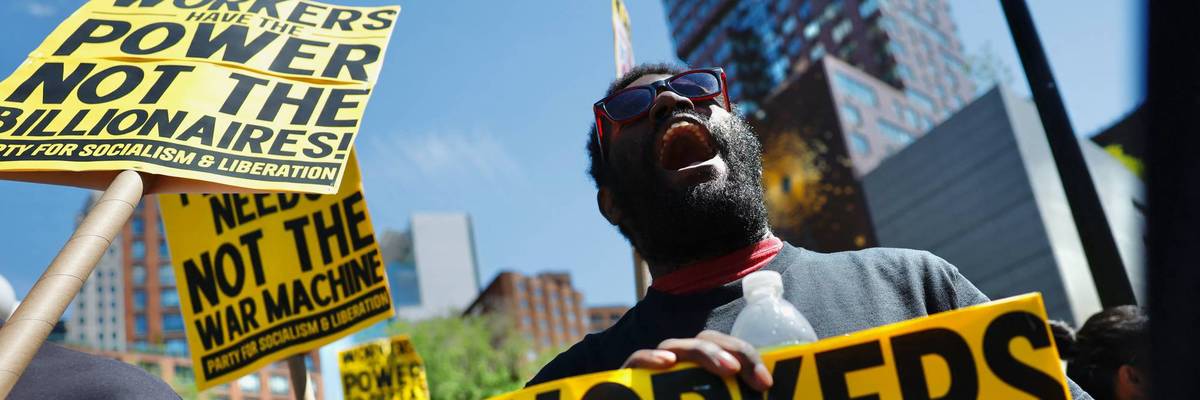
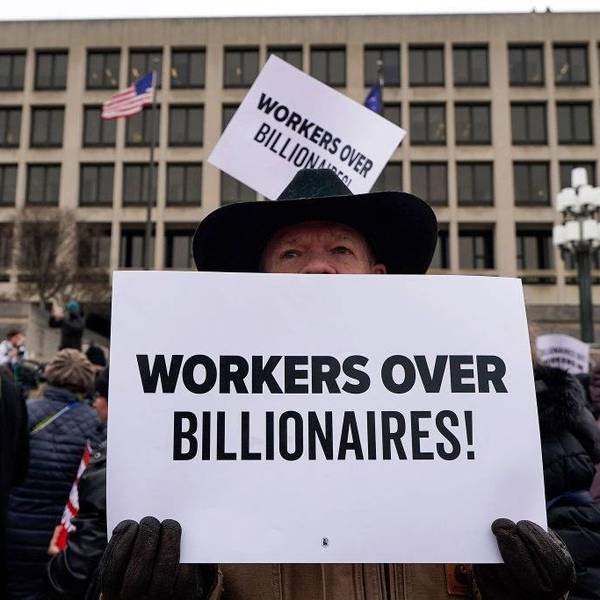
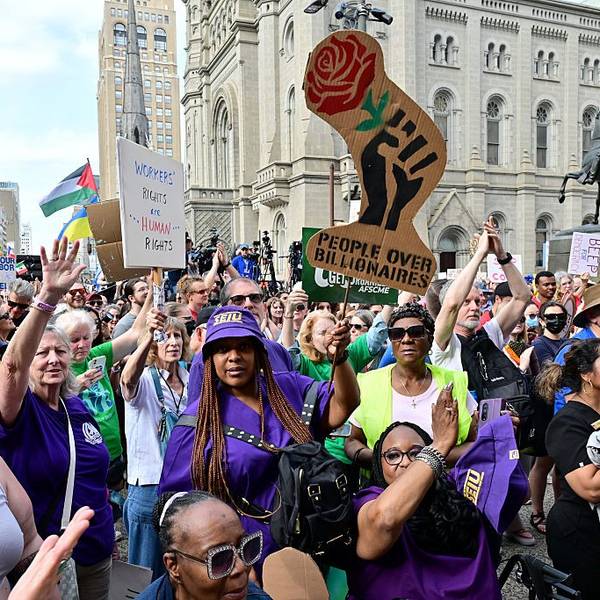
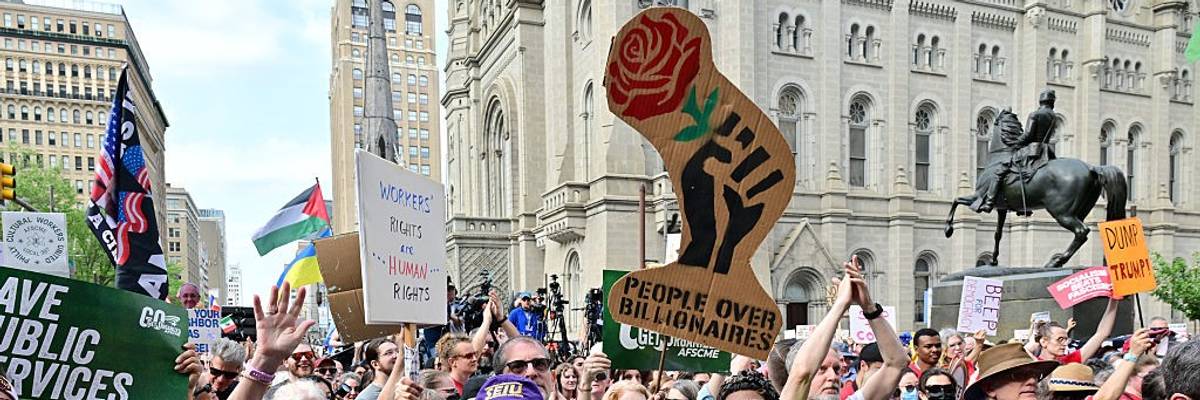
May Day Strong, a coalition of activist groups and labour unions, has called on people to protest under the banner of “workers over billionaires”.
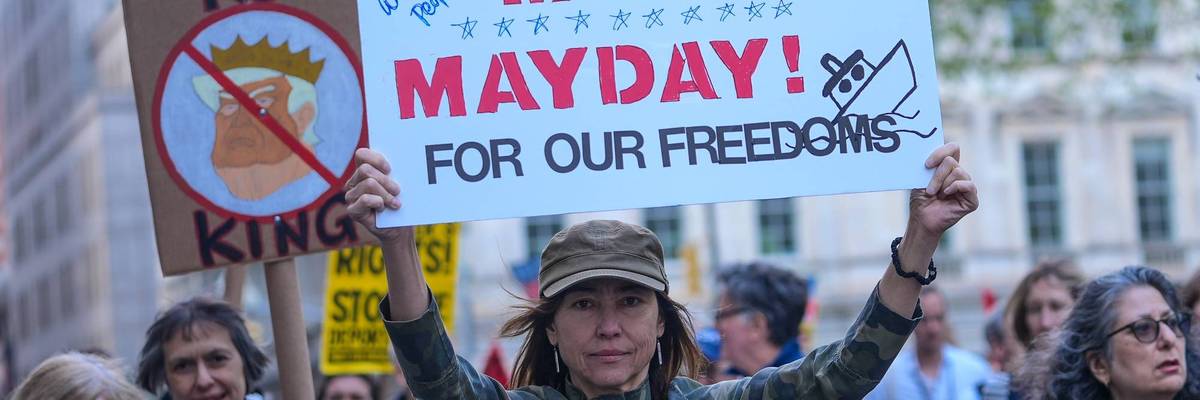
Voicing strong opposition to Trump's policies, organisers listed thousands of May Day actions across the country and are seeking an economic blackout through “no school, no work, no shopping”.
Demands include taxing the rich and putting an end to the Trump administration’s immigration crackdown.
While labour and immigrant rights are historically intertwined, the focus of May Day rallies in the US shifted to immigration in 2006. That’s when roughly 1 million people, including nearly half a million in Chicago alone, took to the streets to protest federal legislation that would have made living in the US without legal permission a felony.
May Day, or International Workers’ Day, dates back more than a century to a pivotal period in US labour history.
In the 1880s, unions pushed for an eight-hour workday through strikes and demonstrations. In May 1886, a Chicago rally protesting the police killing of two striking workers the day before also turned deadly when a bomb was thrown at police, who fired into the crowd in response.
Several labour activists – most of them immigrants and staunch anarchists – were convicted of conspiracy and other charges, despite the fact that the bomber had not been identified; four were executed.
Unions later designated May 1 to honour workers. A monument in Chicago’s Haymarket Square commemorates them with the inscription: “Dedicated to all workers of the world.”
May Day is now observed in much of the world from Europe to Latin America, Africa and Asia.
(FRANCE 24 with AP with AFP)
French unions rally on Labour Day to defend paid holiday rights
French unions are mobilising for Labour Day on Friday, defending the status of 1 May as a paid day off, as the government pushes to allow some businesses to open. The battle comes as inflation and fuel costs stoke calls for salary increases.
Issued on: 01/05/2026 - RFI
Unions are planning to protest to protect the sanctity of the Labour Day holiday on Friday. REUTERS - ERIC GAILLARD
Labour Day on 1 May holds a unique status in France as the only public holiday that is "férié et chômé" – non-working and paid for almost everyone.
Rooted in the labour movement, Labour Day was declared internationally in 1889 after Chicago's Haymarket riot, when a bomb killed several people during a strike for an eight-hour working day.
The holiday symbolises respect for workers, and unions view any erosion of it as a threat to broader protections.
This year’s controversy concerns artisan bakers and florists, some of whom open to sell bread and bouquets of lily of the valley flowers – traditionally given to friends and family on 1 May in France to celebrate the arrival of spring and as a symbol of good luck.
Those who open risk fines from labour inspectors, as current French law permits work on Labour Day only for indispensable activities, such as in hospitals or continuous production.
Courts have rejected automatic exemptions to the mandatory closures for bakers and florists since 2006.
The government wants to clarify this grey area for this year's holiday without fully rewriting the rules, ahead of introducing a law in 2027 setting formal branch agreements on consent and pay.
It proposes protecting these artisans from penalties in 2026 if staff working on 1 May have volunteered to do so and are paid double time.
When Labour Minister Jean-Pierre Farandou presented a bill on Wednesday concerning the 2027 law, he called for “collective wisdom” the it came to skipping fines this year.
France's five biggest trade unions, however, reject the bill outright and are demanding strict enforcement of the holiday closure for all but essential services.
On Friday, union leaders including the CGT’s Sophie Binet, the FO’s Frédéric Souillot and the CFDT’s Marylise Léon will lead the traditional May Day marches in Paris, protesting the long-term decline in manufacturing jobs and calling for higher wages.
According to business information portal Altares, in 2025 some 70,000 French businesses failed, affecting 267,000 jobs.
France’s lower income groups are under mounting pressures from a sluggish economy, with growth projected at just 1 percent for 2026 amid geopolitical strain and rising public debt.
Inflation rose to 1.7 percent in March, driven by energy costs soaring by 7.4 percent due to the Middle East conflict. This has hit low-income households hard as costs rise for essentials such as fuel and food.
(with newswires)
German trade unions to protest job and budget cuts on May Day
01.05.2026 dpa
Photo: Sebastian Willnow/dpa
Germany's trade unions plan to stage several hundred rallies across the country on Friday, the international labour day holiday known as May Day, to protest against job cuts and cuts to social benefits
"Our jobs first, your profits second" is the slogan for this year's events.
The main demands are the preservation of the eight-hour workday, social benefits and a secure state pension, as well as the introduction of higher taxes on large fortunes.
According to the trade unions, companies should only receive state funding if they also invest in Germany. Secure jobs and social security must take precedence over employers’ profit interests.
The main rally, featuring DGB trade union federation President Yasmin Fahimi, will take place in Nuremberg this year.
The Social Democrats' dual leadership will also be appearing, specifically in North Rhine-Westphalia: Finance Minister Lars Klingbeil is due to speak in Bergkamen, and Labour Minister Bärbel Bas in Duisburg, both in western Germany.
(c) 2026 dpa Deutsche Presse Agentur GmbH
Several detained in attempted Workers' Day march on Istanbul’s Taksim
01.05.2026 dpa
Turkish police on Friday clashed with demonstrators attempting to march toward Istanbul’s iconic Taksim Square to mark International Workers' Day, after authorities had banned gatherings in the area, local media reported.
Riot police used tear gas and water cannon to disperse demonstrators, blocking roads leading to Taksim as part of heavy security measures, the Cumhuriyet daily wrote.
Footage broadcast by opposition Halk TV showed several people being forced into police vehicles. The Progressive Lawyers Association (CHD), a local lawyers' union, put the number of detained at more than 300, a figure which couldn't immediately be independently verified.
The Istanbul governor’s office had earlier announced that demonstrations and marches around Taksim Square and nearby areas would not be permitted, citing public order and security concerns.
Authorities also closed some metro stations and major roads in some parts of the city ahead of planned Workers' Day rallies, allocating two sites for celebrations on Istanbul's Asian side.
May Day rallies on Taksim, a symbolic site for Turkey’s labour movement and the scene of the 2013 Gezi Park protests, have effectively been banned since 2012.
(c) 2026 dpa Deutsche Presse Agentur GmbH
Turkish police fire tear gas, arrest hundreds at Istanbul May Day rallies
Istanbul (AFP) – Turkish police on Friday fired tear gas and arrested hundreds of people holding May Day demonstrations in Istanbul, as thousands rallied nationwide.
According to the CHD Lawyers' Association, at least 370 people were arrested in Istanbul, where police fired tear gas from riot-control vehicles into the crowd, AFP journalists observed.
Images aired on the opposition channel HALK TV also showed the president of the Turkish Workers’ Party, Erkan Bas, engulfed in pepper spray.
"Those in power already speak 365 days a year, so let workers talk about the hardships they face at least one day a year," he said.
Two groups were specially singled out in the city's European side after signalling their intention to march to Taksim square -- the scene of several anti-government protests in the past -- which was sealed off overnight by police.
A union official, Basaran Aksu, was arrested just after he had denounced the Taksim lockdown.
"You can't close off a square to the workers of Turkey. Everyone uses Taksim, for official ceremonies, for celebrations. Only the labourers, the workers, the poor find the square closed to them," he fumed. Police lines
May Day, which celebrates workers and the working classes, sees a major police deployment in Turkey every year, with a large area in the heart of Istanbul around Taksim Square sealed off.
Last year, protests moved to the Kadikoy area of the city and more than 400 people were arrested.
The number of arrests this year appeared to be approaching that level.
The CHD lawyers' group, which was present at the rallies, said on a post on X that, at 1100 GMT "according to our information, the number of people in custody stands at 370".
On Friday, a large deployment of police, many in riot gear, and metal barricades were seen choking access to central neighbourhoods of Istanbul.
In the Mecidiyekoy district, police were seen by AFP using tear gas on the crowd, which included members of a Marxist party, the HKP, who tried to push through while chanting "USA murderer, AKP (Turkey's ruling party) accomplice".
Police encircling the Besiktas neighbourhood stepped in -- sometimes violently -- whenever a chant was taken up by the demonstrators. AFP saw several protesters thrown to the ground.
Unions and civil society associations had called for the May 1 demonstrations under the slogan "Bread. Peace. Freedom".
Inflation in Turkey is officially pegged at 30 percent but is closer to 40, according to independent estimates.
In Ankara, about 100 coal miners who had staged a nine-day hunger strike to demand wage arrears were cheered as they joined the May Day march, which was notably large and youthful and monitored by a significant police presence, an AFP journalist said.
Earlier this week, Turkish authorities issued arrest and search warrants against 62 people, of whom they deemed 46 -- including journalists, trade unionists and opposition figures -- were "likely to carry out attacks".
Three shot in Chile May Day clashes Riot police disperse demonstrators with a water cannon during clashes following a May Day march in Santiago
(AFP/Martin BERNETTI)
Sun, May 1, 2022
Three people were wounded by gunfire and two arrested in clashes at May Day demonstrations in Chile, police said.
The shooting occurred during a Sunday march called by a union in the capital Santiago as some protesters erected barricades and entered commercial premises, clashing with merchants.
"There were clashes between street vendors who unfortunately used firearms and injured three people, two of them women and a third man was also injured by a ballistic impact," said Enrique Monras, chief of police for the metropolitan area.
Police confirmed two foreigners were arrested on suspicion of firing the shots.
The force used water cannon and tear gas to disperse the demonstrators.
President Gabriel Boric decried the violence, telling a news channel: "We are normalizing violence, we cannot allow criminal gangs to take over the streets of our country."
Separately, the main traditional May Day march, organized by the Central Unitaria de Trabajadores (CUT) union, passed without incident as thousands of people with flags and banners gathered in the Plaza Italia.
"We are happy, it is a special and particular day after two years of confinement (due to Covid) ... to recognize the work of many colleagues such as health, commerce and transport workers, who were fundamental in this pandemic," said CUT president David Acuna.
They were joined by Labor Minister Jeannette Jara, the first member of the Communist Party to hold the position since the return of democracy in Chile in 1990.
She was the architect of an agreement reached by the CUT and business organizations that will raise the minimum wage by 12.5 percent.
The minimum wage is set to reach 400,000 pesos ($470) per month from August. Boric has said his goal is to raise it to 500,000 pesos by 2026.
msa/gm/dl/mtp/leg
May Day holiday marred by clashes in Turkey, France
Police and protesters clashed in Turkey and France during May Day rallies on Sunday, as tens of thousands marched across the world in support of workers' rights.
Turkish riot police detained scores of demonstrators in Istanbul, pinning some of them to the ground and dragging them away from the rally, which the governor's office said was unauthorised.
And rallies in Paris quickly turned violent as youths clashed with police on the sidelines and buildings were vandalised, though unions said more than 200,000 people joined demonstrations across France and most were peaceful.
May 1 is a public holiday in many countries and Sunday saw events on every continent.
European rallies sparked the most controversy with Turkish protesters gathering at Istanbul's Taksim Square, an area synonymous with anti-government protests, chanting "long live labour and freedom, long live May Day".
City officials said the group refused to disperse and 164 were detained, with government-approved rallies elsewhere in Turkey passing off peacefully.
French ministers denounced the violence in Paris and prosecutors said 50 people had been arrested.
Martine Haccoun, a 65-year-old retired doctor, told AFP she came to protest in the southern city of Marseille to show re-elected President Emmanuel Macron "that we didn't give him a blank cheque for five years".
She said many voted for Macron simply to stop far-right challenger Marine Le Pen.
- 'Not slogans' -
While scuffles were reported in Italian cities including Turin, thousands gathered in London and cities across Germany with no sign of trouble.
In Spain, around 10,000 people joined a demonstration in Madrid and dozens of other cities also held well-attended rallies.
Labour Minister Yolanda Diaz of the communist party said she wanted to show solidarity "with the workers of Ukraine, who today aren't able to protest".
In the Greek capital Athens, more than 10,000 joined rallies against a background of spiralling inflation.
Prime Minister Kyriakos Mitsotakis took to social media to promise a raise in the minimum wage by 50 euros a month.
"We honour the working people not with slogans, but with acts," he wrote on Twitter.
Kenyan Prime Minister Uhuru Kenyatta similarly used his May Day speech to promise a 12 percent hike in the minimum wage, though activists said it was not enough to keep pace with inflation.
The mood was uglier in Sri Lanka, where the opposition showed rare unity in calling for President Gotabaya Rajapaksa to resign over the country's worst-ever economic crisis.
"It is time for us to pull him by his ear and kick him out," former legislator Hirunika Premachandra said at a rally in Colombo.
South African President Cyril Ramaphosa was also feeling the heat, being forced to leave an event when miners stormed the stage he was due to speak at and chanted "Cyril must go".
However, other leaders were able to harness the energy of the crowds.
Xiomara Castro, the new president of Honduras, was greeted by thousands chanting her name, and she responded by telling them she would govern for them and put an end to a "dark era" of corruption and drug trafficking.
There were also two separate marches in the Venezuelan capital of Caracas, with hospital workers and other basic service employees calling for a "dignified salary" at one demonstration.
"People, listen, join the fight!" they chanted.
President Nicolas Maduro addressed the crowds at a separate pro-government march elsewhere in the city, blaming United States sanctions for his country's "economic storm" and announcing "Venezuela is headed for prosperity".
Thousands of May 1 demonstrators in Chile took to the streets only days after the government announced a 12.5 percent rise in the minimum wage, which is set to reach 400,000 pesos ($470) per month from August. President Gabriel Boric has said his goal is to raise it to 500,000 pesos by 2026.
May Day came too soon for many in China to enjoy what is usually one of the year's busiest holidays.
A series of lockdowns sparked by rising Covid cases meant restaurants and tourist sites were deserted during what is usually a frenetic period.
"Obviously it's bad in terms of our own self-interest, but it's necessary overall for the good of the country," said a young waiter at a deserted restaurant near the Forbidden City in Beijing.
burs-jxb/har/caw/
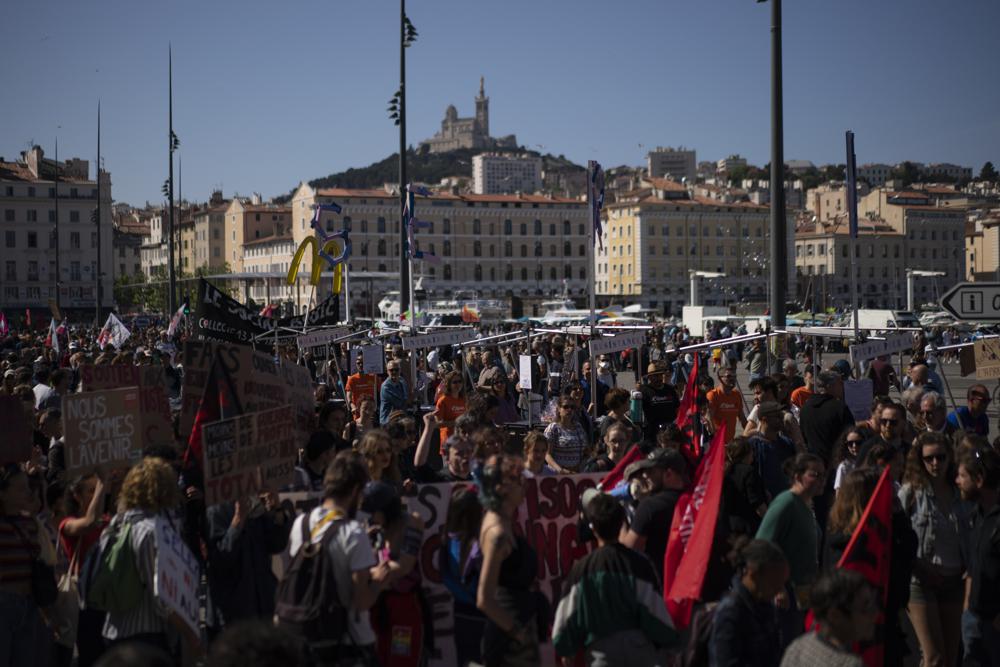
Protesters march during a May Day demonstration in Marseille, southern France, Sunday, May 1, 2022. May 1 is celebrated as the International Labour Day or May Day across the world.
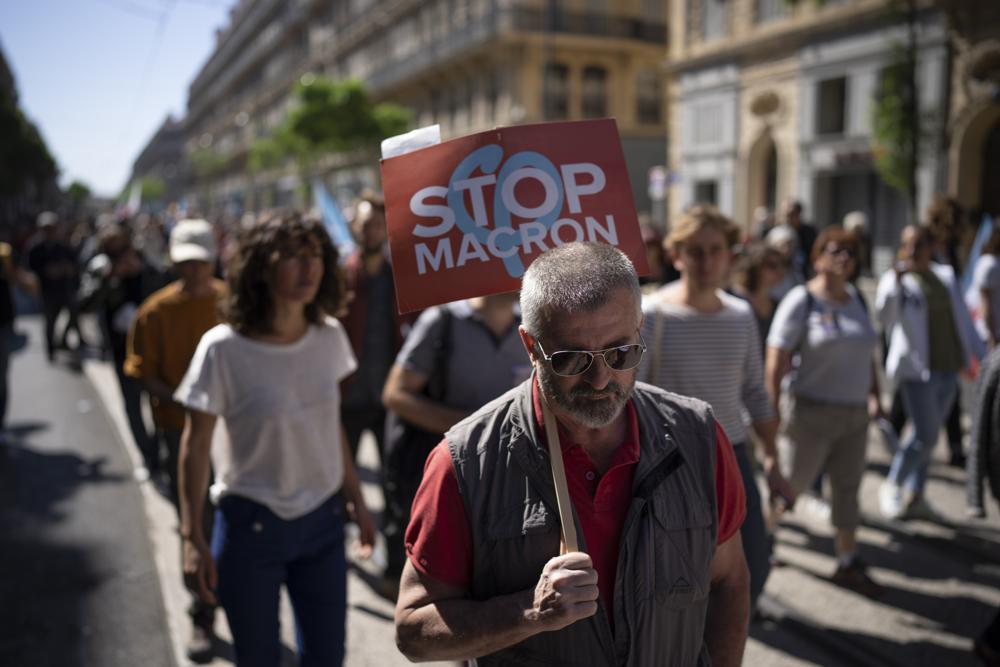
A protester holds a sign reading "Stop Macron" during a May Day demonstration in Marseille, southern France, Sunday, May 1, 2022.
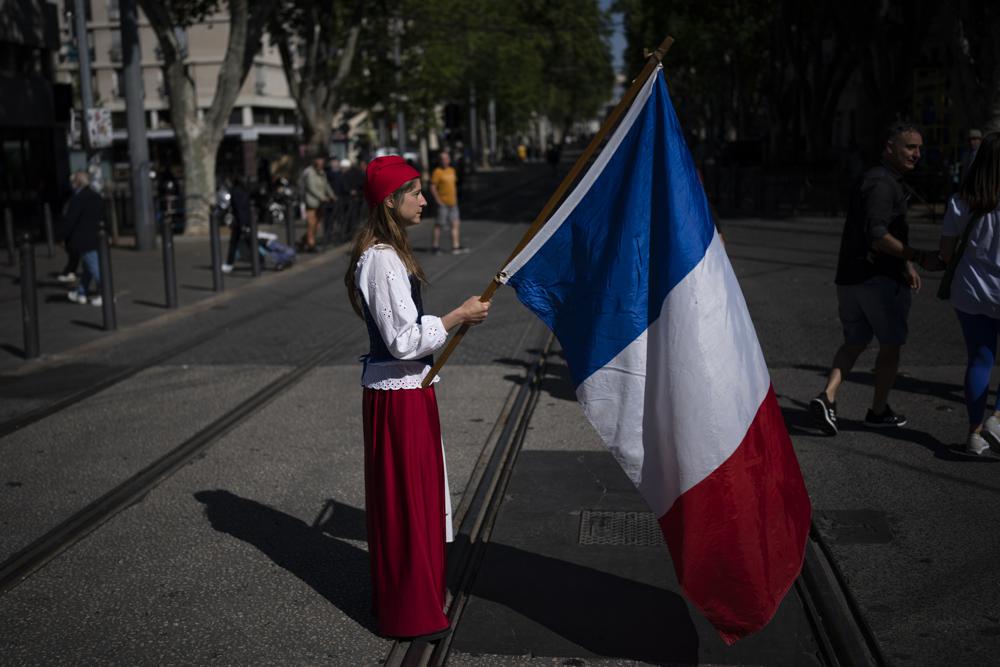
A woman dressed up as Marianne, a woman symbol of the French republic since the 1789 revolution, holds a French flag during a May Day demonstration in Marseille, southern France,
(AP Photo/Daniel Cole)
May Day rallies in Europe honor workers, protest govts
ELAINE GANLEY
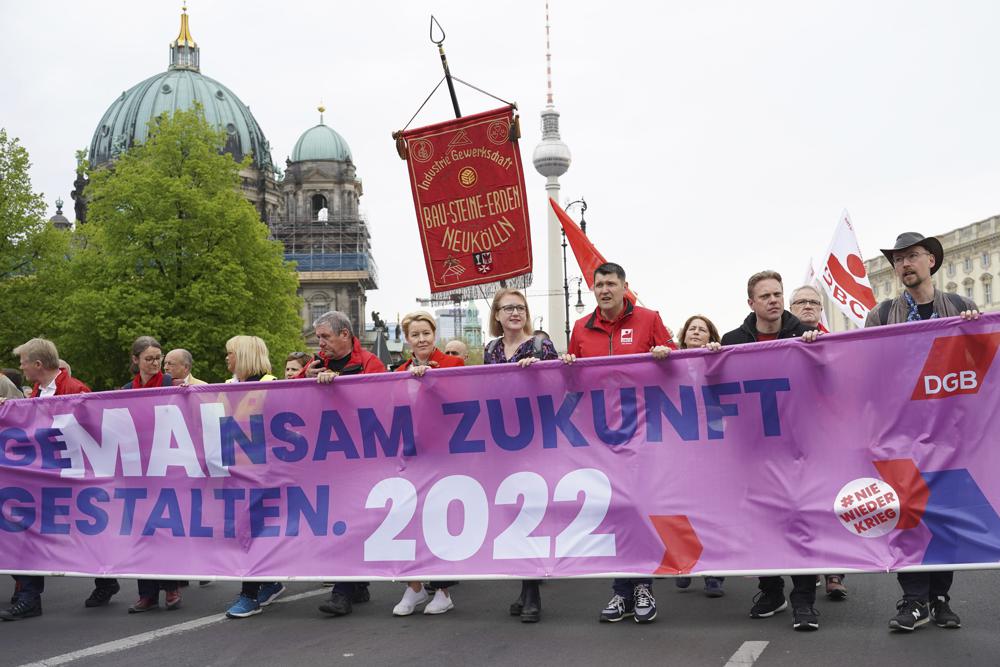
Federal Minister for Family Affairs Lisa Paus, fourth from right, and Governing Mayor of Berlin Franziska Giffey, center, hold a banner with writing in German reading "shape the future together" as they take part in the May Day main rally of the German Trade Union Federation (DGB), in Berlin, Sunday, May 1, 2022. (Joerg Carstensen/dpa via AP)
PARIS (AP) — Citizens and trade unions in cities around Europe were taking to the streets on Sunday for May Day marches, and to put out protest messages to their governments, notably in France where the holiday to honor workers was being used as a rallying cry against newly reelected President Emmanuel Macron.
May Day is a time of high emotion for participants and their causes, with police on the ready. Turkish police moved in quickly in Istanbul and encircled protesters near the barred-off Taksim Square — where 34 people were killed In 1977 during a May Day event when shots were fired into the crowd from a nearby building.
On Sunday, police detained 164 people for demonstrating without permits and resisting police at the square, the Istanbul governor’s office said. At a site on the Asian side of Istanbul, a May Day gathering drew thousands, singing, chanting and waving banners, a demonstration organized by the Confederation of Progressive Trade Unions of Turkey.
In Italy, after a two-year pandemic lull, an outdoor mega-concert was set for Rome with rallies and protests in cities across the country. Besides work, peace was an underlying theme with calls for an end to Russia’s war in Ukraine.
Italy’s three main labor unions were focusing their main rally in the hilltop town of Assisi, a frequent destination for peace protests. This year’s slogan is “Working for peace.”
“It’s a May Day of social and civil commitment for peace and labor,” said the head of Italy’s CISL union, Daniela Fumarola.
People attend a May Day rally on International Workers Day in Belgrade, Serbia, Sunday, May 1, 2022.
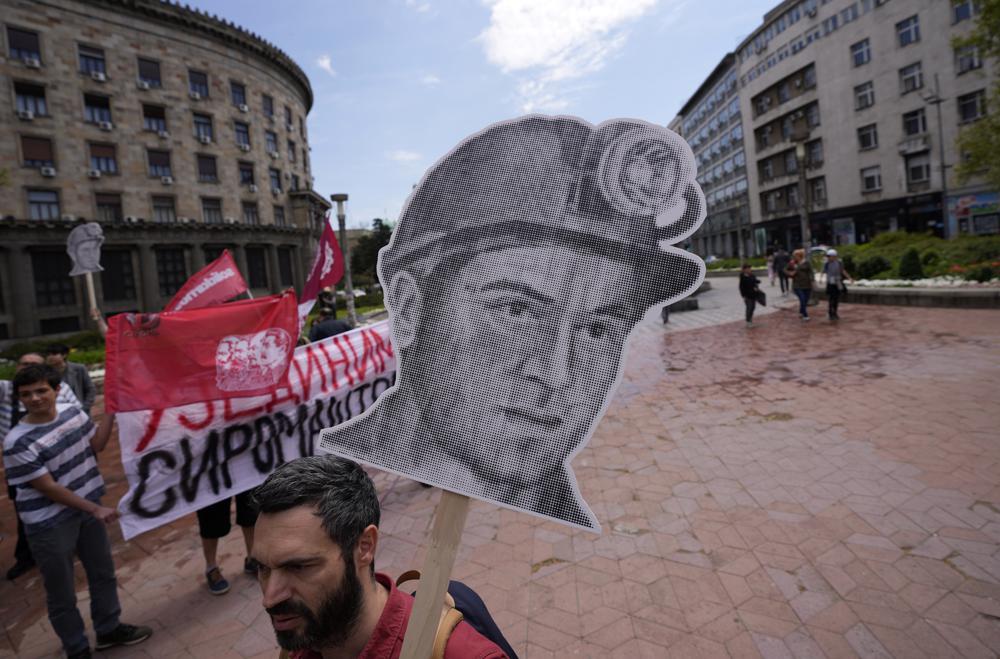
A man holds a flag depicting from left, Friedrich Engels, Karl Marx and Vladimir Lenin, during a May Day rally on International Workers Day in Belgrade, Serbia, Sunday, May 1, 2022. Workers and activists marked May Day with defiant rallies and marches for better pay and working conditions.
(AP Photo/Darko Vojinovic)
Other protests were planned far and wide in Europe, including in Slovakia and the Czech Republic, where students and others planned to rally in support of Ukraine as Communists, anarchists and anti-European Union groups held their own gatherings.
In France, the May Day rallies — a week after the presidential election — are aimed at showing Macron the opposition he could face in his second five-year term and to power up against his centrists before June legislative elections. Opposition parties, notably the far left and far right, are looking to break his government’s majority.
Protests were planned across France with a focus on Paris where the Communist-backed CGT union was leading the main march through eastern Paris, joined by a handful of other unions. All are pressing Macron for policies that put the people first and condemning his plan to raise the retirement age from 62 to 65.
In a first, far-right leader Marine Le Pen was absent from her party’s traditional wreath-laying at the foot of a statue of Joan of Arc, replaced by the interim president of her National Rally party. Le Pen was defeated by Macron in last Sunday’s runoff of the presidential election, and plans to campaign to keep her seat as a lawmaker.
“I’ve come to tell the French that the voting isn’t over. There is a third round, the legislative elections,” said Jordan Bardella, “and it would be unbelievable to leave full power to Emmanuel Macron.”
___
Nicole Winfield in Rome, and Zeynep Bilginsoy in Istanbul, contributed to this report.
Saturday, May 02, 2026
May Day Demonstrations Worldwide Condemn US-Israeli War on Iran, Champion Workers
“Working people refuse to pay the price for Donald Trump’s war in the Middle East,” said the European Trade Confederation.
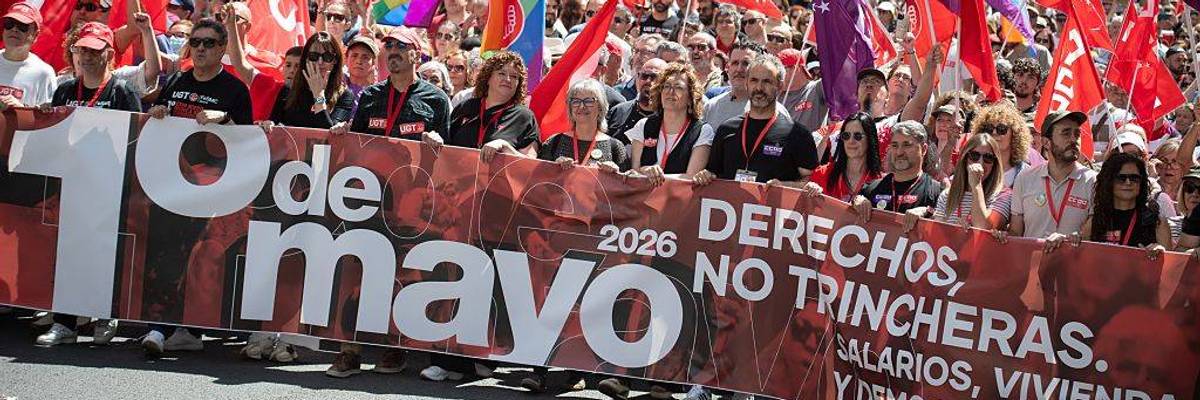
Demonstrators join a demonstration for International Workers’ Day on May 1 2026, in Madrid, Spain. (Photo by Fernando Sanchez/Europa Press via Getty Images)
May Day demonstrations across the world on Friday denounced the US-Israeli war against Iran, which has caused a global energy crisis that is disproportionately harming working-class people.
Among the earliest May Day demonstrations took place in the Philippines, and a video published by The Associated Press shows protesters clashing with police near the US Embassy in the capital city of Manila.
While many demonstrators held signs that referenced local issues, American foreign policy was also a major focus of the protesters, as marchers in Manila carried a large banner that read, “Down With US Imperialism.”
Josua Mata, leader of the SENTRO umbrella group of labor federations, told The Associated Press that the war with Iran was a central focus of protests because of the impact it’s had on energy costs.
“Every Filipino worker now is aware that the situation here is deeply connected to the global crisis,” Mata explained.
Indonesian President Prabowo Subianto attended a May Day rally held in the capital of Jakarta, where Jakarta Globe reported that he announced a host of worker-friendly policies including plans “to build daycare facilities for workers’ children and accelerate the construction of at least 1 million homes.”
France 24 reported that hundreds of demonstrators in Istanbul, Turkey were arrested after attempting to march to the city’s iconic Taksim Square, which police had sealed off.
The Turkish Contemporary Lawyers’ Association (ÇHD) said on Friday afternoon that at least 350 demonstrators in Istanbul have been detained as a result of the protests, with hundreds more potentially in custody.
May Day demonstrations are also taking place across Europe, with many demonstrators blaming US President Donald Trump’s war for the deterioration of workers’ living standards.
The European Trade Union Confederation, which represents 93 trade union organizations in 41 European countries, released a statement declaring that “working people refuse to pay the price for Donald Trump’s war in the Middle East,” adding that “today’s rallies show working people will not stand by and see their jobs and living standards destroyed.”
Trump is also facing protests at home, with more than 4,000 “May Day Strong” events planned across the United States.
Daniel Bertossa, general secretary for Public Services International, said this year’s May Day demonstrations are providing a desperately needed backlash to power grabs being made by the global billionaire class.
Bertossa pointed to the US-Israel attack on Iran, as well as Trump’s repeated threats to invade Greenland, as key turning points that have pushed workers to organize and fight back.
“Rising living costs caused by the war are now driving anger among working-class people and producing a rare and powerful moment to connect and educate,” said Bertossa. “Fascists don’t have the answers to the economic pain they exploited to get elected—international affairs impact us all—and international working-class solidarity matters.”
Bertossa added that “May Day is a vivid reminder that working-class politics is not a spectator sport,” and “we have never won by watching, waiting, or relying on great power leaders to gift us our future.”
In thousands of locations across the United States, workers and students are taking off from work and school and swearing off shopping on Friday as part of a national May Day protest.
May Day Strong, a coalition of activist groups and unions organizing the events, said more than 4,000 actions, from marches to pickets to displays of peaceful civil disobedience, were underway.
It is yet another nationwide display of coordinated resistance to the Trump administration’s agenda, including its war in Iran and its use of US Immigration and Customs Enforcement (ICE) to attack immigrant communities, issues that were at the forefront of March’s “No Kings” protests.
Six young protesters with the Sunrise Movement were taken into custody after blocking a bridge in Minneapolis in what they said was an act of “nonviolent noncooperation” to “stand up to the war in Iran and against ICE terrorizing our neighbors and our cities.”
Dozens more Sunrise protesters in Portland held a sit-in in the lobby of a Hilton hotel that was housing top officials with the Department of Homeland Security, leading to eight arrests.
“It’s May 1st, it’s workers’ day,” one of the protesters was recorded saying while being led away by police. “Don’t forget that you have power.”
In New York, over 100 activists lined up outside every entrance to the New York Stock Exchange in downtown Manhattan, banging drums and chanting “No ICE, no war!” where they were met by a flood of cops.
In the spirit of May Day, a global day of solidarity among workers, Sulma Arias, the executive director of the social justice organization People’s Action, said Friday’s “Workers Over Billionaires” protests are just as much about confronting injustices as about building an alternative.
“During the ‘No Kings’ demonstrations, we showed what we’re against. May Day is the day we’re making clear what we are fighting for,” Arias said. “We are for affordable housing for low-income people. We are for free healthcare for all. We are for utility laws that ensure every home stays warm in the winter and cool in the summer at costs that a person on a fixed income can afford. We are for the right to a fair and equal vote for Americans from every race and in every state. May Day is our day to assert and defend our rights.”
“They want us afraid. They want us divided. But on May 1, we refuse.”
Despite claims by President Donald Trump that the US is entering an economic “golden age” under his leadership, a Gallup poll released this week found that 55% of Americans said their finances were getting worse, the highest number ever recorded in more than 20 years of polling, and even higher than in the doldrums of the Great Recession.
A coalition of labor unions across several major cities, including Philadelphia, Chicago, and Los Angeles, has coordinated what has been called an “economic blackout,” which includes avoiding buying from private sector retailers.
“When we say ‘workers over billionaires,’ ‘billionaires’ is not just this amorphous figure, right? They’re real people,” said Jana Korn, the chief of staff for the Philadelphia Council AFL-CIO, in an interview with The Real News Network. “In Philadelphia, we’re kind of a poor city. We don’t have that many billionaires, but we have one. The CEO of Comcast is the only billionaire that lives in the city.”
“So why should we, as a city, accept that they take and take from us? And then with that money, what do they do? They donate to Trump’s ballroom project,” she continued. “People in Philadelphia are struggling... Our transportation system barely works. We’re at risk of having 17 schools close down this year.”
Some labor organizers have described economic boycotts, undertaken as part of prior mass protest movements against the second Trump administration, as an act of building strength for something larger, such as a future general strike.
“I think really for us in the labor movement,” Korn said, “[the boycott is] about how do we build the capacity to really disrupt, to strike when necessary, to shut things down when we have to. And that’s something that we have not been called to do as a labor movement in a very long time.”
Other unions have used May Day to confront their own employers directly. In New Orleans, hundreds of nurses at University Medical Center announced that they were beginning a five-day strike after attempting to negotiate a contract for more than two years.
In New York City, Amazon workers unionized with the Teamsters assembled on the steps of the public library before marching to Amazon’s corporate offices to demand the company cut its contracts with ICE, which has used its cloud computing services to target immigrants, including some Amazon workers and contractors.
Matt Multari, who has worked as an Amazon driver for a year and a half, told Mother Jones that he joined the protest to “demand the one thing that’s worth fighting for in this life: respect.”
Masih Fouladi, executive director of the California Immigrant Policy Center, said, “May Day is a moment of reckoning.”
“Immigrant communities—from farmworkers in our fields to nurses in our hospitals, from refugees fleeing war to families who have built their lives here for generations—are under siege,” she said. “They want us afraid. They want us divided. But on May 1, we refuse.”
“Workers and immigrants—documented and undocumented, native-born and newly arrived,” she said, “will stand together in the streets because we know the truth: there is no workers’ rights without immigrant rights, and there is no justice for working people here while our tax dollars fund devastation abroad.”
May Day 2026: What Kind of Nation Will This Be?
This year’s May Day rallies go beyond workers’ rights.
People take part in May Day rally and march in New York City to protest the Trump administration, New York, U.S., May 1, 2025. (Photo by Selcuk Acar/Anadolu via Getty Images)
Unlike the rest of the world’s democracies, the United States doesn’t use the metric system, doesn’t require employers to provide workers with paid vacations, hasn’t abolished the death penalty, and doesn’t celebrate May Day as an official national holiday.
Outside the US, May 1 is international workers’ day, observed with speeches, rallies and demonstrations. This year, millions of workers in Europe, Asia and Latin America will take to the streets to demand higher wages, better benefits and improved working conditions.
Ironically, this celebration of working-class solidarity was started by the US labor movement and soon spread around the world, but it never earned official recognition in this country.
This year, on the heels of the three massive nationwide “No Kings” marches and rallies, millions of Americans will join forces, in thousands of cities and towns, in May Day Strong events.
The May Day Strong organizers hoping to bring Americans together to challenge the billionaires, big corporations, and the Trump administration, who have manipulated the rules to lower living standards, attack immigrants, undermine democracy, and direct tax dollars for wars rather than meeting human needs. It will be a day of rallies, marches, teach-ins, labor actions, and a refusal to participate in business as usual—because, as the organizers say, “when those at the top rig the system, collective action is how we set it right.”
Organizers expect over several thousand nonviolent actions across the country. The broad coalition behind the protests include major unions, civil rights, reproductive justice, environmental, immigrant rights, and faith groups, and tenant and community organizations, as well as Indivisible and Democratic Socialists of America.
The protest is inspired by the large day of action on January 23 that shut down much of Minneapolis by asking people not to work, shop, or attend school that day to challenge ICE’s occupation and its illegal actions (including murder) against immigrants and activists.
But the May Day Strong leaders are not calling for a general strike to shut down the economy. That tactic—allowing unions to strike in solidarity with other unions’ strikes—was banned in 1946 when Congress passed the anti-union Taft-Hartley Act over President Harry Truman’s veto. Even so, organizers view this year’s May Day events as a dress rehearsal something close to a general strike in 2028, in anticipation of the presidential and mid-term elections, but that would require the participation of many large unions who may not believe they and their members are prepared for such a militant action or the possible political backlash by the Trump administration and by voters if employers threaten to fire workers for engaging in an illegal strike. In addition, as Philadelphia Inquirer columnist Will Bunch noted, “How many people would need to stop shopping to make a noticeable dent in the nearly $3 billion per day Americans spend?”“
But another massive national day of protest this May Day could help inspire voters to oust more Trump Republicans in November, give Democrats a majority of seats in both the House and Senate, and lay the groundwork for a more progressive policy agenda if the Democrats take back the White House in two years.
In doing so, they will be honoring the original May Day, which was born of the movement for an eight-hour workday. After the Civil War, unregulated capitalism ran rampant in America. It was the Gilded Age, a time of merger mania, increasing concentration of wealth and growing political influence by corporate power brokers known as Robber Barons. New technologies made possible new industries, which generated great riches for the fortunate few, but at the expense of workers, many of them immigrants, who worked long hours, under dangerous conditions, for little pay.
As the gap between the rich and other Americans widened dramatically, workers began to resist in a variety of ways. The first major wave of labor unions pushed employers to limit the workday to ten hours and then later down to eight hours. The 1877 strike by tens of thousands of railroad, factory and mine workers—which shut down the nation’s major industries and was brutally suppressed by the corporations and their friends in government—was the first of many mass actions to demand living wages and humane working conditions. By 1884, the campaign had gained enough momentum that the predecessor to the American Federation of Labor adopted a resolution at its annual meeting, “that eight hours shall constitute legal day’s labor from and after May 1, 1886.”
On the appointed date, unions and radical groups orchestrated strikes and large-scale demonstrations in cities across the country. More than 500,000 workers went on strike or marched in solidarity and many more people protested in the streets. In Chicago, a labor stronghold, at least 30,000 workers struck. Rallies and parades across the city more than doubled that number, and the May 1 demonstrations continued for several days. The protests were mostly nonviolent, but they included skirmishes with strikebreakers, company-hired thugs and police.
On May 3, at a rally outside the McCormick Harvesting Machine Company factory, police fired on the crowd, killing at least two workers. The next day, at a rally at Haymarket Square to protest the shootings, police moved in to clear the crowd. Someone threw a bomb at the police, killing at least one officer. Another seven policemen were killed during the ensuing riot, and police gunfire killed at least four protesters and injured many others.
After a controversial investigation, seven anarchists were sentenced to death for murder, while another was sentenced to 15 years in prison. The anarchists won global notoriety, being seen as martyrs by many radicals and reformers, who viewed the trial and executions as politically motivated.
Within a few years, unions and radical groups around the world had established May Day as an international holiday to commemorate the Haymarket martyrs and continue the struggle for the eight-hour day, workers’ rights, and social justice.
In the United States, however, the burgeoning Knights of Labor, uneasy with May Day’s connection to anarchists and other radicals, adopted another day to celebrate workers’ rights. In 1887, Oregon was the first state to make Labor Day an official holiday, celebrated in September. Other states soon followed. Unions sponsored parades to celebrate Labor Day, but such one-day festivities didn’t make corporations any more willing to grant workers decent conditions. To make their voices heard, workers had to resort to massive strikes, typically put down with brutal violence by government troops.
In 1894, the American Railway Union, led by Eugene Debs, went on strike against the Pullman Palace Car Company to demand lower rents (Pullman was a company town that owned its employees’ homes) and higher pay following huge layoffs and wage cuts. In solidarity with the Pullman workers, railroad workers across the country boycotted the trains with Pullman cars, paralyzing the nation’s economy as well as its mail service. President Grover Cleveland declared the strike a federal crime and called out 12,000 soldiers to break the strike. They crushed the walkout and killed at least two protesters. Six days later, Cleveland—facing worker protests for his repression of the Pullman strikers—signed a bill creating Labor Day as an official national holiday in September. He hoped that giving the working class a day off to celebrate one Monday a year might pacify them.
For most of the 20th century, Labor Day was reserved for festive parades, picnics and speeches sponsored by unions in major cities. But contrary to what President Cleveland had hoped, American workers, their families and allies, found other occasions to mobilize for better working conditions and a more humane society. America witnessed massive strike waves throughout the century, including militant general strikes and occupations. These included a general strike in Seattle in 1919, the 1934 San Francisco general strike, led by the longshoremen’s union; a strike of about 400,000 textile workers that same year; militant sit-down strikes in 1937 by autoworkers in Flint, Michigan, women workers at Woolworth’s department stores in New York, aviation workers in Los Angeles, and others, and the largest strike wave in US history in 1946, triggered by pent-up demands following World War Two.
May 1 faded away as a day of protest. From the 1920s through the 1950s, radical groups sought to keep the tradition alive with parades and other events, but the mainstream labor movement and most liberal organizations kept their distance, making May Day an increasingly marginal affair. In 1958, in the midst of the cold war, President Dwight Eisenhower proclaimed May 1 as Loyalty Day. Each subsequent president has issued a similar proclamation, although few Americans know about or celebrate the day.
Since 2001, American unions and immigrant rights activists have resurrected May 1 as a day of protest around both workers’ rights and immigrant rights. That year, millions of people in over 100 cities—including more than a million in Los Angeles, 200,000 in New York and 300,000 in Chicago—participated in May Day demonstrations.
The huge turnout was catalyzed by a bill, sponsored by Representative James Sensenbrenner Jr. (R-Wis.) and passed by the House the previous December, that would have classified as a felon anyone who helped undocumented immigrants enter or remain in the United States. Since then, immigrant workers and their allies have adopted May Day as an occasion for protest.
In 2006, organized launched a protest they called “A Day Without Immigrants,” which was also termed the “Great American Boycott.” In many cities, workers refused to go to work, high school students walked out of their classrooms and into the street, while consumers shut down businesses that depended on immigrant workers.
In 2017, activists organized another “Day Without Immigrants” protest to dramatize the importance of immigrants to the American economy and protest Trump’s plans to build a border wall and deport millions of undocumented immigrants. The organizers called for immigrants and allies not to go to work, to avoid spending money, and keep children home from school.
“It was mostly immigrants who led the first May Day movement for the eight-hour day. Now a new generation of immigrant workers have revitalized and brought May Day back to life,” observed California State Senator María Elena Durazo, the former head of the Los Angeles County Federation of Labor.
Although the labor movement fell on hard times starting in the 1950s, it nevertheless helped guarantee that more Americans would share in the nation’s post-war prosperity and join the middle class. Moreover, the civil rights, feminist, environmental and gay rights movements, and the more recent immigrant rights movement, drew important lessons from labor movement tactics and built coalitions with organized labor to advance their goals.
America is now in the midst of a new Gilded Age with a new group of corporate Robber Barons, many of them operating on a global scale. The top of the income scale has the biggest concentration of income and wealth since 1928. Several decades of corporate-backed assaults on unions have left only six percent of private sector employees with union cards, down from about one-third of all workers in the 1950s. More than half of America’s 15 million union members now work for government (representing 33 percent of all government employees), so business groups and conservative politicians, including Trump, have targeted public sector unions for destruction.
Despite this, we’ve seen a recent resurgence of activism among rank-and-file workers at fast-food chains, Starbucks, Amazon, Ford, General Motors and Stellantis, Volkswagen, Boeing, Trader Joe’s, Apple, Barnes and Noble, Chipotle, Disneyland, Kaiser Permanente, UPS, Uber and LYFT, REI, film companies and TV studios, meatpacking companies, major hospitals and universities, school districts, and other employers. They have waged strikes, walkouts and union recognition campaigns to win better pay and working conditions.
Public opinion in solidly behind these demands. The decline of union membership is not due to Americans’ opposition to unions. A recent Gallup poll found that 68% of Americans support unions. Support is particularly high among Americans between 18 and 34 years old, 72% of whom embrace unions as a vehicle to address economic inequality and workplace problems. About two-thirds (64%) of Americans think the federal minimum wage—which has been stuck at $7.25 an hour since 2009—should be increased to $17.
The biggest obstacle to a union resurgence is federal labor law. American workers understand that employers resort to a variety of antiunion tactics—including firing employees illegally—to thwart unionization efforts. And there’s the rub. Americans have far fewer rights at work than employees in other democratic societies. Current federal laws are an impediment to union organizing rather than a protector of workers’ rights. The rules are stacked against workers, making it extremely difficult for even the most talented organizers to win union elections. Under current law, and with Trump stacking the National Labor Relations Board with anti-union members, any employer with a clever attorney can stall union elections, giving management time to scare the living daylights out of potential recruits.
This year’s May Day rallies go beyond workers’ rights. They will focus on issues like stopping the billionaire takeover and rampant corruption of the Trump administration, protecting Medicaid, Social Security, and other programs working people rely on, fully funding public schools, healthcare, and housing for all, and stopping the attacks on communities, including policies that target immigrants and people of color. It will also build momentum for a large-scale voter mobilization effort to elect liberals and progressives in the November mid-terms.
“It isn’t just about immigrant rights. It isn’t just about workers’ rights on the job or even about raising the standard of living for all workers,” said Durazo. “It’s about what kind of country we want to be.”
Peter Dreier Peter Dreier is the E.P. Clapp distinguished professor of politics at Occidental College. He joined the Occidental faculty in January 1993 after serving for nine years as Director of Housing at the Boston Redevelopment Authority and senior policy advisor to Boston Mayor Ray Flynn. He is the author of "The 100 Greatest Americans of the 20th Century: A Social Justice Hall of Fame" (2012) and an editor (with Kate Aronoff and Michael Kazin) of "We Own the Future: Democratic Socialism, American Style" and co-author of "Baseball Rebels: The Players, People and Social Movements That Shook Up the Game and Changed America" (2022). Full Bio >
May Day: Day One of a Mass Youth Uprising
This system is not made for everyday working people, and the only way we can change things is if we start disrupting the status quo.
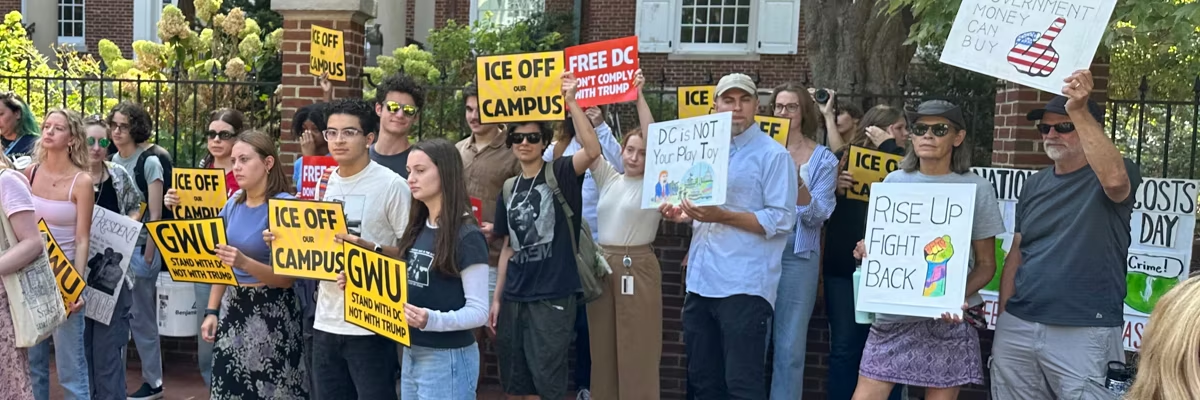
Students at George Washington University and three other schools in Washington, DC walked out on September 9, 2025 to protest the federal takeover of the district and the deployment of National Guard troops. (Photo by the Sunrise Movement)
Today, for May Day, millions of students, educators, and workers are striking for our education, lives, and futures. This isn’t just a rally or march: Whether it’s shutting down corporate offices or leaving classrooms empty, we’re disrupting business as usual. And, young people are taking the lead.
Today isn’t a one-day strike. It’s day one of a mass youth uprising. Throughout history, we’ve seen students and workers on the front lines of anti-authoritarian movements, catalyzing mass societal action.
In the days leading up to May Day, we’ve seen that we’re already having an impact. In Durham, North Carolina, the Durham Public Schools announced last week that school was cancelled on May 1 because over 1,000 students and staff were projected to walk out of school that day. In Madison, Wisconsin, schools shut down after 70% of staff committed to this national day of action. A dozen more school districts have followed suit.
So when pundits ask, “Where are the young people?” The answer is, May Day. Across the country, people are growing increasingly frustrated with political and institutional leadership that are serving billionaires, not us. While the Trump administration commits war crimes in the Middle East, millions are stripped of their healthcare. While billionaires get handouts to build data centers, they claim we can’t solve our housing crisis. While college football coaches are paid million-dollar salaries, tuition to attend school continues to rise.
This May 1, we will strike in hundreds of thousands. In every corner of this country, you will see students walking out of class and workers striking from their jobs.
It’s extremely clear to young people like me: This system is not made for everyday working people, and the only way we can change things is if we start disrupting the status quo. If we’ve learned anything over the past few months, it’s that when people come together in masses, we are more powerful than the people in power, and we win. Specifically, when people practice mass noncooperation in their schools and cities, they win.
Mass noncooperation is the act of not giving in to their “business as usual.” We hold the power because we make the system run, and we have the power to make it crumble. It means recognizing that the system only functions because of us, and choosing to withdraw that labor, that time, that participation is power we hold. It is not enough to protest on our days off, or repost a social media post. We need workers to stop going to work so billionaires lose money. We need students and educators to stop attending classes to show the power of those empty seats. We need to stop working for a system that is failing us, to show them that we can turn it all around if they keep ignoring our needs.
We’ve seen mass noncooperation work in the past. Earlier this year, after tens of thousands of people went on strike in Minneapolis following the murders of Renee Good and Alex Pretti, the Immigration and Customs Enforcement (ICE) commander in the city was removed from his role, and he himself said that the level of noncooperation from Minnesotans was stopping ICE from carrying out its goals. Now, we’re taking that action nationwide.
This May 1, we will strike in hundreds of thousands. In every corner of this country, you will see students walking out of class and workers striking from their jobs. You’ll hear chants and cheers for one another; you’ll feel hope and resilience. And when we do, we’ll show President Donald Trump and his billionaire friends that if they keep going with their agenda, we will stop their regime from operating. If they keep abducting our neighbors, if they keep choosing Wall Street over working people, if they keep starting wars instead of giving us healthcare—the kind of disruption they are seeing today will be a drop in the bucket.
We’re also sending a message to people across this country: We, working people, have the power. We run the economy, we fill the classrooms. If we stop cooperating, the billionaires can’t profit, and the oligarchs can’t rule. We have the power to win what we deserve: a world where we earn a livable wage, breathe clean air, and can afford necessities like education.
Today, on May 1, we say: No work. No school. No spending.
Our work is licensed under Creative Commons (CC BY-NC-ND 3.0). Feel free to republish and share widely.
Shradha Bista Shradha Bista is a first-year honors student at the University of North Carolina at Chapel Hill. She has been a student organizer since high school and organizes with her campus’ Sunrise Movement hub, winning demands like UNC-CH rejecting the Trump Loyalty Oath Compact last fall. Shradha studies Public Policy and Peace, War, and Defense on campus, and she’s excited to see the success of students and workers this May Day and beyond! Full Bio >
‘May Day Strong’ Shows How Trumpism Changed the Game of Political Action
Action isn’t only about pressuring institutions anymore. It’s increasingly about jamming the system, slowing it down, or breaking its rhythm. In plain terms, we’ve shifted from representative politics toward something more like direct pressure. Protesters hold signs during the Nationwide May Day Strong Rally, “Workers Stand Up to Billionaires,” on May 1, 2025 in Philadelphia, Pennsylvania. (Photo by Lisa Lake/Getty Images for May Day Strong)
For decades, American politics rested on one big, mostly unquestioned idea: Real change happens through the system. You vote, you lobby, you go to court, you work the parties. Even the biggest protest movements eventually tried to plug themselves back into those official channels. But lately—especially since Donald Trump burst onto the scene—that old assumption has been crumbling fast.
What we’re seeing now, in things like the “May Day Strong” actions, isn’t just more people protesting. It’s a deeper change in how politics actually works. Action isn’t only about pressuring institutions anymore. It’s increasingly about jamming the system, slowing it down, or breaking its rhythm. In plain terms, we’ve shifted from representative politics toward something more like direct pressure.
The key driver here is the collapse of trust in institutions. One of the most striking things about Trumpism isn’t any single policy—it’s the relentless way it attacked the legitimacy of the middlemen: the media as “the enemy of the people,” judges as biased, elections as rigged. These weren’t just throwaway lines. Over time, they sank in and reshaped how a lot of people view the system’s ability to actually deliver.
When folks stop believing the formal channels can handle their grievances, they start looking for other levers. That’s when direct action, civil disobedience, and economic disruption stop looking fringe and start feeling logical.
“May Day Strong” feels like a live experiment. It’s testing how well networked groups can mobilize and whether hitting the economy where it hurts can deliver lasting political leverage. The answers will matter a lot for where democracy goes next.
“May Day Strong” sits right at that crossroads. The call for “No Work, No Shopping” isn’t subtle. It says: If real power flows through the economy, then choking those flows becomes a form of politics. On the surface it seems straightforward, but it quietly rewrites the textbook definition of power.
In the old model, power lived in government buildings and political offices. You tried to influence them. In the emerging one, power is scattered across economic networks and social connections. So the game moves from representation to targeted disruption—from institutional politics to what you might call infrastructural politics.
This isn’t purely ideological. It also grows out of how people actually experience daily life now: gig work, shaky jobs, disappearing benefits, and costs that keep climbing. When the ground under your feet feels unstable, waiting for institutions to fix things starts to feel naive.
So where does Trumpism fit? It didn’t invent this distrust, but it poured gasoline on it. By hammering institutional norms, torching media credibility, and sharpening polarization, it helped create an environment where formal mechanisms look increasingly broken. In that kind of atmosphere, taking it to the streets—or to the supply chains—doesn’t feel radical. It feels like common sense.
Still, there’s real tension. Disrupting people’s everyday lives is a double-edged sword. If folks see it as standing up for justice, it can build wide support. If it just looks like chaos that hurts regular people trying to get by, it can spark a strong backlash.
That tension defines politics in this post-trust era. Legitimacy no longer comes neatly from institutions. It gets fought over in public opinion—and more and more, the street has become the arena where that fight happens.
In that light, “May Day Strong” feels like a live experiment. It’s testing how well networked groups can mobilize and whether hitting the economy where it hurts can deliver lasting political leverage. The answers will matter a lot for where democracy goes next.
If direct disruption keeps replacing traditional institutional routes, the line between protest and actual governance starts to blur. Suddenly, the power to halt things becomes its own kind of authority. That opens doors for groups that felt shut out—but it also raises the odds of deeper instability.
At the end of the day, this isn’t simply politics getting more extreme. It’s politics changing its fundamental shape. It’s no longer just a contest to control the institutions. It’s becoming a struggle to control the flows—of information, money, goods, and attention.
Trumpism didn’t create this shift, but it accelerated it. By eroding trust and heating up divisions, it helped make direct action feel less like an outlier and more like a normal part of how politics gets done.
The big question now isn’t how institutions can manage protest. It’s whether institutions can hold onto their central role at all.
Our work is licensed under Creative Commons (CC BY-NC-ND 3.0). Feel free to republish and share widely.
Brian Hudson Brian Hudson is a political science graduate from Bates College with a keen interest in international relations and global affairs. As a freelance commentator, he provides analysis on geopolitics, international security, and counter-terrorism. His work has been featured on news analysis platforms such as Modern Diplomacy, Eurasia Review, and others. Full Bio >
Why I’m Answering the May Day Call to Action By Running for Congress
The workers of Uptown and The Bronx have been making the demand for a better life for over a century but Washington has ignored their demands for too long. I’m running to make sure it finally has an answer.
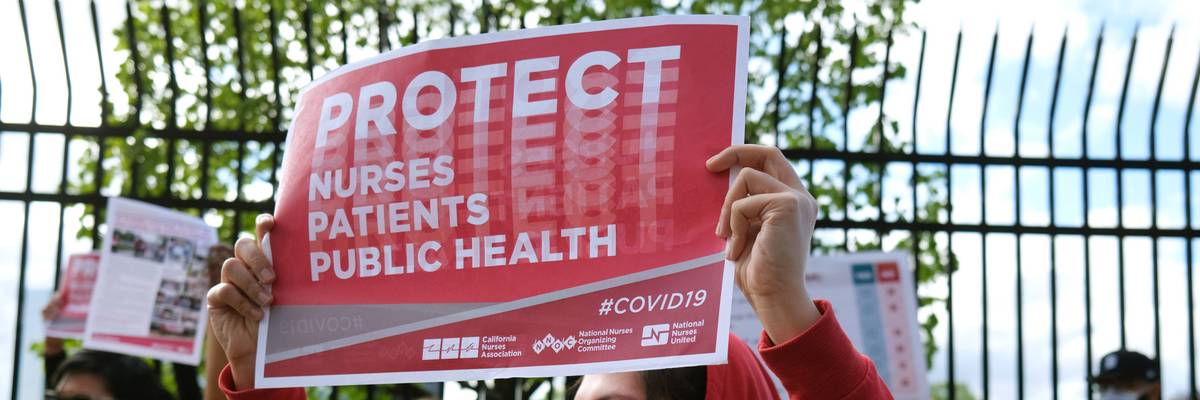
Bronx VA Medical Center nurses hold a demonstration and join other nationwide May Day actions demanding increased Covid-19 protections for nurses and health care workers on May 01, 2020 in New York City. IPhoto by Spencer Platt/Getty Images)
Uptown wakes up before the rest of New York even opens its eyes. Walk Broadway from 125th to 168th, up through Dyckman, as I have, and you’ll see it: The bodega coffee grabbed on the run, the crosstown bus packed before dawn, people clocking into work while downtown is still asleep. These are the people who built our city. Not the CEOs, real estate developers, or the politicians who show up every two to four years with fliers and false promises. The movement fighting for their dignity has always lived here—on these buses and these street corners.
Every May 1, we honor them. May Day, or International Workers’ Day, was created from needless state violence. In 1884, American workers went on strike to win an eight-hour workday. As the deadline approached, a protest in Chicago turned deadly, with police firing into the crowd and arresting seven workers who, after a sham trial, were executed. The bosses thought that would be the end of it. They were wrong. Workers fought for and won the right to an eight-hour workday.
Here in Harlem, Washington Heights, and Kingsbridge, May Day isn’t an abstract history lesson, it’s a mirror. This is a day to honor the transit workers, nurses, teachers, laborers, and caregivers who have always refused to accept less than they deserve and risked everything to fight for a better future for the next generation. They show us what’s possible when working people come together, across generations, race, gender, and culture, and demand a dignified life.
May Day reminds us of something simple and profound: Uptown is a union town. It always has been.
I want to build power for the people on that crosstown bus before dawn who never get thanked for keeping our city running and are told to be grateful for what little they have.
New York, and Uptown especially, has become a stronghold of union power. It was in Harlem, during the Harlem Renaissance, that A. Philip Randolph founded the Brotherhood of Sleeping Car Porters—the first Black-led labor union in American history. It was in Washington Heights and Spanish Harlem where Dominican and Puerto Rican immigrant women transformed the garment industry, becoming so essential to the International Ladies’ Garment Workers’ Union that by the 1950s, the union published its paper, Justicia, entirely in Spanish. And it was in the Bronx that Ella Baker and Marvel Cooke exposed the Bronx Slave Market, where domestic workers, most of them Black women, were paid as little as 15 cents an hour and subjected to workplace harassment and abuse. Their conditions were so appalling that it sparked city-wide organizing to protect domestic workers. This is my community’s inheritance.
That tradition is still alive in our streets today. In January 2026, 70 years after 1199 Service Employees International Union's historic 46-day strike at Uptown hospitals, hundreds of unionized NY State Nurses Association (NYSNA) nurses walked off the job at NewYork-Presbyterian on 168th Street and at hospitals across our community. They stood on their picket lines from dawn to dusk, through a brutally cold January, fighting starvation wages and conditions so unsafe that patients were being put at risk. After 41 days of striking and organizing, they won. That’s the Uptown way.
From the factory floor to the hospital room to the living room, Uptown is still at the center of the labor movement. I think about this legacy when people ask me why I’m running for Congress. The honest answer is: I’m not sure I had a choice.
When you grow up as the daughter of Dominican immigrants and watch your parents work multiple jobs and come home exhausted, see your neighbors get pushed out, watch politicians blame the vulnerable instead of the corporations robbing them blind, all while sending their tax dollars to drop bombs on babies, you organize and fight back. And eventually, the question stops being why run and starts being how could I not?
Congress was not built for us. It was built to manage us. It was built to keep our labor, our rent checks, and our votes flowing to people who have never had to choose between rent and groceries, all while allowing the people who are the foundation of our city to fall through the cracks. But here’s what the establishment never understood about Uptown and The Bronx: We don’t wait for permission.
That’s the legacy I am fighting to protect in Congress. I am a proud card-carrying United Auto Workers member. I’ve picketed alongside NYSNA nurses on 168th Street and Mount Sinai Morningside. I’ve fought with Student Workers of Columbia to protect their peers from harassment by the university and Immigration and Customs Enforcement.
In Congress, I will fight to pass the PRO Act so every worker can organize without fear. I will push to fund public housing, cancel medical debt, and end the forever wars that drain our communities to pad the pockets of defense contractors. I want to build power for the people on that crosstown bus before dawn who never get thanked for keeping our city running and are told to be grateful for what little they have. They built New York and deserve everything it has to offer.
May Day is a call to action. The workers of Uptown and The Bronx have been making the demand for a better life for over a century but Washington has ignored their demands for too long. I’m running to make sure it finally has an answer.
Our work is licensed under Creative Commons (CC BY-NC-ND 3.0). Feel free to republish and share widely.
Darializa Avila Chevalier Darializa Avila Chevalier is a working-class Afro-Latina organizer raised by Dominican immigrant parents. She has spent her life organizing for the people politicians leave behind: she fought to free Abdikadir Mohamed from Immigration and Customs Enforcement detention during Trump's Muslim ban, organized Columbia's encampment in solidarity with Palestinians, and stood up for Mahmoud Khalil when ICE abducted him from his apartment. She is a card-carrying member of UAW and a public defense investigator. She doesn't just talk about the movement—she’s helped build it. Full Bio >
 And now your headlines from the class war.
EUROMAYDAY 006



.png)