Wednesday, June 24, 2026

On the Iranian Revolution

 June 22, 2026

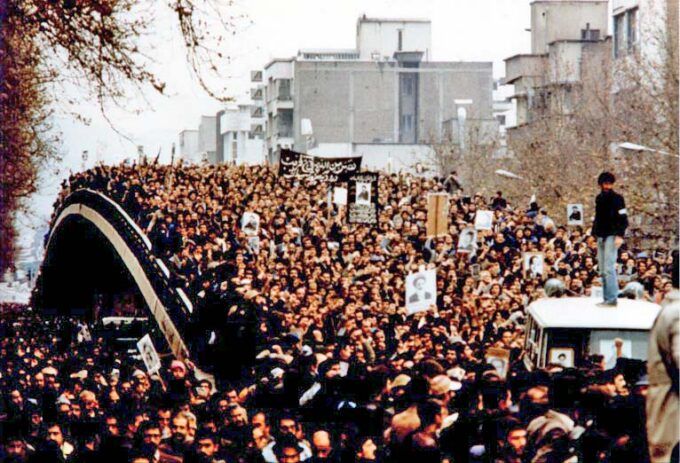
A demonstration in Iran against the Shah, 1978 at College Bridge, Tehran. Wikimedia Commons. GFDL

When trying to figure out what’s going on in the Middle East in general and the war in Iran in particular, I have relied quite a lot upon the works of Mouin Rabbani and Trita Parsi, both of whom have done an exemplary job of explaining ongoing events to wide audiences. I’d encourage anyone who wants to improve their understanding of what’s happening to check out these scholars’ interviews and essays. There are also excellent books one ought to read on the subject, not least of which is Nikki Keddie’s Modern Iran, which, when it comes to the Iranian Revolution, allows us to think historically and analytically about what’s often presented as a riddle.

Before 1979, revolutions — whether in 1776, 1789, 1798, the 1820s, 1848, 1905, 1917, 1949, or 1959 — were broadly speaking politically liberal or left. The 1979 Iranian Revolution, however, was the first modern political revolution that was expressly Islamist. Indeed, this type of revolution was so new that both the USA and the USSR were caught off guard by it and initially confused by what it implied.

Why, then, was there a religious revolution in Iran? Every right-minded person who’s discussed the ongoing war has noted that in 1953 the democratically elected secular prime minister Mossadeq was overthrown by the United States and Britain and replaced by the dictator Mohammad Reza Pahlavi, the so-called playboy prince. Yet while the 1953 coup helps explain the enduring mistrust many Iranians have of the US, it in itself does not explain the revolution that occurred 26 years later. It’s therefore also critical, following Keddie, to think about the contingencies contained in the timeline I would like to provide you. Doing so will allow us to answer our riddle, or perhaps think about whether it’s really a riddle at all:

+ Following the 1953 coup, the Shah disbands Mossadeq’s National Front and the communist Tudeh, and in 1957 the Shah further consolidates power by establishing, with Israeli and US assistance, the SAVAK, which spies on, imprisons, tortures, and executes opponents of the regime.

+ In 1960, JFK is elected US president and encourages allies including Iran to institute reforms in order to keep revolution and socialism at bay. 

+ In 1962, the Shah institutes the White Revolution, leading to disastrous land reforms and the increased secularization of society, including bringing state education to the countryside and granting women the vote. The ulama is livid with the reforms. Among other complaints, the religious class is upset that the Shah’s promotion of secular education causes job losses among religious teachers. As in many other cases, the dispute between religious sectors of society and the Shah are never abstract or merely theological, but instead represent a conflict over society’s resources. In this regard, as one scholar has put it, “religion is the language in which politics expresses itself.”

+ Hitherto, Iran’s religious establishment largely refrained from entering politics, but in 1964 the Ayatollah Khomeini asserts that in the absence of the Twelfth Imam a righteous individual can in fact enter the political arena. Following a blistering speech against the Shah, Khomeini is exiled to Turkey and then Iraq, where he continues decrying the Shah in recorded speeches that are imported into Iran on cassette.

+ In 1971, the Shah again infuriates the religious class by celebrating the 2500th anniversary of Cyrus the Great and the Persian Empire, in effect subordinating Islam to the monarchy while pursuing an increasingly totalitarian regime. 

+ The oil crises of the 1970s introduce massive economic and political disruptions in Iran, as the economy becomes increasingly dependent on oil exports and imports of other goods, bankrupting farmers who move to increasingly overcrowded cities plagued by growing inflation, scarcity, corruption, and inequality. Wealthy foreigners in the cities meanwhile drive up rental prices causing, along with their diplomatic immunity, widespread resentment.

+ In 1976, Jimmy Carter is elected US president and, à la JFK, encourages the Shah to institute a new round of reforms with the aim of suppressing socialism and deep structural change.

+ After Khomeini again condemns the Shah in January 1978, the government slanders Khomeini, leading to widespread protests. After the government kills 70 people in Qom, Khomeini launches repeating cycles of protests every seven and 40 days. The protests represent wide sectors of society including the ulama, the bazaaris or merchant class, students, and others.

+ In the fall of 1978, workers at last join the protests, bringing transportation and energy to a halt. Khomeini increasingly establishes control over the revolution, which is ultimately supported by a resurfaced but weakened Tudeh. 

+ On January 16, 1979, the Shah flees Iran.

+  On February 1, 1979, Khomeini returns to Iran.

+ On April 1, 1979, following a national referendum, the Islamic Republic is established.

Okay. What then is the solution to our riddle concerning the world’s first Islamist Revolution? Or why, we might say, is the so-called riddle not really a riddle at all? If we see religion and culture as the language in which politics is expressed, and if we see the economic and political tumult afflicting Iran as a general and predictable result of Iran’s being precluded from radically challenging its subordination to the United States within an increasingly volatile and exploitative global economy, then our independent variable, so to speak, takes us to the beginning of our timeline. Once the Shah, with U.S. support, crushed the National Front and the Tudeh (that is, the left opposition), it ensured that if and when revolution appeared it would not take the form of liberal or left values but would instead take the form of the only tendency that the Shah could not suppress.

The cruel irony, which is all too relevant today, is that many Western observers diagnosed the new religious government, which soon devoured its erstwhile secular left allies, as an inevitable manifestation of a monolithic, static, and hermetically sealed Islamic “culture.” This, as Edward Said and others have shown, was always imperial propaganda masquerading as scholarship. It’s the innumerable and frequently asymmetrical interactions across cultures and the many contradictions within any given culture that make the so-called cultural explanation a fallacious non-starter (to speak of any single “culture” is always silly, but if you are interested in the subject, I would encourage you to watch the wonderful films of Abbas Kiarostami or read Marjane Satrapi’s excellent graphic novel on the Revolution, Persepolis). But of course, Western leaders and their academic and other supporters were engaged in motivated reasoning (and likely projection), concluding that such a government could only be dealt with by force and pursuing an unending game of imperial whack-a-mole that has continued, as we can see via the Trump Administration’s monstrously destructive stupidity, to this day.

This essay is a revised version of a talk delivered as part of a panel discussion at Los Angeles Valley College on April 22, 2026.

Joshua Sperber teaches political science and history. He is the author of Consumer Management in the Internet Age. He can be reached at jsperber4@gmail.com  

How the Media Aligned Themselves with


Israeli Propaganda


June 22, 2026

Dima Khatib, photograph by Nelson Pereira.

Journalistic coverage of the Israeli military campaign in Gaza after October 7, 2023, continues to draw sharp criticism. Syrian-Palestinian journalist Dima Khatib minces no words: “The media actively relayed Israeli propaganda.”

“Silence is already complicity. But it was worse. It was active engagement with Israeli propaganda,” said the Managing Director of Digital Projects at Al Jazeera, whose journalistic career spans more than three decades.

“And it was an active engagement against journalists themselves,” Dima added. “Not once, not twice, it was repeated. The justification Israel gave for the killings of journalists—obviously false and unacceptable, that is, every time they were terrorists, they were guilty, they deserved it, etc.—it was celebrated, it was lauded.”

Dima, who has reported from over 30 countries across 5 continents, interviewing presidents and people from all walks of life, points to a clear bias in the media in favor of Israel’s official narrative. “The media weren’t even doing their basic job of verifying this information, simply relaying lies against Gazan journalists. And this was proof of racism against journalists who don’t have the skin color required for journalists, at least in the mainstream media, to do their job. We’re not asking for more; we’re asking them to verify the information and publish it.”

Noting that when a journalist is killed elsewhere, it causes an uproar, she denounces the media’s indifference to the murder of Palestinian journalists. “It’s an unspeakable scandal. 262 journalists (*) have been killed in Gaza—a record, a real massacre. Just look at the major media outlets here in Europe, in the United States, and even in the Global South, and see how many times this information has been relayed, published, and reported correctly and ethically.”

Journalism That is No Longer Journalism

According to Dima Khatib, the “poor” media coverage of the killings of journalists in Gaza demonstrated beyond a shadow of a doubt that Palestinians are not considered equal human beings. She admits that this experience was a huge disappointment and a source of great sadness for her.

The same pattern of disinformation has been applied to media coverage of the genocide in general, she adds. “The media continue to repeat Israel’s lies as if nothing had happened, after they have been debunked time and time again. They parrot the lies spewed by Israeli officials, repeating them like stock phrases in their articles.”

A method that transforms journalism into propaganda, Dima emphasizes. “Every time we say a certain word, we add a little phrase to define our position regarding that word, that person, that organization, that place. It’s unethical, it’s not journalism. It’s propaganda.”

“Just look at how media outlets like the New York Times headline and handle the news,” she explains. “They write that 400 Palestinians have died, but they don’t say how or who murdered them. We wonder if they died of heatstroke or indigestion. But as soon as it involves Israelis, the moment an Israeli dies, we’re immediately told that he was killed by a Palestinian. They publish a photo of him playing guitar. Even though he’s a soldier. A humanization that no Palestinian is entitled to, not even a child. This language has become standardized in newsrooms, and many journalists simply repeat it, thus avoiding upsetting their editors.”

Expressing her disappointment with the attitude of many colleagues in the profession, she adds that there are also those who have opposed and denounced editorial policies that lead to the dehumanization of Palestinians. “It’s a deliberate dehumanization of Palestinians, and it’s why I no longer have respect for the media, I no longer have respect for these fellow journalists. At the same time, I’ve seen courageous ones who said no. There are many newsrooms that have experienced this kind of pressure regarding coverage of Palestine, journalists who have lost their jobs, their livelihood, for themselves and their families, just for saying a word. I have great admiration for the journalists who haven’t given in to propaganda and the easy way out.”

Refusing to betray journalism, some journalists decided to embark on independent projects and launched their own media outlets. According to Dima Khatib, this independent journalism movement has everything it takes to replace “what journalism claims to be but no longer is, because selective journalism isn’t real journalism.” She adds that if we can’t do it for Palestine, we won’t be able to do it against fascism. “It’s a universal struggle for all of us.”

Regarding state media, the coverage of the 2003 war against Iraq revealed an alarming complicity with propaganda, notes Dima, who worked in Doha for Al Jazeera during the invasion of Iraq. “The lies were repeated, repeated, repeated, without any verification, from weapons of mass destruction to an association of Iraq with 9/11 that had no basis in reality. This is very problematic because it’s a public service. A journalist’s work is always a public service, with an ethical duty that is essential for democracy. But this is even more true when it’s funded with our taxes.”

Decolonizing Journalism

Dima Khatib joined Al Jazeera in 1997 as a young journalist in Qatar and later became the channel’s first female executive. She subsequently established Al Jazeera bureaus in China and Venezuela. Appointed director of AJ+ in August 2015, she held this position for ten years, overseeing AJ+’s English, Arabic, Spanish, and French channels.

Having encountered such diverse realities, she says she has come to understand that, within newsrooms, a constant process of decolonization is a priority. “I talk a lot about decolonizing journalism, newsrooms, and the journalists themselves. Even journalists from the Global South, who have been colonized, need to undertake this process. For example, in the minds of many Arab journalists, Latin America was discovered by Europeans. Yet, that’s exactly what the Israelis say about Palestine, which was supposedly a land without a people for a people without a land, as if it were empty. They arrive and there are no natives.”

At the root of these ingrained narratives are school curricula that have omitted historical facts. To such an extent that adults who were victims of colonialism are unable to recognize the harm they suffered when confronted with its remnants. “When you erase the existence of a civilization, several civilizations, ancient ones, and great, important ones, and the massacres that took place, so that this discovery—which is colonization—could happen, you are erasing history, you are erasing entire peoples. It’s the same thing that’s being done to us in Palestine, with this same propaganda,” Dima points out.

“By repeating colonial narratives, we perpetuate the dehumanization of the other,” she adds. “Because these narratives were created with the aim of dehumanizing.”

Besides efforts to decolonize and rehumanize history, it’s equally important to know which language to use, Dima emphasizes. And above all, to get rid of labels. “Who is a terrorist? Who isn’t? Who is good? Who is bad? It’s already predetermined by international agencies that have already defined who is bad, who is good.”

She insists that, faced with this imposition of a single truth, we must, first and foremost, listen to the people who come from there. “If you’re going to cover Bosnia and you don’t have a single Bosnian in your newsroom, well, you’re not going to know how to tell the Bosnian story. So, diversity in newsrooms is very important. In our AJ+ newsroom, we had Palestinians—not just any Palestinians, a Palestinian man or woman from Jerusalem, someone from the West Bank, someone from Gaza, someone from the refugee camps in Syria, Palestine, Jordan, a Palestinian Spaniard, a Palestinian American, a Palestinian Colombian—because without that diversity, we’re not going to be able to tell the stories.”

She adds that the much-vaunted objectivity of the media simply means seeing things from the perspective of someone sitting in Paris, London, or Washington. “That’s what objectivity is. It’s about making everything look the same and eliminating any distinction between one story and another. They’re all told under the same umbrella. Objectivity, in fact, is journalism that doesn’t disrupt the status quo of established norms. Always from a Western perspective. And the West has every right to its perspective, but not to erase other perspectives.”

Gaza Journalists

Since Israel did not allow foreign journalists into Gaza during the genocide—and even before, because there had been a blockade for 19 years—Gaza journalists took it upon themselves to tell the story directly. “There wasn’t the parachuted-in journalist, as is always the case, a journalist who arrives with a whole team, who also has access to a bathroom, a comfortable bed, food, etc., and who arrives with their vision of how the story should be told,” Dima emphasizes. “The task was left to the Palestinian journalists in Gaza. While they lacked food, warm beds, shelter, and protection—they had nothing—they were bombed like everyone else, they were hungry like everyone else, they were cold like everyone else, and they didn’t have access to a bathroom like everyone else.” And we saw that live on social media, and it rehumanized the Palestinian story.”

Young people around the world who followed the reports of these young Palestinian journalists on social media saw them in their tears, in their suffering. And that, Dima points out, contributed to the solidarity movement for Palestinians worldwide, but especially among young people, the university generation, Generation Z, who spearheaded the entire solidarity movement in American universities. “I happened to be in the United States when they set up the first camp. I was in Michigan, I arrived, and they asked me, ‘What media outlets are you from?’ Because here, the New York Times, Reuters, and all that, it’s forbidden. They don’t get through. I told them, ‘I’m from Al Jazeera,’ and they replied, ‘Oh, wow, of course, come on over.’ And I took a look around, and they had Al Jazeera English live on an iPad in the camp. And that really touched me. They weren’t Palestinians; they were people from all over the United States—immigrants, white, Black, and maybe a third were Jewish.”

* The number is higher at the time of publication. On June 21st, cameraman Ahmed Wishah was killed in an Israeli air attack on central Gaza’s Bureij refugee camp, less than three months after his brother Mohammed Samir, also an Al Jazeera journalist, was killed in a separate strike. Ahmed is the 12th Al Jazeera journalist killed by Israel in Gaza.

Another Federal Court Rebukes Trump


Administration Over Illegally Withheld


Climate and Environmental Justice Funds


Oil refinery, Ashland, Kentucky. Photo: Jeffrey St. Clair.

Another week, another court ruling that the Trump administration illegally withheld Congressionally appropriated funding from communities. This time, the funding in question comes from the Environmental Protection Agency’s (EPA) Environmental and Climate Justice Block Grant Program.

In 2022, Congress enacted the Inflation Reduction Act, appropriating $2.8 billion in financial assistance to support environmental and climate justice initiatives. The funding, administered through Community Change Grants, was allocated to projects such as a collaboration between Texas A&M University and the Black Belt Unincorporated Wastewater Program to install wastewater treatment systems for households in rural Alabama. Another project aimed to expand residential and commercial composting programs in Waco and McLennan County, Texas, to decrease the volume of waste sent to landfills

The act required the EPA to award grants and assistance by September 30, 2026. But Trump targeted the program in an executive order right after taking office, calling for the termination of all “environmental justice” offices and positions. The administration canceled or clawed back funding for the grants in July 2025 and laid off federal employees in charge of the program, leaving communities in a lurch — which might sound because we’ve written about this with other programs severaltimes. As a result, the Southern Environmental Law Center and the Public Rights Project, acting on behalf of nonprofits and communities, took the administration to court in March 2025.

US District Judge Richard Gergel, in a ruling last week, agreed with plaintiffs that “contrary to Congress’ will, the EPA issued guidance that shuttered the ECJ Program before its end date of September 30, 2026.” To legally cut funding, the administration should have called on Congress to approve a rescission bill. Gergel also agreed that communities that lost funding received an “injury,” ultimately calling the EPA’s decision “arbitrary and capricious and unlawful.” However, Gergel stopped short of ordering the program to resume and rejected a bid to push back the award deadline, noting that the agency’s capacity to handle applications has been decimated by staff departures.

It’s unclear what will happen next. But precedent with the Federal Emergency Management Agency (FEMA) predicts a somewhat positive outcome. After the administration was taken to court for shutting down the Flood Mitigation Assistance (FMA) and Building Resilient Infrastructure and Communities (BRIC) grant programs in a similar fashion, FEMA — the administering agency — eventually issued amended notice of funding opportunities for the FY 2024/2025 grant cycles that had been disrupted. Also, further lawsuits in Federal Claims Court, which Gergel somewhat encouraged, could lead to restitution for applicants and awardees.

These lawsuits are sending a message to the administration that the separation of powers exists and that it must follow the law. If Congress allocates funding to environmental justice programs, the administration doesn’t have the right to end the very programs Congress just funded. It’s just a shame that Congress remains silent on the issue right now. The courts, Supreme Court excluded, appear to be the only part of the government willing to uphold our constitutionally established framework.