It’s possible that I shall make an ass of myself. But in that case one can always get out of it with a little dialectic. I have, of course, so worded my proposition as to be right either way (K.Marx, Letter to F.Engels on the Indian Mutiny)
Maryland leaders tell Trump they don't need the National Guard to curb gun violence
Homicides and shootings have fallen in Baltimore
LEA SKENE Fri, September 5, 2025
Baltimore Mayor Brandon Scott, center left, addresses the crowd, joined by Maryland Gov. Wes Moore, ahead of a Community Walk in northwest Baltimore, Md., on Friday, Sept. 5, 2025. (Ulysses Muñoz/The Baltimore Banner via AP)
BALTIMORE (AP) — In a pointed show of solidarity against President Donald Trump, state and local leaders walked through one of Baltimore’s most historically underserved neighborhoods Friday evening amid ongoing efforts to curb gun violence.
Those efforts are working, Gov. Wes Moore said. Homicides in Baltimore have reached historic lows with sustained declines starting in 2023. He said the last thing Baltimore needs is the National Guard presence Trump has threatened.
“We do not need occupiers,” Moore said to a crowd of law enforcement officers, anti-violence advocates, local clergy and other community leaders who gathered in northwest Baltimore’s Park Heights neighborhood
Moore wrote a letter to the president last month inviting him to visit Baltimore and see its recent success firsthand. Officials attribute the progress to their crime-fighting strategies, which include social services meant to address the root causes of violence.
In an escalating feud over public safety, Trump responded to the invitation by calling Baltimore “a horrible, horrible deathbed” and insulting Maryland leaders.
“I’m not walking in Baltimore right now,” he said.
His refusal prompted state and local leaders to present a strongly united front.
Moore, a U.S. Army veteran, criticized Trump for using National Guard members to send a political message in a “purely theatrical” show of force.
Baltimore Mayor Brandon Scott joined the governor Friday in his childhood home of Park Heights. The sprawling majority-Black community in northwest Baltimore has suffered from decades of disinvestment, but Scott has made a point of investing in its future. Park Heights once boasted a thriving economy and picturesque tree-lined streets surrounding the historic Pimlico Race Course. But white flight and other factors led to increased rates of poverty, violence and economic decline.
As the group started walking, they chanted: “We all we got, we all we need.” They passed a dollar store and other rundown businesses. They turned down a residential street where people waved from the porches of brick row homes
Kevin Myers, a longtime Park Heights resident, was climbing into his truck when the group passed. He said Baltimore leaders are making him proud.
“Let Trump know you can handle Baltimore,” he yelled to the mayor, who smiled widely in response.
Another man briefly heckled the group, saying the event was just a media stunt, not proof that elected officials are truly committed to helping the community.
Trump has previously targeted Baltimore
Scott has repeatedly accused Trump of using racist rhetoric and targeting Black-led cities with his promises to deploy National Guard troops. In remarks after the walk, he urged Baltimore residents to push back against that rhetoric.
“Do not shrink. Stand up in the moment,” he said. “So a hundred years from now … they will know that you stood up to fascism, that you stood up to racism, that you stood up to folks who were trying to destroy your democracy.”
Earlier this week, the president renewed his threats to send National Guard troops to Baltimore, though he appeared more focused on Chicago. He has already sent troops into Los Angeles and Washington, where he has also federalized the police force. He has said he plans similar moves in other Democrat-run cities even as a federal judge on Tuesday deemed the California deployment illegal.
This isn’t the first time Trump has taken aim at Baltimore. He previously called the city a “disgusting, rat and rodent infested mess.” Those comments came amid the president’s attacks on Democratic Rep. Elijah Cummings, whose district included Baltimore until his death in 2019.
In his letter to the president, Maryland’s governor noted recent cuts to federal funding for violence intervention programs. He asked Trump to “be part of the solution, not the problem.”
Homicides and shootings have fallen in Baltimore
Homicides and shootings in Baltimore have plummeted over the past two years. The city recorded 201 homicides in 2024, the lowest annual total in over a decade and a 23% drop from the previous year. The downward trend has continued throughout 2025, including the lowest number of homicides on record for the month of August. It is a relief for Baltimore, where violence surged following the 2015 in-custody death of Freddie Gray and subsequent protests against police brutality.
While Baltimore’s numbers are especially dramatic, other cities are also seeing post-pandemic declines in violence.
Baltimore officials say that is because they are taking a holistic approach to public safety, instead of relying solely on law enforcement. The city is investing in historically neglected communities to help address the myriad factors that perpetuate cycles of gun violence: hopelessness, joblessness, poverty, mental health, substance abuse, housing instability, poor conflict resolution and more.
Wednesday, March 27, 2024
Investigators To Examine Whether Dirty Fuel Caused Baltimore Bridge Crash
A safety probe into a Baltimore bridge collapse will determine whether contaminated fuel played a part in the accident whereby a giant ship lost power and crashed into the bridge forcing it to collapse.
Early investigations suggest that the Singapore-flagged Dali cargo ship was setting off from the Port of Baltimore to Colombo, Sri Lanka, when it apparently lost power and crashed into a support pillar of the Francis Scott Key Bridge.
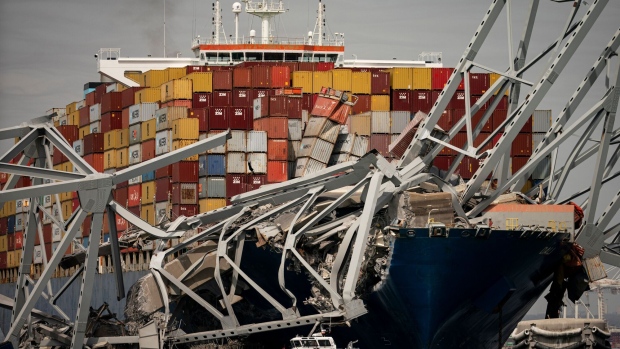
The lights on the Dali, a 948-foot-long container ship capable of carrying 95,000 tonnes of cargo, began to flicker about an hour into the trip, prompting a harbor pilot and assistant to report power issues and a loss of propulsion.
The bridge collapsed on impact and tumbled into the Patapsco River, with the crew managing to send a last-minute mayday call to the police just in time to stop traffic. Emergency responders rescued two people from the water while another six remain missing.
An oil executive has told Fox News there’s some validity to reports that contaminated fuel potentially caused the ship’s engine failure and triggered the accident.
"It's just stealing money, the companies selling them. If nobody's watching closely enough, they'll give them contaminated fuel," United Refining Company CEO John Catsimatidis said in response to a contributor asking how the dirty fuel could get onto the ship.
"Contaminated fuel is being sold to the [New York] schools and sold to the MTA whenthe MTA or the schools are not watching closely enough. You know, you give them 80 percent real fuel and 20 percent garbage. And theFBI should be looking into that," he added.
Supply chain management company Flexport has warned of a vicious feedback loop and supply chain disruptions following the collapse of the Baltimore Bridge.
“It’s not just the port of Baltimore that’s going to be impacted,” Ryan Petersen, the company’s CEO has said. According to Petersen, the port’s closure in Baltimore, Maryland, was just one factor that will contribute to shipping delays.
By Alex Kimani for Oilprice.com
Baltimore's freak bridge collapse reverberates from cars to coal
Nacha Cattan, Heather Perlberg and Brendan Murray, Bloomberg News
The Dali container vessel after it struck the Francis Scott Key Bridge that collapsed into the Patapsco River in Baltimore, on March 26. , Bloomberg
The 1.6 mile-long bridge collapsed in a matter of seconds. The catastrophic consequences are set to stretch out for weeks.
As much as 2.5 million tons of coal, hundreds of cars made by Ford Motor Co. and General Motors Co., and lumber and gypsum are threatened with disruption after the container ship Dali slammed into and brought down Baltimore’s Francis Scott Key Bridge in the early hours of Tuesday.
Six people were presumed dead after a search in the Patapsco River, officials said Tuesday evening. The toll could have been worse except for a mayday call from the Singaporean-flagged vessel as it lost power.
U.S. National Transportation Safety Board Chair Jennifer Homendy said investigators were able to board the Dali Tuesday night to inspect the ship’s bridge, electronics and documentation.
“We do have the data record, which is essentially the ‘black box,’” Homendy said in an interview with CNN. “We’ve sent that back to our lab to evaluate and begin to develop a timeline of events that led up to the strike on the bridge.”
She added that investigators should have information from the vessel’s black box later on Wednesday.
The aftermath of the bridge’s collapse throws another spotlight on the fragile nature of global supply chains that have already been strained by drought in Panama and missile attacks on Red Sea shipping by Yemen-based Houthi militants. Docks in New Jersey and Virginia face the threat of being overwhelmed by traffic that’s being forced away from Baltimore, one of the busiest ports on the U.S. East Coast.
“It’s a large port with a lot of flow through it, so it’s going to have an impact,” John Lawler, Ford’s chief financial officer, told Bloomberg TV. “We’ll work on the workarounds. We’ll have to divert parts to other ports along the East Coast or elsewhere in the country.”
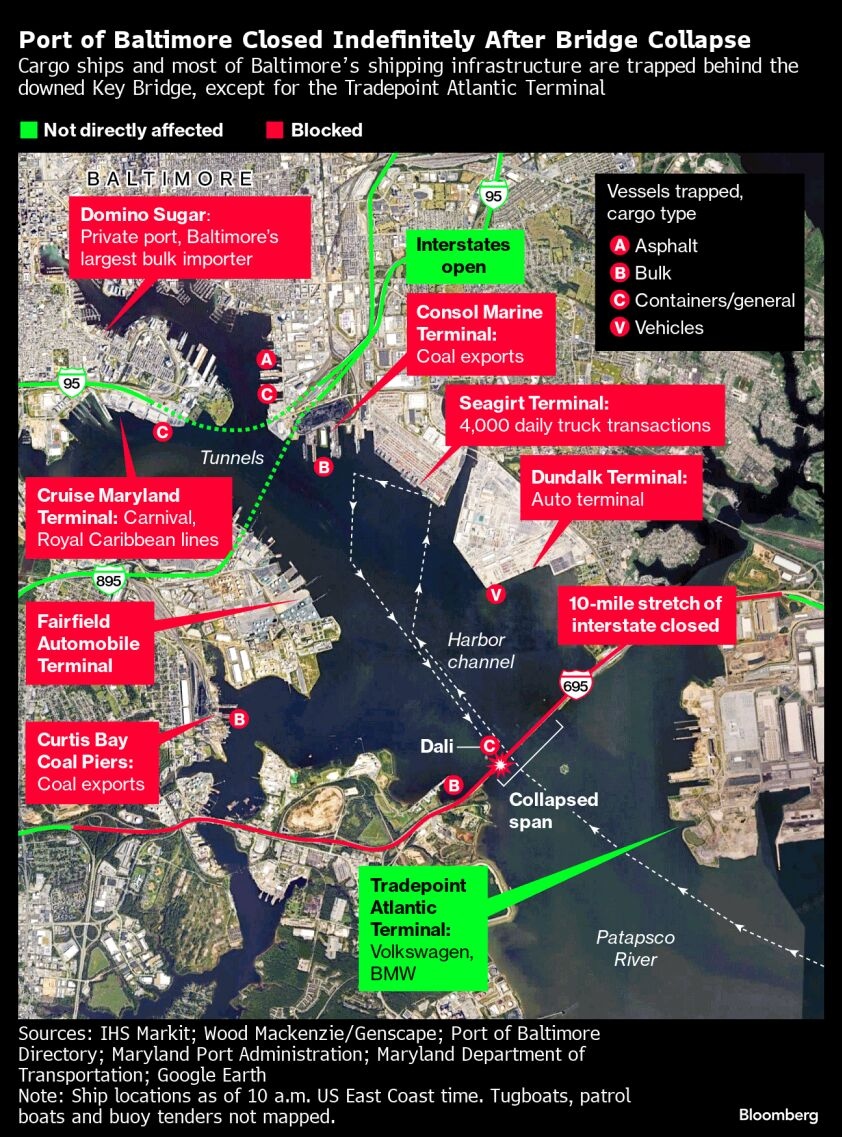
Baltimore only handled about three per cent of all East Coast and Gulf Coast imports in the year through Jan. 31, said S&P Global Market Intelligence. But it’s crucial to cars and light trucks, with European carmakers such as Mercedes-Benz Group AG, Volkswagen AG and BMW operating facilities in and around the port. It’s also the second-largest terminal for U.S. exports of coal, with a shutdown potentially hitting shipments to India.
About a dozen large vessels are stuck inside Baltimore’s harbour as well as a similar number of tug boats, according to IHS Markit and Wood Mackenzie’s Genscape. The list includes cargo ships, automobile carriers and a tanker named the Palanca Rio.
That’s just the impact on the port.
About 35,000 people used the bridge every day. The annual value of goods going over is about US$28 billion, according to the American Trucking Associations.
“We rely on our infrastructure systems for our daily needs, for a huge amount of the goods that we get in the United States from overseas and to have it cut off so suddenly, it’s a huge crisis,” said Yonah Freemark, a researcher at the Urban Institute.
The Francis Scott Key Bridge, named for the man who wrote the text of the Star-Spangled Banner, took five years to build and was completed in 1977. The cost at the time was around $141 million, according to one estimate. A rebuild today is likely to cost “several billion dollars,” said Freemark.
President Joe Biden said he wants the federal government to pay and vowed “to move heaven and earth to reopen the port and rebuild the bridge.”
But Baltimore is in for a lengthy reconstruction. It could be weeks before any port operations resume as officials need to remove bridge debris and the 984-foot Dali from the river.
That’s expected to accelerate a shift of cargo to the U.S. West Coast to avoid bottlenecks from Boston to Miami. A sudden 10 to 20 per cent increase in volumes through a port is enough to cause massive backlogs and congestion, according to Ryan Petersen, the founder and chief executive officer of Flexport Inc., a digital freight platform based in San Francisco.
Trade hub
Traversing Maryland, meanwhile, threatens to create headaches for motorists and truckers. A trip from Edgemere heading south to Glen Burnie was about 15 miles (24 kilometers) over the bridge. It’s 20 miles via the Baltimore Harbor Tunnel. The trip will be even tougher for truckers hauling hazardous materials, which are barred from the tunnel. They’d have to travel 45 miles on the Baltimore Beltway.
The biggest hit though could be to Baltimore itself, a city of close to 600,000 people whose stagnation and high-poverty neighborhoods were made famous by television show The Wire.
The bridge helped connect major parts of Baltimore and was key to its renaissance as a logistics and e-commerce hub after the shuttering of its steel industry. With its deep-water port, shortline railway and well-located interstate highway, the city attracted investors who have been pouring money into redevelopment.
One of the largest projects, Tradepoint Atlantic, has leased millions of square feet in warehouse space to some of the world’s biggest businesses, including Amazon.com Inc. and FedEx Corp.
Facing months of uncertainty, Baltimore and Maryland both declared a state of emergency.
Throughout the morning on Tuesday, crowds gathered in east Baltimore County, camping out in grassy spots or climbing highway guardrails to get a better look of the bridge and snap photos. Across the street from a Dollar General on Dundalk Avenue, residents discussed the roar of the structure collapsing, comparing it to a jet engine during takeoff.
Not far from the collapsed bridge, police changed shifts at the dock of the Hard Yacht Cafe in Dundalk. Officers getting off their boat had been circling the waters as part of the rescue effort for more than 10 hours, they said, adding that divers were searching for remaining victims in the water when they left the scene.
“This is one of the cathedrals of American infrastructure,” said U.S. Transportation Secretary Pete Buttigieg. “The path to normalcy will not be easy, it will not be quick, it will not be inexpensive, but we will rebuild together.”
After Bridge Tragedy, One Baltimore Cargo Terminal is Still Open
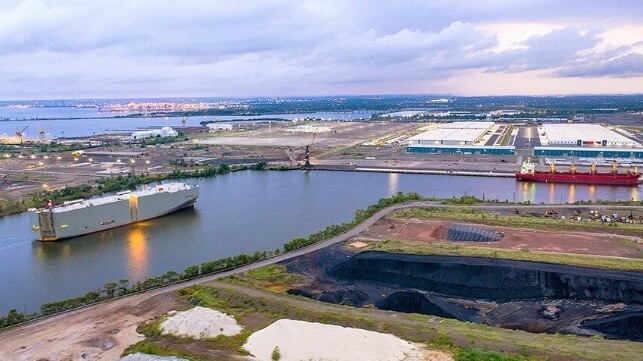
The tragic collapse of Baltimore's Key Bridge has put a new spotlight on Tradepoint Atlantic, the logistics complex located on the former Bethlehem Steel site. Unlike Baltimore's inner harbor, Tradepoint is seaward of the bridge's wreckage, and it is one of the few parts of the city's waterfront still open to deep-sea traffic.
In a statement, the terminal's operator said that it was working closely with officials as the emergency response proceeds.
"Tradepoint Atlantic has been in constant contact with emergency response officials and leaders from Baltimore City, Baltimore County, and the State of Maryland and will continue to coordinate during this extremely challenging situation," the company said. "As part of the Port of Baltimore, we are committed to helping our state and local partners and the entire port community recover and rebuild from this tragedy."
Tradepoint is a receiving terminal for ro/ro vessels in the Baltimore area, and this is a core part of the Port of Baltimore's trade. The port vies with Brunswick, Georgia for the title of biggest ro/ro port in America - but the vast car terminals and parking lots on the far side of the bridge are currently inaccessible. Carmakers Volkswagen and BMW, which both have receiving facilities at Tradepoint Atlantic, have both said that their Baltimore operations are unaffected by the bridge collapse.
The site's importance is only set to grow in years to come. Tradepoint is working with MSC and TIL to build a container terminal at Sparrows Point, which would increase Baltimore's capacity to handle containerized cargo by 70 percent. Subject to federal approval for dredging, it could be open as soon as 2027.
In the meantime, multiple seaports up and down the East Coast have said that they stand ready to absorb the extra cargo volume from Baltimore. The additional cargo per port is not expected to rival the peak surge levels seen during the late-pandemic import boom. The Port of Virginia, which is just 125 nautical miles to the south of Baltimore, has been investing heavily in expansion and is expected to pick up a substantial share of the slack.
“I don’t think we’ll have a large impact in terms of logistics and shipping moving forward. There might be snafus over the next couple days while issues are being worked through, but I think they’ll be able to overcome that pretty quickly,” said Brent Howard, president of the Baltimore County Chamber of Commerce, speaking to The Hill.
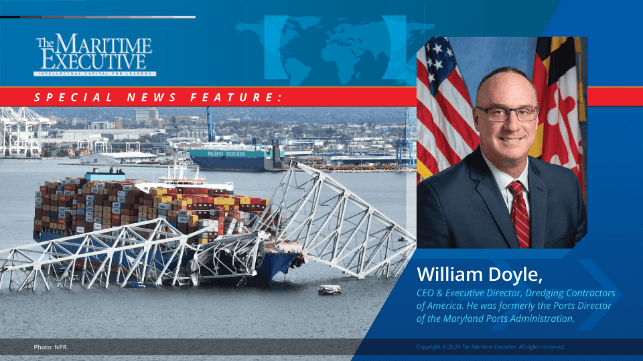
Bill Doyle Comments on Cargo Ship M/V Dali Allision in Port of Baltimore
Special News Feature: Bill Doyle provides insight into the M/V Dali's allision with the Francis Scott Key Bridge. While federal, state and local authorities are on the scene, there is growing speculation about the vessel’s condition and fuel supply.
The 984-foot container ship was transiting the harbor at nine knots when it struck the bridge, and the circumstances of the accident are still under investigation. The ship is owned by Grace Ocean and is registered in Singapore and managed by Synergy Marine.
Six people who were on the bridge are missing and presumed dead. Two others were rescued from the water. Authorities say the eight construction workers were repairing potholes on the bridge. There were 22 Indian nationals and two local pilots aboard the cargo ship.
Multiple Vessels Trapped in Baltimore, Including Sealift Ships
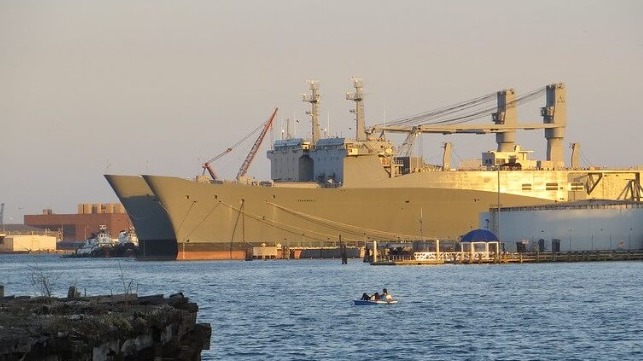
Fast Sealift Ships SS Denebola and SS Antares, Baltimore, 2013 (EllenM1 / CC BY)
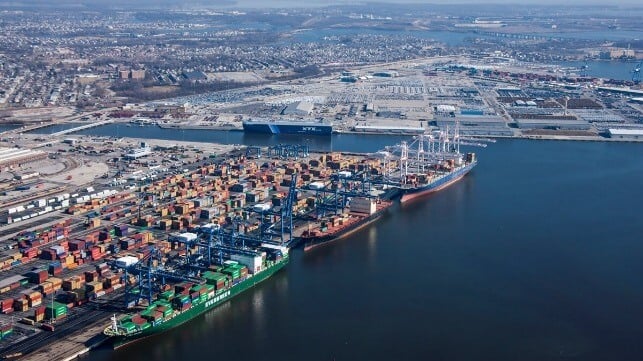
As federal and local authorities focus on the emergency response to the collapse of Baltimore's Francis Scott Key Bridge, Port of Baltimore's inner harbor remains cut off from the rest of the world. No vessels can get in to deliver Baltimore's core cargoes - containers, cars, gypsum and sugar - and no vessels can get out.
The latter fact will be of particular interest for shipowners who have vessels inside the harbor. These include one car carrier, the Swedish-flagged Carmen; four bulkers, the Klara Oldendorff, Balsa 94, Saimaagracht and JY River; and four laid-up ships belonging to the Maritime Administration's Ready Reserve (RRF), the Cape Washington, Gary I. Gordon, SS Antares and SS Denebola.
The Biden administration has restoration of the navigation channel at the top of its list of priorities, Secretary of Transportation Pete Buttigieg said Wednesday.
"We can't wait for the bridge work to be complete to see that channel reopened. There are vessels that are stuck inside right now and there's an enormous amount of traffic that goes through there. That's really important to the entire economy," he told NPR in an interview.
The closure's effect on four RRF vessels could have potential implications for emergency sealift preparedness. The RRF's vessels are kept in reduced operating status at multiple sites around the nation, and the shutdown of any one port would not affect the service's ability to mobilize transport options for most overseas contingencies.
However, two of the vessels in Baltimore are high-value assets - the steamships SS Antares and SS Denebola. These are two out of eight Fast Sealift Ships - a class of SeaLand boxships that were converted for military ro/ro service in the 1980s. They are among the fastest cargo ships in operation today, and their peak speed tops out at 33 knots.
The eight FSS vessels have delivered goods for every major U.S. conflict since the First Gulf War; however, these powerful steamships are 50 years old, and each ship's ability to get under way is not known. The RRF has acknowledged issues with its aging tonnage, and commercially-obsolete steam plants are particularly challenging for MARAD to man and maintain.
Old Lessons May Haunt Baltimore Bridge Tragedy
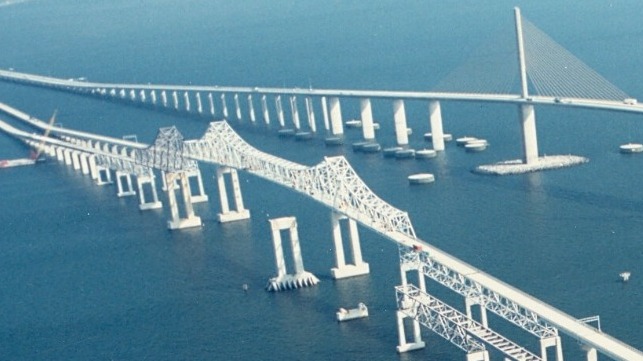
Two standards for bridge protection: the missing span of the old Sunshine Skyway Bridge, left, and the new span with dolphins, right (Apelbaum / CC BY)
For observers who have been in shipping long enough, Wednesday's disastrous bridge collapse in Baltimore brought to mind lessons learned in 1980, when the freighter Summit Venture struck and destroyed half of Tampa's Sunshine Skyway bridge. 35 people died in that disaster, prompting a decade-long rethink of highway bridge design. The Skyway Bridge was rebuilt with a fortress of protective concrete dolphins - but it is unclear whether Baltimore's Francis Scott Key Bridge was updated to meet a similar standard before it was hit by the boxship Dali on Wednesday morning.
Baltimore's Key Bridge opened in 1977, three years before the Skyway Bridge disaster (and two years after a similar casualty in Tasmania). Based on visual evidence, the Key Bridge had one small dolphin on each side of the central span's piers, intended either for scour protection or for defending against allisions. When the container ship Dali approached early Wednesday morning, the vessel appeared to pass by the dolphin and strike the pier directly with her starboard bow.
“Maybe [the dolphin] would stop a ferry or something like that,” consulting engineer Donald Dusenberry told the New York Times. “Not a massive, oceangoing cargo ship.”
Tampa-area attorney Steven Yerrid was involved in the response to the Skyway Bridge disaster in 1980, and he told local media that when he saw the fendering system on the Key Bridge, it looked all too familiar. "I felt not only shock, but extreme sadness, because I knew other people had to unnecessarily lose their lives to learn a lesson that was taught 44 years ago," Yarrid told Tampa's Fox 13.
The Skyway Bridge's lessons were written down and codified by AASHTO, America's highway standards body, in 1991. The rules laid out protection requirements for newly-built bridges and guidance for retrofitting old structures. Risks still remained: in 2002, a barge tow hit a pier on the I-40 bridge in Webbers Falls, Oklahoma, destroying the span and killing 14 people. Only the upstream side of the I-40 bridge had structures to protect it from barge traffic - but the casualty vessel approached from the other direction.
For many engineers, the fact that a landmark structure like the Key Bridge could still be felled by marine traffic is a call to action. "As a matter of principle, when there is a bridge pier in a shipping channel we should expect the bridge to be strong enough to withstand impact or to be protected from impact," structural engineer Shankar Nair told the Baltimore Banner.
"Yes, it could be raised whether it should have been better protected," Cot says. "There has been a historical interest in making fender systems a lot more robust, such that if you have these types of allisions - which are bound to happen - that they do not damage the bridge structure itself. I do think that those representing the vessel interest would probably raise that."
Biden announces $3B to reduce carbon emissions at US ports, 'the linchpin to America’s supply chain'
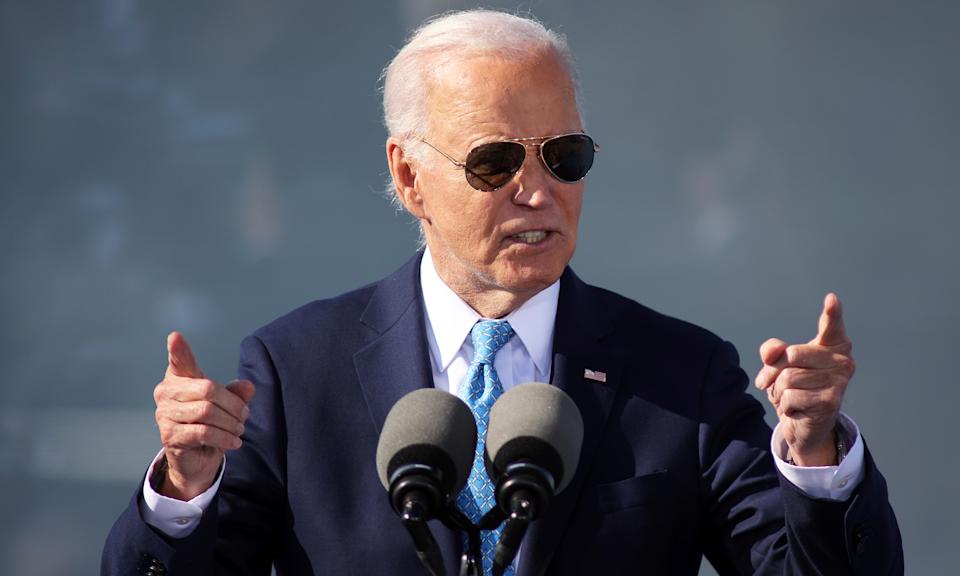
MATTHEW DALY Updated Tue, October 29, 2024 President Joe Biden speaks during an event about his Investing in America agenda, Tuesday, Oct. 29, 2024, at the Dundalk Marine Terminal in Baltimore. (AP Photo/Daniel Kucin Jr.)ASSOCIATED PRESS President Joe Biden speaks during an event about his Investing in America agenda, Tuesday, Oct. 29, 2024, at the Dundalk Marine Terminal in Baltimore. (AP Photo/Daniel Kucin Jr.)ASSOCIATED PRESS Maryland Gov. Wes Moore speaks, Tuesday, Oct. 29, 2024, at the Dundalk Marine Terminal in Baltimore. (AP Photo/Daniel Kucin Jr.)ASSOCIATED PRESS President Joe Biden speaks during an event about his Investing in America agenda, Tuesday, Oct. 29, 2024, at the Dundalk Marine Terminal in Baltimore. (AP Photo/Daniel Kucin Jr.)ASSOCIATED PRESS President Joe Biden walks into BMORE LICKS, a homemade ice cream business in Baltimore, Tuesday, Oct. 29, 2024, after speaking the Port of Baltimore. (AP Photo/Mark Schiefelbein)ASSOCIATED PRESS FILE - The cargo ship Dali is stuck under part of the structure of the Francis Scott Key Bridge after the ship hit the bridge, Tuesday, March 26, 2024, as seen from Pasadena, Md. (AP Photo/Mark Schiefelbein, File)ASSOCIATED PRESS Baltimore Mayor Brandon M. Scott speaks, Tuesday, Oct. 29, 2024, at the Dundalk Marine Terminal in Baltimore. (AP Photo/Daniel Kucin Jr.)ASSOCIATED PRESS Gov. Wes Moore, D-Md., speaks before President Joe Biden arrives to speak at the Port of Baltimore in Baltimore, Tuesday, Oct. 29, 2024. (AP Photo/Mark Schiefelbein)ASSOCIATED PRESS President Joe Biden speaks during an event about his Investing in America agenda, Tuesday, Oct. 29, 2024, at the Dundalk Marine Terminal in Baltimore. (AP Photo/Daniel Kucin Jr.)ASSOCIATED PRESS
WASHINGTON (AP) — The Biden administration is awarding nearly $3 billion to boost climate-friendly equipment and infrastructure at ports across the country, including Baltimore, where a bridge collapse killed six construction workers in March and disrupted East Coast shipping routes for months.
President Joe Biden announced the federal funding Tuesday during a visit to the city's main port, saying the money will improve and electrify port infrastructure at 55 sites nationwide while supporting an estimated 40,000 union jobs, reducing pollution and combating the climate crisis. The presidential visit, a week before Election Day, was intended to highlight efforts by Biden and Vice President Kamala Harris to promote clean energy while protecting and creating jobs.
“Ports are the linchpin to America’s supply chain,'' Biden said in a speech at Dundalk Marine Terminal, near the site of the March 26 bridge collapse that closed commercial shipping traffic for nearly three months. A small blue and white sign near the site reminded passersby, “Project funded by President Joe Biden’s Inflation Reduction Act,'' the 2022 law approved with only Democratic votes.
While the grant announcement appeared timed to help Harris' campaign for president, Biden seemingly ignored those concerns as he followed Maryland Democratic Gov. Wes Moore to the outdoor podium, flanked by metal ship containers. “I think he may be the best governor in the country,” Biden said of Moore, bypassing a chance to praise Harris’ running mate, Minnesota Gov. Tim Walz.
Biden used his speech to repeatedly criticize former President Donald Trump, and he took an indirect swipe at a controversy Trump is facing after appearing at a weekend rally in New York where racist comments were made about Puerto Rico. Biden emphasized that federal funding for ports includes Puerto Rico. At one point, he even reminded himself with a laugh, “Don’t get going, Joe. Slow up.”
The Port of Baltimore, one of the busiest on the East Coast, is a major hub for the import and export of motor vehicles and farm equipment. More than 20,000 workers support port operations, including unionized longshoremen and truckers.
The Baltimore port and others across the country “keep goods moving — keep the economy strong,″ Biden said. “And they employ over 100,000 union workers, from Teamsters to longshoremen. But for too long, they’ve run on fossil fuels and aging infrastructure, putting workers at risk and exposing nearby communities to dangerous pollution.″
The new funding will help ports and communities across the country cut operating costs and keep consumer prices down, "while slashing carbon pollution and supporting an estimated 40,000 new, good-paying jobs to support clean energy manufacturing all across America,'' Biden said.
“This is about environmental justice,'' he added, citing studies that show higher childhood asthma, cancer and lung and heart disease in residents who live near U.S. ports.
Grants announced Tuesday include $147 million for the Maryland Port Administration to buy and install cargo-handling equipment and trucks to transition the port into a zero-greenhouse-gas-emission facility.
The Maryland port is among 55 ports across 27 states and territories that will receive nearly $3 billion through the Clean Ports Program administered by the Environmental Protection Agency. Ports receiving money include the Port Authority of New York and New Jersey, the Detroit-Wayne County Port Authority, the ports of Savannah and Brunswick, Georgia, as well as Philadelphia, Los Angeles and Oakland, California.
The grants are funded by Biden's landmark climate law approved in 2022, the largest investment in clean energy in U.S. history.
Protecting people and the environment “doesn't come at the expense of a booming economy," EPA Administrator Michael Regan said before Biden's visit, offering an implicit rebuke to Trump and other Republicans who have complained that strict environmental regulations hinder the economy. “In fact, healthy communities and a strong economy go hand in hand," Regan said.
The grant announcements, which follow $31 million in federal funds to rehabilitate a section of Baltimore's Dundalk Marine Terminal, come a week after the owner and manager of the cargo ship that caused the deadly bridge collapse agreed to pay more than $102 million in cleanup costs to settle a lawsuit brought by the U.S. Justice Department.
The settlement does not cover any damages for rebuilding the bridge, a project that could cost close to $2 billion. The state of Maryland has filed its own claim seeking those damages, among others.
Funding though the Clean Ports program will slash more than 3 million metric tons of planet-warming carbon dioxide emissions equivalent to energy use by nearly 400,000 homes for one year, Regan said. It also will cut 12,000 short tons of nitrogen oxides and other harmful pollutants, he said.
John Podesta, senior White House adviser for international climate policy, said the grants will help fulfill a promise by Biden and Harris to “rebuild our nation’s infrastructure and tackle the climate crisis ... and uplift the communities who’ve borne the brunt of pollution."
In February, the EPA announced two separate funding opportunities for U.S. ports, a competition to directly fund zero-emission equipment and infrastructure and a separate competition for climate change and air-quality programs. More than $8 billion in requests from applicants across the country were received.
Democratic Sen. Alex Padilla of California hailed the grant announcement, which includes more than $1 billion for seven California ports. The Port of Los Angeles will receive $411 million, the largest award in the country.
“California’s ports move the goods that power our economy," Padilla said Tuesday, noting that state ports process about 40% of all containerized imports and 30% of U.S. exports. The EPA grants will help decarbonize the U.S. supply chain “to produce cleaner air in neighboring communities and meet our climate goals while creating green jobs,” Padilla said.
___
Associated Press writers Will Weissert in Washington and Ayanna Alexander in Baltimore contributed to this story. Top US container ports awarded $1.6B to electrify
John Gallagher Tue, October 29, 2024 The Port of Los Angeles received $412 million for zero-emission equipment. (Photo: Port of Los Angeles)
WASHINGTON — The Biden administration has released $3 billion in funding aimed at cutting pollution at U.S. ports, with roughly half of that going to electrify some of the country’s largest container operations.
Of the 55 grant applicants across 27 states that were awarded money from the Environmental Protection Agency’s Clean Ports Program, the top five winners – the ports of Los Angeles, New York/New Jersey, Virginia, Baltimore and Oakland, California – received $1.6 billion.
Biden speaking at the Port of Baltimore on Tuesday. Credit: The White House
Much of that funding will go toward electric drayage trucks and cargo-handling equipment, along with charging infrastructure and battery energy storage systems.
“The new $3 billion in funding will strengthen supply chains, make American businesses more competitive, and keep consumer prices down while slashing carbon pollution and supporting an estimated 40,000 good paying jobs at ports across America,” said President Joe Biden, speaking at the Port of Baltimore on Tuesday.
The Maryland Port Authority, which oversees the port, will receive $146 million from the program, which is funded by appropriations provided by the Inflation Reduction Act.
The biggest grant winner, the Port of Los Angeles, which received $412 million, will use the money to buy 425 pieces of battery-electric, human-operated cargo-handling equipment and to deploy 250 electric drayage trucks. It will also provide $50 million for workforce development, including union-related jobs.
“The men and women of the ILWU [International Longshore and Warehouse Union] are thrilled to learn of this over $400 million investment by the U.S. EPA,” said ILWU Local 13 President Gary Herrera, in a news release.
“Human operated, zero-emission cargo-handling equipment is the gold standard for maritime port operations not only because it protects good jobs while cleaning the air, but is also the most efficient and cost-effective in terms of port operations, while additionally providing the necessary safeguards against cyber threats to our national security.”
The Virginia Port Authority, the second-largest grant winner, receiving $380 million, will use the funds to replace more than 150 pieces of old port-handling equipment at its Norfolk International Terminals and Richmond Marine Terminal with electric equipment including specialized cranes, forklifts, shuttle carriers for moving containers, and electric locomotives.
“This grant is truly transformative for our port and our community,” said Virginia Port Authority Executive Director Stephen Edwards, in a news release. “It will make our operations more efficient and sustainable, enhance our capabilities and allow us to continue making strides toward becoming the U.S. East Coast’s first net-zero port.”
Funding will be used for similar zero-emission equipment purchases and electric infrastructure for container operations at the Port of New York and New Jersey, which received $347 million, and the Port of Oakland, which received $322 million. Biden lauds Port of Baltimore reopening, infrastructure investments Mike Heuer Tue, October 29, 2024 President Joe Biden lauded the rapid re-opening of the Port of Baltimore during an outdoor event Tuesday afternoon and is pictured giving remarks at a Diwali celebration in the East Room of the White House on Monday. Pool Photo by Jim Lo Scalzo/UPIMore
Oct. 29 (UPI) -- President Joe Biden cited the reopening of the Port of Baltimore in June as evidence of the great things that can be done by investing in America and its infrastructure.
Biden spoke at an open-air event on a dock at the Port of Baltimore and lauded the port's re-opening after that deadly Francis Scott Key Bridge collapse that killed six bridge workers in March.
Biden said union workers and federal agencies made it possible to open the port about 2.5 months after the bridge collapse.
"The middle class built this country, and unions built the middle class," Biden said.
After the cargo ship Dali struck the bridge and caused its collapse early in the morning on March 26, Biden said 30,000 people lost their daily route to work, school and home and "40,000 paychecks" were put at risk.
Salvors with the Unified Command perform a controlled demolition and precision cutting of section 4 of the Francis Scott Key Bridge on May 13 as part of the efforts that re-opened the port 78 days after the deadly bridge collapse. File Photo by Christopher Rosario/U.S. Army Corps of Engineers/UPIMore
"We did everything possible to open this port as fast as possible," Biden said. "We removed 50,000 tons of concrete and steel."
Many estimated it would take six months to re-open the port, but Biden said, "You cleared it in 78 days."
He said $60 million in federal funding and grants helped fund the cleanup and kept businesses open.
Now that the port is reopened, Biden said 8,000 people are back to work and the Port of Baltimore handles 100,000 tons of cargo every day.
"We won't stop until a new bridge is finished," Biden said. "We have to build it back better than before."
He wants Congress to fully fund new bridge construction this year and cited the Port of Baltimore and the pending replacement of the Francis Scott Key Bridge as examples of his "Investing in America" policy.
One of two shipping containers located near the stage held an "Investing in America" sign.
Other examples Biden cited as part of his infrastructure and investment policy include $3 billion in funding from the Inflation Reduction Act for projects in 27 states and territories and $447 million to upgrade equipment and energy at the Port of Baltimore.
He said the port and other locations have depended on fossil fuels for too long, which causes "dangerous pollution" that afflicts children with asthma, heart disease, lung disease and cancer.
Cutting costs at the nation's port facilities will extend supply chains, make businesses more competitive, lower consumer costs and create 40,000 new jobs, Biden said.
He cited the Port of Baltimore as an example, where 2,000 new jobs were created for longshoremen, iron workers and others.
Those are "good-paying union jobs you can raise your families on," Biden said. "This is what we call 'investing in America.' It's working!"
Biden said the United States has the world's strongest economy thanks to legislation enacted during his presidency, including the Chips and Science Act, Inflation Reduction Act and fighting climate change.
The United States is the only nation that emerges from a crisis, like the COVID-19 pandemic, stronger than what it was before the crisis occurred, Biden added.
He said his administration created a record 16 million new jobs, wages are up and inflation is down to the same rate it was before the pandemic.
His administration brought jobs and factories back to the United States, he said, and 19 million new business applications have been filed since he took office.
"Consumer confidence is up [and] the economy is growing," Biden said. "The middle class is doing well."
He said he felt a sense of pride with the rapid reopening of the Port of Baltimore.
"A true measure of a person is not how often you get knocked down," Biden said. "It's how fast you get back on your feet."
"That's what 'Baltimore Strong' is," Biden added. "Let's keep working together."
The president spoke for about 15 minutes during the event that started at 2 p.m. EDT and ended about 30 minutes later.
Biden in Baltimore: Key Bridge funding, ice cream and a $147 million pledge for Port of Baltimore
Jeff Barker, The Baltimore Sun Tue, October 29, 2024
BALTIMORE — President Joe Biden, continuing to make Baltimore a symbol of his administration’s push to upgrade aging infrastructure, pledged $147 million in grants to reduce greenhouse gas emissions at the Port of Baltimore.
“We won’t stop until the new bridge is finished completely,” Biden said Tuesday at the Dundalk Marine Terminal in Baltimore. “I call on Congress to fully fund it this year.”
The Maryland Port Administration will receive $145 million in Environmental Protection Agency grants to purchase zero-emission cargo handling and other equipment, and new heavy-duty transport trucks and locomotives, according to the White House. It said the port also will receive $2 million to help it “chart a path to greater emissions reductions in the future.”
The infusion of money is expected to ultimately lead to 2,000 jobs as the projects occur over the next three to four years, according to administration estimates.
The aid is part of a $3 billion national investment in ports that was part of the Inflation Reduction Act signed by Biden in 2022. It is aimed at reducing pollution for port workers and surrounding communities and creating union jobs.
Biden spoke at the marine terminal in front of a red, white and blue sign reading, “President Joe Biden. Investing in America.” Shipping vessels were visible in the water behind him.
Before Biden spoke, Mayor Brandon Scott, Democratic Sen. Ben Cardin, Baltimore County Executive Johnny Olszewski Jr., and other Maryland lawmakers thanked the president for his support of Baltimore and the port.
“Thank you, President Biden, for coming to our rescue and being with us all the way,” Cardin said, thanking Biden in particular for his pledge to obtain 100% federal funding to replace the Key Bridge following its collapse that killed six construction workers and halted activity at the Port of Baltimore in March.
Speaking before Biden, Gov. Wes Moore recounted the Key Bridge collapse in March.
“The Port of Baltimore is back,” Moore said. “It’s great that today we’re here because of a triumph.”
Biden’s speech, one week before the presidential election, was part of a push by national Democrats to promote the administration’s efforts to upgrade aging infrastructure. Biden has joked that Republicans who voted against a massive infrastructure package in 2021 now seek to claim credit for large projects in their districts.
The $146 million for Maryland will come from a grant program called “Clean Ports” that the state’s port administration applied for and is administered by the EPA, which lists the project start date as Feb. 1.
Biden has made Baltimore a symbol of his push to upgrade ports, roads, bridges, transit systems and broadband.
In 2021, the Democratic president toured the port to celebrate the passage of the infrastructure improvement legislation that came as American ports, particularly along the West Coast, experienced jams that spurred price jumps for many products as the nation recovered from the coronavirus pandemic.
More recently, Biden visited Baltimore following the Key Bridge collapse.
He pledged then that his administration would help clear the channel — that was completed in June — and secure full federal funding for the bridge replacement.
The $147 million is distinct from the push by Maryland lawmakers to secure 100% funding from Congress for the replacement of Key Bridge. That effort is ongoing, and Maryland Democratic Sen. Chris Van Hollen said Tuesday that the state’s federal delegation hopes to have that approval from Congress by the end of the year.
Biden headed from the port to BMORE LICKS, a popular Canton ice cream store.
“Oh my god, Joe Biden is here,” a passerby shouted.
The small shop became a news conference venue as Biden was asked about North Korean troops and Vice President Kamala Harris’ campaign speech Tuesday night.
Biden said he planned to watch Harris’ speech in Washington but not attend. “It’s for her,” he said.
The corner shop, with a mural of an ice cream cone on an outside wall, advertises “homemade hard ice cream” and “flurries.”
Wednesday, April 03, 2024
Maryland Gears Up to Provide Relief for Baltimore's Longshoremen
Dundalk Marine Terminal in busier times (Port of Baltimore file image)
Help may soon be on the way for longshoremen who depend on freight traffic at the Port of Baltimore. The port generates $2 million per day in wages, according to the U.S. Department of Transportation, but the protracted shutdown from the collapse of the Francis Scott Key Bridge has sidelined stevedores and put local businesses at risk.
Maryland's state legislature is responding with a bill to let the governor use the state "rainy-day" fund to pay for worker-assistance programs. The bill would also help small companies, like drayage and logistics firms, that serve the Port of Baltimore.
“What we are trying to do . . . is provide some modicum of protection and relief for the individuals and small businesses in the port industries that rely on . . . the full operation of the Port of Baltimore,” State Senate President Bill Ferguson told local WBAL.
Ferguson's bill would pay wages for port workers, help underwrite payroll costs for affected small businesses, and incentivize those businesses to stay in Baltimore instead of moving to a different seaport. The bill incorporates amendments from the governor's office that would waive the unemployment insurance work requirement for longshoremen while they wait for the port to reopen.
The timeline depends on clearing the port's channel, and local logistics businesses are telling their clients to expect the shutdown to be measured in months, according to the Washington Post. Looming over all of Baltimore's port stakeholders is a simple fact of containerized freight: boxes can move through any suitably equipped port, and one port can be substituted for another. In a disaster scenario, this is a boon to the logistics network, since cargo can flow around a single disruption. Over the long term, if shippers get used to routing boxes a new way - for example, through Newark and Norfolk - Baltimore would have to compete to get that cargo volume back.
First Tug Makes it Out of Baltimore Harbor After Bridge Collapse
The first commercial vessels to exit Baltimore's inner harbor after the collapse of the Francis Scott Key Bridge have made it safely through a temporary channel set up by the Army Corps of Engineers.
After careful surveys and a rapid deployment of channel marker buoys, two tug and barge transits took place Monday afternoon. The first one through was the tug Crystal Coast, bound for Dover Air Force Base with a barge full of jet fuel.
The channel - one of two new shallow-draft passages - will allow for the movement of salvage vessels between the two sides of the bridge's wreckage. The two temporary channels have depths of 11 and 14 feet, respectively, and a third channel with a 20-25 foot control depth is in the works as well.
"I'm thankful that only a week after the collapse, we have pathways and channels so commercial traffic can now move through," said Gov. Wes Moore at a press conference Tuesday.
In addition to the good news for tug and barge operators, ro/ro carriers are also seeing positive movement: Tradepoint Atlantic, the giant terminal complex at Sparrows Point, will be receiving a large number of extra ro/ro ships. The Port of Baltimore is America's busiest ro/ro port, and it appears set to keep much of its cargo volume despite the shutdown. Tradepoint Atlantic told the Baltimore Sun that it will be accepting nine extra ro/ro ships over the span of two weeks.
The Sparrows Point site is the port's only large cargo terminal located seaward of the Key Bridge, and its accessibility will also help the salvage effort. One of its multipurpose piers will be used to receive and recycle wrecked steel from the bridge.
The clearance of the main shipping channel is the unified command's primary objective, but it is a highly complex undertaking with an uncertain timeline. The wreckage of the main span is tangled up and partially buried in the mud on the bottom, making it harder for salvage engineers to plan for its removal.
In the long run, Baltimore will need a new bridge, and it is going to be expensive. It will likely be a much different structure with more redundancy built in, like a twin span cable-stayed bridge, according to civil engineering experts. Prof. Joseph L. Schofer of Northwestern University, a civil engineering expert, told Marketplace that the price tag in today's economy will probably come in somewhere in the range of $2-5 billion. Federal officials are predicting a similar price tag in the range of $2 billion, according to Roll Call. The original bridge cost $60 million in 1977, or roughly $360 million in current dollars. The project could take three to five years to complete.
Days after a massive cargo ship collided with the Francis Scott Key Bridge in Baltimore, Republican US senate candidate Larry Hogan called for the federal government to foot the bill for the bridge’s reconstruction. Hogan’s demand follows his efforts as Maryland’s governor to attract such outsize cargo vessels to Baltimore’s port in the first place — despite safety warnings from an insurance giant and transportation experts.
Regardless of those concerns, Hogan’s gubernatorial administration pledged that bringing ever-larger cargo ships to Baltimore would strengthen the economy — and even improve safety.
His administration’s major public-private partnership to attract such mega-ships promised that it “reduces the occurrences of crashes, fatalities and injuries among transportation users.”
As the insurance conglomerate Allianz was spotlighting the dangers of large cargo ships, Hogan positioned himself as his state’s highest-profile supporter of the mega-ship industry — at one point declaring that thanks to his administration’s investments, “every year we are seeing larger and larger container ships choosing the Port of Baltimore.”
During the Republican governor’s tenure, mega-ship traffic in Baltimore exploded, transporting record amounts of cargo through the port worth billions of dollars. But as the port expanded with Hogan’s support, expertssay the Key Bridge, as it was commonly known, may not have been fortified for the possibility of a collision with such large ships — even though a cargo vessel had already crashed into the bridge a few decades earlier, when ships were smaller.
Hogan, who is now running for one of Maryland’s US senate seats, did not respond to multiple requests for comment.
Expansion Amid Warnings
In 2015, two institutions sounded alarms about the push for ever-larger cargo ships.
“Ship size growth raises risk management concerns,” warned a report that year from insurance giant Allianz. “Larger ships could also mean larger losses. . . . Maximum exposure will not necessarily be limited to vessel and cargo value but could also include environmental, social or business interruption backlash.”
In a report published that same year by the International Transport Forum, a consortium of sixty-six governments, researchers wrote, “The costs to salvage hulls of [the] largest existing containerships in case of accident will increase because of the lack of salvage equipment and technology capable of removing a wreck of this size.”
The International Transit Forum report explicitly warned cities against using public money to retrofit ports to encourage larger ships.
“In the case of mega-ships, this situation risks [leading] to situations where the public sector picks up the bill of costs imposed by shipping lines,” the report said. “Especially where ports are engaged in fierce competition to attract mega-ships, port authorities might be tempted [to] use public funds to attract these. . . . There is no inherent public interest in stimulating mega-ships, so there is no reason why public funds should be used to favour mega-container ships.”
Nonetheless, in 2017, Hogan’s port officials, who manage operations and strategic planning for the Baltimore port, purchased additional land to build infrastructure to attract ever-larger cargo vessels. At the time, Baltimore’s port on the Chesapeake Bay was one of the busiest in the nation and just one of four on the East Coast that could handle these mega-ships.
The following year, the Maryland Port Administration requested millions of dollars of federal funds to accommodate the “ever-increasing size of container ships.”
The proposal specifically touted the port’s additional safety enhancements, asserting that it “improves navigational safety, thereby reducing the potential for release of hazardous materials into the nation’s waterways.”
Hogan, first elected governor in 2014, reportedly had an active role in championing the expansion.
Maryland Port Administration executive director James White, who oversaw large parts of the port’s expansion during his eighteen-year tenure, emphasized Hogan’s support for the project in a 2019 statement. “Governor Hogan’s support for the Port of Baltimore from day one has set the course for the future of the port from the Howard Street Tunnel to key infrastructure investments,” noted White.
The Hogan administration’s 2018 port-expansion application included implementing safety requirements for dredging the channel, widening the space needed for these boats’ turning radius, and fortifying the wharf structure, among other considerations. But it did not make any adjustments or designate protections for the nearby Key Bridge, which the ultra-large crafts would be traveling under.
Meanwhile, the port administration said the project had “few and well-mitigated risks.”
But as the port expansion was nearing completion, Allianz sounded another alarm.
“While approach channels to existing ports have been dredged deeper and berths and wharfs extended to accommodate ultra large vessels, the overall size of existing ports has remained the same,” wrote one of the insurance company’s senior marine risk consultants. “As a result, ‘a miss’ can turn into ‘a hit’ more often for the ultra large container vessels.”
A Previous Collision
Maryland officials pushing the port expansion offered safety reassurances despite engineers and marine experts previously expressing concerns about the safety of the Key Bridge, which was completed in 1977 and was at the minimum height needed to accommodate such ships.
“Extra capacity and safety tends to be needed all the more when the bridge is older,” researchers wrote in the International Transport Forum report, recommending bridge updates in busy port areas.
“The preferred method for building bridges today is that there is redundancy built in,” Jennifer Homendy, chair of National Transportation Safety Board, which is investigating the recent crash, told the Washington Post following the Key Bridge’s collapse on March 26. “This bridge did not have redundancy.”
In 1980, when a ship collided with the Sunshine Skyway Bridge in Florida, killing thirty-five people, a top state engineer said the Key Bridge could not withstand a similar crash. “I’m talking about the main supports, a direct hit — it would knock it down,” the official reportedly told the Baltimore Sun.
In the last decade, officials managing the Port of New York and New Jersey raised the nearby Bayonne Bridge to accommodate mega-ships traveling through the New York harbor. Federal, state, and local governments also invested more than $1.5 billion into replacing the Gerald Desmond Bridge in Long Beach, California, with a taller bridge that could accommodate larger vessels.
Despite the lack of such upgrades to the Key Bridge, in December 2018, Hogan announced that the state had been awarded the $6 million–plus in federal funding to expand Baltimore’s port. Less than a year later, the port welcomed its largest-ever ship, the Triton, at 1,210 feet long — longer than three football fields. That record was eclipsed in 2023 with the arrival of Ever Max, which holds one thousand more containers than the Triton.
“Thanks to Maryland’s investment in a 50-foot berth, every year we are seeing larger and larger container ships choosing the Port of Baltimore,” Hogan said in May 2019.
Yet the Key Bridge barely allowed for the arrival of new, larger cargo cranes for Baltimore’s expanded port. Maryland’s then transportation secretary Greg Slater boasted in a 2019 blog post about shutting down the bridge to allow “four new, massive Neo-Panamax container cranes . . . [to] pass beneath the Key bridge with just 3 feet of clearance.”
Ever-Growing Ships
Since 1968, container ships like the one that hit the Baltimore bridge have increased their carrying capacity by almost 1,500 percent, according to a fifty-year analysis by the business insurance company Allianz. These mega-ships are attractive to shipping companies because they’re more profitable: the larger the ship, the more goods it can transport while requiring less fuel per container.
The push to modernize and expand Baltimore’s port’s infrastructure was part of a race among East Coast cities to accommodate these mega-ships and the economic activity they would bring, once the Panama Canal completed its 2015 overhaul to allow for supersized cargo ships. In early 2012, Baltimore was already competing with other cities to expand its port infrastructure, installing enormous cranes and dredging its harbor.
But as the boats got bigger, so did the risks. In 2022, the Ever Forward — owned by the same Hong Kong–flagged company that grounded a different ship in the Suez Canal in 2020, an accident that is estimated to have cost the global economy up to $60 billion in delayed cargo — was grounded in the Chesapeake Bay for over a month.
The Chesapeake Bay features a characteristically shallow ecosystem, further exaggerating the risks of these mega-ships. Consequently, Maryland’s port administration and the US Army Corps of Engineers have to dredge 4.5 million tons of sediment from the port’s channel each year to keep ships from beaching.
Baltimore’s port expansion faced other objections. Environmental justice advocates had long sounded the alarm over the ship exhaust and toxic dust being generated by the second-largest coal-exporting port in the nation, and suggested that the expansion would open the door to greater hazards for portside communities in South Baltimore that have long faced environmental injustices.
But Hogan, a pro-business Republican who said the port project fit the state’s “Open for Business” agenda, has largely championed the industries and businesses that rely on the supersized ships. In doing so, he echoed the Baltimore business groups that pushed for the port expansion. Business sectors like construction and natural resource extraction, which heavily rely on the port, have been some of Hogan’s largest campaign donors.
Hogan recently stepped down from his position as honorary chairman of the new No Labels party, a moderate party aligned with secretive corporate interests, while launching his own bid for a Maryland senate seat.