Showing posts sorted by relevance for query F-35. Sort by date Show all posts

Monday, December 02, 2024

F-35 components sent to Israel from UK airbase 14 times

Exclusive: Twice as many supplies for Israel’s “most lethal” fighter jets were sent from Britain than previously known.

JOHN McEVOY
2 December 2024
DECLASSIFIED UK
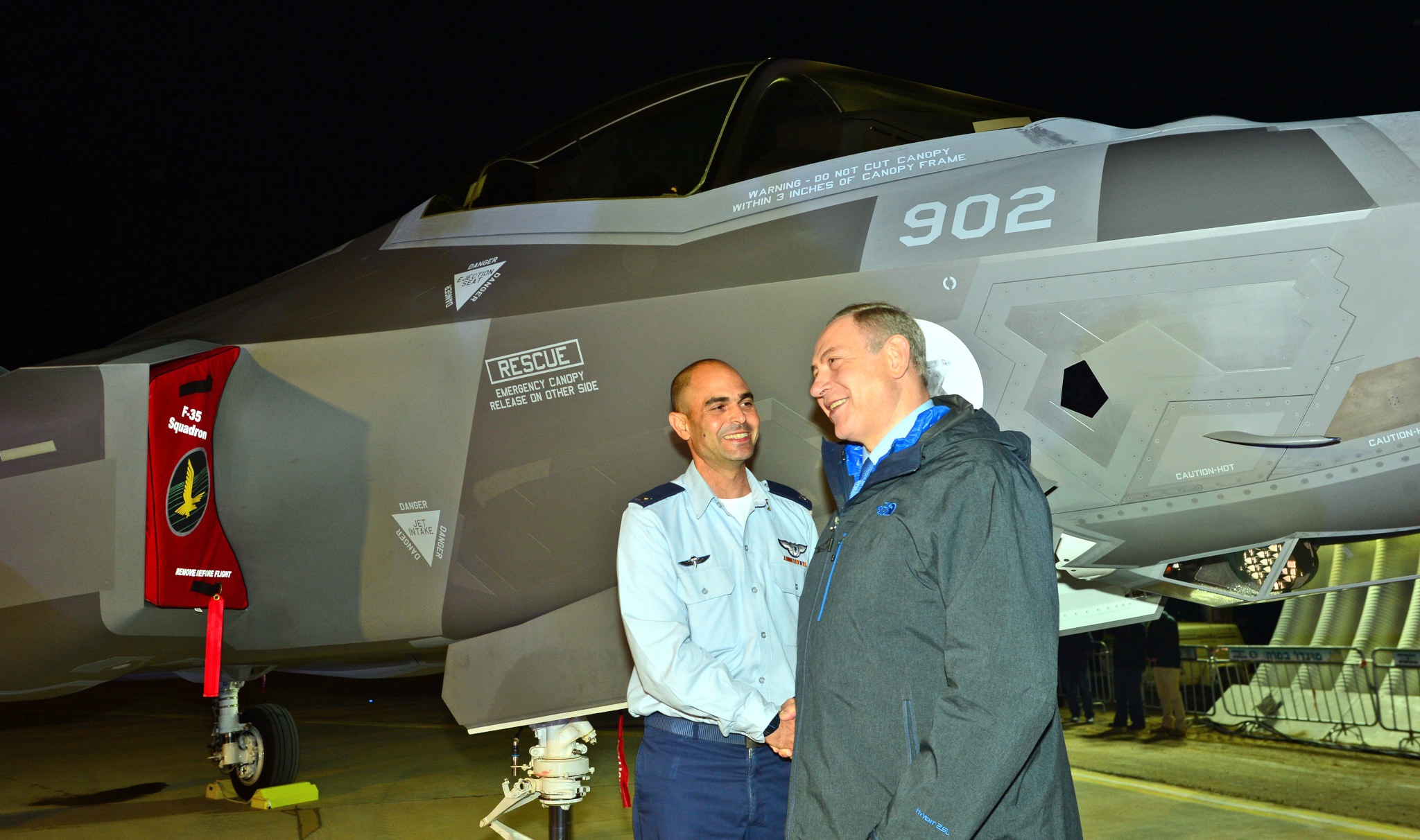
Benjamin Netanyahu welcomes a delivery of F-35s at Nevatim.
 (Photo: Kobi Gideon / GPO)

F-35 components have been shipped from an RAF base to Israel fourteen times amid the Gaza genocide, it can be revealed.

At least two of the deliveries took place this summer shortly after Keir Starmer became UK prime minister.

The shipments were dispatched from a Royal Air Force base in Marham, Norfolk. They were transferred to Nevatim airbase which houses the Israeli air force’s squadrons of F-35 jets.

Declassified previously revealed that seven shipments of F-35 parts had been transported from RAF Marham to Israel since the Gaza bombing began.

The Ministry of Defence has now admitted that there were in fact “14 transfers of F-35 components from RAF Marham to Israel between October 2023 and August 2024”.

There have been no further “exports of F-35 parts direct to Israel via RAF Marham since the licensing suspension” announced by the Labour government in September 2024.

It released the data in response to a parliamentary question tabled by Clive Lewis, the MP for Norwich South.

The revelation could implicate British ministers in war crimes. An Israeli F-35 fighter jet was used to bomb a designated safe zone in Gaza, killing 90 people, in July.

Sam Perlo-Freeman of Campaign Against Arms Trade told Declassified: “The F-35 plays a key role in Israel’s genocidal war on Gaza. By not merely permitting but actively facilitating the supply of F-35 components to Israel from RAF bases, UK ministers have made themselves parties to war crimes, and risked making UK military personnel complicit”.

RELATED
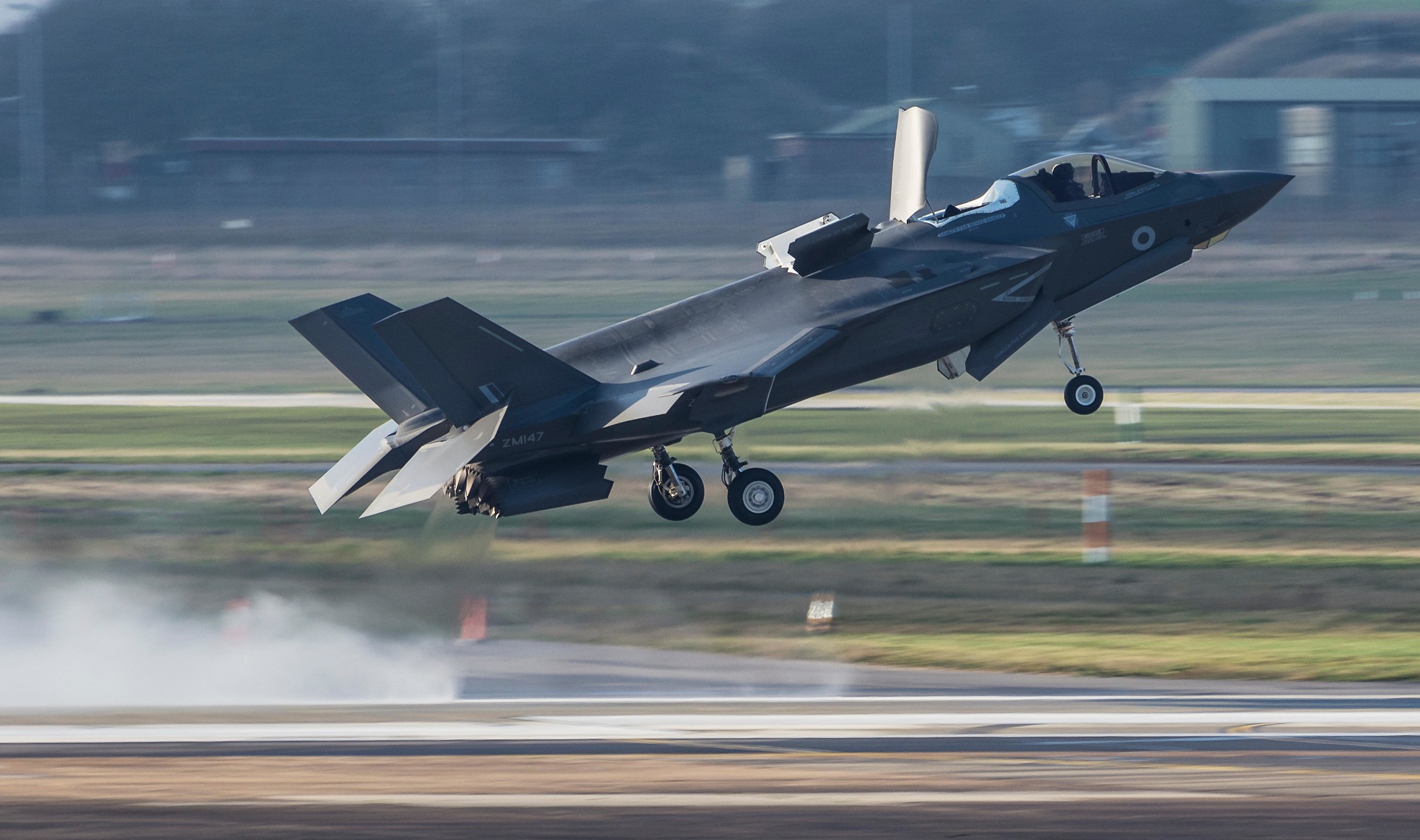
F-35 components sent to Israel from Royal Air Force base

Lockheed Martin

Based in Norfolk, RAF Marham describes itself as “the home of the F-35 Lightning, a fifth generation, multi-role, stealth fighter”.

Over 15% of the components for the F-35 are made in the UK, including the rear fuselage, ejection seats, and electronics. The fighter jet has been described as the most “lethal” in the world.

The registered sender of at least seven of the shipments from RAF Marham to Israel was the Lockheed Martin UK Integrated Systems office based in Havant, a town near Portsmouth.

Lockheed Martin is a major US arms corporation and the lead player in the international consortium that produces the F-35 fighter jets. The Havant site is the company’s main headquarters in Britain.

Components were sent from RAF Marham to Heathrow Airport, and then transported to Tel Aviv on cargo flights operated by Israeli airline El Al. They were subsequently transferred to Nevatim airbase.

A Lockheed Martin representative previously told Declassified: “Our company’s success depends on an enduring commitment to business integrity which includes adhering to all United Kingdom government guidelines on the export of defence and dual use equipment from the UK to any country”.


Starmer’s suspensions

Labour suspended some arms export licences to Israel in September but will continue to allow shipments of F-35 components to the country through “global hubs”.

This would allow Britain to send F-35 components to the US for onward export to Israel. Fighter jet parts can also still be exported directly to Israel if they are for onward export to a third country in the F-35 programme.

The Labour government insists that “suspending all licences for the F-35 programme would undermine the global F-35 supply chain that is vital for the security of the UK, our allies and NATO”.

Campaign Against Arms Trade believes UK ministers have not done enough, commenting that “by continuing to allow indirect supplies of components to Israel, they are placing arms industry interests over human lives and international law. The only legal and moral course of action is to stop all arms supplies to Israel, direct or indirect, now”.

Britain has also continued to export components for the Israeli air force’s training aircraft since September because of further gaps in the government’s restrictions on arms sales.

Declassified recently revealed how items were dispatched by UK-based engineering firm Martin-Baker to an Elbit Systems factory in Karmiel, Israel, in October.

Martin-Baker specialises in ejection seats, which are found in military planes across the West, including in the cockpit of the IAF’s T-6 training fleet.


ABOUT THE AUTHOR

John McEvoy is acting Head of Investigations for Declassified UK.

Friday, May 13, 2022

An Engine Replacement Could Kill Europe’s Huge F-35 Plans

If the decision to replace the engine for the F-35A is implemented, countries flying F-35s will find themselves forced into unforeseen and overly complicated supply chains.


by Gaja Pellegrini-Bettoli

With the war in Ukraine and Europe’s ensuing plans to develop its own unified defense force, we are reminded daily why it’s important for the United States to encourage its European allies to stick with the F-35 acquisition program.

Yet current proposals in America to replace the F-35 Lightning II’s propulsion system with an entirely new engine would require an additional supply and logistics chain for the newer jets. While European countries do not have a unified policy on F-35 purchases, the resulting impact on cost and efficiency caused by an engine replacement may still seriously impede future European sales.

Eight partners have shared costs and take part in F-35 production: the United States, the United Kingdom (U.K.), Italy, the Netherlands, Australia, Norway, Denmark, and Canada. Turkey was ousted from the program a few years ago for buying Russian S-400 surface-to-air missiles. Moreover, Israel, Japan, South Korea, Singapore, Belgium, and Poland are purchasing F-35s through the U.S. Foreign Military Sales program. Finland—currently a non-aligned nation—and Switzerland are pursuing similar purchases. All of this indicates that many European countries are seeking U.S. support.

The F-35 deserves much credit; it’s called the “quarterback of the skies” for its intelligence, surveillance, target acquisition, and reconnaissance capabilities. The three variants—the F-35A for traditional runways, the short-takeoff-and-vertical-landing F-35Bs used by the U.S. Marine Corps and some European navies, and the F-35C, which is used by the U.S. Navy for carrier arrested landings—are enhanced by their interoperability, in which common parts allow for integrated supply chains.

Unfortunately, the U.S. Air Force-led Adaptive Engine Transition Program seeks to replace Pratt & Whitney’s F-135 engine, which is only technically feasible for the conventional landing “A” variant. This would create dissimilar engine plants for the F-35 fleet. For instance, in Italy and the U.K., this would lead to three separate logistics and maintenance pipelines for the older F-35As, newer F-35As, and F-35Bs.

The F-35 is considered the most advanced fighter in the world. Germany’s historic decision two months ago to acquire thirty-five jets, replacing its aging Tornado fighters, was likely motivated by the F-35’s capability to carry nuclear weapons and its stand-off ability to detect and engage targets at long range. Interoperability with F-35 partner nations is a big plus. For Italy, the Netherlands, Finland, and Switzerland, Germany’s decision will result in streamlined battlefield communications, as F-35 onboard computers can network with other aircraft.

According to the U.S. Defense Department, such "integrated deterrence" will be a key element in future defense strategies and is central to Secretary of Defense Lloyd Austin’s plan for the American military. A Pentagon official described it as "integrated across domains,” involving nuclear, cyber, space, informational, and other operating environments—all of which are accessible or visible from the F-35’s cockpit. Most importantly, the Pentagon believes such integration must be inclusive of U.S. “allies and partners, which are the real asymmetric advantage that the United States has over any other competitor or potential adversary."

Forcing two different engine systems for F-35As in the middle of the jet’s lifespan doesn’t fit this U.S. integration theme. Not only do European Union allies appear not to get a vote, but the “adaptive engine” is incompatible with the other variants.

Consider also a key European gap in F-35 enthusiasm. Germany’s choice has angered France—still upset about last year’s canceled submarine deal with Australia—which perceives the F-35 as a symbol of U.S. power within NATO, according to researcher Paul Maurice at the French Institute of International Relations in Paris. More importantly, Germany’s decision sparked fears of an end to the Franco-German-Spanish Future Combat Air System, an entirely new European project designed to replace the French Rafale and the German Eurofighter by 2040.

In practice, if the decision to replace the engine for the F-35A is implemented, countries flying F-35s will find themselves forced into unforeseen and overly complicated supply and logistics chains. This would be an obstacle to foreign military sales.

At a Pentagon briefing last month, U.S. Air Force officials mentioned a nearly $290 million increase in its 2023 defense budget to fund the F-35 alternative engine program. That would translate into significantly more Euros for European taxpayers during the aircraft’s remaining approximately fifteen-year production cycle—a reality that’s flying under the radar so far.

At a time when security threats in Europe are so high, the United States and its European allies should be going out of their way to mutually support defense interoperability and efficiency. Although we’ve seen an overwhelming preference for the F-35 so far, America must not forget the geopolitical sacrifices being made by some to accommodate the aircraft’s operational and economic advantages. If those advantages are whittled away, then F-35 sales—along with the jet’s integrated deterrence potential—may be significantly reduced as European nations pursue other procurement options.

Gaja Pellegrini-Bettoli is a Rome-based dual American-Italian citizen, political analyst, independent journalist and published book author. A former United Nations and European Commission press officer, and assistant at the European Parliament, her focus areas are defense, U.S. politics, and the Middle East and Afghanistan. She served as a regular guest analyst on Italy’s national news channel for the 2020 U.S. elections. She holds a Master of Science degree from the London School of Economics, and is fluent in four languages.


Image: Flickr.

Saturday, February 22, 2025

U$A THE WORLDS GUNRUNNER

What is the F-35 fighter jet that Trump has promised Modi?

The F-35 is billed as the most advanced fighter jet ever made.


Dawn.com Published February 21, 2025


In a significant boost to defence cooperation between the United States and India, President Donald Trump announced his administration’s willingness to sell F-35 fighter jets to India, America’s most advanced military aircraft.

The offer came during Indian Prime Minister Narendra Modi’s visit to Washington on February 13, as part of broader discussions on trade and security cooperation.

But what exactly is the F-35, and why is this offer significant?
A ‘next-generation’ fighter

The F-35 Lightning II is, according to manufacturer Lockheed Martin, the world’s most advanced fighter jet, combining stealth technology with supersonic speed and highly sophisticated combat capabilities.

According to product documentation, the “Joint Strike Fighter” represents the pinnacle of American military aviation technology and is described as the “quarterback of the fighting force”.

Lockheed adds that the jet has logged over 983,000 flight hours, with over 1,110 deliveries made to 20 operating nations.

What makes the F-35 special is its “5th Generation” capability: a combination of radar-evading stealth technology, advanced sensors, information fusion, and network connectivity.

The aircraft can operate without being detected at supersonic speeds, making it particularly valuable in modern warfare scenarios.


An F-35 jet lands on the flight deck of the USS Carl Vinson aircraft carrier south of Oahu, Hawaii in this file photo from July 2024. — Reuters/File


Why India wants it


India currently relies on an ageing fleet of Russian fighter jets and a small number of French-made Rafale aircraft. Access to F-35s would represent a significant upgrade to India’s air force capabilities, which has traditionally relied heavily on Russian equipment.

On February 27, 2019, a day after Indian aircraft violated the Line of Control and performed strikes from Pakistani airspace, two Indian Air Force planes were shot down by Pakistan, with an Indian pilot captured.

Then-director general of the Inter-Services Public Relations Major General Asif Ghafoor confirmed the development on Twitter (now X), writing: “[The] PAF shot down two Indian aircraft inside Pakistani airspace. One of the aircraft fell inside AJ&K (Azad Jammu and Kashmir) while [the] other fell inside IoK (Indian-occupied Kashmir). One Indian pilot [was] arrested by troops on [the] ground while two in the area.”


US President Donald Trump and Indian Prime Minister Narendra Modi are pictured in a mirror as they attend a joint press conference at the White House in Washington on February 13. — Reuters

According to the Institute of Strategic Studies Islamabad think tank, one of the Indian aircraft shot down was a MiG-21 Bison, the most common jet-powered military aircraft, as certified by the Guinness Book of World Records.

India is the largest operator of the MiG-21, with Rahul Bedi writing for The Wire in 2023 that since 1963, India inducted around 870 variants of the plane. As of 2023, only 40 aircraft remain in active service, with the last two squadrons to be phased out this year.

Aside from the plane’s ageing design, it has been plagued by crashes and a poor safety record. Bedi wrote that over 500 MiG-21s have crashed killing over 170 pilots. The incidents “led to the fighters being ignominiously dubbed by the media as ‘flying coffins’ and ‘widowmakers’”, he wrote.

The potential acquisition would also strengthen India’s position in the Indo-Pacific region, where it faces an increasingly assertive China. By 2025, there will be more than 300 F-35s operating in the Indo-Pacific region, according to Lockheed Martin data.

The US has expressed interest in selling the jets to India since as far back as 2011. The US Defence Department, in a report to Congress on US-India security cooperation, said if New Delhi indicated an interest in Lockheed Martin’s F-35 Joint Strike Fighter, the Pentagon would be willing to provide information on the aircraft’s security and infrastructure requirements.

Technical specifications

The F-35A, the variant that is sold the most, boasts:Maximum speed: Mach 1.6
Combat radius: More than 590 nautical miles
Weapons payload: 18,000 pounds
Advanced stealth technology
Sophisticated sensor suite and combat systems
The exclusive club

If the deal moves forward, India will join an elite group of nations authorised to purchase the F-35. Current operators include US military services, Nato allies, close partners like Israel and Japan and select nations like Australia and South Korea.


According to Lockheed Martin, the first F-35 was delivered to the US in July 2011, with the first international delivery of the aircraft being to the United Kingdom the next year.

The jet first saw combat in 2018 in Israel, which used modified versions of the plane with the moniker ‘Adir’. According to Defense News, which cited Haaretz, the Israeli military tweeted that it was the first nation to use the F-35 in an operational capacity.

“The Adir planes are already operational and flying in operational missions,” the tweet said, quoting Israel Air Force head Major General Amikam Norkin. “We are the first in the world to use the F-35 in operational activity.”

Most recently, on February 4, Norwegian F-35s intercepted a flight of Russian aircraft near northern Norway.

Nato reported that the F-35s “quickly located and identified the Russian aircraft”, adding that the Joint Strike Fighter’s “advanced capabilities allowed them to gather important information and ensure that the Russian aircraft did not violate Nato airspace”.

Regional implications

Pakistan has expressed deep concern about the potential F-35 sale to India. The Foreign Office spokesperson, Shafqat Ali Khan, warned that such transfers could “accentuate military imbalances in the region and undermine strategic stability”.

He urged “international partners” to adopt “a holistic and objective view of the issues of peace and security in South Asia” and avoid taking “one-sided positions divorced from ground realities”.

Challenges ahead

Despite the bonhomie on display at the White House, the path to India acquiring F-35s is complex, as was evident by the measured tones that Indian officials demonstrated when commenting on the potential purchases.

Should India pursue acquiring the aircraft, it will need to consider the costs of owning and operating the F-35.

According to the Centre for Arms Control and Non-Proliferation, the cost-per-unit of an F-35 Lightning II exceeds $100 million. In 2021, The F-35A variant, with conventional takeoff and landing, cost $110.3m; the F-35B, with STOVL (Short Takeoff and Vertical Landing) capabilities, cost $135.8m; the F-35C, designed for use with aircraft carriers, cost $117.3m.

These costs included depot maintenance, ground support and spare parts, the Centre said.

A file photo from 2020 shows the vertical takeoff capabilities of the F-35 in action at an airshow in Singapore. — Reuters/File


Additionally, John A Tirpak wrote for Air and Space Forces Magazine in 2020 that the F-35 costs $35,000 per flight hour to operate, though he noted that the F-35 Joint Programme Office aims to lower these costs to $25,000 per hour by this year.

Over its lifetime, the aircraft has cost the US Defence Department over $1 trillion to operate, according to an April 2024 report from the US Government Accountability Office.

Additionally, the Centre for Arms Control warned in a 2021 datasheet that there is a significant risk of injury to pilots who eject from the aircraft.

“Tests in July and August of 2015 demonstrated a 23 per cent probability of death and a 100pc probability of neck injury upon ejection for pilots weighing between 136 and 165 pounds, and a 98pc probability of death for pilots under 136 pounds,” the data read.

The Centre added that modifications to the ejection seat “allegedly” lowered the risks, but cited a 2017 internal report by the US Air Force warning that a dozen pilots could be killed by flaws in the ejector seats.

Despite its advanced avionics, the F-35 has a documented history of crashes, with one crashing in Alaska as recently as January 29, the latest of 11 reported crashes, according to Anadolu.

According to a report released last year by the US Director of Operational Test and Evaluation, the F-35 faced ongoing challenges with reliability, maintainability, and availability, with aircraft being ready for missions just 51pc of the time, falling short of the targeted 65pc goal.

“The operational suitability of the F-35 fleet remains below service expectations and requirements,” the report, released in January 2024, said.

Indian Foreign Secretary Vikram Misri has noted that no formal process has yet begun, characterising the F-35 deal as merely “a proposal at this point”. This caution reflects the considerable groundwork still needed before any potential sale could move forward.

Header image: An F-35 fighter jet taxis after landing during the “Aero India 2025” air show at the Yelahanka air base in Bengaluru on February 11.

 — Reuters/File


Tuesday, August 27, 2024

F-35 BILLION DOLLAR BOONDOGGLE

Billions deficit undermines UK F-35 existence, Tempest is a priority

Experts are currently examining the future of the F-35 program in Britain amidst ongoing defense budget concerns. With an anticipated budget shortfall of £22 billion and discussions of potential defense budget cuts, there’s also the matter of prioritizing the Tempest under the Global Air Combat Program [GCAP]. 

British F-35 fighter jet
Photo credit: Royal Navy

Although the voices advocating for the reduction of the F-35 program in the UK are still relatively quiet, they are expected to grow louder over time. Defense analyst Peter Suciu highlights warnings from the UK Ministry of Defence that such cuts could pose a threat to national security.

Lord Dannatt, the former Chief of the British Army, recently spoke to the media and expressed strong concerns about London’s potential withdrawal from the US F-35 fighter program. He termed such a decision “madness,” equating it to creating a “white elephant.” “Considering the massive investment already made in the Carrier Strike Group program, it would be absurd not to continue investing to ensure we have enough advanced aircraft. Otherwise, the entire initiative might end up being a white elephant.” 

Still unbuilt, Tempest is losing ground to the F-35
Photo credit: Wikipedia

But it’s not just the defense budget cuts that are alarming. Vital defense projects, such as modernizing equipment, enhancing cyber defenses, or acquiring new military assets, could face delays or cancellations. This would severely impact the military’s ability to keep pace with technological advancements.

Budget constraints often lead to fewer training and readiness exercises, which can hamper the military’s ability to swiftly and effectively tackle threats. There’s even a chance the government might consider downsizing the military, resulting in fewer troops and resources, thereby limiting the UK’s capacity to project power and handle crises. 

A tighter defense budget might also compel the UK to cut back on its commitments to international alliances such as NATO. This could impact its global standing and diminish its role in international security operations. Additionally, inadequate defense funding could leave the UK more exposed to external threats like cyber-attacks, terrorism, and military aggression from hostile nations.

F-35's helmet sights: A key advantage over the F-22 in visual combat
Photo credit: Royal Navy

While this forms a crucial aspect for Britain, the potential downsizing of the F-35 program poses a formidable challenge not only for Britain but for the US as well. The F-35 is integral to NATO’s collective defense strategy. A reduction in British participation could diminish NATO’s overall air power, considering the UK is one of the most significant and capable partners in the program. This may strain the alliance’s capacity to project power and perform joint operations efficiently. 

The costs associated with the F-35 program are distributed among the participating nations. Should the UK scale back its involvement, the US might have to bear a larger portion of the expenses, possibly intensifying the financial load on the US defense budget.

The UK plays a crucial role in the F-35 program, contributing to production, technology development, and maintaining supply chains. Any reduction in UK involvement could disrupt these supply chains, drive up production costs, and potentially delay aircraft deliveries. 

South Korean F-35A
Photo credit: USAF

This scenario has broader geopolitical and strategic implications. The F-35 program transcends aircraft; it’s about fortifying the bonds between the US and its allies. A decrease in British participation could signal a weakening of the UK defense relationship and might embolden adversaries, seeing it as a sign of disunity among Western powers.

The F-35 isn’t just a standalone fighter; it’s designed to operate within an integrated network, sharing crucial data and intelligence with other F-35s and allied systems. Should the UK cut back its fleet, it could weaken this network capability, impacting joint missions and overall interoperability. 

In summary, the US will encounter both strategic and operational hurdles if the UK exits the F-35 program. This would require significant adjustments in how the US and its allies plan and execute joint military operations. 

British F-35 crashed due to one of the F135's air intake blank
Photo credit: Navy Lookout

The initial plans aimed for the UK to acquire 138 fifth-generation multirole fighters, including those meant for the air wings of its two Queen Elizabeth-class aircraft carriers. However, so far, only 48 of these aircraft have been ordered, with 34 already delivered. Unfortunately, one was damaged beyond repair while it was operating from HMS Queen Elizabeth in the Mediterranean in 2021. 

In the event of a Labour government, the Ministry of Defence might have to choose between continuing with the F-35 or moving forward with the future Tempest, the planned sixth-generation fighter that is part of the UK-led Global Air Combat Program [GCAP].

The UK has teamed up with Italy and Japan on the Global Combat Air Program [GCAP]. Much like the U.S. Air Force’s Next Generation Air Dominance [NGAD] initiative, GCAP envisions a cohesive system that merges a manned fighter jet with an array of unmanned aerial systems [UAS] or drones. 

Riyadh wants a cutting-edge fighter and has turned to London - GCAP fighter
Photo credit: BAE Systems

Moreover, BAE Systems highlighted that over 1,000 suppliers are involved with the GCAP program, and about 3,500 individuals are directly working on the aircraft’s development. This creates a ripple effect, supporting an impressive 16,000 jobs across the UK. With these factors in mind, it’s becoming evident that the UK might scale back on the F-35 to expedite its Tempest fighter jet project. Changing this course might prove challenging for policymakers.


LA REVUE GAUCHE - Left Comment: Search results for PERMANENT ARMS ECONOMY 

Monday, June 19, 2023

Flying the F-35 stealth fighter can leave pilots looking 'like they are 100 years old,' says test pilot

Isobel van Hagen
Sat, June 17, 2023 

A US Air Force F-35 Lightning II flies over the US Central Command area of responsibility, July 17, 2020.
US Air Force photo by Airman 1st Class Duncan C. Bevan

F-35 test pilots described how intense it is to fly the aircraft, The Jerusalem Post reported.


"It's like an 800-pound gorilla sitting on your chest," a pilot said in a Lockheed Martin webinar.


"After some training, pilots come out looking like they are 100 years old," another test pilot said.


A US test pilot described the challenges of flying one of the world's most advanced warplanes, the F-35 fighter jet, in a recent discussion in a webinar organized by Lockheed Martin.

Tony "Brick" Wilson, an F-35 test pilot for the American defense company who formerly served in the US Navy, described the "g-forces" — or gravitational force — must deal with when flying the hi-tech US fighter jets.

"It's like an 800-pound gorilla sitting on your chest," Wilson said earlier this month, The Jerusalem Post reported.

The F-35 has a top speed of around Mach 1.6 or 1,228 mph.

Aircraft-to-aircraft "dog fighting" is like a full-body workout, and "you are wiped out" by the end, Wilson added.

The hi-tech, fifth-generation aircraft produced by Lockheed Martin is a multirole stealth aircraft that is intended for air superiority and strike missions, Insider previously reported.

Monessa "Siren" Balzhiser, another F-35 test pilot for the company, also addressed "g-forces" in the discussion.

An average roller coaster pulls about three to four "g-forces," Balzhiser said, who, prior to joining Lockheed, served in the US Air Force.

"For a g-force, think about your weight. So if you were 100 pounds, pulling 9 g's, you would be pulling 900 pounds of force on a person's body. Imagine that much pressure on your body. It takes a lot of training and special training," Balzhiser said.

Following a mission, "pilots come out looking like they are 100 years old," she added.


F-35 jet fighter refueling mid-air.guvendemir/Getty Images

Wilson was later asked how far the jets could fly, per The Jerusalem Post, and he described the different fuel levels available in each variant of the jet.

An F-35A carries 18,000 pounds of fuel, the F-35B carries about 13,000 pounds of fuel, and the F-35C carries almost 20,000 pounds of fuel, the test pilot said.

Generally, on missions, pilots fly no more than "500 to 700 nautical miles, execute a mission, and then travel back" to base, Wilson said.

When Russia invaded Ukraine, the US Air Force deployed F-35 fighter jets to NATO's front line to patrol for Russian missiles that could threaten planes, Insider previously reported.


An F-35 taxis down the flight line.DVIDS

A multirole stealth aircraft, the F-35 is intended for air superiority and strike missions and is now flown by at least 17 airforces worldwide.

It is equipped with a powerful electronic warfare and intelligence, surveillance, and reconnaissance suite. The capabilities, which allow the F-35 to gather and distribute real-time battlefield information to friendly forces, have earned it the nickname "the quarterback of the skies."

In the webinar, Balzhiser said what she most valued about the warplanes is "the amount of information and situational awareness that the F-35 gave me in comparison to the F-16."

The F-16 has three separate screens and displays, with each screen tied to a specific sensor," she said, per The Jerusalem Post. "The pilots needed to do sensor fusion in their brain to take the information, think about it, and come up with a solution. The F-35's large graphic display does that, provides that situational awareness faster than what I was able to do in the F-16."

The weaponry carried by the F-35 varies. In a configuration known as "beast mode," it carries four 500-pound GBU-12 laser-guided bombs on its wings, two GBU-12 in its internal weapons bay, and an AIM-9 air-to-air heat-seeking missile. That configuration sacrifices stealth for firepower, according to a 2022 Insider report.

Friday, May 31, 2024

F-35 fighter jets: 10 crashes in 6 years raise alarm over safety

SENATOR JOHN McCAIN

Facing reliability, maintainability challenges, 10 F-35 Lockheed Martin fighter jets crashed since 2018, mainly in US, according to data compiled by Anadolu

Esra Tekin |Update : 31.05.2024


ISTANBUL

An F-35 fighter jet crashed in the US state of New Mexico on Tuesday, bringing renewed attention to the safety standards of the aircraft.

This was the 10th crash of an F-35 jet since 2018, according to figures compiled by Anadolu from a database maintained by the Aviation Safety Network, which is sourced from media reports.

The development of the fighter jet, which is manufactured by US firm Lockheed Martin, took off back in 1995 within the scope of the Joint Strike Fighter program and 26 years later, its full-rate production started.

Three years before its full-rate production began, the warplane suffered its first crash in its history.

The following is a timeline of major accidents involving the F-35 jet over the past six years:

May 29, 2024

A Lockheed Martin F-35 Lightning II jet crashed near an airfield in Albuquerque, New Mexico, close to the southern US state's main international airport.

The warplane crashed after departing from runway 21 in the vicinity of the airport, with the pilot ejecting from the aircraft. The pilot was subsequently hospitalized with serious injuries.

Albuquerque Fire Rescue said on X that the pilot of the jet was located and transported while the fire was extinguished.

The crash brought under the spotlight the recurrent concerns about the safety of the jets.

Sept. 17, 2023

An F-35 fighter jet of the US Marine Corps crashed in the US state of South Carolina.

The accident occurred at the Marine Air Station Beaufort in the city of North Charleston.

After switching the jet to autopilot mode, the pilot managed to eject from the aircraft and survived.

Oct. 19, 2022

An F-35 fighter jet went down during its final approach maneuver to land at the Hill Air Force Base in the US state of Utah.

The pilot ejected and survived the crash with minor injuries, while the jet was completely destroyed.

An accident investigation board determined that the aircraft lost control just before landing because of errors in the air data system, leaving the pilot with no chance to regain control.

Jan. 24, 2022

An F-35 fighter jet had an accident while landing on the USS Carl Vinson aircraft carrier in the South China Sea.

The pilot ejected safely, but the aircraft hit the edge of the ship's deck, slid along its entire length, and then plunged into the sea.

Seven sailors sustained injuries in the accident, which the then-commander of the US 7th Fleet Vice Admiral Karl Thomas said was "the result of pilot error."

Jan. 4, 2022

A South Korean Air Force F-35A conducted an emergency landing at an airbase in South Chungcheong province.

The cause was a landing gear malfunction believed to be related to avionics.

During the landing at the Seosan Air Base, the aircraft also collided with a flying eagle.

The damage sustained by the aircraft was severe enough that it was deemed irreparable and written off.

Nov. 17, 2021

An F-35B aircraft of the British Royal Air Force plunged into the Mediterranean Sea during takeoff from the HMS Queen Elizabeth aircraft carrier.

The pilot ejected safely and was later rescued. The aircraft was also recovered from the seabed.

Sept. 29, 2020

An F-35 fighter jet of the US Marine Corps came into contact with an extended-range tanker during an air-to-air refueling operation.

The pilot successfully ejected while the aircraft crashed and was destroyed.

The tanker made a forced landing with its landing gear up in a carrot field near Thermal, an area in the US state of California.

May 19, 2020

An F-35 of the US Air Force crash-landed at the Eglin Air Force Base in Florida.

The pilot ejected safely, sustaining non-life-threatening injuries.

The aircraft rolled, caught fire, and was completely destroyed. An investigation concluded that the cause was a combination of unchecked speed during the landing and a problem with the aircraft's flight control.

April 9, 2019

An F-35A of the Japanese Air Force crashed into the Pacific Ocean off northern Japan.

The plane went missing during a training exercise that involved three more F-35A jets.

The pilot died in the accident and his body was recovered months later.

Sept. 28, 2018

An F-35B fighter jet belonging to the US military crashed during a training flight.

The accident occurred in coastal South Carolina, with the pilot managing to eject safely.

The cause of the crash was determined to be a manufacturing defect that caused an engine fuel tube to burst during the flight.

'Reliability and maintainability issues'

According to an annual report published by the US Director of Operational Test and Evaluation, the F-35 Lockheed Martin fighter jets last fiscal year faced ongoing challenges with reliability, maintainability, and availability, with aircraft being ready for missions just 51% of the time, falling short of the targeted 65% goal.

“The operational suitability of the F-35 fleet remains below service expectations and requirements,” the report, which was released in late January, said.

The report also said that the F-35 continues to fall short of the reliability and maintainability benchmarks outlined in the Operational Requirements Document.

Similarly, according to a US Government Accountability Office report released in April this year, the costs “to sustain the F-35 fleet keep increasing – from $1.1 trillion in 2018 to $1.58 trillion in 2023.”

It said the US Department of Defense “plans to fly the F-35 less than originally estimated, partly because of reliability issues with the aircraft.”

“The F-35's ability to perform its mission has also trended downward over the past 5 years,” the report added.

Saturday, December 07, 2024

Winnipeg plant one of largest F-35 parts producers in Canada

Magellan Aerospace builds the horizontal tail assemblies for the controversial aircraft


James Wilt 


A graphic showing Canadian contributions to the production of F-35 jets. 
Image courtesy Lockheed Martin.


Of the more than 100 companies in Canada that produce components for the F-35 combat aircraft, Mississauga-based Magellan Aerospace is one of the largest. Notably, it is also majority owned and chaired by billionaire N. Murray Edwards, the 35th richest person in Canada, who controls oil sands giant Canadian Natural Resources Limited, or CNRL, and the mining company Imperial Metals, responsible for the catastrophic Mount Polley tailings disaster.

However, most of Magellan’s fighter jet manufacturing does not take place in Ontario, where much of the Canadian F-35 supply chain is concentrated, or even in provinces like Alberta or British Columbia, where Edwards’ many other interests are located. Instead, Magellan’s main F-35 production happens in a large factory in the St. James neighbourhood of Winnipeg, right next to the city’s airport.

In 2013, the general manager of Magellan’s Winnipeg operations said the plant was “doing the largest volume of work on the F-35 in Canada.” This claim was reiterated in 2016 when the Winnipeg Free Press reported that that “Magellan’s St. James plant is one of the largest participants in the F-35 program in Canada.” Shortly after, the Winnipeg plant was again described as the “largest Canadian structural supplier to the controversial jet.”

Specifically, Magellan’s Winnipeg factory manufactures the horizontal tail assembly for the F-35A: the main variant of F-35 that Canada recently committed to buying 88 of, and that serves as the basis of Israel’s special subvariant, the F-35I. The company won an initial contract to build the essential parts in 2009, with the first completed tail assembly installed onto an F-35 at Lockheed Martin’s Fort Worth factory in 2013.

Magellan had this contract renewed several times since, most recently in late 2022, right before Canada announced its plan to finally pull the trigger on buying the fighters. Over the lifespan of the Joint Strike Fighter (JSF) program, Magellan’s Winnipeg plant is expected to ship more than 1,000 horizontal tail assemblies, accounting for half of all tail assemblies for the F-35A. In 2019, Magellan reported that the plant was ramping up deliveries to 60 per year. In total, it is anticipated that these contracts will be worth about $1.5 billion in revenues.


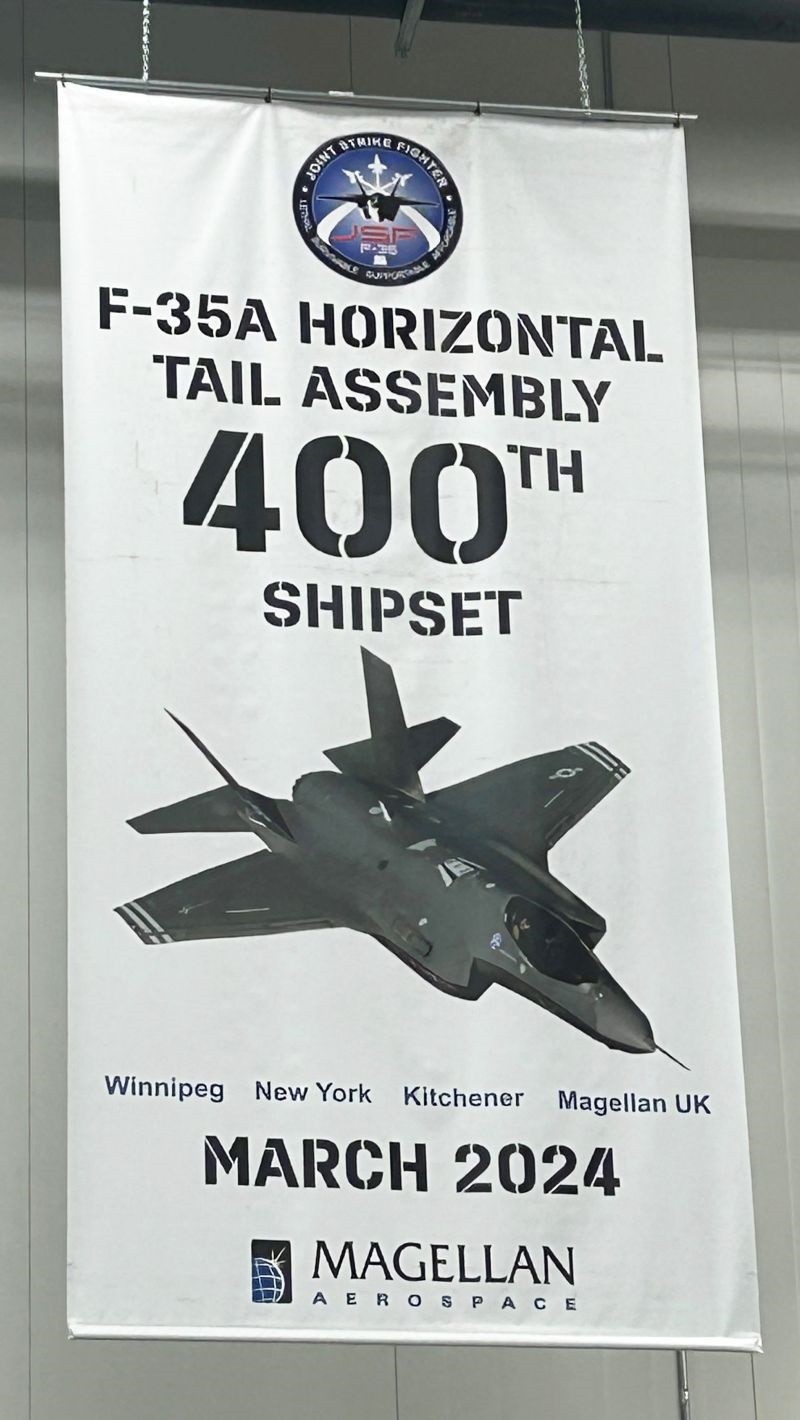
Magellan celebrates the manufacture of its 400th tail assembly for the F-35A fighter aircraft. Photo courtest Magellan Aerospace Limited/LinkedIn.The plant also produces vane boxes and transition ducts, critical components of the propulsion system for the F-35B, which is the “short take-off and vertical landing aircraft” (STOVL) variant. Magellan started working on F-35B parts in 2003, with its Winnipeg plant responsible for fabrication and assembly operations. By 2013, the company reported that it had manufactured these parts “for all of the F-35B Short Take Off and Landing variants flying today.” Many other smaller parts for F-35s have also been made in the Winnipeg factory.

Magellan’s F-35 production operations in Winnipeg have received massive support from all levels of government. In 2008, the federal government provided a $43 million interest-free loan for Magellan to expand its Winnipeg plant for F-35 parts manufacturing, which was followed by a $20 million loan from the province. In 2010, the City of Winnipeg sold a large parcel of surplus land valued at $638,000 to Magellan for $1, allowing for the construction of the 138,000 square foot Advanced Composite Manufacturing Centre, which was opened in late 2011. Then, in 2018, the federal government gave $5 million to Magellan for its Winnipeg plant.

Magellan has also received various indirect supports through state funding of research and technology development. The federal and provincial government has contributed millions of dollars to the Composites Innovation Centre, a non-profit set up to advance product development in composites that Magellan often collaborates with. In 2011, the federal government allocated $4.4 million to Red River College to establish the Centre for Non-Destructive Inspection Technologies (CNDI) at the Magellan campus, which the company heralded as “integral in meeting the demanding production schedule and quality requirements for the manufacture of the composite components that comprise the next-generation F-35 aircraft.”

Conservative politicians in particular have supported Magellan’s Winnipeg operations. The huge $43 million loan to the company was announced by the Conservative government only days before the election call in 2008, with MP Vic Toews stating “Prime Minister Harper and the government are working hard to maximize business opportunities available to Canadian companies under the JSF program.” Harper also visited the plant in 2010 for the formal groundbreaking of the Advanced Composite Manufacturing Centre, where the prime minister reportedly “lavished praise on the skills of the [Magellan subsidiary] Bristol Aerospace workforce for its success in building state-of-the-art parts for the new fighter jet.”

It was later reported that during this period, Conservative minister Rona Ambrose had vacationed on a yacht owned by Edwards, the billionaire owner of Magellan. The Globe and Mail reported that “archived public records show Magellan, or one of its divisions, won federal contracts or benefited from funding worth almost $100-million between 2008 and 2015, when Ms. Ambrose held a series of cabinet roles, including public works.” In 2016, Manitoba Premier Brian Pallister conducted a press conference alongside several major aerospace executives—including from Magellan—to call for greater federal support for the industry and more consideration of purchasing the F-35, “the construction of which has received considerable local investment.”

Notably, Magellan’s Winnipeg-based F-35 program director served as chair of the Canadian JSF Industrial Group, which played a major role in lobbying for Canada to buy F-35s over other fighter jets. Magellan has also claimed that the jobs of the 150 workers who manufacture F-35 parts at the Winnipeg plant were in jeopardy if Canada did not proceed with the acquisition, a threat that was curiously rebuffed by a Pentagon official who said it would not make a difference given existing contracts.

In total, F-35 parts production makes up about one-quarter of jobs at the Winnipeg plant—150 of about 600 jobs—with defence contracting accounting for one-third of Magellan’s total revenue. Magellan also appears a miserly employer, with a multi-month strike taking place in 2011, the sixth and longest in the 35 years prior, over the company’s attempt to cut retirement benefits and remove cost-of-living increases.

Canadian Dimension
 November 15, 2024 

James Wilt is a Winnipeg-based PhD candidate and freelance writer. His latest book is Dogged and Destructive: Essays on the Winnipeg Police.

Saturday, September 14, 2024


37 British MPs urge govt. to stop licensing for Israeli F-35

37 British MPs urge govt. to stop licensing for Israeli F-35

TEHRAN, Sep. 14 (MNA) – More than three dozen British parliamentarians have called on the government to account for its failure to suspend export licenses for F-35 parts that can end up being used in Israel’s nearly year-old war on Gaza.

In a letter on Friday, a group of 37 MPs wrote to the UK foreign secretary, defense secretary and business secretary to express their concerns about the continued licensing of F-35 fighter jet parts after the British government announced the suspension of only 30 licenses for the export of arms to Israel, PressTV reported.

The lawmakers said the partial ban on arms sales “does not go far enough,” and that the sales risk “continued UK complicity in Israel’s grave violations of international law in the illegally occupied West Bank and Gaza” as London has the autonomy to remove Tel Aviv from the list of approved recipients for the F-35 parts.

“The government has admitted it cannot license the direct transfer of F-35 components to Israel because of the clear risk of serious international humanitarian law violations,” they write.

“But it has not suspended licenses to export UK-made F-35 components to Israel as an end user via third-party countries including the United States. There are serious questions that we demand answers to about the legality and practical necessity of such an exemption.”

The group of MPs underlined in their letter that, “There appears to be no legal justification for the exemption,” and called for a “fuller and proper explanation to Parliament about how this exemption is practically necessary and most importantly – regardless of the practicalities – how it is consistent with the UK’s international obligations.”

Making the announcement about the partial ban last week, Foreign Secretary David Lammy claimed at the parliament that suspending the components “would undermine the global F-35 supply chain that is vital for the security of the UK, our allies and NATO.”

The exemption of the UK-made F-35 parts, which make up 15 percent of every fighter jet, raised major concerns among arms campaigners and human rights groups, including one that described it as “a workhorse of Israel’s brutal bombing campaign.”

Last week, Danish news outlet Information revealed that the Israeli military used an F-35 stealth fighter in a July 13 attack on a designated safe zone in Gaza which killed at least 90 people.

The United States and United Kingdom as well as their European allies have provided the Israeli regime with unstinting support in the fields of finance, intelligence and logistics since the occupying entity launched its merciless war in Gaza in October last year.

Israel’s bloody war machine has killed more than 41,000 Palestinians and wounded upwards of 95,000 others since October 7, 2023. The vast majority of the fatalities are women and children.

The savage campaign was launched after Gaza-based resistance groups carried out the historic Operation Al-Aqsa Storm against the usurping entity in retaliation for the regime’s intensified atrocities.

SD/

News ID 221217
37 MPs demand explanation on failure to prevent F-35 fighter jet parts reaching Israel

13 September, 2024
Left Foot Forward

They said the government's position risks 'continued UK complicity in Israel's grave violations of international law in the illegally occupied West Bank and Gaza'


A group of 37 MPs have written to the foreign secretary, defence secretary and business secretary expressing concern about the continued licensing of F-35 fighter jet parts to Israel. Their letter follows the government’s decision to suspend a small proportion of arms licenses to Israel.

In their letter, the MPs say that the partial ban on arms sales “does not go far enough” and that this risks “continued UK complicity in Israel’s grave violations of international law in the illegally occupied West Bank and Gaza”.

The continued licensing of parts for F-35 fighter jets has been one of the most contentious aspects of the government’s decision on arms exports to Israel. F-35 jets are currently operating in Gaza, with one having been confirmed to have carried out an attack which killed 90 people and injured at least 300.

In their letter, the group of MPs said that “there appears to be no legal justification for the exemption”, and has called for a “fuller and proper explanation to Parliament about how this exemption is practically necessary and most importantly – regardless of the practicalities – how it is consistent with the UK’s international obligations.”

British made F-35 components may still reach Israel as a result of a loophole in the government’s suspension of licenses. The government has restricted the licensing of exports of the components that are sent directly to Israel. However, it has exempted those which are first sent to other countries – such as the USA – before finally reaching Israel as the end-user.

The F-35 jet is described by its manufacture Lockheed-Martin as “the most lethal, survivable and connected fighter jet in the world”.

The government is coming under increasing pressure over its decision to only suspend some arms exports licences with Israel. Earlier this week, the TUC voted at its annual Congress to call on the government for a complete ban on arms sales.

The full list of MPs to sign the letter are as follows:

  • Zarah Sultana (Independent)
  • Diane Abbott (Labour)
  • Shockat Adam (Independent)
  • Apsana Begum (Independent)
  • Sian Berry (Green)
  • Kirsty Blackman (SNP)
  • Richard Burgon (Independent)
  • Ian Byrne (Independent)
  • Ellie Chowns (Green)
  • Jeremy Corbyn (Independent)
  • Ann Davies (Plaid Cymru)
  • Carla Denyer (Green)
  • Mary Kelly Foy (Labour)
  • Claire Hannah (SDLP)
  • Adnan Hussain (Independent)
  • Imran Hussain (Independent)
  • Kim Johnson (Labour)
  • Ayoub Khan (Independent)
  • Ben Lake (Labour)
  • Peter Lamb (Labour)
  • Chris Law (SNP)
  • Ian Lavery (Labour)
  • Graham Leadbitter (SNP)
  • Clive Lewis (Labour)
  • Seamus Logan (SNP)
  • Llinos Medi (Plaid Cymru)
  • Andy McDonald (Labour)
  • John McDonnell (Independent)
  • Abitsam Mohamed (Labour)
  • Iqbal Mohamed (Independent)
  • Grahame Morris (Labour)
  • Brendan O’Hara (SNP)
  • Adrian Ramsay (Green)
  • Bell Ribeiro-Addy (Labour)
  • Liz Saville-Roberts (Plaid Cymru)
  • Nadia Whittome (Labour)
  • Steve Witherden (Labour)

Chris Jarvis is head of strategy and development at Left Foot Forward

Image credit: Diliff – Creative Commons


Wednesday, January 03, 2024

Former VP claims Turkey opted out of F-35 purchase due to multiple malfunctions
WHY THEY WANT THE F-16

December 29, 2023

Levent Kenez/Stockholm

In a statement made during a parliamentary Foreign Relations Committee meeting on Tuesday, Chairman Fuat Oktay, the former Turkish vice president, claimed that Turkey had decided on its own against the acquisition of F-35 fighter jets.

Oktay said both the Ministry of Defense and the chief of general staff had expressed their disinclination to acquire the F-35s long before. He highlighted the stance of the Turkish Armed Forces (TAF) and the government, advocating for the purchase of the F-16 Block 60, 4.5 generation of the aircraft, deeming it a more suitable option.

In 2021 the US administration officially removed Turkey from the F-35 Joint Strike Fighter program due to Ankara’s purchase of the Russian S-400 missile system in 2017.

According to Oktay, the declining appeal of the F-35 was attributed to a series of accidents and technical deficiencies, leading to a loss of attraction for the aircraft. Oktay clarified that Turkey’s reversion to the F-16 was not due to an inability to procure the F-35s but rather to the lack of significant interest in the F-35.

Oktay further emphasized the positive outcome following the S-400 crisis with the US, indicating that it had impacted Turkey’s strategic decision-making, resulting in a favorable outcome regarding the F-35 aircraft.

President Recep Tayyip Erdogan had previously announced that Turkey paid $1.25 billion to participate in the F-35 program. Part of the supply chain for F-35 production, Turkey was expected to generate $9 billion in revenue. Additionally, the six F-35 aircraft produced for Turkey were not delivered by the United States. Turkey paid approximately $2.5 billion to Moscow for the first batch of S-400s. Experts estimate that Turkey has incurred a loss of $13 billion so far, considering the inactive status of the S-400 system.

Turkey seeks to redirect funds initially allocated for the F-35 program towards the purchase of new F-16 fighter jets. The US expects Turkey to quickly approve Sweden’s NATO membership to facilitate the F-16 sale, adding further complexity to the negotiations. It is as of yet uncertain whether the US Congress will approve the sale.

Russia sent two S-400 batteries and more than 120 long-range missiles as part of the agreement along with experts to train Turkish soldiers on how to operate them. The second batch has yet to be delivered.
The US has repeatedly warned Turkey that activating the S-400 missiles or buying a second batch would trigger heavier sanctions under the Countering America’s Adversaries through Sanctions Act (CAATSA). On December 14, 2020, the US imposed sanctions on Turkey’s Presidency of the Defense Industry (Savunma Sanayii BaÅŸkanlığı, SSB) and certain of its principal officers over the S-400 procurement.

On June 20, 2018 a ceremony took place at the Lockheed Martin facilities in Texas to mark the delivery of the first aircraft as part of the F-35 project, in which Turkey was a program partner. At the ceremony the then-head of the Undersecretariat for the Defense Industry (later renamed the Presidency of the Defense Industry, SSB), Serdar Demirel, representing the government, said participation in the F-35 project was an honor for Turkey. The aircraft was expected to be brought to Turkey in 2019 following the completion of pilot training
.
Serdar Demirel

Oktay left unanswered the question as to why the option of international arbitration wasn’t considered for the delivery of F-35s produced and paid for by Turkey, as raised by opposition lawmakers in the committee meeting. He said Turkey’s domestically produced KAAN aircraft would be more advanced than the F-35.

Initially unveiled to the public during Erdogan’s re-election campaign in May, KAAN underwent a taxiing test on the runway, marking its introduction. However, the opposition criticized this display, labeling it a political maneuver to solicit support during the election. They contended that showcasing a non-flying aircraft was unnecessary and alleged that the KAAN project was not progressing as quickly as portrayed by the government. Financial challenges were also raised as concerns by the opposition.

Snapshot from the ceremony marking the delivery of the first F-35 to Turkey in 2018.

TAI KAAN, also referred to as the TF (Turkish Fighter) — Milli Muharip Uçak [National Combat Aircraft] in Turkish, or MMU — is an advanced, twin-engine, stealth, all-weather air superiority fighter currently in development by Turkish Aerospace Industries (TAI). British BAE Systems operates as a subcontractor for this ambitious project. Its main objectives include replacing the aging F-16 aircraft in service with the Turkish Air Force and potentially being available for export to other nations.

The initial delivery of the KAAN to the Turkish Air Force is slated for 2028, while the quest for a suitable engine is ongoing. Presently, the prototypes are equipped with American-made F110 engines, planned for the initial production of the first 20-25 units of KAAN.

At present, two companies have shown interest in producing a specialized engine for KAAN. British company Rolls-Royce has collaborated with Turkey’s Kale Group to enter the competition. Simultaneously, Ukrainian company Ivchenko Progress has also submitted a proposal for the aircraft engine.

In a media statement in May, TAI President Temel Kotil outlined plans to deliver 20 units of KAAN Block-10 aircraft to the Turkish Air Force by the year 2028.
Minutes of the committee meting on December 26, 2023.

The first test flight of KAAN was scheduled for December 27, but due to the preparations and several tests not being completed on time, this flight has been postponed to a later date. Experts predict that there will also be delays in the delivery of the aircraft to the Turkish Air Force.

Meanwhile, Oktay has been alleged to have received $50 million in bribes from a criminal organization to prevent the government from seizing its assets in the country. These allegations surfaced from recordings made public by prominent investigative journalist Cevheri Güven, who featured a former insider currently incarcerated for the group leader’s murder. Oktay denies the allegations and accused Güven of being a terrorist. The Turkish government commonly accuses critical journalists of being terrorists and the puppets of foreign countries.