How Netanyahu’s political survival depends on the genocide in Gaza

Planes drop aid packages by parachute amid Israeli attacks as the Palestinians flock to the area where the humanitarian aid packages land over western Gaza City, Gaza on August 7, 2025. [Mahmoud Abu Hamda – Anadolu Agency]
by Peter Rodgers
August 11, 2025

On 26 July, the Israeli daily Haaretz ran the headline: “Israel at War: Day 659. Gaza medical sources: At least 25 people killed by Israeli fire, some while waiting for aid.” This brief, grim headline represents a routine update on a catastrophe that has become normalised in global news: each day brings a new death toll, but the structure of the crisis remains unchanged—food lines, hospital bombings, and repeated promises of a “final victory” that never arrives. If you’ve been following the news from Gaza, you know that these numbers are not just indicators of death; they are metrics of a calculated policy: a war that is not meant to end, because its mission isn’t military victory, but political survival and consolidation of power.
Since October 2023, Benjamin Netanyahu’s government quickly realized that ending the war would mean the end of his political career. Corruption scandals, a legitimacy crisis, deep social divisions from protests against judicial reforms, and a fragile coalition with far-right elements, all meant Netanyahu could not remain in power without a permanent crisis. The Gaza war gave him just that. Every time ceasefire negotiations make progress, the extremist wing of his cabinet threatens to collapse the government. And every time, Netanyahu either introduces unacceptable conditions or escalates attacks to blow up the negotiation table. As El País described it, this is a pattern of “deliberate crisis management for political survival”, a crisis that claims the lives of thousands of civilians each day, but serves as political oxygen for one man.
This pattern is not new for Israel. Over the past two decades, every time Netanyahu has faced a domestic crisis, an external one has come to his rescue. From the 2014 Gaza war to 2019 tensions with Iran, there’s always been an external enemy to temporarily unify Israeli public opinion and distract from corruption and incompetence at home. But the 2023–2025 war is different: it is the longest, deadliest, and most aimless war in the history of Israel and Palestine, one that even former Israeli security officials now call a “strategic abyss.” Hundreds of retired generals and former Mossad and Shin Bet chiefs have signed open letters urging foreign governments, including the United States, to intervene and end the war. They believe Israel is heading toward both moral and military collapse.
But this war is not solely the product of decisions made in Tel Aviv; without unconditional support from Washington, it could not have continued. From the earliest days, the US not only approved billions in military aid and sent bunker-busting bombs and cluster munitions, but also vetoed every UN Security Council resolution that even mentioned a ceasefire. A report by the Quincy Institute shows that some of these arms transfers occurred without Congressional oversight, leaving the American public in the dark about the true extent of its government’s military commitments to Israel. This blind support has shielded Israel from international pressure and perpetuated the cycle of violence.
This scenario is not unfamiliar to Americans. From Vietnam to Iraq and Afghanistan, the U.S. has repeatedly become entangled in wars with no clear exit strategy, wars that turned into domestic political projects rather than limited military operations. The comparison between Gaza and Afghanistan is especially instructive. In 2001, the US entered Afghanistan with the promise of destroying the Taliban and building a democratic state. Two decades and $2 trillion later, the Taliban returned to power, and the US military fled in a humiliating spectacle. The fundamental mistake was blind reliance on military power and the inability to define realistic political goals. Israel today is on the same path. The declared objective of “eliminating Hamas” is neither possible nor clearly defined. Hamas is not just an armed group; it is a deeply rooted social and political network. Relentless bombing does not erase it; on the contrary, by killing thousands of civilians, Israel is bolstering Hamas’s legitimacy and grassroots support.
The human toll of this policy is devastating. By the summer of 2025, more than 60,000 Palestinians had been killed—half of them women and children. Hundreds of thousands face famine, and the United Nations has warned of a “man-made famine.” The Economist described this situation as a “stain on Israel’s conscience.” But this stain is not only moral, it is strategic. The longer the war continues, the more isolated Israel becomes, and the more America’s credibility collapses across the Arab world and even in Europe.
Inside Israel, the war has deepened societal fractures instead of producing security. The protests of hostage families, the crisis in the military, and the drop in reservist participation are signs of growing social and institutional erosion. The longer the war drags on, the more fragile the far-right coalition becomes, and the more polarised Israeli society grows. Even in the US, support for Israel is increasingly contested. Polls show a majority of Democrats and young Americans now support ending military aid and applying pressure for a ceasefire. Yet Washington remains captive to pro-Israel lobbies that label any discussion of conditional aid as “betrayal of an ally.” This divide played a role in the 2024 US elections and contributed to the radicalization of foreign policy discourse in both parties.
Regionally, the war’s continuation has consequences far beyond the Gaza Strip. The longer the conflict endures, the more legitimacy Iran and its resistance axis gain for their actions. Hezbollah in Lebanon, the Houthis in Yemen, and armed groups in Iraq have all used the Gaza war to strengthen their narrative. At the same time, Russia and China are exploiting the erosion of U.S. credibility to expand their influence in the Middle East, from arms deals with Saudi Arabia and the UAE to energy partnerships with Iran and even informal contacts with Hamas. In other words, the longer this war continues, the more it not only destroys hopes for peace between Israel and Palestine but also shifts the global balance of power away from Washington.
Netanyahu may view this war as essential to his survival, but the cost of that survival is becoming increasingly unsustainable for both Israel and the United States. Israel grows more isolated and vulnerable each day; the US is increasingly seen as complicit in war crimes; and Palestinians are being driven deeper into despair and radicalisation. This is the very formula that turned America’s endless wars in Afghanistan and Iraq into disasters: an enemy that multiplies with every bombing, an ever-receding horizon of victory, and a legacy of destruction that will last generations.
If Washington wants to break this cycle, it must change its policy: end unconditional military aid, apply real pressure for a ceasefire, and initiate a political process centered on Palestinian rights. Without such a shift, Haaretz headlines will keep counting: “Israel at War, Day 700… Day 800…” and the deadly queues for food aid will continue to tell the same truth—that this war continues not for security, but for politics. And as the Afghanistan experience showed, no war designed for domestic politics ever ends with honor.
The views expressed in this article belong to the author and do not necessarily reflect the editorial policy of Middle East Monitor.
Speak Out Now Against Netanyahu's Final Solution for Gaza
It is morally and ethically irresponsible for mainstream Jewish and Christian groups not to condemn Netanyahu's continuation of the war as genocide.
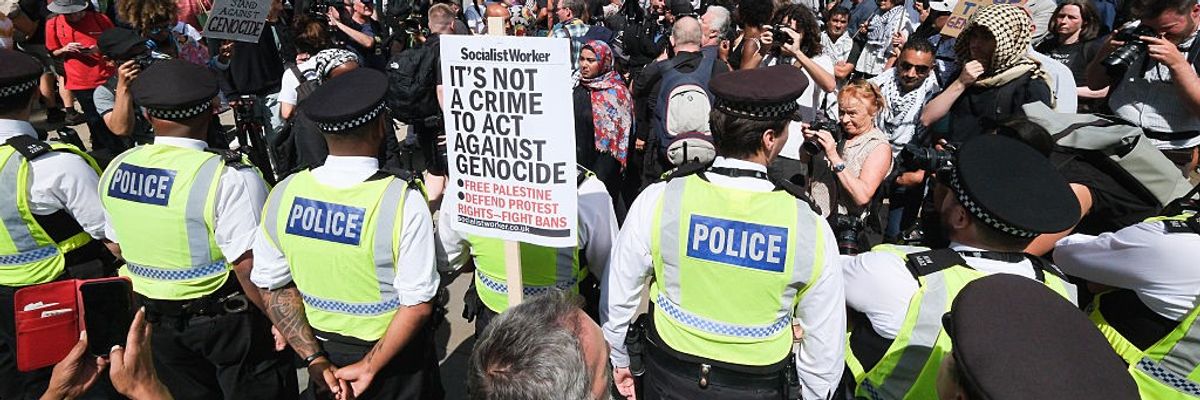
Supporters of the proscribe group Palestine Action protest in Parliament Square, with many arrests.
(Photo: Matthew Chattle/Future Publishing via Getty Images)
Steve Minkin
Aug 12, 2025
Aug 12, 2025
Common Dreams
The world is asking why major Jewish organizations, and congregations around the country, aren't speaking out about genocide. It can't be hidden. The failure to condemn Israel's crimes against humanity is a glaring breakdown of moral responsibility, casting a dark shadow and is a growing source of antisemitism.
I have overheard neighbors, who are not political, talking about what Israel is doing in Gaza. An acquaintance during a conversation suddenly asked, "Are you Jewish?" A Christian friend asked me, "Why aren't the Rabbis speaking out?"
The world is asking why major Jewish organizations, and congregations around the country, aren't speaking out about genocide. It can't be hidden. The failure to condemn Israel's crimes against humanity is a glaring breakdown of moral responsibility, casting a dark shadow and is a growing source of antisemitism.
I have overheard neighbors, who are not political, talking about what Israel is doing in Gaza. An acquaintance during a conversation suddenly asked, "Are you Jewish?" A Christian friend asked me, "Why aren't the Rabbis speaking out?"
Gaza has more children missing limbs per capita than any other place in the world.
Contemplate this fact as children are preciously guided through Jewish education culminating in the Bat Mitzvah for girls and Bar Mitzvah for boys. As new adults they will grow up with a history different from their parents, grandparents, and great grandparents. Rather than being survivors of the Holocaust, they will inherent a legacy of Jewish people committing mass murder, starving millions, and violently carrying out ethnic cleansing. Growing up, secular or religious, they are living at a time when Israeli politicians, religious fanatics, and a majority of ordinary citizens have supported the commission of genocide as exigent to the survival of the Jewish State.
Omer Bartov, an Israeli professor of Holocaust and genocide studies at Brown University, wrote in The New York Times:
My inescapable conclusion has become that Israel is committing genocide against the Palestinian people. Having grown up in a Zionist home, lived the first half of my life in Israel, served in the IDF as a soldier and officer, and spent most of my career researching and writing on war crimes and the Holocaust, this was a painful conclusion to reach, and one that I resisted as long as I could. But I have been teaching classes on genocide for a quarter of a century. I can recognize one when I see one.
In the future, who among today's Jewish children will be able to say my parents protested, my rabbi spoke out, they supported resolutions to end America's backing of genocide at this crucial moment when Israeli Prime Minister Benjamin Netanyahu's murderous regime is planning a final solution for Gaza.
Reports by leading Israeli human rights organizations B'Tselem and Physicians for Human Rights Israel concluded that their country is committing genocide.
B'Tselem produced a detailed study titled, "Our Genocide":
An examination of Israel's policy in the Gaza Strip and its horrific outcomes, together with statements by senior Israeli politicians and military commanders about the goals of the attack, leads to the unequivocal conclusion that Israel is taking coordinated action to intentionally destroy Palestinian society in the Gaza Strip. In other words: Israel is committing genocide against Palestinians in the Gaza Strip.
Whitewashed words and bleached language cannot erase the genocide being committed by Israel and underwritten by the United States. Nor can it hide behind a smokescreen of deflections such as "Israel has the right to defend itself" or "Hamas started the war."
It is morally and ethically irresponsible for mainstream Jewish and Christian groups not to condemn Netanyahu's continuation of the war as genocide. A group of some 600 retired Israeli security officials, including former heads of intelligence agencies, have written to U.S. President Donald Trump asking him to force Israel to immediately end the war in Gaza.
"It is our professional judgement that Hamas no longer poses a strategic threat to Israel," the officials said.
Yet the bombing and starvation continue. And the record numbers of child amputees in Gaza will continue to climb. Making matters worse Netanyahu has announced plans for a new full-scale invasion of Gaza designed to inflict even more pain and suffering for no logical reasons other than the acceleration of ethnic cleansing and furthering the genocide.
No matter how many lies are told, genocide cannot be koshered in the name of support for Israel. Synagogues and their national organizations must loudly condemn crimes against humanity and demand the United States halt arms shipments to Israel.
Even Eyal Zamir the current Israel Defense Forces chief of staff thinks the plan to continue and expand the war is disastrous. But he is powerless as long as Trump supports Netanyahu and Congress continues to approve the sale of 1,000-pound bombs and other weapons used in the commission of war crimes.
In order to reset the record, major Jewish and other religious organizations should take out full-page ads in newspapers around the country calling for an immediate cease-fire to enable the United Nations and others to bring in unlimited food, water, medical supplies, and other essentials. In return, the surviving hostages and thousands of Palestinians unlawfully held in Israeli prisons must be released without delay.
Nations Must Act Directly to Stop Israel's Genocide in Gaza
The nightmare in Gaza has been unfolding for 22 months and during this entire time Israel’s savage use of violence and its punishment of innocent Palestinians has been unrelenting. Rhetoric and condemnation are not enough.
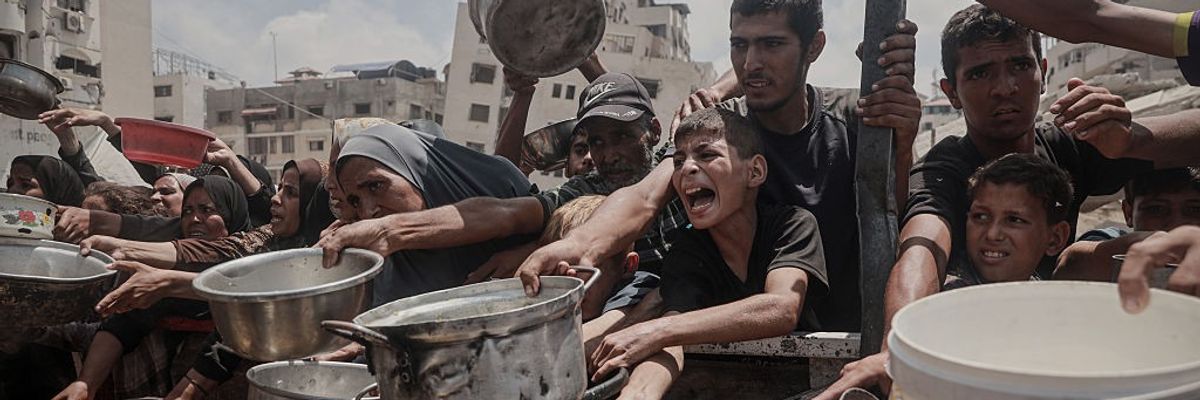
Palestinians, facing food shortages due to Israel's blockade and ongoing attacks on the Gaza Strip, gather with pots and pans as a charity distributes meals in western Gaza City, Gaza on August 08, 2025.
James Zogby
Aug 11, 2025
The nightmare in Gaza has been unfolding for 22 months and during this entire time Israel’s savage use of violence and its punishment of innocent Palestinians has been unrelenting. Rhetoric and condemnation are not enough.
Palestinians, facing food shortages due to Israel's blockade and ongoing attacks on the Gaza Strip, gather with pots and pans as a charity distributes meals in western Gaza City, Gaza on August 08, 2025.
(Photo by Abdalhkem Abu Riash/Anadolu via Getty Images)
James Zogby
Aug 11, 2025
Common Dreams
We’ve reached a sort of tipping point in the way political leaders in the West are reacting to Israel’s genocidal assault on Palestinians in Gaza. It’s maddening for two reasons: that it took this long to get an official response from Western capitals; and that, once the magnitude of the tragedy became clear, the responses have been so decidedly ineffectual.
The nightmare in Gaza has been unfolding for 22 months and during this entire time Israel’s savage use of violence and its punishment of innocent Palestinians has been unrelenting. Early on, Israel’s genocidal intent became clear as they demolished hospitals, universities, and entire neighborhoods using 2000-pound bombs; forced hundreds of thousands to flee their neighborhoods and homes; and ordered electricity and water cut off and blocked the entry of food and medical supplies.
At this point, what is required to end the genocide, save lives, and restore respect for international law and some level of sanity to the region, is for Western nations to take concrete steps to punish Israel, demanding changes in policy.
All this was known in 2023, and yet no action was taken. Back then, when we called for a ceasefire, the US Secretary of State told me that a ceasefire would be deplorable and the US would not support such a move. In mid-2024, when the United Nations Security Council twice voted on a ceasefire resolution, only the US opposed. A third attempt at a ceasefire resolution introduced by the US passed, but it was never acted upon, because despite President Biden disingenuously saying Israel had agreed to this resolution, he knew they had not. The entire effort was nothing more than a public relations stunt.
The bottom line is that the world has long known that this war on Gaza’s people had to end and yet other than voting on dead-end UN resolutions, they did nothing. Worse still, they continued to do business with and sell weapons to Israel. So what has changed now?
The pictures of devastation and eyewitness testimonies, a staple for those who have been following the news on social media, are now featured in mainstream media. As a result, it has become more difficult for the manufacturers of Israeli hasbara to convince the public that the devastation is exaggerated and the stories of human suffering are fabricated. In most European countries, the percentage of those who support Israel’s actions in Gaza has fallen to less than one-third. Despite the effort of Israeli propagandists, the reason behind this sharp decline in support for Israel isn’t the large number of Muslim immigrants in Western Europe, nor is it antisemitism. What has changed is that European and American publics now know and are horrified by what Israel is doing in Gaza. They are rejecting the lame excuses offered by their leaders, who had hoped they wouldn’t need to respond with anything more than an occasional UN vote of disapproval, expressions of concern, or toothless condemnations of isolated Israeli acts.
As the pressure has grown—with pictures of starving Palestinian children and aerial photos of mass devastation now dominating media coverage of the war on Gaza—Western leaders are struggling to find ways to react. Most disturbing is that their motivation appears to be more a need to be seen as acting than finding ways to actually effectuate change.
For example, the British threat to recognize a Palestinian state unless Israel agrees to a ceasefire is, at best, a hollow gesture. The German threat to review cultural and trade ties amounts to the same. And the continuing lame calls for “renewed negotiations leading to a two-state solution” (when it is well known that Israel has no interest in nor feels any pressure to submit to such an outcome). These gestures are more performative than effective. Even if the entire United Nations (except, of course, the US) were to recognize a Palestinian State, little would change on the ground, except possibly enraging the Israelis to take more drastic measures in Gaza, the West Bank, and East Jerusalem.
At this point, what is required to end the genocide, save lives, and restore respect for international law and some level of sanity to the region, is for Western nations to take concrete steps to punish Israel, demanding changes in policy. These must include an end to the assault on Gaza, a ceasefire and withdrawal of Israel forces, and allowing the entry of international peacekeepers and aid, and the start of reconstruction efforts.
While the above steps are in line with the Arab peace plan, a group of 30 nations meeting in Colombia have gone a step further by endorsing a comprehensive package of proposals designed to end the “the era of impunity…and enforce international law,” with 13 of the participants agreeing to measures that would prohibit the transfer of arms and other forms of support to Israel that enable Israel’s assault on Gaza and violations of law in the West Bank. Calling themselves The Hague Group, they pledge concrete actions “to ensure justice for victims of crimes committed in the Occupied Palestinian Territory.”
They will bring their compact to the UN in September urging other nations to join them. Instead of hollow declarations of recognition or calls for renewed negotiations for a two-state solution, this is the reaction needed to end Israel’s crimes.
Our work is licensed under Creative Commons (CC BY-NC-ND 3.0). Feel free to republish and share widely.
James Zogby
Dr. James J. Zogby is the author of Arab Voices (2010) and the founder and president of the Arab American Institute (AAI), a Washington, D.C.-based organization which serves as the political and policy research arm of the Arab American community. Since 1985, Dr. Zogby and AAI have led Arab American efforts to secure political empowerment in the U.S. Through voter registration, education and mobilization, AAI has moved Arab Americans into the political mainstream. Dr. Zogby has also been personally active in U.S. politics for many years; in 1984 and 1988 he served as Deputy Campaign manager and Senior Advisor to the Jesse Jackson Presidential campaign. In 1988, he led the first ever debate on Palestinian statehood at that year's Democratic convention in Atlanta, GA. In 2000, 2008, and 2016 he served as an advisor to the Gore, Obama, and Sanders presidential campaigns.
Full Bio >
We’ve reached a sort of tipping point in the way political leaders in the West are reacting to Israel’s genocidal assault on Palestinians in Gaza. It’s maddening for two reasons: that it took this long to get an official response from Western capitals; and that, once the magnitude of the tragedy became clear, the responses have been so decidedly ineffectual.
The nightmare in Gaza has been unfolding for 22 months and during this entire time Israel’s savage use of violence and its punishment of innocent Palestinians has been unrelenting. Early on, Israel’s genocidal intent became clear as they demolished hospitals, universities, and entire neighborhoods using 2000-pound bombs; forced hundreds of thousands to flee their neighborhoods and homes; and ordered electricity and water cut off and blocked the entry of food and medical supplies.
At this point, what is required to end the genocide, save lives, and restore respect for international law and some level of sanity to the region, is for Western nations to take concrete steps to punish Israel, demanding changes in policy.
All this was known in 2023, and yet no action was taken. Back then, when we called for a ceasefire, the US Secretary of State told me that a ceasefire would be deplorable and the US would not support such a move. In mid-2024, when the United Nations Security Council twice voted on a ceasefire resolution, only the US opposed. A third attempt at a ceasefire resolution introduced by the US passed, but it was never acted upon, because despite President Biden disingenuously saying Israel had agreed to this resolution, he knew they had not. The entire effort was nothing more than a public relations stunt.
The bottom line is that the world has long known that this war on Gaza’s people had to end and yet other than voting on dead-end UN resolutions, they did nothing. Worse still, they continued to do business with and sell weapons to Israel. So what has changed now?
The pictures of devastation and eyewitness testimonies, a staple for those who have been following the news on social media, are now featured in mainstream media. As a result, it has become more difficult for the manufacturers of Israeli hasbara to convince the public that the devastation is exaggerated and the stories of human suffering are fabricated. In most European countries, the percentage of those who support Israel’s actions in Gaza has fallen to less than one-third. Despite the effort of Israeli propagandists, the reason behind this sharp decline in support for Israel isn’t the large number of Muslim immigrants in Western Europe, nor is it antisemitism. What has changed is that European and American publics now know and are horrified by what Israel is doing in Gaza. They are rejecting the lame excuses offered by their leaders, who had hoped they wouldn’t need to respond with anything more than an occasional UN vote of disapproval, expressions of concern, or toothless condemnations of isolated Israeli acts.
As the pressure has grown—with pictures of starving Palestinian children and aerial photos of mass devastation now dominating media coverage of the war on Gaza—Western leaders are struggling to find ways to react. Most disturbing is that their motivation appears to be more a need to be seen as acting than finding ways to actually effectuate change.
For example, the British threat to recognize a Palestinian state unless Israel agrees to a ceasefire is, at best, a hollow gesture. The German threat to review cultural and trade ties amounts to the same. And the continuing lame calls for “renewed negotiations leading to a two-state solution” (when it is well known that Israel has no interest in nor feels any pressure to submit to such an outcome). These gestures are more performative than effective. Even if the entire United Nations (except, of course, the US) were to recognize a Palestinian State, little would change on the ground, except possibly enraging the Israelis to take more drastic measures in Gaza, the West Bank, and East Jerusalem.
At this point, what is required to end the genocide, save lives, and restore respect for international law and some level of sanity to the region, is for Western nations to take concrete steps to punish Israel, demanding changes in policy. These must include an end to the assault on Gaza, a ceasefire and withdrawal of Israel forces, and allowing the entry of international peacekeepers and aid, and the start of reconstruction efforts.
While the above steps are in line with the Arab peace plan, a group of 30 nations meeting in Colombia have gone a step further by endorsing a comprehensive package of proposals designed to end the “the era of impunity…and enforce international law,” with 13 of the participants agreeing to measures that would prohibit the transfer of arms and other forms of support to Israel that enable Israel’s assault on Gaza and violations of law in the West Bank. Calling themselves The Hague Group, they pledge concrete actions “to ensure justice for victims of crimes committed in the Occupied Palestinian Territory.”
They will bring their compact to the UN in September urging other nations to join them. Instead of hollow declarations of recognition or calls for renewed negotiations for a two-state solution, this is the reaction needed to end Israel’s crimes.
Our work is licensed under Creative Commons (CC BY-NC-ND 3.0). Feel free to republish and share widely.
James Zogby
Dr. James J. Zogby is the author of Arab Voices (2010) and the founder and president of the Arab American Institute (AAI), a Washington, D.C.-based organization which serves as the political and policy research arm of the Arab American community. Since 1985, Dr. Zogby and AAI have led Arab American efforts to secure political empowerment in the U.S. Through voter registration, education and mobilization, AAI has moved Arab Americans into the political mainstream. Dr. Zogby has also been personally active in U.S. politics for many years; in 1984 and 1988 he served as Deputy Campaign manager and Senior Advisor to the Jesse Jackson Presidential campaign. In 1988, he led the first ever debate on Palestinian statehood at that year's Democratic convention in Atlanta, GA. In 2000, 2008, and 2016 he served as an advisor to the Gore, Obama, and Sanders presidential campaigns.
Full Bio >

No comments:
Post a Comment