
Britain’s colonial theft of Venezuela’s gold continues

JUNE 20, 2026
By Tim Young, Venezuela Solidarity Campaign
Did you know that the Bank of England is still withholding 31 tonnes of gold bars currently worth about $4.6 billion which Venezuela, through its Central Bank of Venezuela, had deposited there, despite repeated calls for the gold to be returned to the country?
Venezuelan governments of different shades politically had long stored gold reserves with the Bank of England before its battle to reclaim its deposit of 31 tonnes of gold from the Bank’s vaults began back in 2018. At the time, the first Trump administration was using all means at its disposal to cut Venezuela off from its overseas assets, assembling an astonishing number of sanctions – over 1,000 – against the country.
Since then, the Bank has consistently refused to transfer the gold back to Venezuela, claiming this would infringe the US government’s sanctions against Venezuela, which have impacted heavily on the poorest and most vulnerable Venezuelan citizens.
The Bank’s stance hardened after January 2019 when Juan Guaidó, the then-President of the National Assembly, declared himself “interim president” of the country in an attempt to grab power. The United States, followed by a number of other countries, rushed to offer support.
On the basis of that recognition and a further supporting statement from the Foreign Office, a UK Supreme Court judgement accepted that Guaidó was the head of the Venezuelan state and therefore legally entitled to appoint the board of the Central Bank of Venezuela (BCV).
Venezuela’s state meanwhile argued in the courts in response that it was the only “validly appointed authority” to oversee the BCV’s foreign assets.
This particular pretence for not returning Venezuela’s gold is now impossible to maintain. Guaidó is not an important part of the Venezuelan or international political scene, and hasn’t been for some time. To give one example, following 2020’s elections to the Venezuelan National Assembly, the EU’s 27 states said in January 2021 that they could no longer legally recognise him after he lost his position as president of the outgoing assembly.
Furthermore, the British government acknowledged in January 2023 that it no longer recognised Guaidó.
Of additional significance more recently is that the International Monetary Fund (IMF) announced in April 2026 that formal relations with Venezuela had been re-established. This move reverses the decision the IMF took in 2019 when it followed US orders by stripping the country of its Special Drawing Rights, a system created by the IMF to “provide liquidity to global economies and offer additional reserves to member countries in times of crisis.” In doing so, at the onset of the COVID-19 pandemic, the IMF stopped Venezuela from accessing $5 billion to which it was entitled, amidst the severe hardship caused by the virus. Venezuela is currently seeking for these assets to be sent to the country.
The IMF – of which Britain is a voting member – taking this course is yet another reason why the British government should enable the gold being quickly returned to Venezuela, and gives a clear precedent that could be followed.
However, even if the gold is returned to Venezuela, illegal US sanctions on the country are still in place, restricting its economic activity and impacting severely on its people. At the time of writing, over 1,000 of these damaging sanctions are in place – and are widely opposed across the political spectrum in Venezuela itself, including by both pro- and anti-government forces.
Pressure must be maintained to demand that the gold is returned to Venezuela and that all the US’s illegal sanctions – supported by Britain – are lifted.
- EVENT: The 25 Year US War on Venezuela – end all sanctions, give back the gold! Marx Memorial Library London, Thursday, June 25th, 6:30 pm, London EC1R 0DU. With Venezuelan speakers, Francisco Dominguez (Venezuela Solidarity Campaign) and Kate Hudson (CND.) Register here.
- PETITION: Keir Starmer – give Venezuela Back It’s Gold! Sign here.
Image: https://www.worldhistory.org/article/2778/the-brinks-mat-robbery/ Creator: Andrzej Barabasz | Credit: Andrzej Barabasz / World History Encyclopedia Copyright: Andrzej Barabasz Licence: Attribution-ShareAlike 4.0 International CC BY-SA 4.0 Deed
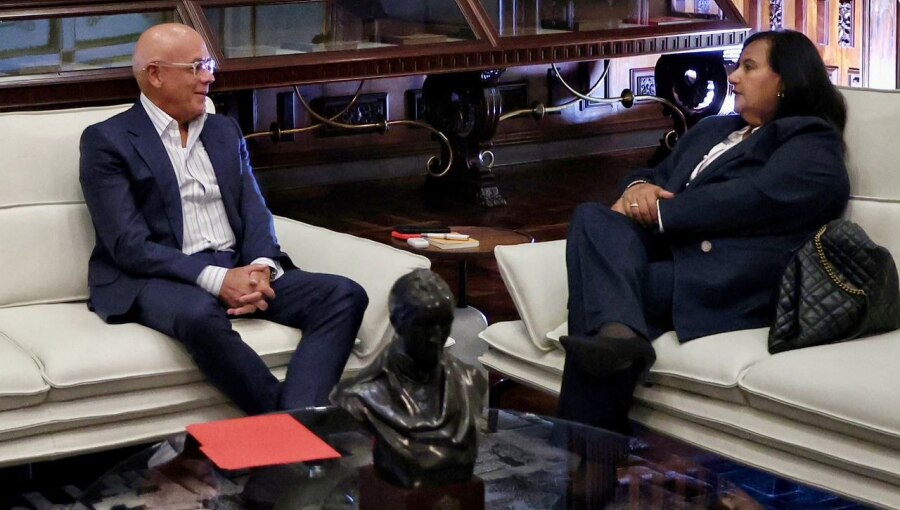
Venezuela's interim government held its first formal talks on June 18 with Dinorah Figuera, a former opposition lawmaker who returned from eight years of exile at the invitation of the US State Department, in a move backed by Washington aimed at charting a path towards a democratic transition.
Jorge Rodríguez, president of Venezuela's National Assembly, met Figuera at the Federal Legislative Palace in Caracas, in his capacity as a delegate for political dialogue on behalf of his sister Delcy Rodríguez, who has served as interim president since Nicolás Maduro's capture in a US military intervention roughly six months ago. The National Assembly described Figuera in a statement as a representative of opposition deputies elected for the 2015-2020 term.
The State Department endorsed the meeting, saying in a statement that it provided an opportunity to "discuss an agenda that will serve as the roadmap for a political dialogue on a democratic transition.” The agenda would cover "key priorities" including the rebuilding of democratic institutions, the strengthening of the electoral authority, and guarantees for political participation, the department added. The US embassy in Caracas separately confirmed its backing for the talks in a social media post.
Figuera, a 65-year-old doctor who once led the 2015-elected parliament, told reporters on her arrival in Caracas that she was acting at Washington's request. "At this moment I am accepting an invitation from the State Department to take on all these challenges . . . in terms of having a credible National Electoral Council," she said, as quoted by AFP.
According to Figuera, the process originated at a meeting convened at the State Department by Michael Kozak, the US assistant secretary of state for western hemisphere affairs, who sought to establish what she described as an institutional channel between the 2015 National Assembly — which retains formal control over Venezuelan state assets abroad, including the Citgo refining group and gold reserves held in the UK — and the current parliament. The National Assembly said the two sides had agreed to form a "joint technical and political working group."
Figuera said the negotiations carried a target date of December 2026 for delivering legislative reforms, with technical teams to review electoral law, audit the vote-counting system and secure international observation missions. She added that the agenda also encompassed the reinstatement of political parties' legal registration under their legitimate leaderships, press freedom guarantees, a review of Supreme Court appointments, and the return of exiled Venezuelans along with restitution of expropriated property.
Marco Rubio, the US Secretary of State, told a House of Representatives hearing earlier this month that Venezuela required "a new electoral committee" in order to "hold elections with guarantees."
The talks notably exclude María Corina Machado, the firebrand opposition leader and Nobel Peace Prize laureate, whose Unitary Platform coalition has said she alone should negotiate with the Rodríguez government on the opposition's behalf. Figuera said she sought no presidential ambitions of her own and described Machado as "the leader elected in the primary elections by the opposition," arguing that a credible electoral authority was needed to guarantee a future Machado candidacy or that of any other contender.
Elias Ferrer, director of the Caracas-based advisory firm Orinoco Research, said Washington's strategy marked a shift from its previous approach to the country. "There is a focus on 'rules of the game' rather than on the players," he wrote on X, adding that the emphasis on reforming institutions ahead of any vote represented "a radical turning point from how the US used to approach Venezuela." Ferrer said he did not expect a presidential election before late 2027 or 2028 at the earliest, though other votes — such as a constitutional referendum or local council elections — could come sooner. He added that the White House appeared to be prioritising economic reform and opportunities for US companies over a rapid push to the ballot box, which could trigger destabilisation and hinder the country's economic revival.
The opposition coalition led by Machado has long maintained that her candidate, exiled seasoned diplomat Edmundo González Urrutia, won the 2024 presidential election, in which Maduro claimed victory amid widespread allegations of fraud. Machado has repeatedly called on Washington to support a negotiated "restoration of democracy." However, after Maduro's ouster the Trump administration sidelined her and opted to work with Rodríguez, who has presided over a reform drive aimed at opening the oil and mining industry to US investors, alongside only a limited opening on civic freedoms. President Donald Trump has since heaped praise on Rodriguez, calling her a “terrific person” who is “doing a great job.”
Figuera went into exile in Spain in 2018 after what she described as threats and harassment over her role as spokesperson in the case of Fernando Albán, a fellow Primero Justicia party member who died in prison that year. In 2023 she took on the presidency, from abroad, of a parliamentary commission made up of legislators elected in 2016 who had been bypassed by Maduro and whose legitimacy the US had continued to uphold until Trump’s recognition of Rodriguez as legitimate leader in March.
Separately, the US Treasury's Office of Foreign Assets Control this week issued three licences easing sanctions, permitting certain transactions involving Venezuelan state oil bonds, the supply of goods and services to state airline Conviasa, and postal and courier exchanges with Venezuela.
An inverse transition: Delcy Rodríguez as Venezuela’s first post-Chavista president

First published in Spanish at Corriente Comunes. Translation by Federico Fuentes for LINKS International Journal of Socialist Renewal.
In recent weeks, various Bolivian social movements have blockaded highways and streets, besieging the capital to protest President Rodrigo Paz’s economic and social policies. A few days ago, I listened to two students from Argentina’s anti-capitalist left speak at a university occupation with great clarity about their resistance and defending their rights.
Right now, social and indigenous groups in Ecuador are preparing for a national strike on June 24–26, having initiated a recall process against President Daniel Noboa. They want an end to extractivist policies, and reject the government’s public service price hikes and failure to comply with previous agreements.
The ‘stabilisation phase’ and dismantling the state
While social movements in the rest of the region are pushing back against anti-popular economic policies, in Venezuela, the process of state restructuring has accelerated since the January 3 US bombing. It began with the hydrocarbon law reform, then the mining law reform. More recently, the announced electricity law reform paves the way for privatisation and price hikes to make the sector more profitable for private companies.
According to US Secretary of State Marco Rubio and the US government, Venezuela is currently in a “stabilisation” phase. What does this phase entail? It seems to mean the structural transformation of the state by dismantling its legal framework — a process focused on facilitating foreign investment, privatisations and the gradual elimination of the rule of law and rights enshrined in the Constitution of the Bolivarian Republic of Venezuela.
Last week, National Assembly president Jorge Rodríguez, with the same arrogant vehemence with which he defended the opening up and privatisation of the oil sector, criticised the state’s management of agricultural farms. He called into question the entire land redistribution process under former President Hugo Chávez and announced a cattle ranching law reform to “rectify” those “failings.” This represents the final restoration of latifundismo (large landed estate ownership) in Venezuela, which is responsible for high levels of violence and contract killings against the peasant movement in recent years.
This stabilisation plan, announced by Rubio and agreed to by the Delcy Rodríguez government, is about more than just control and management of the economy. It involves a structural transformation of Venezuela’s social state and rule of law, dismantling whatever social policies remain. The US government insists that, by the end of the stabilisation phase, there should be a complete transformation of Venezuela’s social institutions and legal framework. This radical reform is to be carried out by the United Socialist Party of Venezuela (PSUV) and its allies — that is, by Chavismo.
A kamikaze government: Bearing the political cost
It is worth asking why the US government has kept the upper echelons of Chavismo in power. Is it simply because they can manage and guarantee political stability and territorial control through their hold over the repressive apparatus?
Or, additionally, because forcing Chavismo to eliminate social policies — not just those it introduced, but even institutions that predated Chavez’s election in 1998 — would represent its final and definitive defeat. By delegating the dismantling of Venezuela’s social state to Chavismo, the US guarantees the next government will not bear the political cost of implementing such reforms. It also avoids having Chavismo in opposition, which could act as a counterweight by mobilising society against these reforms.
Since about 2017, there has been a debate in academic and political opinion circles over what the first post-Chavista government might look like. Reflecting on that transition, analysts and investigators noted that any new government would have to carry out a “political self-immolation” or become a kind of “kamikaze government” to enable such a transition. The first post-Chavista government would have to implement unpopular and brutal austerity measures, such as “adjusting” public service and petrol prices, restructuring debt and the state, and turning to the International Monetary Fund to secure capital injections.
Discussions in these circles centred on the “day after” syndrome: the magical expectation of recovery following the change in government clashing with the harsh reality of this structural adjustment. Any post-Chavista government would have to bear the high political and social cost of dismantling institutional controls.
One variable excluded in these analyses was the possibility that a Chavista government could implement these policies. The Nicolás Maduro government began to do this with many of its measures, but his government never dismantled the legal system and apparatus that formally constitutes Venezuela’s social state. Instead, policies were implemented via de facto measures, national emergency decrees or states of emergency due to economic crisis, and measures such as the anti-blockade law. Delcy Rodríguez’s government represents a certain continuity and radicalisation of that process.
Yet, at the same time, it also represents the first post-Chavista government in the sense described by analysts between 2017-20. It is dismantling the state and its legal apparatus because the US overlord believes that Chavismo must bear the social cost of austerity, while using its repressive apparatus and carrying out an ideological juggling act to contain its social base, which in theory should be the first to react in opposition.
Annilating popular resistance
But does Chavismo have the capacity to mobilise against these policies? To answer this, we need to consider that Venezuela’s grassroots, at times organised around the most advanced Chavista sectors, did mobilise against austerity policies in 2018-19.
In subsequent years, the campesino movement mobilised and suffered first-hand measures aimed at destroying the movement, from assassinations to cooption and division. The same occurred with the trade union movement, with dozens of its leaders arrested and jailed, including some well-known Chavista militants. Other sectors with a significant mobilising capacity, but whose leaders were not Chavista, were subjected to intense repression: the nurses’ and teachers’ unions initiated escalating struggles across the country in 2023, which led to political persecution and threats.
Left sectors that broke with the government, or that never supported it, were intervened into and stripped of their electoral registration. Criticism was relentlessly criminalised. The capacity to resist anti-popular austerity measures had to first contend with Maduro’s government, which operated both through repression and soft mechanisms of control.
Ultimately, large sections of Caracas’ poor neighbourhoods, which had been key to mobilising support for Chavismo, also took to the streets in the wake of the July 28 elections [when the Maduro government claimed victory while refusing to publish results] only to be violently repressed. The most macabre social terror was unleashed in these areas to prevent further protests. This dealt a sustained blow to the capacity of social sectors to respond to the state’s dismantling.
I began by mentioning the capacity for resistance of social movements in countries where progressive governments were replaced at the ballot box by right-wing governments, but where a greater capacity for mobilisation and confrontation persists, precisely due to this contrast. The Chavista government never devised a strategy for relinquishing power; the hegemonic bloc, which drove out other internal forces, never considered a strategy for stepping down and becoming an opposition with agency.
On the contrary, they squandered mobilising capacity, social support and the power of resistance, preferring to cling to power through fear and terror. Every possible election loss was seen as an existential crisis: relinquishing power was equated with disappearing as a political force. Each election was seen as all or nothing, and in that all or nothing, the country lost.
The Bolivarian Revolution has found itself left with nothing, not just for itself but for all Venezuelans. Restoring the social fabric and capacity for mobilisation will be an uphill struggle but is the main organisational challenge for the coming years.
Stage set for the transition
Rubio’s stabilisation plan involves the Delcy Rodríguez government — the ruling echelons of Chavismo — completing the dismantling of the social state and rule of law enshrined in the constitution, radically transforming the legal apparatus, bearing the political cost of austerity, and overseeing the transition as the first post-Chavista government. As such, the next government will have stage set and the dirty work already done for them. If nothing is done in time, they will face a completely demoralised, fragmented and impotent opposition.
This analysis must not become an epitaph for popular struggles. The greatest victory that the current stabilisation plan could achieve is convincing society that demobilisation is irreversible. Avoiding this trap requires overcoming the grief for what has been lost and grasping the new contradictions that will inevitably generate fresh antagonisms.
Rebuilding mobilisation requires grassroots work at the lowest level, in the streets alongside living forces in the trade union, peasant and student movements, as well as identifying new arenas for struggle. It is not a question of repeating the slogans of the institutionalised movement, but of acting in defence of concrete material conditions. Venezuelan society faces an uphill battle, but one that is indispensable for building a new hegemony from below.
Manuel Azuaje Reverón is a member of Corriente Comunes. A Spanish version of this article can be read on their website.

No comments:
Post a Comment