“A climate process that remains vulnerable to obstruction and corporate influence cannot deliver the action this crisis demands,” said one group.
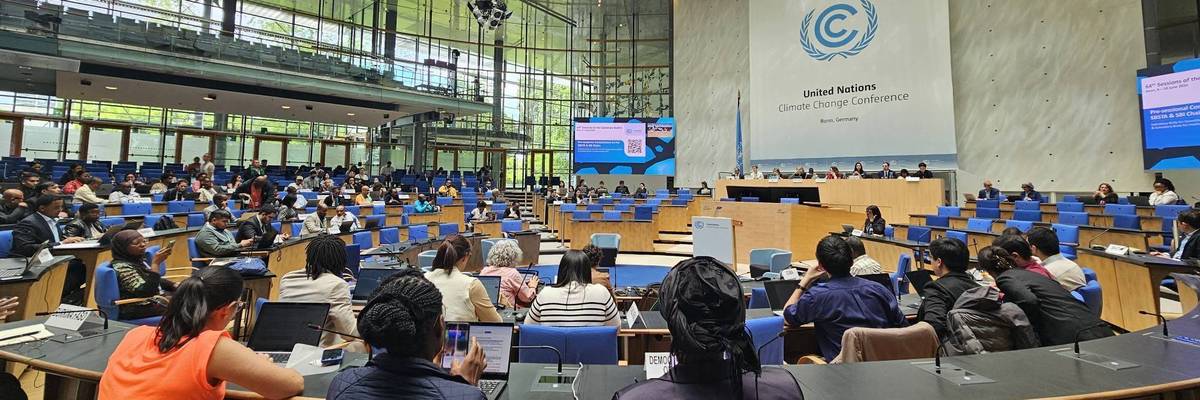
Delegates take part in the United Nations Framework Convention on Climate Change (UNFCCC) Mid-Year Subsidiary Bodies meetings, or SB64, in Bonn, Germany on June 8, 2026.
(Photo by LDC Group on Climate Change/Facebook)
Brett Wilkins
Jun 18, 2026
COMMON DREAMS
As international climate talks backed by the United Nations wrapped up Thursday in Bonn, Germany, campaigners stressed that policymakers must do more to curb the influence of polluting industries if such negotiations are going to have any hope of helping the world bring the fossil fuel era to an end.
The Bonn climate talks—officially the United Nations Framework Convention on Climate Change (UNFCCC) Mid-Year Subsidiary Bodies meetings, or SB64—serve as a technical and diplomatic staging ground for the next UN Climate Change Conference, or COP31, which is scheduled to take place in Antalya, Türkiye this November.
With current national climate pledges remaining far from what’s needed to limit planetary warming to 1.5°C—the increasingly moribund target at the heart of the Paris Climate Agreement—experts and campaigners are taking aim at the UNFCCC’s reliance on consensus-based decision-making, which allows a handful of fossil fuel-producing nations and the oil, gas, and coal industries to block ambitious climate action and weaken international agreements.
“At the climate talks in Bonn, States failed to make meaningful progress and pushed back on already established agreements, exposing a critical truth: Climate justice should not be vetoed, and reform of the UNFCCC is needed to enable climate action at the speed and scale the crisis demands,” Lien Vandamme, senior campaigner at the Center for International Environmental Law (CIEL), said in a statement Thursday.
Vandamme added that “effective multilateralism is the only way out of the climate crisis, and this process does not live up to that expectation.”
Rallying under a “Friends of Science” banner, dozens of nations are calling out coordinated attacks by fossil fuel producers and the oil, gas, and coal industries on science that threatens their economic prospects.
“We see coordinated efforts to cast doubt on the best available science driven by a narrow set of interests, not by the needs of our people,” lead Panamanian negotiator Ana Aguilar said during a Wednesday press conference.
“We have seen this playbook before,” she added. “Manufacture doubt, delay the response, and let the vulnerable people pay this bill.”
Lead Fijian negotiator Sivendra Michael put it more bluntly, telling reporters, “Anyone that is blocking references to science—they are not our friends.”
There has been some progress. As CIEL noted:
It is encouraging that, after more than three decades, the UNFCCC has begun to acknowledge concerns around the corporate capture of the process. The open dialogue on transparency and integrity that happened in Bonn represents an important—but long overdue—step towards addressing the influence of polluting industries in the climate negotiations. This dialogue must be the start toward a meaningful, comprehensive policy to address corporate capture of climate negotiations. A climate process that remains vulnerable to obstruction and corporate influence cannot deliver the action this crisis demands.
Erika Lennon, CIEL’s senior attorney, pointed to April’s First Conference on Transitioning Away from Fossil Fuels in Santa Marta, Colombia, as a hopeful sign. The Santa Marta conference, which was free of major polluters like the United States, China, Russia, and India, took aim at what climate defenders called the “shamefully weak” draft text—called the Multirão Decision—produced at last November’s COP30 in Brazil. The final document removed all mentions of fossil fuels amid pressure from oil and gas-producing nations like the United States, Russia, and Saudi Arabia, and the presence of a record number of industry lobbyists.
“The Santa Marta Conference demonstrated that a fossil fuel phaseout is not out of reach,” Lennon said Thursday. “But Bonn showed that the institutions meant to deliver that accountability remain constrained by outdated rules and undue influence from polluting interests.”
“We need effective multilateralism and an effective climate regime, not one that is incapable of delivering accountability or tackling the root cause of the climate crisis, fossil fuels, at the speed and scale the crisis demands,” she added. “As attention turns to COP31, governments must confront the structural barriers that continue to delay meaningful action, from consensus rules that allow a small number of states to block progress, to the absence of robust safeguards against conflicts of interest, or violations of the rights of meaningful participation of representatives from climate-vulnerable communities.”
Nations allege ‘attacks’ on science at key climate talks
AFP
June 17, 2026
AFP
June 17, 2026
Delegates representing the EU, Switzerland and dozens of developing nations accused some countries of undermining the scientific consensus on global warming at climate negotiations underway in the German city of Bonn – Copyright AFP/File ANDRE PAIN
Crucial negotiations ahead of the COP31 summit have been frustrated by a “small group of fossil fuels interests” attacking the science of climate change behind closed doors, envoys said Wednesday.
Delegates representing the EU, Switzerland and dozens of developing nations accused some countries of undermining the scientific consensus on global warming at climate negotiations due to conclude on Thursday in Bonn, Germany.
“There are powerful interests desperate to protect their wealth and influence,” said Fiji’s head of delegation Sivendra Michael, flanked by supporters in T-shirts emblazoned with the slogan “Science is Not Negotiable”.
“We are seeing certain countries holding the process hostage as vulnerable people suffer heat stress, and king tides and storms, drought and famine,” he said.
Bonn is where texts are drafted and differences narrowed ahead of the decisions taken by political leaders at the UN-sponsored COP31 climate talks which are due to start November 9 in Antalya, Turkey.
The preparatory talks had seen “coordinated attacks across the negotiation rooms by the small number of fossil fuel interests”, said Manjeet Dhakal, an adviser to the 44-nation Least Developed Countries bloc.
These countries had tried to remove references to the IPCC — the UN’s expert scientific panel on climate change — and the need to limit warming to 1.5C in draft texts under negotiation, Michael said.
– Pressure for delay –
No country was singled out by name.
But oil-rich Saudi Arabia had opposed language expressing concern about the El Nino weather pattern and requesting the IPCC provide regular updates on climate science, reported the independent Earth Negotiations Bulletin.
India suggested deleting any reference to “irreversible changes”, added the bulletin, which tracks UN treaty negotiations and is permitted to observe talks not generally open to journalists or the public.
Saudi Arabia and other oil-rich states have been accused of frustrating climate action by exploiting the consensus-based process by which the UN-sponsored Conference of the Parties summits are governed.
India, Saudi Arabia and China have pushed for the publication of the IPCC’s next major climate assessment to be delayed by a year until 2029, a move opposed by the EU among others.
“The EU calls on all parties to uphold science, support the IPCC and promote information integrity here in Bonn and beyond,” said Demetris Psyllides, a representative for the 27-nation European Union.
Scientists say keeping global warming as close as possible to 1.5C relative to pre-industrial levels is essential to avoid the worst impacts of climate change.
That limit was agreed by nearly 200 nations in the Paris Agreement of 2015 but could be breached by 2030.
On Tuesday, the chair and chief negotiator of the Alliance of Small Island States said she was “extremely troubled by the attempts to delink and undermine the best available science” at Bonn.
Samoan diplomat Anne Rasmussen urged all countries to “stop playing games. Do not abandon your commitment to the 1.5C goal”.
Crucial negotiations ahead of the COP31 summit have been frustrated by a “small group of fossil fuels interests” attacking the science of climate change behind closed doors, envoys said Wednesday.
Delegates representing the EU, Switzerland and dozens of developing nations accused some countries of undermining the scientific consensus on global warming at climate negotiations due to conclude on Thursday in Bonn, Germany.
“There are powerful interests desperate to protect their wealth and influence,” said Fiji’s head of delegation Sivendra Michael, flanked by supporters in T-shirts emblazoned with the slogan “Science is Not Negotiable”.
“We are seeing certain countries holding the process hostage as vulnerable people suffer heat stress, and king tides and storms, drought and famine,” he said.
Bonn is where texts are drafted and differences narrowed ahead of the decisions taken by political leaders at the UN-sponsored COP31 climate talks which are due to start November 9 in Antalya, Turkey.
The preparatory talks had seen “coordinated attacks across the negotiation rooms by the small number of fossil fuel interests”, said Manjeet Dhakal, an adviser to the 44-nation Least Developed Countries bloc.
These countries had tried to remove references to the IPCC — the UN’s expert scientific panel on climate change — and the need to limit warming to 1.5C in draft texts under negotiation, Michael said.
– Pressure for delay –
No country was singled out by name.
But oil-rich Saudi Arabia had opposed language expressing concern about the El Nino weather pattern and requesting the IPCC provide regular updates on climate science, reported the independent Earth Negotiations Bulletin.
India suggested deleting any reference to “irreversible changes”, added the bulletin, which tracks UN treaty negotiations and is permitted to observe talks not generally open to journalists or the public.
Saudi Arabia and other oil-rich states have been accused of frustrating climate action by exploiting the consensus-based process by which the UN-sponsored Conference of the Parties summits are governed.
India, Saudi Arabia and China have pushed for the publication of the IPCC’s next major climate assessment to be delayed by a year until 2029, a move opposed by the EU among others.
“The EU calls on all parties to uphold science, support the IPCC and promote information integrity here in Bonn and beyond,” said Demetris Psyllides, a representative for the 27-nation European Union.
Scientists say keeping global warming as close as possible to 1.5C relative to pre-industrial levels is essential to avoid the worst impacts of climate change.
That limit was agreed by nearly 200 nations in the Paris Agreement of 2015 but could be breached by 2030.
On Tuesday, the chair and chief negotiator of the Alliance of Small Island States said she was “extremely troubled by the attempts to delink and undermine the best available science” at Bonn.
Samoan diplomat Anne Rasmussen urged all countries to “stop playing games. Do not abandon your commitment to the 1.5C goal”.

No comments:
Post a Comment