Three-year-old boy pulled living from the rubble as Venezuela quake toll nears 2,000
The confirmed death toll from the twin earthquakes that rocked Venezuela has reached nearly 2,000, National Assembly president Jorge Rodriguez said Tuesday. While some 50,000 people remain unaccounted for, Jordanian rescue teams pulled a three-year-old boy from the rubble, where he'd managed to survive six days since the catastrophe.
Modified: 30/06/2026
FRANCE 24
 The UN said food and shelter is needed urgently in Venezuela. © Federico Parra, AFP
Tens of thousands of people urgently need food and shelter in Venezuela after the two devastating earthquakes that killed nearly 2,000, the UN said on Tuesday, as doctors warned of outbreaks of disease with survivors sleeping in the streets.
Last week's 7.2 and 7.5 magnitude shocks – one of the worst earthquake disasters in Latin America – collapsed whole residential complexes, left tens of thousands unaccounted for and prompted frantic search-and-rescue operations for survivors trapped in the rubble.
The UN refugee agency said "food shortages are widespread, basic services have broken down and connectivity has been largely severed" in the port city of La Guaira – the worst hit area north of the capital Caracas.
"They give out supplies here, but sometimes people nearly kill each other for food ... it's like a cockfight," said Daniela Armas, 18, a vendor in La Guaira who was injured falling from a motorbike during the quakes.
Venezuela: Mother and baby among earthquake survivors as rescue time runs out

01:13
In a daily update, Venezuela's National Assembly President Jorge Rodriguez said deaths had risen to 1,943, with more than 10,500 injured in the twin quakes.
He said nearly 6,500 people had been rescued from the rubble in La Guaira, but that number was likely closer to 20,000 including those who escaped or were helped out by family.
Jordanian rescue teams pulled a three-year-old boy from the rubble on Tuesday, Jordan's civil defence said, six days after the devastating earthquakes.
Rescue workers cheered with joy upon discovering the child, who had survived. The boy received first aid and was immediately taken to hospital, the Jordanian civil defence said in a statement.
Many Venezuelans have expressed anger at the government's slow response to the disaster in a country already struggling with years of crippling US sanctions and deepening economic crisis that has weakened infrastructure and health services.
The UN agency said it needed some $14.85 million to scale up aid and temporary shelter for 30,000 people over six months.
"Community tensions are rising as access to assistance remains constrained," UNHCR spokesperson Carlotta Wolf said.
The quakes likely damaged or destroyed 58,870 buildings, according to a preliminary assessment of satellite data published by NASA.
World Health Organization spokesman Christian Lindmeier said health services in Venezuela were overstretched and under "extreme pressure".

"There's an increased risk now of outbreaks of vaccine-preventable diseases" such as measles and diphtheria, due to low pre-earthquake vaccination coverage, he said.
Bare hands
With international rescue teams from the US, Mexico and dozens of other countries scrambling with trained dogs and heavy equipment to dig out survivors, Venezuelans began burying the dead they could find.
Others were frantically searching by hand for missing loved ones in the rubble, but also in hospitals and morgues.
"It's harder not knowing because you ask yourself, 'What do I do? Where do I look for her?" said Rosanna Luna, looking for her sister Soraida in the wreckage of her home.
AFP journalists on Monday saw black body bags containing victims of the quake lined up near a makeshift morgue at the dock in La Guaira, where many people came for news or to identify remains.

Darvin Silva, 37, described how he battled to reach his mother, who died under a pillar in a collapsed building.
"The effort it took me to get her out of there with my bare hands, with sledgehammers, with pickaxes ... you can't even begin to imagine," he said.
"I hope that I can now offer her the rest she deserves," he said.
The critical 72-hour window during which survivors were still likely to be found closed on Saturday evening.
But rescuers in hard hats and high-visibility vests were still picking through the twisted metal and shattered concrete.
Around 50,000 people are still listed as missing, according to the UN.
Body bags
Some seven million people in Venezuela would be affected by the disaster, the UN has said, with the quakes knocking a $6.7-billion hole in the economy – or six percent of Venezuela's GDP.
A total of 27 countries have mobilised nearly 40 search-and-rescue teams. They include more than 2,000 troops and personnel, along with more than 160 dogs, according to Gianluca Rampolla, the UN coordinator in Venezuela.
The world body is providing 10,000 body bags, though it hopes the final toll will be lower.
At the makeshift morgue at La Guaira's port, many are still waiting for the remains of their loved ones who are presumed dead.
"My family is there – I'm told my sister and her children are there, as well as the children of my brother," Wilker Molalla told AFP as he waited to identify the remains.
"There were 11 people in my household," he said. "Only two of us survived because we were at work."
(FRANCE 24 with AFP)
Death toll from Venezuela earthquakes climbs to 1,943
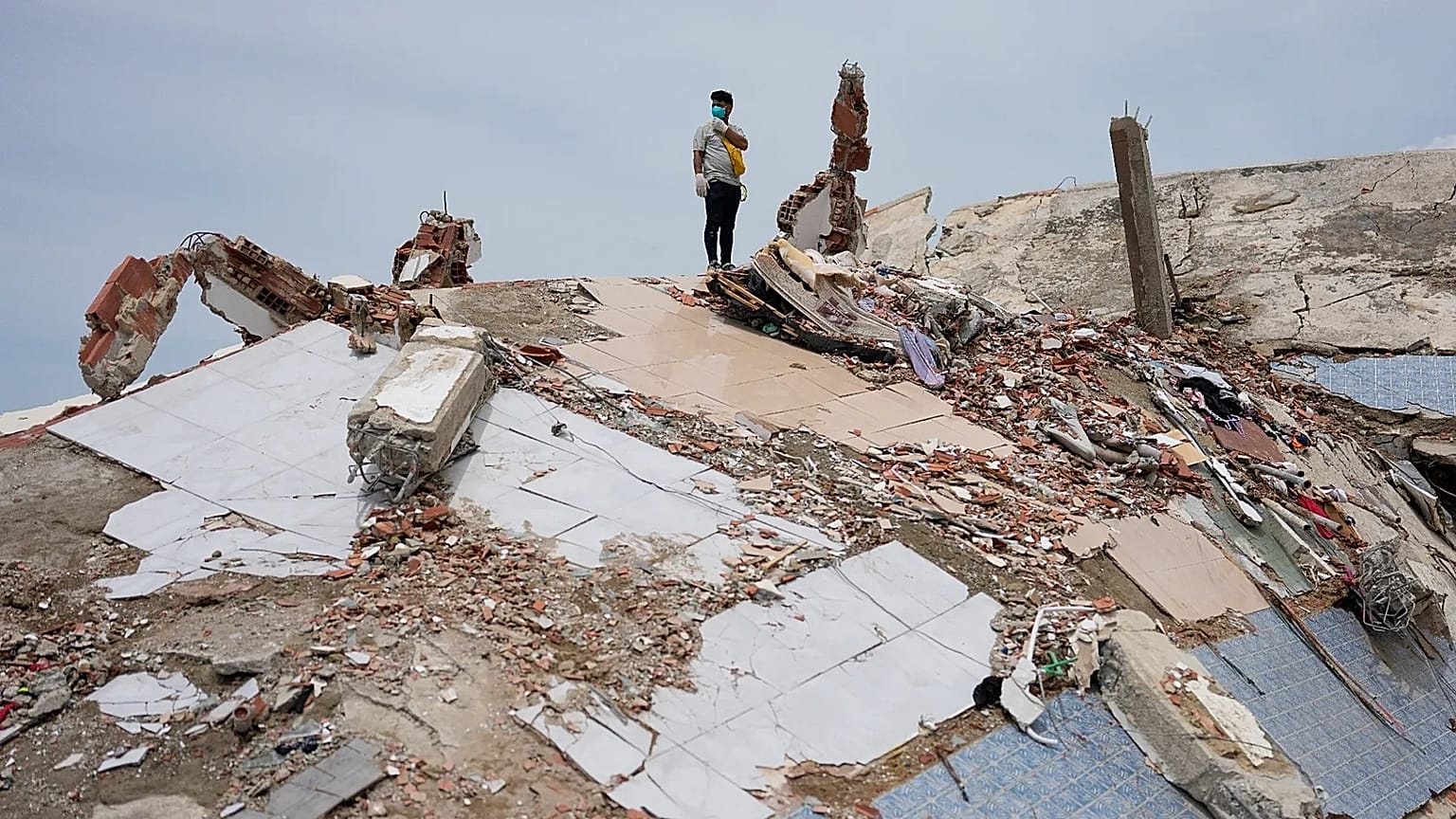
UNICEF has estimated that around 1.8 million people, including 680,000 children, require humanitarian assistance following the quakes.
The death toll from two devastating earthquakes that struck northern Venezuela last week has risen to 1,943, authorities said on Tuesday.
A further 10,571 people have been injured and 28,380 are receiving care in hospitals or temporary camps following the quakes, according to Jorge Rodríguez, the president of the country's National Assembly.
Back-to-back 7.2- and 7.5-magnitude tremors hit Venezuela on the evening of 24 June, causing widespread destruction and leaving tens of thousands of people missing. A strong aftershock also rattled the region on Friday, sending people fleeing into the streets as the ground shook once again.
Emergency crews and volunteers have since been racing to rescue those trapped under collapsed buildings, with rescuers from around the world joining local crews to dig through the rubble. The first 72 hours are said to be the most crucial for successful rescues. It has been almost a week since the quakes hit.
Video footage on social media shows emergency responders navigating small, unstable crawl spaces as they attempt to get to survivors.
Venezuela's acting president, Delcy Rodríguez, said on Monday that 3,681 rescuers from 30 countries had joined the search efforts. The international community has also provided over 1,000 tons of supplies, 27 vehicles, and 118 search dogs, she added.
More than 6,450 people have been found alive as of Tuesday, with a further 13,500 able to escape by themselves, per Venezuela's government.
UNICEF has estimated that around 1.8 million people, including 680,000 children, require humanitarian assistance following the quakes.
A preliminary estimate from the United Nations Development Programme has put the cost of direct physical damage caused by the tremors at $6.7 billion.

June 30, 2026
By UN News
Five days after powerful earthquakes struck central-northern Venezuela, the death toll continues to climb along with the intense rescue operation and the UN coordinates humanitarian assistance, warning that recovery “is going to take time.”
Venezuelan authorities confirmed on Monday that at least 1,719 people have died following the earthquakes of 24 June, with some 5,000 more injured. Around 12,000 people have been displaced, and officials have yet to confirm a figure for the missing.
Survivors still emerging
In a press briefing for correspondents in New York, UN Resident and Humanitarian Coordinator in Venezuela, Gianluca Rampolla, said that seven people were pulled alive from the rubble on Sunday as search efforts continue.
He also reported that the UN and Venezuelan authorities had agreed to procure 10,000 body bags in anticipation of the death toll rising further.
Seven states have been affected, but the greatest concentration of casualties is in La Guaira state and the Distrito Capital of Caracas. Around 2,500 structures were damaged, many of which have collapsed entirely.
Conditions on the ground remain hazardous. Approximately 500 aftershocks have been recorded since the initial earthquakes, including a magnitude 5.2 tremor in the early hours of Monday morning, while a tropical wave is threatening to bring heavy rains to affected areas.
“We continue to operate in a high-risk environment,” Mr. Rampolla said.
Over 2,000 rescuers on the ground
More than 2,000 rescue workers from 27 countries – along with over 160 search dogs – are currently deployed across more than 40 teams.
Although search and rescue operations typically focus on the first 72 hours, teams have extended their work after continuing to receive signs of life from beneath the rubble and locating survivors beyond that window.
“Together with the search and rescue operations, we are focusing, together with the Government, on providing emergency healthcare, shelter, food assistance, water and sanitation, and logistical support to ensure not only the storage but also the distribution of all the supplies arriving in the country, as well as protection,” Mr. Rampolla said, adding that the UN is working on a new emergency appeal to supplement its existing humanitarian plan.
‘There are people who need a hug’
The UN is preparing three assistance centres in La Guaira for families who have lost their homes, offering medical care, food, water, sanitation, protection and psychosocial support.
Vanessa May, head of the UN Office for the Coordination of Humanitarian Affairs (OCHA) in Venezuela, told UN News that many people had lost all sense of stability. “Moving from having a house, from having a home, to being in a shelter or temporary accommodation is not going to be easy,” she said.
Ms. May stressed that emotional support would be as essential as food, water or medical care. “There are people who need a hug,” she said, describing families waiting for news of loved ones, and others who already know their relatives remain buried under the debris.
‘This is going to take time’
Once search operations conclude, the UN and its partners will carry out rapid assessments to identify needs, including those of older people and persons with disabilities.
Debris removal and early recovery will follow, with particular attention to damage to schools and hospitals.
Ms. May said the reconstruction phase would require working with authorities to determine where displaced families can be resettled and conducting soil surveys before any relocation. “This is going to take time,” she said.
She attributed the speed of the initial UN response to the humanitarian architecture established in Venezuela since 2019, which brought together UN agencies, national and international NGOs, the Red Cross and other actors. Coordinating the surge in public donations – with many individuals and organisations arriving spontaneously at affected areas – has been among the key logistical challenges.
“Don’t let that solidarity stop,” Ms. May said, urging that attention on Venezuela be sustained well beyond the initial weeks of disaster recovery.
As the death toll continued to rise, the US Department of Homeland Security said that “when an individual is no longer in ICE custody, ICE is no longer responsible for them.”
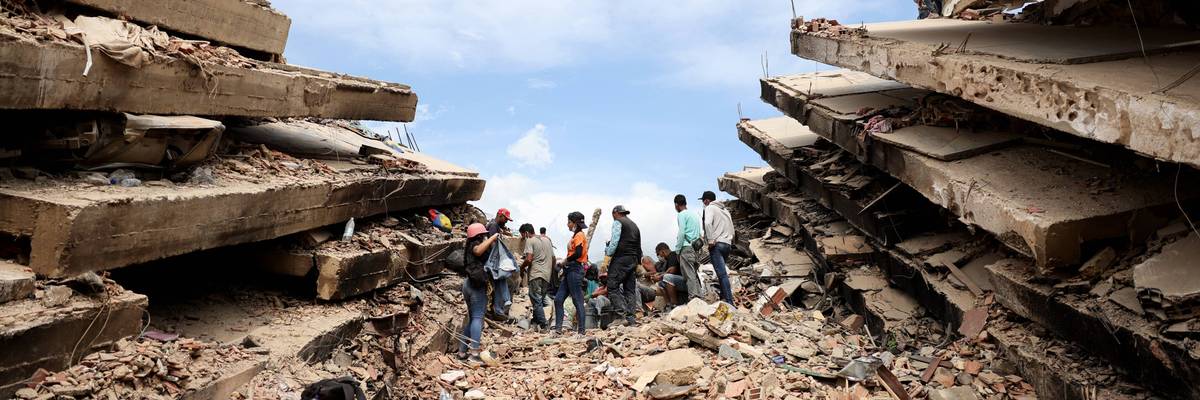
Rescuers continue to search for victims at a collapsed building after a pair of earthquakes on June 28, 2026 in Carabellada, La Guaira, Venezuela.
(Photo by Jesus Vargas/Getty Images)
Jessica Corbett
Jun 29, 2026
COMMON DREAMS
Tens of thousands of people still haven’t been found after a pair of devastating earthquakes in Venezuela last week—including some Venezuelans who had just been deported from the United States as part of President Donald Trump’s mass deportation push and were being held in a hotel when the temblors hit, The Associated Press revealed Monday.
There were 146 Venezuelans, including 19 women and seven children, on a deportation flight that arrived just hours before the 7.2- and 7.5-magnitude earthquakes, the AP reported, citing a Human Rights First initiative that has tracked thousands of such flights under Trump. They were brought to Hotel Santuario La Llanada in La Guaira, which collapsed because of the quakes.
Thousands Feared Dead After Back-to-Back Earthquakes Devastate Venezuela
Advocates Renew Call for End to US Sanctions After Devastating Venezuela Earthquakes
“Lisbeth Portillo, 58, said she escaped the rubble from the hotel with about 20 other deportees who walked the streets looking for help. They saw people running, some naked and others barefoot as they emerged from the rubble of the building,” according to the outlet.
Another deportee who survived, 24-year-old Jenny Rodriguez, told Telemundo: “I was trapped under the rubble. A colleague who had been on the same flight came by; I managed to free my hand from the debris, grabbed him by the trousers, and begged for help... Thanks to God—and to him—I was able to get out of there.”
Oswadeliz Núñez Ramírez is still “frantically searching for her son,” 28-year-old Daniel Alejandro Núñez Ramírez, who was also on the deportation flight and at the hotel, the Miami Herald reported Monday. A member of the Bolivarian National Intelligence Service who called himself “Jonathan” told her that he had pulled her son from the rubble, but, “skeptical of the official account, his mother has searched every hospital, clinic, and sector of La Guaira and Caracas without success.”
While US Immigration and Customs Enforcement did not respond to the AP’s request for comment, a spokesperson for the Department of Homeland Security, which oversees the agency, told the Herald: “This flight safely reached Venezuela, and all illegal aliens on board were returned home. When an individual is no longer in ICE custody, ICE is no longer responsible for them.”
Venezuelan National Assembly President Jorge Rodríguez said Monday that the earthquake has left at least 1,719 dead, 5,034 injured, and 15,866 displaced from their homes.
UN News noted Monday that the ongoing search and rescue effort involves more than 2,000 workers from over two dozen countries, plus over 160 dogs, and Gianluca Rampolla, the United Nations resident coordinator in Venezuela, “reported that the UN and Venezuelan authorities had agreed to procure 10,000 body bags in anticipation of the death toll rising further.”
Rampolla said that “together with the search and rescue operations, we are focusing, together with the government, on providing emergency healthcare, shelter, food assistance, water and sanitation, and logistical support to ensure not only the storage but also the distribution of all the supplies arriving in the country, as well as protection.”
As of Monday evening, more than 44,000 people remained missing, according to a reunion website for families. As NBC News detailed Monday:
Even as the chances of finding survivors diminished with every passing hour, Venezuelans continued using shovels, ropes, and their bare hands as they dug through mountains of collapsed concrete.
They were joined by a growing number of international rescue teams, who pulled multiple survivors from the wreckage, offering desperate families a rare glimmer of hope.
Among the rescues, teams from the United States, France, and Venezuela pulled a man and his son from the ruins Sunday morning after they had spent four days trapped beneath the rubble.
Organizations including US-based peace group CodePink and the Center for Economic and Policy Research, a Washington, DC-based think tank, have called on the US and allied countries to lift all sanctions against Venezuela in the wake of the earthquakes.
Trump earlier this year directed an illegal invasion of Venezuela, during which US forces killed scores of people and abducted President Nicolás Maduro, then seized control of the South American country’s nationalized oil industry.


No comments:
Post a Comment