What is GlobalEye, the Swedish aircraft set to become NATO’s new ‘eyes in the sky’?
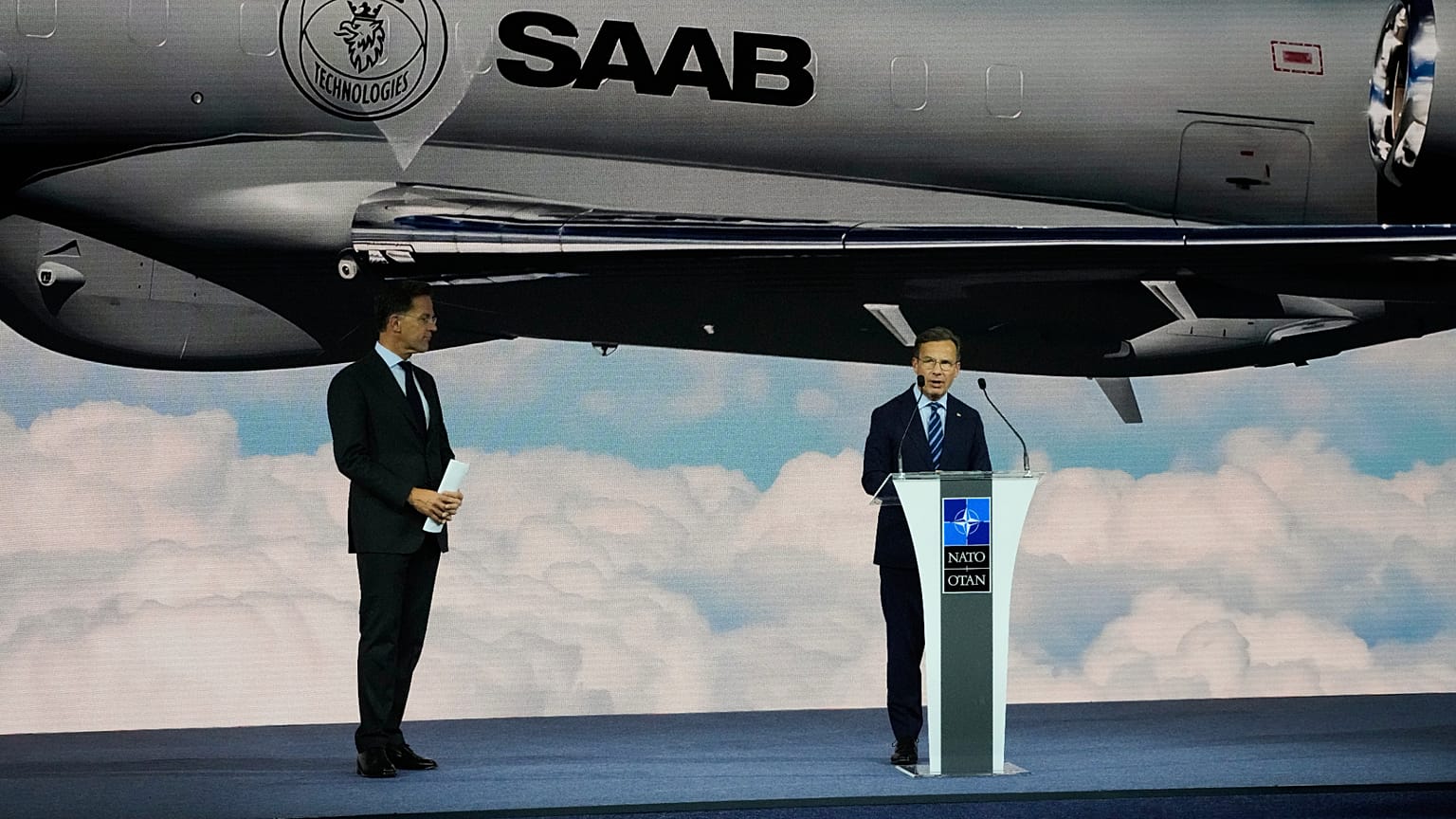
As NATO members discuss future defence capabilities in Ankara, Swedish defence company Saab announced its GlobalEye aircraft will become the alliance’s new “eyes in the sky”.
Swedish-made aircraft are set to replace NATO’s ageing US-built surveillance fleet.
At the NATO Summit Defence Industry Forum in Ankara, NATO and the Swedish government announced that the military alliance had chosen GlobalEye, an Airborne Early Warning and Control (AEW&C) system made by Swedish defence company Saab, as the replacement for NATO’s current Boeing E-3A aircraft.
NATO plans to open negotiations with Saab to purchase up to 10 GlobalEye aircraft, according to an announcement by the Swedish government.
What is the Early Warning & Control System?
An Early Warning & Control (AEW&C) system is a modified aircraft fitted with long-range radar, sensors and command-and-control systems.
Flying at high altitude, it can detect aircraft, ships, missiles and other threats at long distances, including low-flying targets that ground-based radars may miss. It can also help direct friendly forces during military operations.
“In a serious security situation, the ability to detect threats early and control operations in the air, at sea and on the ground is becoming increasingly important,” Pål Jonson, the Swedish minister of defence, said at the summit.
“GlobalEye provides precisely the kind of advanced situational awareness that modern defences need to combat everything from drones, missiles and other types of threats,” he added.
NATO calls its airborne early warning and control capabilities its “eyes in the sky”.
Unlike most military assets in the alliance, NATO’s current airborne early warning fleet is operated by NATO itself rather than by a single member state.
The military alliance currently operates 14 Boeing E-3A aircraft, which have been in service since 1982.
The selection marks NATO's second attempt to replace the ageing fleet: the alliance initially chose Boeing's E-7A Wedgetail in 2023, but that plan collapsed in 2025 after the US Air Force dropped the aircraft from its budget in favour of space-based surveillance.
Specs of the new reconnaissance aircraft
Saab says its GlobalEye is “the only AEW&C solution on the market that can provide long-range air, sea and land surveillance in real time, from a single platform.”
The advanced reconnaissance aeroplane uses a combination of long-range active and passive sensors. It is built on the Global 6500 aircraft family from Canadian business jet maker Bombardier.
The Swedish company says GlobalEye can detect, identify and track objects at distances of more than 550 kilometres, while its radar is designed to reach even farther in some conditions.
It can remain airborne for more than 11 hours and “combines excellent flight performance with low maintenance costs,” according to an announcement by the Swedish government.
For comparison, NATO says one Boeing E-3A can track aircraft and ships at distances over 400 km and fly up to 10 hours.
A single current NATO surveillance aeroplane can monitor an area roughly the size of Poland. Three coordinated aircraft can continuously scan the entirety of Central Europe.
Saab has not yet disclosed an equivalent area-coverage figure for GlobalEye.
The planned purchase is being backed by 11 NATO countries: Belgium, Canada, Denmark, Germany, Latvia, Lithuania, Luxembourg, the Netherlands, Norway, Romania and Sweden.
No contract has been signed yet. Saab says it will now proceed to formal negotiations with the NATO Support and Procurement Agency to secure a deal.
Saab’s CEO Micael Johansson told Swedish newspaper Dagens Nyheter that the company could begin deliveries in 2030 if an agreement is reached soon.
UK to lead European initiative to fund next
generation of long-range missiles
The United Kingdom, France, Germany and other European countries will spend more than $50 billion over the next 10 years to develop long-range precision weapons in a boost to NATO's defence capabilities, the UK government announced on Wednesday.
Issued on: 09/07/2026 - RFI
Outgoing UK Prime Minister Keir Starmer was set to unveil details of the programme at the NATO summit in Ankara.
Backed by a dozen European partners, the UK-led initiative "is expected to announce that allies will spend $50 billion over the next 10 years to develop deep precision strike capabilities to bolster defence and deterrence across the alliance", Downing Street said in a statement.
The investment will deliver "the most advanced weapons NATO will have at its disposal in the future – with the ability to strike targets no less than 300km away and in some cases beyond 2000km, with pinpoint accuracy", it added.
Such missiles have proved crucial in the Ukraine war, allowing Ukrainian forces to hit targets far from the front line.
The partners, who are also expected to include Baltic nations, will work on several different missiles with a view to avoiding duplication.
The weapons will be developed without the involvement of the United States.
Europe’s defence dilemma: autonomy or dependence?

Closer European cooperation
Starmer on Wednesday urged leaders to "show the unity and the strength of NATO" against a background of the Ukraine conflict and the US war with Iran.
"We must continue to work together as allies to develop the capability of the future to bolster security and protect growth at home," he said in a statement.
The NATO leaders' summit comes at a fraught time for the 77-year-old transatlantic alliance, with US President Donald Trump lashing out at allies as Washington steps back from Europe.
The second day of the tense meeting in the Turkish capital saw Trump pose for the traditional group photo of 32 NATO leaders, before taking part in a working session and holding a highly anticipated meeting with Ukrainian President Volodymyr Zelensky.
The summit is expected to see European allies make plans to take a bigger role in NATO, including by upping defence spending.
(with newswires)

No comments:
Post a Comment