Sunday, November 23, 2025

The Rich People Who Own the Media Want Generations to Fight, Not Classes


 November 21, 2025


Photograph by Nathaniel St. Clair

The idea of generational warfare is pernicious tripe. It gets pushed endlessly in the media because rich people would rather see kids lashing out at their parents than at them. And since the rich own the media, we hear a lot about generational inequality. Jeff Bezos’ Washington Post gave us the latest effort at generational warmongering.

Just to give some basic facts that are not in dispute, the country is getting richer year by year. Using the projections from the Social Security Trustees, per capital income is projected to be 15.4 percent higher in 2035, 32.6 percent higher in 2045, and 54.3 percent higher in 2055, when virtually all the baby boomers will be dead.

Since the baby boomers are for the most part not going to be partaking in these higher levels of consumption, who do the generational warriors think will be getting this income? It’s worth mentioning that these could prove to be very conservative projections of income growth. If AI has anywhere near the impact its proponents are claiming, per capita income will grow by far more than the Social Security Trustees are projecting.

Given the indisputable fact that the country is getting richer, how can there be a story where Gen Xers, Millennials, and Gen Zers will be poorer on average than baby boomers? There is a story where generations can do worse through time, but that would be a story of within generation inequality, not between generations inequality.

The problem is not greedy boomers, but rather ridiculously rich people like Elon Musk, Jeff Bezos, and Mark Zuckerberg hoarding the country’s wealth for their own use and the use of their heirs. People are less likely to see that story because these super-rich people are the ones who own the major media outlets and social media platforms, but that is reality.

Given these simple and undeniable facts, it is striking how often we see this generational inequality nonsense. As is the case with this piece, they often push outright lies to make their case. For example, this piece tells readers:

“’Baby boomers “entered the labor force during decades of strong economic growth, rising productivity and relatively high real wages,’ Mitchell said. They were in their prime earning and saving years during long bull markets, namely in the 1980s and ’90s, she said, as well as the economic recovery that followed the Great Recession.”  ….

“And ‘particularly for middle-income workers, real wage gains since the 2000s have been modest, compared to the robust wage growth that boomers benefited from mid-career,’ Mitchell said.” …

“Post-World War II, ‘you had this tremendous boom that many got to ride for a very long period of time,’ Ney said.” [Jeremy Ney, a professor at Columbia University’s business school.]

This turns reality on its head. As I wrote in a piece last month:

“There was in fact a golden age, but it predated the entry of most boomers into the labor market. The economy experienced a period of low unemployment and rapid real wage growth, which was widely shared, from 1947 to 1973. At the endpoint of this boom period, the oldest boomers were 27, and the youngest were 9.

“After 1973, the economy took a sharp turn for the worst. The most immediate cause was the Arab oil embargo, which sent oil prices soaring. The economy at that time was far more dependent on oil than is the case today. Soaring oil prices sent inflation higher, which prompted the Fed to bring on severe recessions, first in 74-75 and then again in 1980-82.

“The full story is more complicated and highly contested, but what happened to the economy is not. We had a period of far higher unemployment and stagnant real wage growth that lasted until the mid-1990s. The median real wage in 1996 was actually 4.4 percent lower than it had been in 1973.

“The average unemployment rate for people between the ages of 20-24 over the years 1973 to 1988 (when the last boomer hit 24) was 11.3 percent. By comparison, it averaged 7.2 percent over the last decade, although it has been rising rapidly in 2025.”

After stagnating for two decades, the median real wage has been rising modestly for the last three decades.

Finally, the piece includes this inadvertently damning comment for the argument it is trying to push on readers.

“’In 1940 there was a 90 percent chance that you were going to earn more than your parents. To somebody born today, it is just a coin flip,’ Ney said.”

Since average income has risen consistently over the last seventy years and is universally projected to continue to rise (barring a climate disaster), the only reason why most workers won’t earn more than their parents would be a further rise in inequality. In other words, more money going to people like Washington Post owner Jeff Bezos and less money going to ordinary workers.

If there is not a further increase in inequality, then most workers in ten or twenty years will be earning considerably more than do workers today. That is irrefutable logic, which apparently has no place in the Washington Post.

This first appeared on Dean Baker’s Beat the Press blog.

Dean Baker is the senior economist at the Center for Economic and Policy Research in Washington, DC. 

Trump Adds Censorship to the Campaign Against Arms Control and Disarmament


 November 21, 2025

Photograph Source: Office of Speaker Mike Johnson – Public Domain

Donald Trump made it clear in the 2016 presidential debates that he had no understanding of the central issues of the nuclear arms race, particularly the role of the nuclear triad.  When Trump couldn’t answer a question on nuclear verification, he predictably responded that “it would take me an hour and a half to learn everything there is to know about missiles.  I think I know most of it anyway,”

The Pentagon’s Joint Chiefs of Staff were so alarmed by Trump’s nuclear ignorance that they held a seminar to brief the president on the nuclear inventory in 2017.  Following the meeting, responding to Trump’s demand for increasing the size of the nuclear inventory tenfold, Secretary of State Rex Tillerson referred to Trump as a “fucking moron.”

In his second term, Trump has deployed a new weapon, which is the censoring of sensitive documents that reveal the danger of an accidental launch of nuclear weapons and the problems associated with nuclear exercises.  In an unprecedented act, the Department of State has removed from its website a 15-page document dealing with a 1983 NATO nuclear exercise that produced a “war scare” in the Kremlin.  The document was withdrawn from the department’s series on the “Foreign Relations of the United States,” which contains over 400 volumes.

When Trump began his second term, he fired the nine nonpartisan members of the Historical Advisory Committee, who presumably would have stood in the way of this unusual censorship.  The censored document dealt with U.S. naval exercises that “simulated surprise naval air attacks on Soviet targets.”  Soviet and Russian officials over the years have assumed that such exercises would be used to conceal an actual U.S. attack against Russia, which is why any evidence of a sophisticated strategic exercise would raise alarm bells in the Kremlin.

I was one of several Soviet analysts at the CIA in 1983 who convinced CIA director William Casey that the Soviet “war scare” was genuine and that President Reagan needed to be informed,  Casey was hesitant at first and his deputy, Robert Gates, was downright dismissive of our analysis.  Fortunately this was one of the few times that Casey ignored Gates and followed the lead of his Soviet analysts.  As a result, President Reagan withdrew from participation in the exercise and the overall exercise was toned down and made less threatening.  This opened the door to the Reagan-Gorbachev summits in the 1980s that produced major success in the field of arms control and disarmament.  (CIA analysts had the advantage of a Soviet agent, Oleg Grinevsky, who provided credibility to the argument that the war scare in the Kremlin was genuine.)

The White House and the Pentagon presumably withdrew the document from the historical record because it explores the danger of possible misuse of nuclear weapons and the added danger of the failure to conduct a strategic dialogue.  Similarly, the Pentagon currently is waging a propaganda war against the important film, “House of Dynamite,” because it exploits the dangers of an accidental launch and the ineffectiveness of national missile defense.  (I co-authored a book, “Phantom Defense,” nearly 30 years ago that documented the failures and waste associated with national missile defense.)

The Trump national security team cannot even claim to have a serious expert on arms control and disarmament at a time when there are compelling reasons for a high-level Russian-American dialogue to reduce nuclear weapons, to restrict military exercises, and to avoid any return to nuclear testing. The Russians have called for such a dialogue; the United States has not yet responded.

The Cuban missile crisis should have taught us lessons in support of bilateral negotiations in times of tension as well as the need to bring China into the strategic dialogue.  Shouldn’t we assume that Russian and Chinese leaders who face U.S. military encirclement and aggressive military exercises could overreact to the actions and policies of their major adversary?

Melvin A. Goodman is a senior fellow at the Center for International Policy and a professor of government at Johns Hopkins University.  A former CIA analyst, Goodman is the author of Failure of Intelligence: The Decline and Fall of the CIANational Insecurity: The Cost of American Militarism, and Whistleblower at the CIA: An Insider’s Account of the Politics of Intelligence.  His forthcoming book is American Carnage: Donald Trump’s War on Intelligence.  Goodman is the national security columnist for counterpunch.org.

“A House of Dynamite,” the “Failsafe” Film for 2025


My interest in conflict and war goes back decades. In 1961, the film Failsafe starring Henry Fonda as the U.S. president presented a dire warning about the nuclear arms race taking off. It revealed our vulnerability: human error, miscommunication, and technological failure. The tragic ending was shocking. Film director Kathryn Bigelow’s new A House of Dynamite is equally gripping, demonstrating to viewers the reality of our modern world, our closeness to global destruction. Failsafe was alarming. House of Dynamite is foreshadowing.

In 1961, I was at UCLA earning a doctoral degree in evolutionary biology and studying animal behavior, including humans. My early interests included conflict resolution and gender differences. Decades later, after a period of writing fiction and promoting one of my novels, I was drawn back to the topic of war. Voice of the Goddess, a Bronze-age epic, told of a non-violent, non-warring, goddess-worshipping culture on the island of Crete and a warrior hero from the nearby mainland Mycenaean culture. To promote the book, I gave a talk entitled, “If women ran the world there would be no war.”

During the talk, a woman in the audience challenged my book’s core message. She cited the work On Aggression by my academic forefather, Konrad Lorenz, arguing that aggression is an unchangeable part of human nature. With limited speaking time, I couldn’t explain why Dr. Lorenz was only partly right, particularly when it comes to the relationship of women to war.

But the question did rattle my certainty that if women ran the world, war wouldn’t exist. I subsequently launched into two and a half decades of research to answer the questions: when did we start making war, why do humans make war, and could we stop? In my research, I determined that men have not been and will not be able to end war without significant shared leadership with women. The number of women who were able to break into powerful decision-making spaces was, to my knowledge, so few in 2015 that I felt the problem wouldn’t be remedied in my lifetime. In 2018, I wrote my last book on the subject – War and Sex and Human Destiny. It felt like a farewell to the subject.

Time moved on, and I went back to writing fiction. But six years later, Mika Brzezinski, a TV host on Morning Joe, announced that Forbes magazine would soon host another meeting in Abu Dhabi of 500 powerful women from around the world. Women from Forbes’s annual 50 Over 50 and 30 Under 30 lists would gather to address the world’s challenges. I caught my breath! A sufficient empowerment of women had happened without my noticing. This change in women’s status, along with advancements in technology and communication since the 1960s meant that ending international wars had become a genuine possibility.

So how does that relate to A House of Dynamite? The global community has built a house and stored explosives within it: landmines, Semtex, C-4, atomic and other bombs, and yes, dynamite. And we are choosing to live in that house. Democracies around the world appear to be losing their grip. Nuclear-armed nations are spending to refurbish and upgrade nuclear arsenals. The president of Russia, after invading Ukraine, on several occasions has brandished his nuclear saber. Non-nuclear nations like Iran are feeling the urgent need to acquire their own Weapons of Mass Destruction (WAMDs). All this to say, an enforceable international peace treaty is urgently needed. The good news is that in this century we have the knowledge and the means to fashion one.

In 2024, I, with several close friends, laid the foundation for a campaign to make enduring international peace a reality, Project Enduring Peace (PEP). Drawing on my research, we have developed a petition that outlines the means to secure a lasting treaty, based on historical examples from the Iroquois Confederacy to the European Union. If the global community successfully blocks wars between nations, none need fear attack by another. Disputes would be resolved by negotiations or other means. Eventually, nuclear arsenals would be perceived as dangerous and expensive burdens. Nations would become secure enough to abandon them, allocating the saved resources elsewhere.

A House of Dynamite makes the case that we need to act before it is too late. PEP is offering a perspective that anyone can support by signing the Project Enduring Peace Petition urging the United Nations to make haste to begin peace treaty negotiations. It’s our choice: we can continue to risk living in our existentially dangerous house or rise up, escape the treadmill of international warfare, and leave behind an enduring legacy of global peace.

Dr. Judith L. Hand is an evolutionary biologist and author whose work centers on the biological roots of human conflict and the pathways to a warless future. She is also the Co-Founder of Project Enduring Peace, a non-profit committed to educating the public about peace systems and ending all inter-state wars through a global peace treaty.

H: Kathryn Bigelow’s Empire of Fear

November 21, 2025

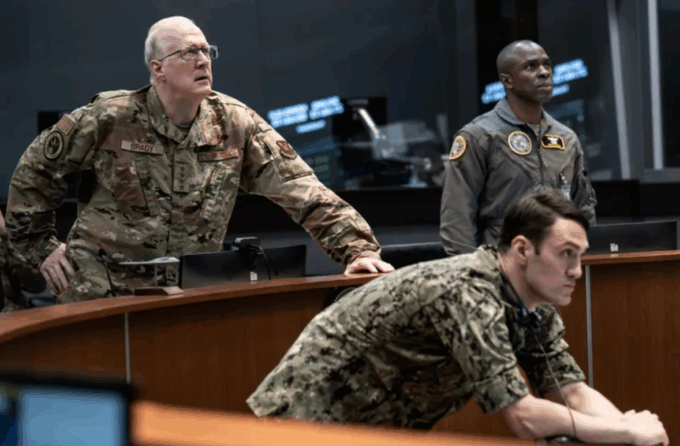
Still from A House of Dynamite.

Kathryn Bigelow is back, and not much has changed. Eight years since her last feature film, the first woman to win the Best Director Oscar for her unwavering depiction of the trauma of the occupier, the American filmmaker has made yet another war film – one that, like The Hurt Locker and Zero Dark Thirty, is seeped in the language of responsibility, yet, like those movies, remains problematic at its core.

A House of Dynamite arrives dressed as an anti-war, anti-nuclear weapons story. It claims to confront the horror of nuclear weapons with clear-eyed realism – to show, without melodrama, the suddenness with which the world could unravel. But peel back the surface and the film reveals something far darker: a work of imperial fantasy, a fever dream – wholly detached from any semblance of political reality – in which the United States imagines itself as the victim of the bomb it invented.

The film’s plot is absurd. It imagines a nuclear strike on the US – a missile bound for Chicago, which will wipe out the city and kill ten million people in the blink of an eye. It’s a fantasy that might have made sense in the 1960s, at the height of Cold War paranoia after the October Crisis (Cuban Missile Crisis). In 2025, however, it borders on delusion. No nation on Earth could, or would, launch a nuclear attack on the US. In fact, the only country ever to have used atomic weapons against civilians is the US itself – and not once, but twice. Yet Bigelow asks us to imagine – in 2025, no less – that the empire which annihilated Hiroshima and Nagasaki now trembles beneath its own mushroom cloud.

This inversion is not new to the veteran filmmaker. Bigelow has always filmed the machinery of empire with reverence. In Zero Dark Thirty, torture is procedural, and the lives of Pakistani civilians are afterthoughts – objects in the way of the US manhunt for Bin Laden; collateral ultimately rationalised by the ends. In The Hurt Locker, war is stripped of history and turned into a soldier’s addiction. A House of Dynamite continues the same project but with a slightly different disguise. Gone are the overt symbols of triumphalism or battlefields; in their place, a solemn tragedy. The film mourns American fragility so earnestly that the terror of annihilation becomes one more opportunity for self-mythology.

It follows officials, generals, and analysts struggling to save the homeland, all from different perspectives, which ultimately collapse into the same one anyway. Even as these people repeatedly make comments about how this could spell the deaths of hundreds of millions around the world, the US is all we see. Beyond a token exchange with Russia’s foreign minister, the rest of the world ceases to exist for the duration of the film’s almost two-hour runtime. No one asks what would happen to Pyongyang, Tehran, or Beijing if a nuclear war began; the only catastrophe worth filming is American. The empire’s imagination, it turns out, cannot stretch beyond its own borders. Even at the end of the world, the camera never leaves Washington.

This claustrophobic gaze serves a purpose. By erasing everyone else from the frame, the film plays on the fears baked into American exceptionalism. And so, the dread of sudden obliteration it imagines is less an argument against nuclear weapons and more for endless defence spending. Early in the story, a $50 billion missile-interception system is introduced. It has a 61 per cent chance of success, according to the film. “A coin toss,” as the viewer is constantly told. When it fails, the not-so-subtle implication is this: even as millions of Americans struggle to live paycheck to paycheck, without access to healthcare, the billions going towards the war machine are necessary because what if, one day, an adversary decides to nuke us on a whim?

This logic comes at a time when militarism, in the eyes of the US public, is waning. The US military faces plummeting recruitment, record scepticism, and rising outrage over its global conduct – at the core of which lies its facilitation of Israel’s genocidal assault on Gaza. Within this climate, A House of Dynamite functions as a cultural triage designed to resuscitate faith in the institution by reminding Americans of their supposed vulnerability. Want to protect your family from the next imaginary nuke? Well, you’d better keep funding the war machine that is currently incinerating fishermen in the Caribbean.

Part of what makes the film so insidious is how convincingly it moves. Bigelow’s realism – her eye for detail and her fluency in military ritual – is well regarded. This gives every frame in A House of Dynamite a sheen of authenticity, especially for those unfamiliar with the politics of empire. It is also why Bigelow has long enjoyed privileged access to the security state. The procedural accuracy of Zero Dark Thirty, for example, famously benefited from CIA cooperation. “We really do have a sense that this is going to be the movie on the UBL [Bin Laden] operation – and we all want the CIA to be as well-represented in it as possible,” stated an internal email sent from the CIA’s Office of Public Affairs in June 2011, about that movie. This is how modern propaganda works, not through flag-waving, but through immersion. The more “authentic” it feels, the less you question the fantasy. It is why Zero Dark Thirty retains credibility and reverence among the liberal elite and American critics, and Red Dawn doesn’t.

When A House of Dynamite reaches its climax, the unnamed POTUS (Idris Elba) must decide how to retaliate after the $50-billion coin-toss fails. An adviser mutters to the president about “bad guys” – the script’s actual term, believe it or not – for the possible culprits. The president hesitates, reluctant to start a nuclear holocaust yet seemingly forced to defend the US. Bigelow stages the moment as tragedy, but the politics are obscene. The implication is that even the contemplation of mass murder is a uniquely American burden. There is no anti-war message here, only the self-flattering belief that US violence, even nuclear annihilation, would be reluctant, and therefore righteous.

By the time the film reaches its conclusion, A House of Dynamite has achieved something almost admirable in its cynicism. It transforms a fantasy of impossible destruction into moral theatre. It asks us to sympathise with the empire’s fear while ignoring the empire’s victims. This is propaganda for an age of liberal despair. The danger is never what America does. The danger is what might happen to America.

For all its talk of “the human cost”, A House of Dynamite never imagines a human outside the frame of the US flag. And to put this movie out now – while Gaza starves under American bombs, while arms manufacturers post record profits – is to see how seamlessly culture serves capital. The mushroom cloud over Chicago is fiction; the bombs over Fallujah and Rafah are not.

Hamza Shehryar is a writer and journalist. He covers film, culture, and global politics.